
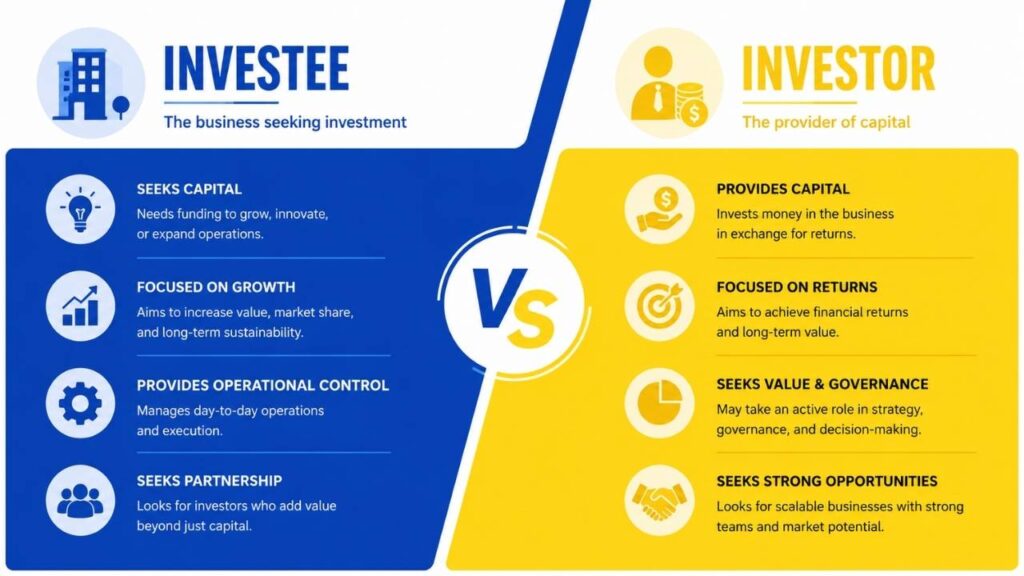
Ever read a business article and mixed up who’s giving the money and who’s getting it? You’re not alone. Finance vocabulary trips up even seasoned professionals, and these two words look almost identical on paper.
That’s exactly what this guide clears up. You’ll get simple definitions, side-by-side comparisons, and real sentence examples so investee vs investor never confuses you again. We’ll also cover the investor vs investee relationship in contracts, startups, and everyday business talk. Stick with it, and you’ll walk away using both terms like a pro.
Define Investor
An investor is a person or organization that puts capital into a business, startup, or project, expecting a solid return on investment. Investors keep the wheels of the financial world turning because they fund growth that companies can’t always self-finance.
Investors come in different shapes. You’ve got angel investors, venture capitalists, and everyday individuals buying stock. On the institutional side, pension funds, endowments, and insurance companies also invest heavily.
Before writing a check, most investors dig into market research, review financial statements, and study business plans. Many also lean on financial advisors to sharpen their decisions and manage risk tolerance.
- Provides capital or funding to a venture
- Expects measurable returns over time
- Evaluates risk before committing money
- Diversifies across multiple opportunities
- Monitors performance after investing
Investee vs Investor
Here’s the simplest way to remember it: the investor hands over the money, and the investee puts it to work. The investee is the business, startup, or project that receives capital from an investor in exchange for equity or a promised return.
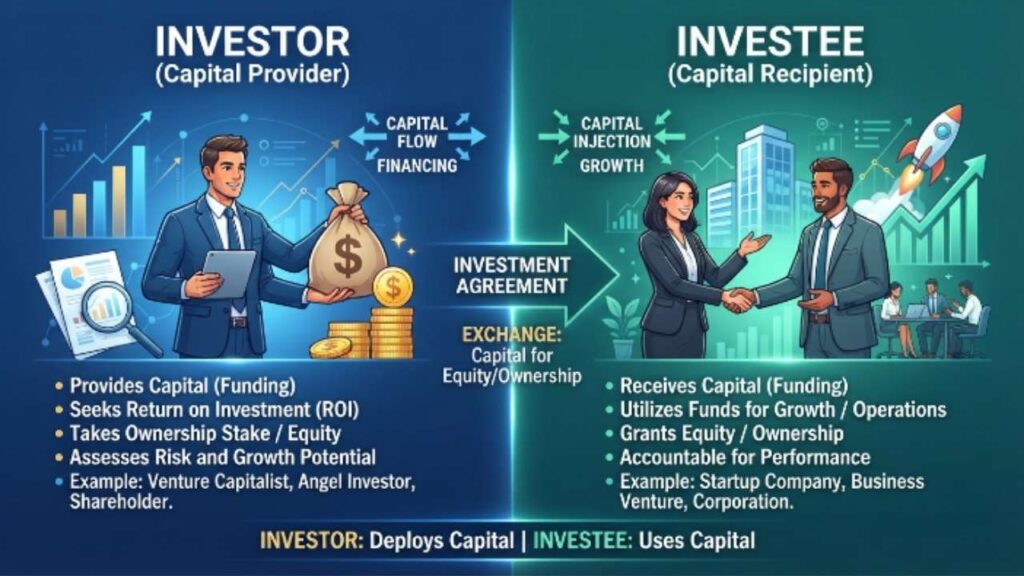
Investees range from brand-new startups to established firms chasing fresh funding rounds. They might land money through venture capitalists, crowdfunding platforms, or angel investors. Some also secure grants or loans through government channels.
To attract funding, investees usually share detailed financial statements, growth projections, and a clear business plan. Negotiations often cover valuation, funding amount, and each party’s rights and responsibilities.
| Role | Investor | Investee |
| Money flow | Sends capital out | Takes capital in |
| Primary goal | Earn a return | Fuel growth |
| Key document | Due diligence report | Business plan |
| Risk position | Bears financial risk | Bears performance pressure |
Key Differences Between Investor and Investee
Once you see them side by side, the investor vs investee distinction becomes second nature. Below is a breakdown that covers the core differences you’ll run into in real conversations and contracts.
| Investor | Investee |
| Provides capital or funding | Receives capital or funding |
| Expects a return on investment | Delivers returns or shares profit |
| Runs research before committing | Supplies financial statements and plans |
| Consults financial advisors | Negotiates investment terms |
| Takes on financial risk | Executes growth strategy |
| Decides based on risk tolerance | Reports progress to funders |
- Funding direction flows one way, from investor to investee
- Accountability sits with the investee once funds land
- Expectations center on returns for the investor
- Documentation differs sharply between both parties
- Terminology shifts slightly depending on the deal type
How To Properly Use Investor & Investee in Sentences
Getting the grammar right matters just as much as knowing the definitions. Investor and investee each play a distinct grammatical role, and swapping them changes the entire meaning of a sentence.
What’s The Easiest Way To Remember Which Word Is Which?
Think of the “-or” suffix as the doer, like “actor” or “creator.” An investor acts, an investee is acted upon. That one trick solves most confusion instantly.
How To Use ‘Investor’ in a Sentence
An investor funds a project and expects something back. Here’s how that plays out naturally:
- The investor decided to back a clean-energy startup.
- She’s a cautious investor who sticks to low-risk bonds.
- Many investors chase the stock market for its upside.
- As an angel investor, he trades capital for equity.
These examples show the investor’s decision-making role while weaving in natural financial vocabulary.
How To Use ‘Investee’ in a Sentence
The investee sits on the receiving end of the deal:
- The investee used fresh funds to expand into new markets.
- As an investee, the startup shared detailed financials with backers.
- The investee must deliver regular updates to its investors.
- Several investees are targeting growth across Southeast Asia.
Notice how each sentence highlights responsibility and accountability, the investee’s defining traits.
More Examples of Investor & Investee Used in Sentences
Repetition builds fluency, so here’s a larger batch of examples covering both terms in varied business contexts.
Examples of Using Investor in a Sentence
- The investor put money into a promising tech startup.
- She’s a sharp investor who studies trends before acting.
- Many investors spread risk across several portfolios.
- The investor sat through the founder’s pitch deck.
- Venture investors often bring mentorship along with cash.
- He became an investor in a solar energy company.
- The investor tracks quarterly performance closely.
- Some investors favor equity over debt financing.
- The investor pulled funding after weak results.
- Angel investors help early founders get off the ground.
Examples of Using Investee in a Sentence
- The investee used capital from venture backers to launch its app.
- As an investee, the firm shared reports to attract more funding.
- The investee expanded into international markets using new funds.
- Many investees juggle growth goals against investor demands.
- The investee negotiated better terms with its angel backer.
- The investee built a plan to prove its long-term potential.
- Investors track each investee’s financial health closely.
- The investee rolled out a new service to boost revenue.
- The investee executed its strategy and pulled in more capital.
- Every investee must manage funds responsibly for solid returns.
Common Mistakes To Avoid
Even confident writers slip up here. Let’s fix the most frequent errors people make with investor and investee.
1. Using Investor and Investee Interchangeably
This is the number one mistake. An investor provides funding, and an investee receives it, full stop. Swapping the two flips the entire meaning of your sentence.
2. Ignoring Context in Sentences
Vague sentences confuse readers fast. “The investee decided to invest” makes no sense, since investees don’t fund others in that role. Add context: “The investor chose to fund the startup investee.”
3. Mixing Up Financial Roles
Joint ventures, loans, and grants each use different labels. Applying investor or investee loosely in these situations creates real confusion in contracts.
4. Forgetting About Returns and Responsibilities
The investor wants a return; the investee must deliver results with that money. Skip this distinction, and your writing loses accuracy fast.
Tips To Avoid These Mistakes
- Ask who’s giving money and who’s receiving it first
- Use financial terms like capital and return to add clarity
- Proofread carefully in reports and formal writing
- Practice with sample sentences until it feels automatic
- Read the sentence aloud to catch awkward swaps
Context Matters
Definitions only go so far. The real test of investor vs investee comes down to context, since these words shift meaning slightly depending on the setting.
What Industries Rely Most Heavily On These Terms?
Venture capital, private equity, and startup ecosystems use investor and investee constantly. Legal and financial reporting also depend on precise usage.
1. Business Relationships
A venture capitalist investor funds a startup investee building something new. Using the terms correctly shows exactly who’s taking the risk and who’s driving growth.
2. Legal Contexts
Contracts demand precision. An investor typically holds rights to review the investee’s financial statements, while the investee must meet reporting obligations.
3. Personal Finance or Small-Scale Investments
Even casual arrangements follow the same logic. An investor might fund a friend’s small business investee project, and that business still owes updates and results.
4. International and Regional Variations
Usage stays fairly consistent worldwide, though casual speech sometimes blurs the lines. Formal financial reporting, however, always separates investor from investee clearly.
Exceptions To The Rules
Not every funding relationship uses investor and investee. Certain arrangements swap in different terminology entirely.
1. Joint Ventures
When multiple parties pool capital, resources, or expertise into a new entity, they’re called joint venture partners, not investor and investee.
- Example: “The joint venture partners split profits evenly from the new project.”
2. Loan Agreements
Borrowing money involves a lender and a borrower, not an investor-investee pair. The lender expects repayment plus interest rather than equity returns.
- Example: “The borrower secured a loan, and the lender set the repayment schedule.”
3. Government Grants
Government funding introduces grantor and grantee instead. The grantor supplies capital for a specific purpose, often research or public benefit.
- Example: “The grantee used the grant to fund a community health program.”
4. Employee Stock Ownership Plans (ESOPs)
Employees receiving company shares through an ESOP become shareholders, not traditional investors or investees.
- Example: “Employees gained partial ownership through the ESOP, without acting as formal investors.”
Practice Exercises
Exercise 1: Fill in the Blank
Complete each sentence with investor or investee.
- The _______ provided funding to help the startup launch.
- The _______ used the capital to expand into new markets.
- As an _______, always research potential investees first.
- The _______ must manage funds and deliver solid returns.
- Many angel investors look for promising _______ companies.
Answer Key: 1. investor 2. investee 3. investor 4. investee 5. investees
Exercise 2: Sentence Writing
Try writing your own sentences using each term correctly.
- The investor funded a green energy project after reviewing its plan.
- The investee hired a team to execute its growth strategy.
- A seasoned investor spreads capital across several investees.
- The startup investee sent regular revenue updates to its backer.
Which Word Should You Use In A Business Pitch Deck?
Founders pitching for funding should call themselves the investee implicitly by describing their business, while referring to funders directly as investors. This keeps your pitch deck language precise and professional.
FAQs
What’s the core difference between an investor and an investee?
An investor provides capital or funding, while an investee receives that capital to grow a business or project.
Can someone be both an investor and an investee at once?
Yes. A person can act as an investor in one company while being an investee receiving funds from another party.
Are investor and investee terms limited to startups?
No, these terms apply across startups, established companies, joint ventures, and other investor-backed arrangements.
Is it ever correct to use investor and investee interchangeably?
No. Swapping investor and investee creates confusion since each word describes an opposite financial role.
What replaces investor and investee in loan agreements?
Loan agreements use lender and borrower instead, since the investor–investee framework doesn’t quite fit debt financing.
Do investees always have to be startups?
No, an investee can be a startup, an established company, or even a project seeking additional funding beyond its usual channels.
Why does correct usage of investor and investee matter in contracts?
Precise investor vs investee language in contracts avoids legal disputes and keeps financial responsibilities crystal clear for both parties.
Conclusion
Getting investee vs investor right isn’t just a grammar exercise, it’s a communication skill that builds credibility. An investor supplies capital expecting a return, while an investee receives that capital to fuel growth and deliver results.
Mixing up investor vs investee in a contract, pitch deck, or report can create real confusion, so precision matters here. Remember the exceptions too: joint ventures, loans, grants, and ESOPs each swap in their own terminology.
With the definitions, examples, and practice exercises above, you’re now equipped to use both terms confidently in any business or financial conversation.

Amelia Brooks is a US-based author known for inspiring stories on meaning, growth, and hope, blending insight with simple, engaging storytelling.