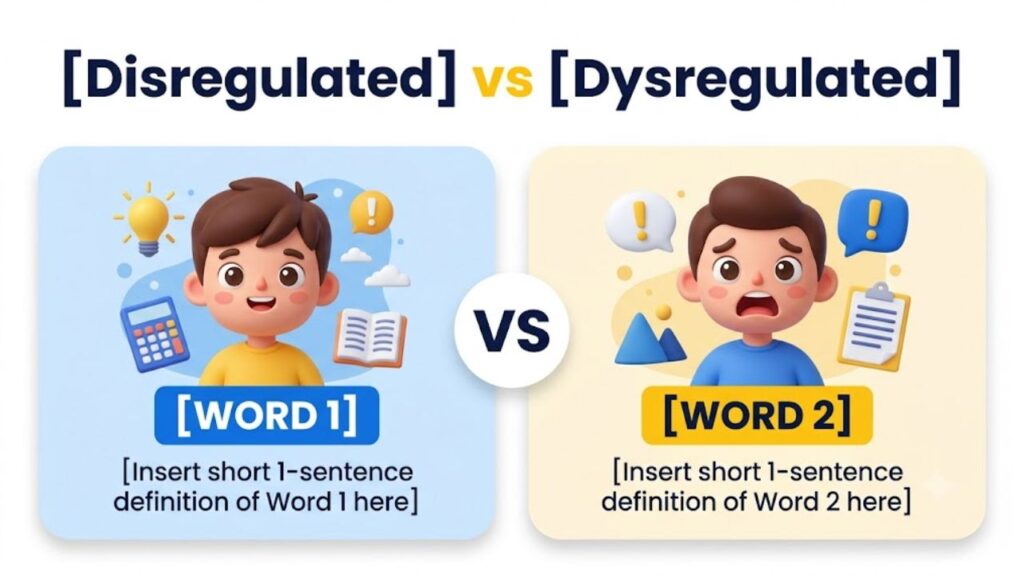
You typed the word, stared at it for a second, and something felt off. That’s the exact moment most people run into the disregulated or dysregulated debate a mix-up that sneaks into essays, therapy notes, and casual texts alike. It looks harmless. It sounds fine when you say it out loud. But one of these two spellings simply doesn’t exist in real English, and using it can quietly chip away at your credibility.
Here’s the good news: by the end of this guide, you’ll never hesitate over dysregulated or disregulated again. We’ll walk through the correct spelling, the psychology behind why the mistake happens, and exactly how the word shows up in real conversations about emotions, biology, and mental health. Stick with me, because this one small fix changes how sharp your writing looks.
Disregulated or Dysregulated
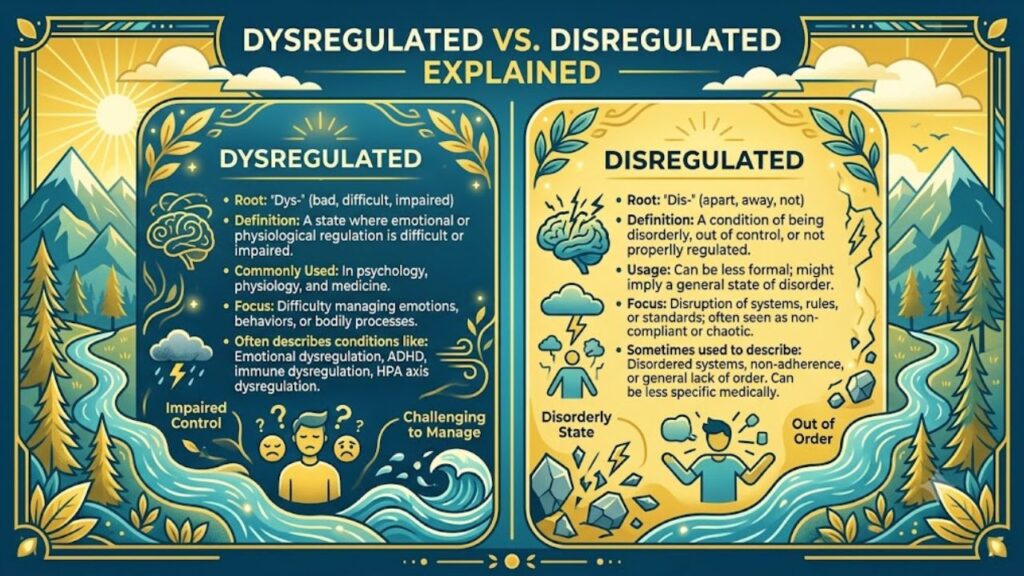
The short answer up front: dysregulated is correct, and “disregulated” isn’t a recognized English word at all. This section breaks down exactly why that single letter swap makes such a big difference in meaning and credibility.
What’s the Fastest Way to Tell These Two Words Apart?
People searching for a quick answer want one clean rule they can trust immediately, without wading through linguistics.
- Dysregulated describes a system that’s malfunctioning internally
- Disregulated has no accepted dictionary entry anywhere
- The prefix “dys-“ signals impairment, not absence
- Spellcheckers often miss the error, so don’t rely on autocorrect
- Medical and psychology texts use only dysregulated
| Term | Status | Common Setting |
| Dysregulated | Correct, dictionary-recognized | Psychology, medicine, biology |
| Disregulated | Incorrect, non-standard | Typos, casual writing, autocorrect slips |
Example in texting: Friend 1: my emotions have been so dysregulated since finals started Friend 2: same honestly, I can’t calm down after one bad grade
The Core Difference You Need to Know
Strip away the jargon and the core difference comes down to one prefix carrying real linguistic weight. This heading sets up the entire foundation for everything else in the article.
- Dys- means impaired, abnormal, or malfunctioning
- Dis- means absence, removal, or reversal
- Combining “dis” with “regulate” produces no accepted meaning
- Combining “dys” with “regulate” produces a precise clinical term
- Dictionaries, journals, and style guides only list one version
Example in chat: Friend 1: is it dysregulated or disregulated when someone’s nervous system is off Friend 2: dysregulated, always. the “y” version is the real one
Disregulation or Dysregulation
When people aren’t sure about the adjective, they usually stumble on the noun form too, wondering whether it’s disregulation or dysregulation. The same rule applies here without exception.
Just like its adjective cousin, the noun form follows the exact same prefix logic. Dysregulation refers to the state or process of a system losing its ability to self-correct, while “disregulation” simply doesn’t hold a place in standard English. Writers who get the adjective wrong almost always get the noun wrong too, so fixing one automatically fixes the other.
| Word Form | Correct Version | Incorrect Version |
| Adjective | Dysregulated | Disregulated |
| Noun | Dysregulation | Disregulation |
| Verb (rare) | Dysregulate | Disregulate |
What Does Dysregulated Mean? A Clear, Practical Definition
Let’s answer the question people actually type into Google: what does dysregulated mean in plain terms, without the textbook language getting in the way.
Plain-English Definition
Dysregulated simply means a system, whether emotional, biological, or behavioral, isn’t functioning the way it’s supposed to. It’s not about a total absence of control. It’s about impaired regulation, where the system is still trying to work but doing so poorly. Think of it as a thermostat that’s technically running but can’t settle on the right temperature anymore.
- Impaired describes the malfunction, not total shutdown
- Applies to emotions, hormones, nervous system, and behavior
- Different from simply feeling upset or having a bad day
- Often used clinically to describe patterns, not single moments
- Shows up frequently in therapy and psychiatric evaluations
Understanding the Prefix: Why “Dys” Changes Everything
Prefixes carry hidden clues, and once you notice them, spelling mistakes like this one become much easier to catch on your own.
Prefix Breakdown
The prefix “dys-“ comes from Greek and consistently signals something abnormal or impaired, as seen in words like dysfunction, dyslexia, and dystrophy. The prefix “dis-“ instead signals negation or removal, as in disconnect or disappear. Neither prefix is interchangeable with the other, even though they sound deceptively similar in casual speech.
| Prefix | Core Meaning | Example Word | Real-World Signal |
| dys- | Impaired, abnormal | dysfunction | Something is broken internally |
| dis- | Not, opposite of | disconnect | Something is missing or removed |
Why “Disregulated” Keeps Showing Up (Even Though It’s Wrong)
Mistakes rarely happen at random, and this one follows a very predictable pattern rooted in familiar word structures people already know well.
Common Reasons People Use “Disregulated”
- Familiarity with common “dis-“ words like disorganized
- Pronunciation overlap makes both versions sound alike
- Limited exposure to clinical or psychological terminology
- Autocorrect tools sometimes fail to flag the error
- Visual similarity between the two spellings on a page
Reality Check: Is “Disregulated” a Word? (Detailed Breakdown)
If you’re wondering is disregulated a word, the honest answer is no, and it’s worth unpacking exactly why. It doesn’t appear in Merriam-Webster, Cambridge, or Oxford. It isn’t accepted in academic publishing, clinical documentation, or professional editing standards. Using it in a formal context can genuinely undercut how knowledgeable you sound, especially in psychology or medical writing where precision matters most.
Why “Disregulated” Feels Right (But Isn’t)
At a glance, “disregulated” looks completely reasonable, and that’s exactly what makes this particular mistake so persistent among writers.
The Real Reason Behind the Confusion
Your brain is pattern-matching against words you already know. Dis plus connect becomes disconnect. Dis plus appear becomes disappear. Dis plus organize becomes disorganize. So it feels logical to assume dis plus regulate should become disregulated. But English doesn’t always follow tidy, predictable rules, and this is one of those exceptions where the correct prefix is dys, not dis.
Why “Dysregulated” Is the Correct Term
Dysregulated traces back to a completely different linguistic root than the “dis-” family of words, which explains why the two can’t be swapped.
The prefix dys- consistently signals malfunction rather than removal, and that distinction is exactly why dysregulated meaning fits so naturally into psychology, biology, and behavioral science. Once you see the pattern across dysfunction, dystrophy, and dyslexia, dysregulated stops feeling like an exception and starts feeling like part of a consistent family.
What Happens If You Use “Disregulated”?
Getting this wrong isn’t just a technical slip. It carries real consequences depending on where the writing shows up.
In Professional and Medical Contexts
- Signals a lack of subject-matter knowledge instantly
- May confuse readers familiar with clinical terminology
- Reduces trust in academic or research-based writing
- Search engines favor the correct, high-volume term
- Editors and reviewers will likely flag it as an error
Why You Won’t Find “Disregulated” in Dictionaries
Dictionaries track recognized, widely accepted usage, and this word never earned a spot on that list.
Here’s What You’ll Notice
Dysregulated consistently appears across psychology texts, medical research, and clinical discussions, while “disregulated” rarely shows up anywhere credible. When it does appear, it’s almost always flagged as a misspelling rather than treated as a legitimate variation.
Is Disregulated Ever Acceptable in Casual Writing?
Even in relaxed, informal settings, using the wrong spelling can still create small moments of confusion for careful readers.
Casual texting and social media posts are far more forgiving than academic papers, but that doesn’t mean the error is actually correct. It’s simply less noticeable in low-stakes writing. If you’re building a habit of stronger writing overall, it’s worth training yourself to use dysregulated even in texts and quick messages, so the correct version becomes automatic everywhere.
When People Accidentally Use It
You’ll typically spot “disregulated” in blog posts published without editing, student essays written under time pressure, and informal forum discussions. The pattern is consistent: the more polished and professional the content, the less likely this error slips through unnoticed.
Quick Fix Strategy
Fixing this mistake permanently doesn’t require memorizing linguistics. It just requires one dependable mental shortcut you can reuse forever.
Simple Rule to Remember
If you’re describing emotions, behavior, biology, or mental health, always default to dysregulated. That single rule covers nearly every situation where this word choice comes up in real writing.
Memory Trick That Actually Works
Here’s a trick that sticks: DYS equals dysfunction, and DIS equals disconnect. Dysregulated therefore means something isn’t working properly, while “disregulated” doesn’t correspond to any real meaning at all. Anchor the word to “dysfunction” in your memory, and you’ll never second-guess the spelling again.
What’s the Best Way to Remember Dysregulated Spelling?
Beyond one-off tricks, building a lasting habit means connecting the word to others you already spell correctly without thinking twice.
- Pair it mentally with dysfunction, a word most people already spell correctly
- Say the full word slowly out loud before typing it
- Notice that dys- words often relate to health or systems
- Avoid trusting autocorrect blindly in clinical writing
- Reread sensitive documents specifically for this one word
Don’t Let a Small Mistake Undermine You
It’s an easy slip, but it’s also an easy fix. “Disregulated” isn’t a harmless stylistic variation. It’s a subtle error that quietly weakens otherwise strong writing. Dysregulated, on the other hand, carries genuine linguistic weight, professional credibility, and consistent real-world usage across serious fields.
Dysregulated Meaning in Psychology: Where It Matters Most
This term carries the most weight inside mental health conversations, where precision genuinely changes how a description is understood.
Dysregulated Definition Psychology
In psychology, dysregulated describes impaired control over emotional or behavioral responses. This goes beyond occasional frustration. It points to a deeper, more persistent pattern that shows up repeatedly across situations rather than as a one-time reaction.
Emotional Dysregulation Meaning
- Intense emotional reactions that feel disproportionate
- Difficulty returning to a calm baseline afterward
- Emotional instability across everyday situations
- Reduced ability to consciously manage responses
- Patterns that repeat rather than isolated incidents
Dysregulated vs Deregulated: Don’t Mix These Up
These two words sound similar but describe completely unrelated ideas, and confusing them creates a different kind of mistake entirely.
Dysregulated points to internal dysfunction inside a person or system. Deregulated instead refers to the removal of external rules, most often used in economics or policy discussions. Think of dysregulated as a broken engine, while deregulated is closer to a road with no traffic laws left at all.
| Term | Meaning | Typical Field |
| Dysregulated | Internal malfunction | Psychology, health |
| Deregulated | Removal of external rules | Economics, policy |
Why Does Dysregulated Matter in Professional Writing?
Word precision might feel like a small detail, but it genuinely shapes how credible and trustworthy your writing appears to readers.
In academic papers, therapy notes, and clinical reports, using dysregulated correctly signals real familiarity with the subject matter. Using “disregulated” instead can make otherwise strong research look unpolished or under-edited, even when the underlying ideas are solid. Precision here isn’t about pedantry. It’s about protecting the authority of your work.
Common Sentences Using Dysregulated Correctly
Seeing the word inside full sentences makes the correct usage far easier to internalize than memorizing a rule in isolation.
- “Her nervous system felt dysregulated after weeks of poor sleep.”
- “The therapist noted dysregulated emotional responses during the session.”
- “Chronic stress left his hormone levels visibly dysregulated.”
- “Children with ADHD often show dysregulated behavior patterns.”
- “The immune system became dysregulated, triggering autoimmune symptoms.”
Dysregulated Nervous System and Everyday Life
Beyond emotions alone, this term extends directly into how your body physically responds to daily stress and pressure.
A dysregulated nervous system struggles to return to a balanced, resting state. Signs include constant tension, disrupted sleep, persistent fatigue, sudden anxiety spikes, and a general sense of emotional overload throughout the day. Internally, this often reflects an overactive stress response paired with poor recovery afterward, similar to a car stuck revving even when there’s nowhere to go.
FAQs
What is emotional dysregulation in psychology?
It’s the reduced ability to manage emotional responses effectively, often showing up as intense or prolonged reactions.
Are dysregulated and disregulated interchangeable in any context?
No. Only dysregulated is recognized, whether the setting is casual, academic, or clinical.
Why is dysregulated the correct spelling instead of disregulated?
The prefix “dys-” accurately signals impaired function, while “dis-” implies absence, which doesn’t fit the meaning.
What are common dysregulated behavior examples?
Overreacting to minor stress, sudden emotional outbursts, and struggling to calm down after conflict.
Is disregulated ever listed in dictionaries?
No major dictionary recognizes disregulated as a standard, accepted English word.
What’s the simplest way to remember dysregulated correctly?
Link it mentally to “dysfunction,” since both share the same impairment-focused prefix.
Does dysregulated only apply to emotions?
No, it also describes biological systems like hormones, immune responses, and the nervous system.
Conclusion
At the end of the day, the choice between disregulated or dysregulated isn’t really a coin flip. Only one version, dysregulated, holds real meaning, dictionary recognition, and consistent use across psychology, medicine, and everyday writing. The other version simply doesn’t exist in standard English, no matter how natural it might sound out loud.
Next time you’re second-guessing yourself mid-sentence, trust the version with the “y.” Whether you’re writing about dysregulated emotions, a stressed nervous system, or a shifting hormone balance, this single spelling choice quietly signals whether your writing sounds informed or unpolished. Small fix, real difference.

Amelia Brooks is a US-based author known for inspiring stories on meaning, growth, and hope, blending insight with simple, engaging storytelling.