

You’ve typed the email, your cursor hovering over “half day” or “half-day,” and suddenly you’re not sure which one is right. It’s a small thing, but it nags at you, especially when you’re sending something to your boss or clients.
Here’s the good news: half day or half-day isn’t actually a mystery once you see the pattern. This guide walks you through the difference, gives you real sentence examples, and shows you a simple half-day or half day memory trick you’ll never forget. Let’s clear this up for good.
Half Day or Half-Day? Which is Correct?
Both spellings are correct, and that’s exactly why so many writers freeze up over this one. The real question isn’t which version is “proper” English. It’s which job the phrase is doing in your sentence.
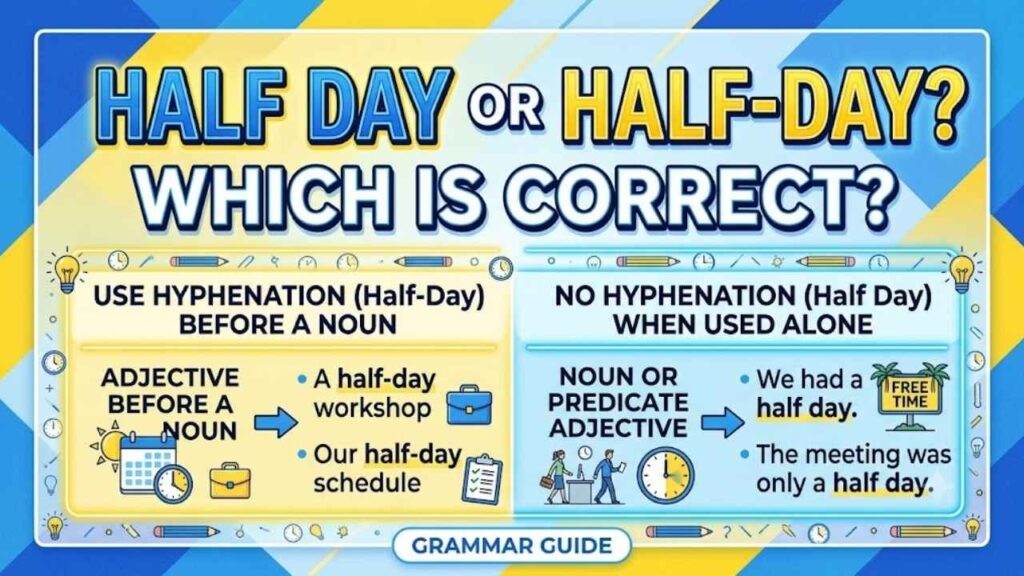
Here’s the simple split you need to remember:
- Half day (no hyphen) works as a noun — a chunk of time
- Half-day (with hyphen) works as an adjective — a describing word
- The hyphen only appears when the phrase sits in front of another noun
- Both forms show up constantly in workplace emails and HR paperwork
- Getting this right instantly makes your writing look more polished
Think of it like “well known” versus “well-known author.” Same idea. Different job, different punctuation.
Understanding the Key Difference
So how do you actually tell them apart in the moment? It comes down to one question: is the phrase standing alone, or is it describing something else?
When “half day” stands by itself, it’s the subject or object of your sentence. You’re talking about the time itself. “I took a half day” — the half day is the thing.
When “half-day” sits in front of a noun like meeting, workshop, or shift, it becomes a compound modifier. It’s no longer the main idea. It’s now dressing up another word, telling readers what kind of meeting or workshop you mean.
This is the same logic behind pairs like “full-time job” versus “I work full time,” or “long-term plan” versus “planning for the long term.” The hyphen shows up only when the phrase is doing descriptive work right before a noun.
Is half day hyphenated
Technically, “half day” is hyphenated only in its adjective form, never as a standalone noun. So the honest answer is: it depends entirely on the sentence.
If you’re describing a time period you took off work, skip the hyphen. “She took a half day on Friday.” If you’re describing an event, session, or class that lasts that long, add it. “She attended a half-day seminar on Friday.”
| Situation | Correct Form |
| Referring to time off | half day |
| Describing an event’s length | half-day |
| Followed by a noun (meeting, class, shift) | half-day |
| Standing alone as subject/object | half day |
Most confusion happens because people apply one rule everywhere instead of checking what follows the phrase. Always look at the next word before deciding.
Half Day: Meaning and Usage as a Noun
As a plain noun, “half day” simply means roughly four hours, half of a standard workday. It’s the version you’ll use most often when talking about scheduling, attendance, or personal time.
You’ll typically see this form paired with verbs like taking, requesting, or having. It refers to the block of time itself rather than describing anything else.
- Use it when discussing time off from work or school
- Use it when the phrase is the main subject of your sentence
- Never add a hyphen when it stands alone
- Common in HR forms, leave requests, and school notices
- Often follows words like “a,” “the,” or “my”
Companies commonly split this into morning or afternoon blocks, usually ending or starting around noon, giving employees flexibility without losing a full work hour count.
Half-Day: Meaning and Usage as an Adjective
Once you attach the hyphen, “half-day” flips into a compound adjective. It no longer names a chunk of time on its own. Instead, it tells you what kind of noun follows it.
This form never floats alone in a sentence. It always sits directly before the word it modifies, forming one tight descriptive unit that reads as a single idea.
- Always appears directly before a noun like workshop or session
- Functions as one grammatical unit, not two separate words
- Prevents readers from misreading the phrase mid-sentence
- Common before words like training, retreat, or seminar
- Signals professional communication and attention to detail
A quick test: ask “what kind of workshop?” If “half-day” answers that question, the hyphen belongs there every time.
When the Hyphen Becomes Essential
Style authorities like AP Style and the Chicago Manual of Style both favor hyphenating compound modifiers before a noun, and this phrase is no exception. Skipping it isn’t wrong exactly, but it slows readers down.
Without the hyphen, “half day workshop” forces a tiny mental pause. Is it half of a day-long workshop? A workshop lasting half a day? The dash removes that ambiguity instantly.
This matters most in business writing, academic papers, and anything going to a client or supervisor. A missing hyphen won’t wreck your message, but it signals a small gap in polish that sharper writers avoid.
There’s one exception worth knowing: after a linking verb like “was” or “is,” some writers drop the hyphen. “The training was half day” reads fine either way, though consistency matters more than the rule itself here.
How to Use Half Day and Half-Day in Emails and HR Documents
Workplace writing leans on both forms constantly, and getting them mixed up in an email to HR looks careless fast. This section keeps your messages clean and professional.
- Write “requesting a half day” when asking for time off
- Write “half-day leave request” when naming the form or policy
- Match your company’s internal style guide if one exists
- Avoid switching forms halfway through the same document
- Double-check subject lines, since errors there stand out most
| Email Context | Correct Phrasing |
| Subject line for a leave request | Half-Day Leave Request |
| Body text describing your absence | I’m taking a half day |
| Describing a scheduled event | Half-day onboarding session |
| HR policy document heading | Half-Day Absence Policy |
Is “Half Day” One Word or Two Words?
It’s always written as two words, never merged into “halfday.” The confusion usually comes from the hyphen question, not a spacing question, so don’t let that trip you up separately.
- Always two words, whether hyphenated or not
- “Halfday” as one word is never correct
- The hyphen connects the two words; it doesn’t merge them
- Spell-check will usually flag the merged version anyway
- Consistency in spacing matters as much as the hyphen itself
Examples of Using “Half Day” in A Sentence
Seeing the noun form in real contexts makes the rule stick faster than any explanation. Here’s how it shows up across everyday writing:
- “I’m taking a half day tomorrow for a dentist appointment.”
- “Our office gives everyone a half day before public holidays.”
- “He asked for a half day to handle some personal errands.”
- “The school announced a half day because of the storm warning.”
- “She used a half day to catch an earlier flight home.”
Each of these treats “half day” as the main noun in the sentence, never modifying anything else that follows it.
Examples of Using “Half-Day” in A Sentence
Now compare that to the adjective form, always locking in front of another noun:
- “We’re hosting a half-day workshop for new hires next week.”
- “I signed up for a half-day seminar on project management.”
- “The half-day training covered fire safety and evacuation routes.”
- “Management scheduled a half-day retreat to boost team morale.”
- “Students joined a half-day field trip to the science museum.”
Notice how every single example places “half-day” right before the noun it’s describing, whether that’s workshop, seminar, training, retreat, or trip.
Half-Day Leave, Half-Day Off, and Other Common Phrases
A handful of set phrases trip writers up more than the general rule does, mostly because they blend the noun and adjective forms in confusing ways.
- “Half-day off” is technically inconsistent but widely accepted in casual use
- “Taking a half day” stays unhyphenated, since it’s the noun form
- “Half-day schedule” hyphenates, since it describes the schedule itself
- “Working half days” drops the hyphen across the plural noun form
- “Half-day pay” hyphenates, describing the type of pay structure
Grammar Rules Behind the Hyphen
This pattern isn’t unique to “half day.” English uses hyphens across dozens of similar compound modifiers, and once you spot the pattern, it becomes automatic.
Compare these familiar pairs: “long-term project” versus “planning for the long term.” “High-quality product” versus “a product of high quality.” “Full-time employee” versus “working full time.” Same logic, every time.
- Hyphens link words acting as one describing unit before a noun
- The pattern breaks once the modifier moves after the noun
- Adverbs ending in “-ly” never take a hyphen, unlike other modifiers
- “Part-time,” “full-day,” and “short-term” all follow the same rule
- Consistency across a single document matters more than perfection
Why Does the Hyphen Matter So Much in Half-Day?
Because without it, readers momentarily misread the phrase, and that split-second confusion adds up across a long document or a fast-moving email thread.
- Prevents readers from pausing mid-sentence to reparse meaning
- Signals that two words function as a single descriptive unit
- Matters most in formal, academic, or client-facing writing
- Shows attention to detail in professional communication
- Becomes almost invisible once you’ve trained your eye to spot it
Common Mistakes to Avoid
Even careful writers slip up here, usually in one of two predictable directions. Once you know what to watch for, these errors become easy to catch during a quick proofread.
- Adding a hyphen to the standalone noun: “taking a half-day off” is wrong
- Dropping the hyphen before a noun: “half day workshop” reads awkwardly
- Switching forms inconsistently within the same document or email
- Assuming British and American English always match on this point
- Forgetting the hyphen stays in the plural form: “half-days,” not “half days”
Which Form Should You Use in a Resignation or Leave Letter?
Leave letters almost always use the plain noun form, since you’re naming a block of time you’re requesting rather than describing an event.
- Write “I’m requesting a half day on Friday” in the letter body
- Only hyphenate if you’re naming a specific half-day program or session
- Keep the phrasing simple and match your company’s leave policy wording
- Avoid mixing both forms within the same short letter
- When unsure, the noun form is the safer, more common default
Half Day or Half-Day in Legal and Official Writing
Contracts, HR policies, and official notices carry more weight than casual emails, so precision with this hyphen matters even more in these documents.
- Legal documents favor the hyphenated adjective form before defined terms
- Policy titles like “Half-Day Work Policy” almost always hyphenate
- Body text describing an employee’s absence stays unhyphenated
- Government and school notices often follow AP Style conventions
- Consistency across a legal document protects against ambiguity claims
Quick Reference Guide and Memory Tricks
Here’s the fastest mental shortcut: if the phrase answers “what kind of?” before a noun, hyphenate it. If it stands alone as the thing itself, leave it plain.
- Ask “what kind of meeting?” — if half-day answers it, hyphenate
- Try swapping in “four-hour” mentally to test the adjective form
- Standalone time reference — no hyphen, ever
- Directly before a noun — hyphen, every time
- When editing, check the very next word after the phrase
| Quick Test | Result |
| Followed by a noun (meeting, class, shift) | Hyphenate |
| Standing alone as the subject | No hyphen |
| Plural form (half-days) | Hyphenate |
| After a linking verb (was, is) | Either works |
Frequently Asked Questions
What is the plural of half-day?
The plural is “half-days,” keeping the hyphen intact. For example, “The retreat runs across two half-days.” Half day or half-day rules still apply to the plural form the same way.
Is half day hyphenated in every situation?
No, only when it functions as an adjective before a noun. As a standalone noun, half day or half-day stays as two plain words without any hyphen.
How should half day be written in formal writing?
Use “half-day” before a noun, like “half-day session.” Use “half day” when it stands alone, since half-day or half day depends entirely on grammatical role.
What are typical hours for a half day?
Morning half days usually run from 8 or 9 AM to around noon. This four-hour window defines most half day or half-day scheduling across companies.
Can half day and half-day be used interchangeably?
No, they serve different grammatical jobs. Swapping them causes confusion, since half-day or half day depends on whether a noun follows the phrase.
Do other compound words follow the same hyphen pattern?
Yes, “full-day,” “part-time,” and “long-term” all mirror this exact rule. Recognizing this pattern makes half day or half-day decisions much faster over time.
Why do so many people get this hyphen wrong?
Most writers never learned the noun-versus-adjective test. Once you apply it consistently, half day or half-day stops feeling like guesswork entirely.
Conclusion
Half day or half-day really comes down to one simple test: is the phrase standing alone, or is it describing a noun right beside it? Use “half day” for the plain time reference, and reach for “half-day” the moment it sits in front of a word like meeting, workshop, or session. This small distinction between half-day or half day shows up constantly in emails, HR forms, and everyday writing, so it’s worth locking in for good.
Next time you catch yourself hesitating over this hyphen, run the “what kind of?” test before you hit send. It takes two seconds and saves you from an awkward second-guess every single time.

Amelia Brooks is a US-based author known for inspiring stories on meaning, growth, and hope, blending insight with simple, engaging storytelling.


