
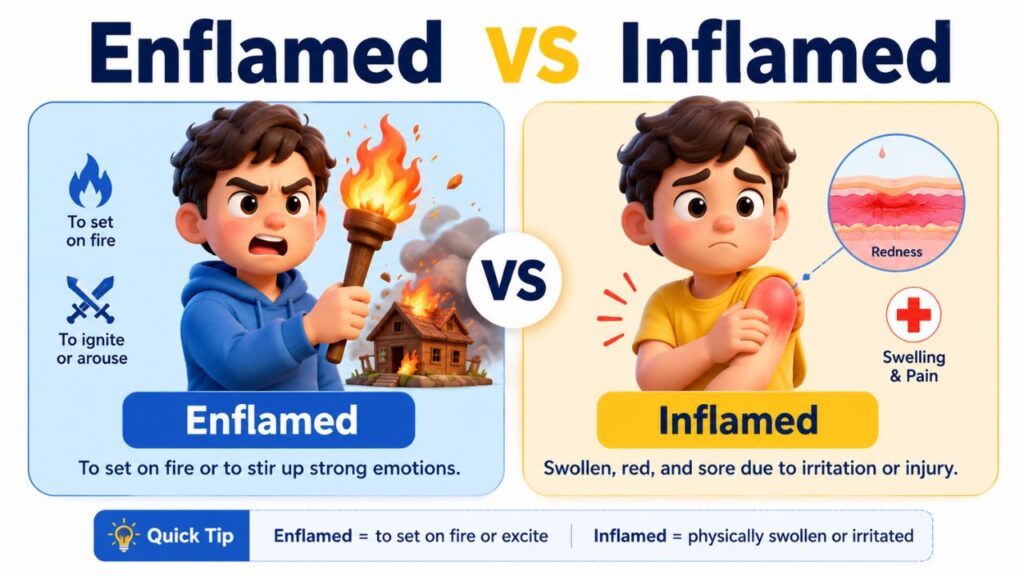
You’re halfway through a sentence about a sore knee or a heated argument, and you freeze. Is it enflamed or inflamed? That tiny pause is more common than you’d think, and it doesn’t mean your grammar is shaky.
Here’s the good news: this article walks you through the real meaning behind both words, shows you exactly when each one belongs, and gives you a simple rule you’ll actually remember. The confusion around enflamed or inflamed disappears once you see the pattern side by side. Stick with me, and you’ll never second-guess this word pair again.
Enflamed Vs Inflamed Correct?
Inflamed is the preferred and standard spelling in modern English. It describes a body part that becomes red, swollen, or painful because of injury, infection, or irritation. Enflamed is a rare, outdated variant that appears in older texts but is not recommended for everyday writing or professional communication.
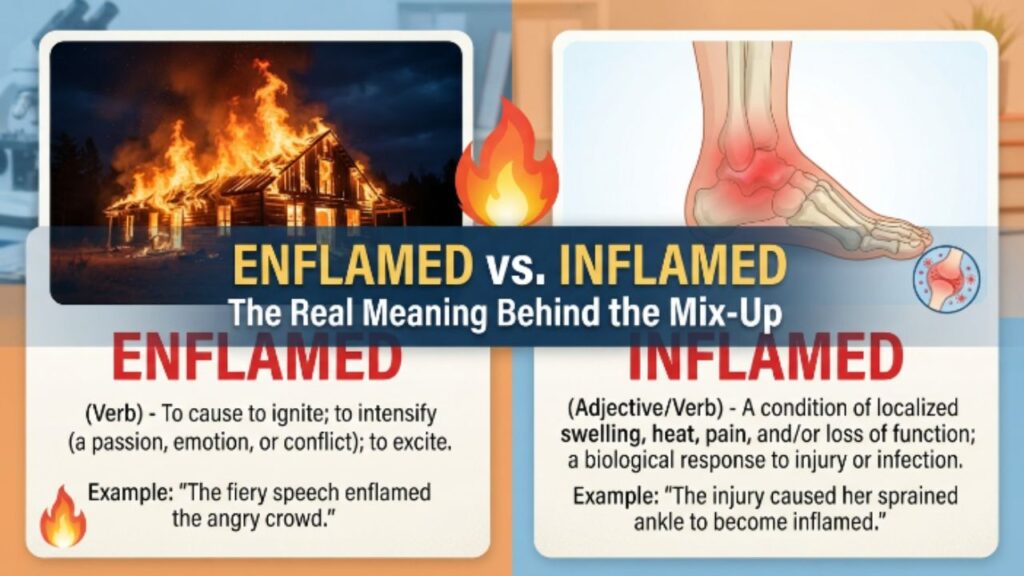
| Word | Correct? | Meaning | Example |
|---|---|---|---|
| Inflamed | ✅ Yes | Red, swollen, or irritated due to injury, infection, or irritation. | Her inflamed knee needed medical treatment. |
| Enflamed | ⚠️ Rare/Nonstandard | An uncommon variant of inflamed, but generally avoided in modern English. | The old text used the word “enflamed.” |
The Confusion Around Enflamed Vs Inflamed
Picture this: you’re drafting a medical note, a school essay, or a quick text to a friend about your sore ankle. Suddenly you stop. Which spelling is right here?
That hesitation is exactly why the confusion around enflamed vs inflamed trips up so many writers. Both words look legitimate. Both sound almost identical out loud. And both seem to describe the same swollen, irritated, or emotionally charged state.
- Sound-alike spelling makes the eye skip right past the difference
- Shared root meaning ties both words back to fire and burning
- Spellcheck rarely helps since both forms are technically real words
- Medical contexts raise the stakes, since precision really matters there
- Casual writing blurs the line even further because nobody checks twice
Even seasoned editors admit they’ve paused over this pair. Once you understand how the two words relate, the choice becomes almost automatic.
What Each Word Actually Means
This section clears up the exact meaning behind each spelling before comparing them directly. Knowing the roots of inflamed and enflamed makes the rest of this guide click into place fast.
What Does Inflamed Really Mean in Everyday Language?
Inflamed is the standard past participle and adjective form of the verb “inflame.” It describes something swollen, red, irritated, or intensely stirred up emotionally.
- Medical writing relies on it constantly for swelling and irritation
- Everyday speech uses it for sore joints, skin, or throats
- Figurative use covers anger, tension, or heated public debate
- Grammar checkers almost never flag this spelling as unusual
- Global English treats it as the default, expected form
Doctors write it in charts. Journalists use it to describe rising public anger. It’s the safe, expected choice in nearly every situation.
Example sentence: “The patient’s throat was inflamed after the infection.” Or figuratively: “The controversial speech inflamed tensions within the community.”
enflamed or inflamed: Side-by-Side Comparison
A direct comparison makes the enflamed or inflamed decision far less intimidating than it first appears. Seeing both words lined up next to each other clears up most of the lingering doubt.
| Feature | Enflamed | Inflamed |
| Core meaning | Variant of inflamed; far less common | Swollen, irritated, or intensely stirred |
| Word form | Adjective, past participle | Adjective, past participle |
| Everyday frequency | Rare, often sounds dated | Standard, expected everywhere |
| Typical setting | Older or literary text | Medical, business, academic writing |
| Sample sentence | The speech enflamed the crowd | Her ankle became inflamed overnight |
| Safe to swap? | Occasionally, with caution | Yes — this is the modern default |
What Does Enflamed Mean and Where Does It Come From?
Enflamed comes from the verb “enflame,” meaning to set alight, excite strongly, or stir up intense feeling. It’s a real word, just a much rarer one today.
- Historical roots tie it to older literary English
- Emotional emphasis leans toward passion or fiery excitement
- Modern usage has faded compared to its twin spelling
- Reader reaction may register it as unusual or old-fashioned
- Medical writing almost never chooses this variant
Example sentence: “The speech enflamed the crowd’s emotions.” That sentence works, but most modern readers would expect “inflamed” instead.
Why People Mix Up Inflamed or Enflamed
Every mix-up has a reason, and the pattern behind enflamed or inflamed confusion isn’t random at all. Both words share deep linguistic roots that go back centuries.
Language historians point out that English carries many “en-” and “in-” word pairs that developed side by side. In some pairs, both survived. In others, one quietly won out.
Pronunciation plays a role too. Spoken aloud, enflamed and inflamed sound nearly identical, so listeners rarely catch the difference. If you’ve only heard the word, not read it, guessing the spelling becomes a coin flip.
Familiarity matters as well. Most people know the verb “inflame” well. Far fewer recognize “enflame” as its own standalone word, which fuels the ongoing confusion.
What Does It Mean When Something Feels Inflamed?
This question comes up constantly in health searches, and it deserves a direct, simple answer. Something inflamed feels swollen, warm, tender, or visibly red to the touch.
- Redness signals increased blood flow to the area
- Swelling happens as tissue reacts to irritation or injury
- Warmth often accompanies active inflammation nearby
- Tenderness makes the area sensitive when touched
- Restricted movement can follow when joints are involved
These signs explain why healthcare writing leans so heavily on this exact spelling. Patients search for it, doctors chart it, and it never sounds unusual.
The Simple Rule to Remember Which Is Which
You don’t need a linguistics degree to nail enflamed vs inflamed every single time. One short rule covers almost every situation you’ll ever face.
If you’re describing swelling, irritation, redness, infection, or medical inflammation, reach for inflamed. Doctors, journals, and health writers overwhelmingly favor this spelling, and readers expect it without exception.
- “The athlete’s knee became inflamed after the game.”
- “The dentist noticed inflamed gums during the exam.”
- “Her skin looked inflamed after the allergic reaction.”
When you’re describing strong emotion rather than physical swelling, either word technically works. Even then, inflamed remains the safer, more natural pick for most modern readers.
Common Mistakes People Make With Enflamed or Inflamed
Even confident writers slip up here, usually without realizing it. Spotting these patterns helps you avoid the exact same mistakes going forward.
| Common Mistake | Why It’s a Problem | Better Choice |
| “An enflamed appendix” | Sounds unusual in medical writing | “An inflamed appendix” |
| Assuming enflamed is a typo | It’s a real, if rare, word | Recognize both exist |
| Treating them as fully identical | Frequency of use differs sharply | Default to inflamed |
| Trusting spellcheck completely | Both spellings pass as valid | Check context yourself |
Trusting spellcheck alone is the riskiest habit on this list. Since both words are legitimate, your software will never flag the less expected choice for you.
Real Sentence Fix — enflamed or inflamed
See the Mistake, Fix the Mistake
These real-world corrections show exactly how the enflamed vs inflamed swap plays out in practice. Each pair highlights the mistake, the fix, and the reasoning behind it.
Example in writing: ❌ “The doctor said my knee was enflamed after the fall.” ✅ “The doctor said my knee was inflamed after the fall.”
Example in writing: ❌ “Customer complaints were enflamed by the delay.” ✅ “Customer complaints were inflamed by the delay.”
Example in writing: ❌ “Polluted air can leave the lungs enflamed.” ✅ “Polluted air can leave the lungs inflamed.”
- Medical writing always defaults to inflamed for accuracy
- Business writing prefers the standard, expected spelling
- Academic writing rarely tolerates the rarer variant
- Everyday health talk leans entirely on inflamed
- Emotional contexts still favor inflamed for clarity
Real-World Examples: Enflamed or Inflamed Used Correctly
Seeing correct usage across different settings makes the enflamed or inflamed choice feel automatic rather than academic. Context shapes tone, but the winning spelling barely changes.
- Casual conversation: “My ankle is still inflamed from yesterday’s hike.”
- Professional writing: “The investigation inflamed public concern about workplace safety.”
- Academic writing: “Researchers observed inflamed tissue around the affected area.”
- Creative writing: “The unfair accusation inflamed his anger until he could barely speak.”
- Healthcare charts: “Patient presents with an inflamed lymph node.”
These examples span casual chat to formal research, yet inflamed dominates nearly every one. That consistency is exactly why it’s the safer long-term habit to build.
Is Enflamed Ever the Better Word Choice?
Some writers wonder if enflamed ever genuinely outperforms its more common twin. The honest answer is: rarely, and only in very specific creative settings.
Literary or poetic writing sometimes reaches for enflamed deliberately, chasing an old-fashioned or dramatic tone. Outside of that narrow lane, it usually just confuses modern readers instead of impressing them.
If you’re writing fiction set in an older era, or crafting deliberately archaic prose, enflamed can add flavor. For everything else, including business, health, and news writing, stick with the standard spelling.
British English vs. American English — Does It Affect Enflamed or Inflamed?
This is one question readers ask constantly, expecting a regional split like so many other spelling debates. Surprisingly, enflamed vs inflamed isn’t a British-versus-American issue at all.
Writers across the United States and the United Kingdom overwhelmingly favor inflamed in contemporary usage. Canada, Australia, and other English-speaking regions follow the exact same pattern without variation.
Because the split isn’t regional, readers everywhere experience the same moment of hesitation. The real cause is simply two valid words used at very different rates, not a national spelling convention.
What Grammar Checkers and Style Guides Say About Enflamed or Inflamed
Most grammar authorities recognize both spellings as legitimate English. However, they consistently point toward the version readers encounter far more often: inflamed.
- Style guides generally recommend inflamed for clarity
- Grammar checkers rarely flag enflamed since it’s technically valid
- Editors default to inflamed unless context calls for something rarer
- Dictionaries list enflame as a valid, older variant of inflame
- Consistency matters more to readers than technical correctness
Autocorrect tools won’t save you here, since neither spelling triggers an error. That’s exactly why understanding the distinction yourself beats relying on software entirely.
How Can You Quickly Check Which Word Fits Your Sentence?
A fast mental test saves you from ever second-guessing this pair again mid-sentence. Ask yourself one simple question before you finish typing.
Are you describing swelling, redness, or a medical condition? Choose inflamed every time, without exception. Are you reaching for a dramatic, old-fashioned tone in creative writing? Enflamed might occasionally fit, though inflamed still works fine.
This quick filter takes under five seconds once it becomes a habit. Most writers find they rarely need the rarer spelling at all.
Enflamed or Inflamed in Professional and Academic Writing
Word choice shapes clarity in professional and academic settings more than most writers realize. Readers expect familiar language, especially across medicine, science, law, and formal research.
Write “enflamed tissue” in a research paper, and most readers will still follow along fine. Even so, some may pause, since they expected “inflamed tissue” from prior reading experience.
Precision carries extra weight in translated documents and cross-cultural communication. Choosing the most widely recognized term consistently prevents unnecessary confusion for global readers.
The reassuring part is how easy this distinction is to master. Once you accept inflamed as the modern standard, hesitation fades almost completely.
Quick Recap: Enflamed or Inflamed at a Glance
- Both enflamed and inflamed are legitimate English words
- Inflamed dominates modern usage across nearly every context
- Medical and scientific writing almost always chooses inflamed
- Enflamed tends to sound dated or overly literary today
- When genuinely unsure, default to inflamed without hesitation
Frequently Asked Questions About Enflamed or Inflamed
Is enflamed a real word?
Yes, enflamed is a legitimate English word from the verb “enflame.” It’s simply far less common than inflamed in modern writing.
Which is more correct, enflamed or inflamed?
Neither is technically wrong, since both exist in standard English. Inflamed is the expected, preferred form in nearly every modern context.
Why do doctors always write inflamed instead of enflamed?
Medical professionals rely on inflamed because it’s the accepted standard in healthcare communication. Readers recognize and understand it instantly, without confusion.
Do enflamed and inflamed mean exactly the same thing?
They share very similar meanings tied to irritation, excitement, or heightened emotion. The real difference lies in frequency, not underlying meaning.
Should writers avoid using enflamed completely?
You don’t need to avoid it entirely, especially in creative or literary work. For clarity and modern style, inflamed remains the safer everyday choice.
Does British English treat enflamed or inflamed differently than American English?
No, both regions strongly favor inflamed in contemporary writing. The confusion isn’t regional; it comes from two valid but unevenly used words.
What’s the fastest way to remember enflamed vs inflamed?
Picture swelling, redness, or a medical condition, and default to inflamed immediately. Save enflamed only for deliberately old-fashioned or literary tone.
Conclusion
The debate over enflamed vs inflamed really comes down to one dependable habit: default to inflamed unless you have a specific literary reason not to. Both words are technically correct, but inflamed is the version modern readers expect, especially in medical, academic, and professional writing. Understanding enflamed or inflamed stops being confusing once you remember that frequency, not correctness, separates them.
Next time you pause mid-sentence over a swollen joint, a heated debate, or a medical chart, trust the rule you just learned. Reach for inflamed as your everyday default, and save enflamed for the rare moments when an old-fashioned tone genuinely fits. Confidence in this word pair comes down to one simple habit, and you’ve already built it.

Amelia Brooks is a US-based author known for inspiring stories on meaning, growth, and hope, blending insight with simple, engaging storytelling.