Something about a man who never bends can feel oddly familiar. You’ve met someone like that before, a person who trusts rules more than people, and you’ve probably wondered what makes them tick.
That’s exactly what this guide unpacks. You’ll get a clear, honest look at Javert meaning, why he still shows up in memes and debates today, and what his story quietly teaches about justice. The Javert meaning in english is simpler than it looks, and once you see it, you can’t unsee it. Keep reading.
Javert Meaning | Javert Meaning in English
Understanding Javert meaning starts with one blunt fact: he is the human shape of rigid law. That single idea explains almost everything he does.
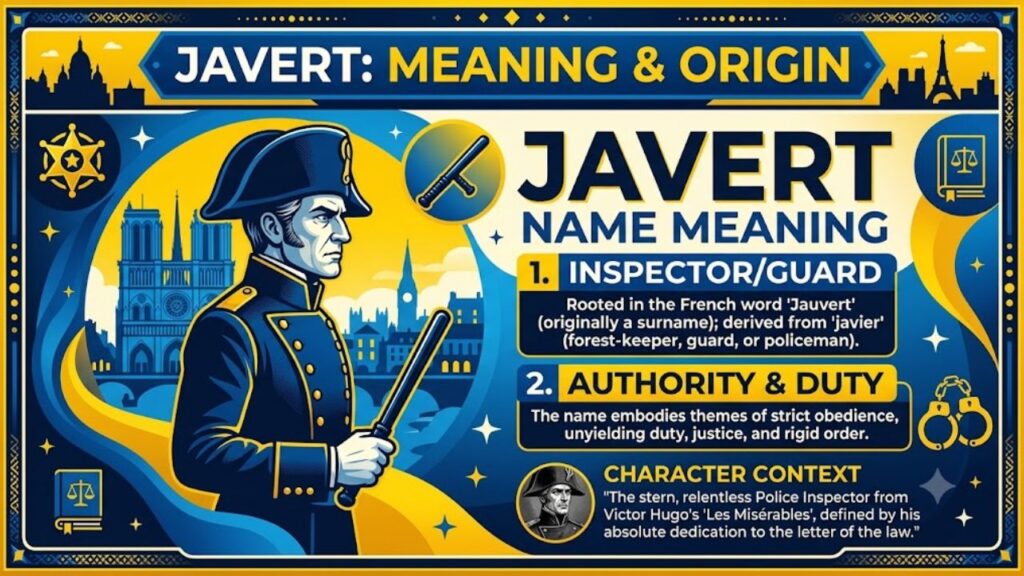
In plain terms, the Javert meaning in english boils down to unwavering discipline paired with a total refusal to forgive. He is a fictional police inspector from Victor Hugo’s Les Misérables, and his entire identity is built around law and order, duty, and the belief that a criminal never truly changes. People search this phrase because the character feels heavier than a simple dictionary term he’s a warning wrapped in a man.
What Makes Javert Meaning Different From a Normal Dictionary Definition?
- Symbolism matters more than the literal name itself
- Moral rigidity defines his every decision
- Jean Valjean gives the meaning its emotional weight
- Justice without mercy is the core takeaway
- Tragic collapse gives the meaning its ending
Example in chat: Friend 1: why does everyone call strict people “a Javert” lol Friend 2: bc the javert meaning is basically “rules over everything, no exceptions ever”
Who Is Javert?
He’s the inspector who never smiles, never doubts, and never once considers that a criminal might actually deserve a second chance in life.
Javert is a police inspector in Les Misérables, and his entire personality centers on catching lawbreakers and enforcing law and order without hesitation. He spends the novel chasing one man, Jean Valjean, because Valjean broke parole years earlier. To Javert, that single broken rule matters more than decades of good behavior. He isn’t cruel for fun. He genuinely believes strict enforcement keeps society safe, and that belief becomes his whole identity.
What Role Does Javert Actually Play in the Story?
- Enforcer: chases lawbreakers with total focus
- Foil: contrasts sharply with Valjean’s mercy
- Symbol: represents the justice system itself
- Antagonist: pursues the hero across decades
- Casualty: ultimately breaks under his own rules
| Detail | Description |
| Occupation | Police inspector |
| Main target | Jean Valjean |
| Core trait | Absolute devotion to law |
| Story role | Antagonist and moral foil |
Example in chat: Friend 1: is Javert the villain in Les Mis? Friend 2: not really, he’s more like law enforcement taken to a scary extreme
Literal Meaning of the Name “Javert”
Names rarely feel accidental in classic literature, and Hugo picked one that sounds cold, sharp, and almost mechanical on purpose.
The name doesn’t have one confirmed dictionary root, but many readers connect it to old French sounds tied to warning or reporting, which fits an inspector perfectly. Others link it to the idea of turning away, matching how he constantly turns from compassion toward pure procedure. Whatever its exact origin, the sound of the name reinforces the Javert meaning readers already sense: something rigid, official, and stripped of warmth.
Does the Name Javert Have a Confirmed Origin?
- No official root exists in standard French dictionaries
- Hugo likely invented it for symbolic sound
- Warning connotations match his enforcer role
- Turning away theme mirrors his personality
- Cold phonetics reinforce his character type
Example in chat: Friend 1: does Javert actually mean something in French? Friend 2: not officially, it just sounds strict and that’s basically the point
Symbolic Meaning | What Does Javert Represent?
He isn’t just a man chasing a criminal. He’s an entire philosophy wearing a uniform, and that’s why readers still argue about him.
At its core, the Javert meaning represents justice stripped of mercy. He believes rules are absolute, and once someone breaks one, that person is permanently marked. Hugo uses him to question systems that value punishment over redemption, and the contrast with Valjean makes that question impossible to ignore. Javert isn’t evil. He’s what happens when order forgets that people can grow.
What Larger Idea Does Javert Symbolize in the Novel?
- Law vs compassion sits at his symbolic core
- Fixed identity clashes against transformation
- Authority stands opposite genuine humanity
- Punishment overshadows any chance of forgiveness
- Rigid systems eventually crack under real change
Example in chat: Friend 1: why does everyone say Javert is “the system”? Friend 2: bc he represents rules with zero room for mercy, that’s the whole symbol
Javert’s Personality | The Anatomy of a Rigid Mind
Picture someone who has never once said “it depends.” That’s Javert, and it explains almost every choice he makes in the story.
His personality is built entirely around duty-bound behavior and total loyalty to authority. He treats his job like a religion, and any moral gray area feels like a personal threat. This rigidity isn’t laziness or simplicity it’s a deeply held worldview that leaves zero room for kindness toward anyone who has broken the law, even once.
How Would You Describe Javert’s Personality in One Sentence?
- Emotionally closed off from nearly everyone around him
- Obsessed with rules more than outcomes
- Loyal to authority figures without question
- Uncomfortable with mercy in almost every scene
- Isolated because his identity leaves no room for connection
Example in chat: Friend 1: Javert seems exhausting honestly Friend 2: right, imagine having zero flexibility about literally anything
Javert vs. Jean Valjean | The Real Conflict
Two men, one obsessed with rules and one who proved rules don’t define a soul, and that clash becomes the real engine of the whole story.
Javert believes law defines a person forever. Valjean proves the opposite by transforming his entire life. That contradiction destroys Javert slowly, because if Valjean can change, everything Javert built his identity on might be false. This isn’t a simple hero-versus-villain setup. It’s a war between two entirely different views of what justice should mean.
Why Does This Conflict Matter So Much in Les Misérables?
- Fixed belief meets living proof of change
- Punishment stands against forgiveness directly
- Obedience clashes with personal moral choice
- Valjean’s growth threatens Javert’s entire worldview
- Neither side fully wins by the story’s end
| Javert | Jean Valjean |
| Law and order | Mercy and redemption |
| Fixed identity | Personal transformation |
| Obedience to rules | Moral courage |
Example in chat: Friend 1: who’s actually right, Javert or Valjean? Friend 2: Valjean, but Javert can’t accept that people actually change
Why Javert Kills Himself | The Literary Explanation
There’s a moment where mercy and law collide inside one man’s head, and neither belief survives the collision intact.
Valjean spares Javert’s life even when he has every reason not to, and that single act of kindness breaks Javert completely. He can no longer hold two truths at once: Valjean is a lawbreaker, yet Valjean is also good. His mind was never built for contradiction, so instead of adapting, he chooses the river.
What Actually Triggers Javert’s Final Breakdown?
- Valjean’s mercy contradicts everything Javert believed
- Rigid thinking offers no room for nuance
- Identity collapse follows the loss of certainty
- Emotional overload replaces years of control
- Suicide becomes his only escape from contradiction
Example in chat: Friend 1: why does Javert jump into the river? Friend 2: bc his whole belief system just broke and he had no backup plan
Javert as a Tragic Figure
Not every downfall comes from weakness. Sometimes the strongest, most disciplined person breaks precisely because they refuse to ever bend.
Javert never doubts his beliefs, and that same certainty becomes his tragedy. He confuses law with absolute truth, so when life shows him something softer, he has no framework to process it. Readers don’t just judge him. They feel the weight of watching someone destroyed by their own perfect discipline.
Why Do Readers Consider Javert a Tragic Character?
- Certainty becomes his greatest weakness over time
- Discipline leaves no space for adaptation
- Perfection according to law still isn’t enough
- Identity tied to duty makes collapse inevitable
- Sympathy grows even without agreeing with him
Example in chat: Friend 1: I actually felt bad for Javert at the end Friend 2: same, he’s not evil, just built way too rigid to survive change
Javert’s Obsession with Valjean | More Than a Chase
What starts as a routine assignment slowly turns into something far more personal, almost like Javert is chasing his own unraveling certainty.
Valjean represents change, and change is the one thing Javert cannot accept. So the pursuit stretches across years and cities, fueled by surveillance and constant monitoring. It stops being professional. It becomes Javert trying to protect his entire worldview from collapsing under one man’s transformation.
Why Does Javert Refuse to Let Valjean Go?
- Valjean challenges Javert’s belief in fixed identity
- Mercy feels dangerous to a rigid legal mind
- Moral uncertainty terrifies Javert more than failure
- His identity depends entirely on catching Valjean
- Failure to capture him would break everything he trusts
Example in chat: Friend 1: why is Javert so obsessed with one guy Friend 2: bc catching him is literally the only thing holding Javert’s identity together
Real-World Impact | Why Javert Still Matters Today
Strip away the 19th-century setting, and Javert looks a lot like arguments people still have right now about rules, fairness, and second chances.
He represents extreme enforcement thinking, the belief that rules apply no matter the human cost. You still see that mindset in zero-tolerance policies, harsh sentencing for minor offenses, and bureaucratic systems that ignore personal context entirely. That’s why he still gets quoted in modern debates about justice.
How Does Javert Connect to Modern Justice Systems?
- Zero-tolerance policies echo his rigid worldview
- Harsh minor sentencing mirrors his all-or-nothing logic
- Bureaucracy often ignores personal circumstances the same way
- Authority figures sometimes value rules over real context
- Compassion versus control remains an unresolved debate
Example in chat: Friend 1: why do people still bring up Javert in real arguments Friend 2: bc he’s the perfect example of rules without any compassion
What Does Javert Mean in Les Misérables?
Inside the novel itself, one word keeps circling back whenever his name comes up, and that word is simply rigidity given a badge.
Within Les Misérables, Javert functions as the embodiment of the justice system’s coldest edge. Hugo positions him opposite Valjean so readers feel the full weight of law without mercy. His meaning inside the story isn’t subtle. He’s there to test whether justice can survive contact with real human change.
Why Did Hugo Create a Character Like This?
- Contrast with Valjean sharpens the novel’s central theme
- Structure gives the plot its central tension
- Warning shows what happens when rules ignore people
- Depth comes from his internal, not external, conflict
- Legacy keeps the character relevant generations later
Example in chat: Friend 1: what’s Javert’s actual purpose in the story Friend 2: he’s there to show what happens when law never bends
Famous Javert Quotes and Their Meaning
His words rarely sound like a person speaking. They sound like policy read aloud, and that’s exactly the point Hugo was making.
Lines associated with Javert lean on duty, certainty, and total rejection of doubt. One recurring idea is his devotion to his badge above everything else, treating enforcement like sacred duty rather than a simple job. Even softer adaptations keep that same controlled, unwavering tone in his dialogue.
What Do Javert’s Most Famous Lines Reveal About Him?
- Duty and identity merge into a single idea for him
- Justice always means punishment, never understanding
- Fixed identity shows up in his views on criminals
- Certainty replaces emotional reasoning in every line
- Control stays constant across every adaptation
Example in chat: Friend 1: Javert’s lines are kind of intense honestly Friend 2: yeah he talks like a rulebook, not a person
Common Misconceptions About Javert
People love sorting characters into hero or villain, but Javert refuses to fit neatly into either box, no matter how hard readers try.
A common mistake is treating him as pure evil, when really he believes he’s protecting society. Another misconception says he hates Valjean personally, but his obsession is philosophical, not personal. His suicide also gets misread as weakness, when it’s actually a total identity collapse.
Is Javert Truly a Villain in the Story?
- Not evil, despite how harsh his actions can feel
- No personal hatred drives his pursuit of Valjean
- Suicide isn’t weakness, it’s an identity breaking apart
- Consistency defines him more than cruelty ever does
- Complexity makes him far more than a simple antagonist
Example in chat: Friend 1: so is Javert actually a bad guy Friend 2: not really, he’s more tragic than evil once you look closer
Javert’s Psychological Profile
Underneath the badge sits a mind built entirely on structure, one that simply cannot process contradiction without eventually breaking down completely.
Psychologically, Javert shows strong black-and-white thinking and heavy emotional suppression. Everything must fit clean categories: legal or illegal, right or wrong. When mercy enters his world, his mind has no backup system, and that missing flexibility becomes the root of his collapse.
What Psychological Traits Define Javert’s Mind?
- Extreme need for control shapes every decision he makes
- Difficulty processing emotion keeps him isolated from others
- Obsessive focus on Valjean consumes his thinking
- Black-and-white categories replace nuanced judgment
- No framework exists for handling contradiction
Example in chat: Friend 1: Javert seems like he’d break under any pressure honestly Friend 2: exactly, his mind only works if everything stays simple
How Adaptations Changed Javert
Depending on which version you meet first, Javert can feel like a machine, a tragic soul, or something in between entirely.
In Hugo’s original 1862 novel, he stays cold and controlled throughout. The musical version softens him, giving songs like his solo before his death real emotional doubt. Film adaptations swing between harsher, robotic portrayals and warmer, more sympathetic ones, but every version keeps his core belief in law without mercy intact.
Which Adaptation Shows Javert Most Sympathetically?
- 1862 novel keeps him distant and mechanical
- Musical version adds visible emotional doubt
- Some films make him harsher and colder
- Other films humanize his internal struggle more
- Core belief in strict law stays constant everywhere
Example in chat: Friend 1: is Javert more sympathetic in the musical Friend 2: yeah, you actually hear his doubt before he dies in that version
Why Is Javert Important to the Story’s Message?
Without him, Valjean’s mercy would have nothing to push against, and Hugo’s entire argument about redemption would lose its sharpest edge.
Javert gives the novel its moral stakes. His rigid belief in punishment forces every act of Valjean’s kindness to feel earned and dangerous at once. Without that tension, the story’s message about redemption over rigid judgment would carry far less weight.
Would the Story Work Without a Character Like Javert?
- Tension depends heavily on his unbending presence
- Valjean’s mercy means more against his resistance
- Redemption theme needs opposition to feel powerful
- Stakes rise every time Javert closes in
- Moral argument loses force without his rigidity
Example in chat: Friend 1: why does Javert matter so much to the plot Friend 2: he’s the pressure that makes Valjean’s growth actually mean something
The Philosophy Behind Javert | Hugo’s Big Argument
Hugo wasn’t just writing a chase scene. He was building an argument about whether people can ever truly outgrow their past mistakes.
Javert symbolizes absolute law, a system that values rules over people. Valjean represents growth and mercy. Their clash forms the philosophical center of Les Misérables: should justice punish forever, or should it allow transformation? Hugo answers clearly through Valjean, while Javert represents the cost of refusing that answer.
What Is Hugo Really Arguing Through Javert’s Character?
- Absolute law gets challenged through Valjean’s growth
- Rigid systems eventually meet real human complexity
- Redemption proves possible despite Javert’s certainty
- Compassion ultimately outweighs blind rule-following
- Collapse shows the cost of refusing to evolve
Example in chat: Friend 1: what’s Hugo actually trying to say through Javert Friend 2: that people can change, and systems that deny that eventually break
Quick Reference Table | Javert at a Glance
Sometimes you just need the short version, so here’s every core fact about Javert laid out in one simple, scannable table.
This table pulls together his identity, beliefs, and fate so you can revisit the Javert meaning without rereading the whole novel. It’s built for quick study sessions, essays, or simple curiosity about the character’s core traits.
What Are the Most Important Facts to Remember About Javert?
- Role: police inspector enforcing strict law
- Belief: rules never bend, ever
- Obsession: Jean Valjean’s criminal past
- Outcome: suicide after moral collapse
- Legacy: a lasting symbol of rigid justice
| Category | Detail |
| Full name | Inspector Javert |
| Origin | Les Misérables (1862), Victor Hugo |
| Core belief | Law is absolute |
| Outcome | Suicide after moral collapse |
Example in chat: Friend 1: got a quick summary of Javert for my essay Friend 2: rigid inspector, obsessed with Valjean, breaks when mercy proves him wrong
Javert Syndrome | Meaning and Usage
Some literary characters become so recognizable that their name turns into shorthand for a whole personality type, and Javert is one of them.
“Javert Syndrome” isn’t a clinical term, but it describes anyone who follows rules with zero flexibility, regardless of context. People use it for strict managers, harsh teachers, or any authority figure who refuses exceptions. It’s become a quick cultural label for extreme legalism.
What Does It Mean to Have Javert Syndrome?
- Strict managers who punish small mistakes harshly
- Teachers who ignore effort and only mark errors
- Authority figures who reject any exceptions
- Systems that value rules over human needs
- Emotional detachment often accompanies the mindset
Example in chat: Friend 1: my boss has full Javert Syndrome honestly Friend 2: no exceptions ever? yeah that tracks with the Javert meaning perfectly
“Pulling a Javert” | Internet Phrase Explained
Online, literary characters get flattened into slang fast, and this particular phrase spread because it’s just too accurate to ignore.
“Pulling a Javert” describes someone becoming overly strict or obsessed with rules in everyday situations. It shows up on forums and social media, usually with humor, but it still points back to the same rigid worldview the original character represents.
What Does “Pulling a Javert” Mean Online?
- Refusing exceptions even in small situations
- Focusing only on rules, ignoring real context
- Pushing punishment instead of understanding
- Treating minor issues like serious offenses
- Using humor to describe overly strict behavior
Example in chat: Friend 1: he’s totally pulling a Javert over one late submission Friend 2: lol true, zero flexibility, just like the character
Important Question: What Is Javert’s First Name?
It’s a small detail that says a lot, and once you notice it, you can’t unsee how deliberate that silence really is.
Victor Hugo never gives Javert a first name in the original text. That omission is intentional. It reinforces his role as a symbol rather than a fully personal individual, tying his identity entirely to his job instead of any private life.
Why Doesn’t Javert Have a First Name in the Novel?
- No recorded first name appears anywhere in the text
- Intentional choice by Hugo to emphasize symbolism
- Identity tied to role, not personal history
- Function over person defines how he’s portrayed
- Symbolic weight grows from that missing detail
Example in chat: Friend 1: wait does Javert even have a first name Friend 2: nope, Hugo never gives him one on purpose
What Can Javert Teach Us About Justice Today?
Long after the pages close, his story keeps asking one uncomfortable question that modern justice systems still haven’t fully answered.
Javert teaches that rules without room for context eventually fail the people they’re meant to protect. His downfall isn’t just personal tragedy. It’s a caution against systems that mistake rigidity for fairness, a lesson still relevant in classrooms, courts, and workplaces today.
What Lesson Does Javert’s Downfall Offer Modern Readers?
- Rigid rules can break under real human complexity
- Context matters as much as the rule itself
- Mercy doesn’t weaken justice, it completes it
- Systems need flexibility to stay fair long-term
- Identity shouldn’t rest entirely on enforcing rules
Example in chat: Friend 1: what’s the actual lesson from Javert’s story Friend 2: that justice without any mercy eventually collapses on itself
Javert in Modern Discussions | Memes, Opinions, and Community Reactions
His story left the page a long time ago and now lives comfortably inside memes, debates, and internet arguments about fairness.
People reference Javert whenever discussions turn to strict rule enforcement or zero-tolerance policies. Memes joke about him as “the no exceptions guy,” while others defend him as a symbol of discipline taken too far. Either way, his name keeps surfacing in modern conversations about authority.
How Do Modern Communities Talk About Javert?
- Memes label him the “rule book is my personality” guy
- Debates use him to discuss fairness versus enforcement
- Defenders praise his discipline and consistency
- Critics see him as a warning about rigidity
- References appear across justice and authority debates
Example in chat: Friend 1: why is Javert still a meme template basically Friend 2: bc he’s the perfect symbol for “rules over people” energy
FAQ’s
What does Javert mean in Les Misérables?
Javert meaning centers on strict law enforcement without mercy. He represents justice stripped of compassion in Hugo’s novel.
Why is Javert so rigid?
His entire identity ties to duty and authority. That’s why Javert meaning connects so closely with moral rigidity.
Is Javert a hero or a villain?
Neither, really. Javert meaning shows a tragic figure caught between law, justice, and human compassion.
Why does Javert chase Jean Valjean?
He believes criminals never change. Javert meaning reflects his obsession with fixed identity and punishment.
What causes Javert’s downfall?
His rigid thinking collapses once mercy enters his world. Javert meaning shows how inflexible law eventually breaks a person.
Why do people still discuss Javert today?
He mirrors real debates about justice systems. Javert meaning connects directly to modern arguments about punishment versus forgiveness.
What lesson does Javert’s story teach readers?
It warns that strict rules without humanity can destroy lives. Javert meaning cautions against extreme moral rigidity.
Conclusion
The Javert meaning comes down to one clear idea: law without mercy eventually breaks whoever enforces it too rigidly. His story shows how a mind built entirely on rules can shatter the moment real human complexity shows up. That collapse isn’t weakness. It’s the natural result of refusing to bend even once.
Understanding Javert meaning in english helps readers see why this 19th-century inspector still fuels memes, debates, and classroom discussions today. He’s more than an antagonist chasing Jean Valjean. He’s a mirror for anyone who has ever mistaken strictness for fairness. Next time rigid rules feel unquestionable, remember Javert, and ask whether a little mercy might actually make things stronger, not weaker.

Amelia Brooks is a US-based author known for inspiring stories on meaning, growth, and hope, blending insight with simple, engaging storytelling.