
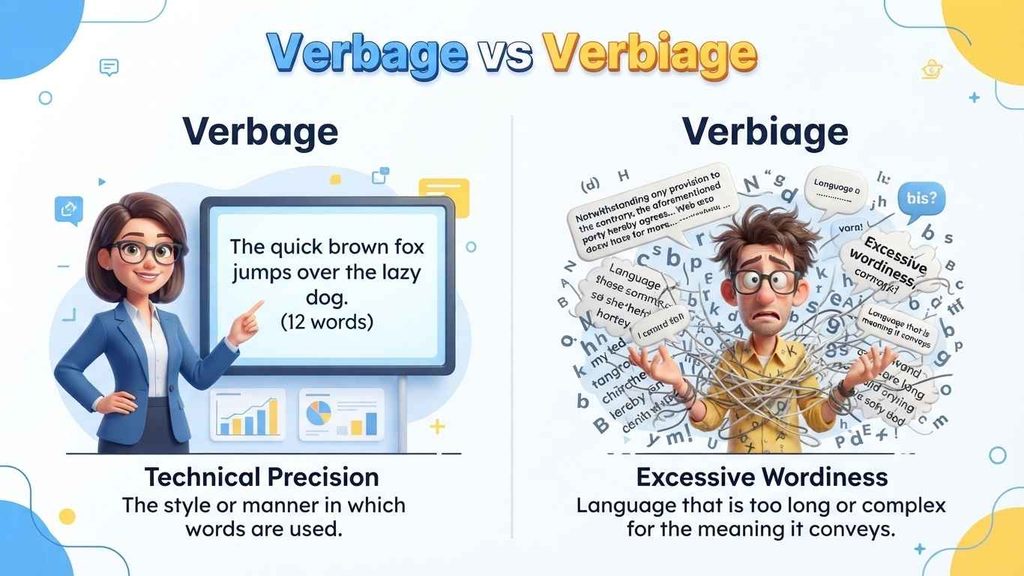
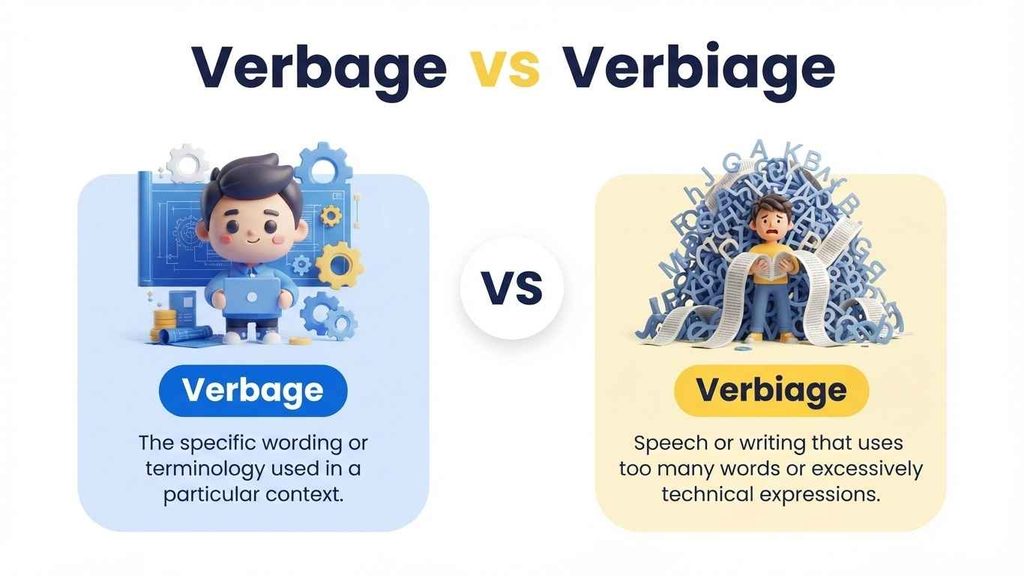
You’ve typed it, deleted it, and typed it again is it verbage or verbiage? That tiny pause before hitting send, wondering if a client or teacher will notice the “mistake,” is oddly stressful for something so small. Most people feel this exact hesitation at least once, especially when writing something formal.
Here’s the good news: by the end of this guide, you’ll never second-guess it again. We’ll break down the real verbiage meaning, show you exactly where “verbage” went wrong, and give you simple tricks, tables, and examples so the correct verbiage usage sticks for good. Keep reading it’s simpler than it looks.
LSI, NLP & Semantic Keywords used throughout this article: verbiage, verbage, wording, phraseology, jargon, verbose, wordiness, legalese, boilerplate, redundant language, superfluous words, contract language, business jargon, technical jargon, plain language, concise writing, word choice, terminology, phrasing, legal documents, filler words, excessive wording, uncountable noun, synonym, common misspelling, correct spelling, formal writing, academic writing, business communication, editing, proofreading, spell check, style guide, dictionary definition
Quick Answer
Wondering if you’ve been writing it wrong this whole time? You’re not the only one and thankfully, the fix takes ten seconds. Here’s the short version before we go deeper.
Verbiage is the only correct spelling. Verbage is a common misspelling that doesn’t appear in any major dictionary. The verbiage meaning refers to wording, phrasing, or, more specifically, an excessive and unnecessary amount of words used in writing or speech.
Is Verbage or Verbiage the Correct Word?
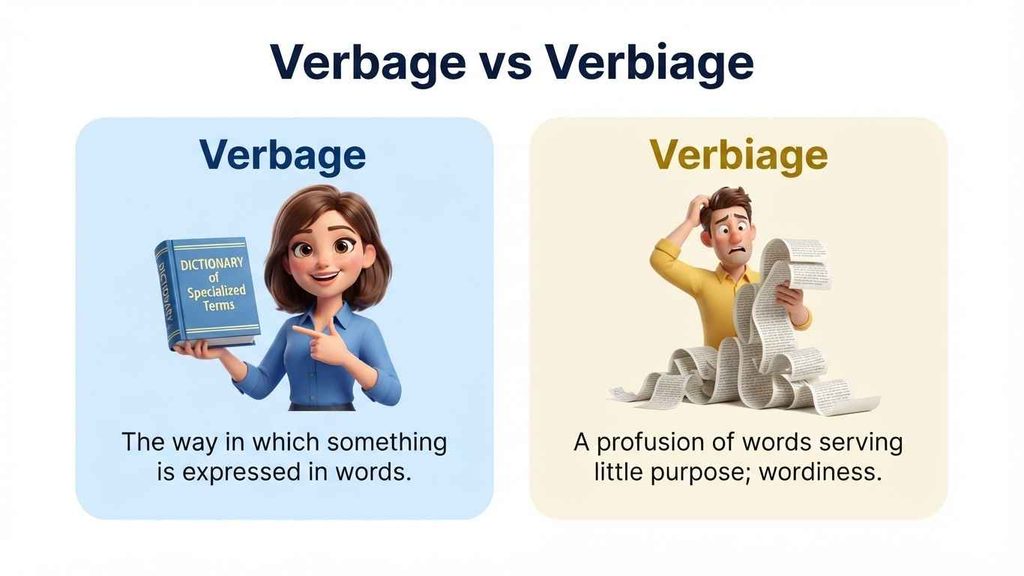
- Correct spelling: verbiage (with an “i”)
- Incorrect spelling: verbage (a phonetic misspelling)
- Part of speech: noun, usually uncountable
- Common context: legal documents, business emails, contracts, essays
- Typical tone: often slightly negative, implying wordiness or jargon
Example in texting: Friend 1: did u read that contract they sent?? Friend 2: barely, so much verbiage i almost gave up halfway through
Verbage or Verbiage
Let’s settle this one for good, because the confusion between verbage and verbiage trips up even sharp writers. Only one of these words has ever existed in real, standard English.
Search engines show thousands of monthly searches for “verbage or verbiage,” which tells you something important: this mix-up is incredibly common, not a sign that you’re bad at spelling. It usually comes down to how the word sounds out loud rather than how it’s actually spelled.
Why Do People Search “Verbage or Verbiage” So Often?
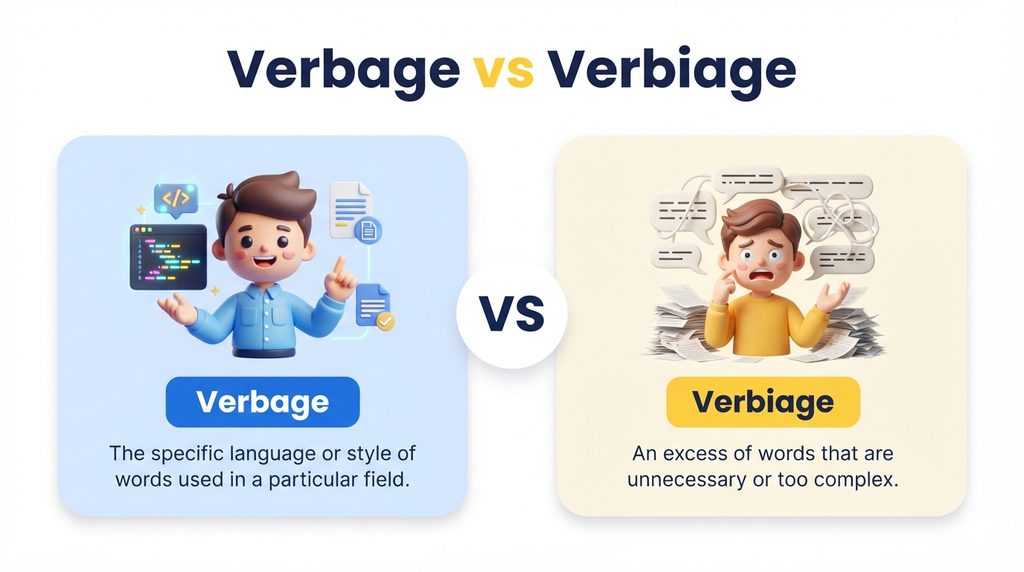
- Pronunciation makes “verbage” feel like the natural spelling.
- Autocorrect doesn’t always catch it in casual apps.
- Workplace writing (contracts, reports) increases exposure to the word.
- Similar-sounding words like “garbage” reinforce the wrong spelling.
- Confidence gaps make people Google it instead of guessing.
Example in chat: Friend 1: is it verbage or verbiage lol Friend 2: verbiage, always verbage isn’t a real word
Verbage Definition
Since so many people search for a “verbage definition,” it’s worth being direct: there isn’t one. No dictionary not Merriam-Webster, not Oxford, not Cambridge lists “verbage” as a legitimate entry.
What people are actually looking for when they search this is the verbiage meaning. Think of “verbage” as a phantom word: it sounds plausible, it even feels like it should exist next to words like “garbage” or “average,” but it simply has no accepted definition anywhere.
| Search Term | Actual Word Intended | Dictionary Status |
| “verbage definition” | verbiage | Not listed |
| “verbage meaning” | verbiage | Not listed |
| “verbiage definition” | verbiage | Listed and correct |
- No dictionary recognizes “verbage” as a standalone word.
- Spell-checkers in Word and Google Docs will flag it instantly.
- Style guides (AP, Chicago, MLA) never reference “verbage.”
- Professional editors will always correct it to verbiage.
- Search intent behind “verbage” almost always means verbiage.
Verbiage or Verbage
Flip the phrase around and the answer stays exactly the same: verbiage wins every time. This section exists because people search both word orders, but the correct choice never changes based on which word comes first.
Whether you type “verbiage or verbage” or “verbage or verbiage,” you’re really asking the same underlying question: which spelling is real? The answer, again, is verbiage a real noun with a real, useful meaning in everyday and professional writing.
Does Word Order Change Which Spelling Is Correct?
- No, the correct spelling stays the same regardless of phrasing.
- Search engines treat both phrasings as the same query intent.
- Grammar checkers flag “verbage” in either sentence position.
- Context never makes “verbage” acceptable, formal or casual.
- Consistency matters more in professional documents than phrasing order.
Example in texting: Friend 1: verbiage or verbage, which one again Friend 2: verbiage i had to look it up too 😅
Meaning and Definition of Each Word
Understanding exactly what each word is trying to communicate clears up so much confusion. One of these terms carries real linguistic weight; the other is simply an echo of mispronunciation.
Knowing the true verbiage meaning helps you use it with confidence in emails, essays, and conversations, while understanding why “verbage” fails will stop you from ever typing it again by accident.
What Does Verbiage Actually Mean in Plain English?
- Verbiage means wording, phrasing, or overall style of language used.
- It often implies too many words used unnecessarily.
- It’s frequently applied to contracts, reports, and speeches.
- It can describe writing that’s technically correct but overly wordy.
- It’s always used as a noun, never a verb or adjective.
1. Verbiage
Definition: The way words are expressed, most often referring to excessive or unnecessarily complicated wording.
Simple explanation: People use it when a document, speech, or email has more words than it needs think dense legalese or padded corporate jargon.
Examples:
- The contract is full of confusing verbiage.
- Try to cut the verbiage in your final essay draft.
- His speech had too much verbiage and too little clarity.
2. Verbage
Definition: Not a recognized word. It’s simply a misspelling of verbiage, formed by dropping the “i.”
Simple explanation: If “verbage” shows up in a formal document, it will almost always be flagged as an error.
Examples (incorrect usage):
- ❌ The report contains unnecessary verbage.
- ✔️ The report contains unnecessary verbiage.
Example in chat: Friend 1: what does verbiage even mean Friend 2: basically fancy word for “too many words,” lol
Is Verbiage a Formal or Informal Word?
Great question, because tone matters just as much as spelling when you’re choosing words for an email, essay, or presentation. Here’s where verbiage actually fits.
Verbiage leans formal. You’ll see it constantly in legal writing, corporate memos, and academic papers, but it also works fine in casual conversation when you’re joking about a wordy text or an over-explained group chat message.
- Formal contexts: contracts, policies, academic essays, legal notices.
- Semi-formal contexts: workplace emails, business proposals, official reports.
- Casual contexts: joking about a friend’s overly long text message.
- Avoid using it in creative writing meant to feel warm or personal.
- Tone signal: using verbiage instantly makes writing sound more professional.
| Context | Is “Verbiage” Appropriate? |
| Legal contract | Yes very common |
| Casual text to a friend | Yes often used jokingly |
| Poetry or fiction dialogue | Rarely feels clinical |
| Business email | Yes sounds professional |
Example in texting: Friend 1: ur email had SO much verbiage lol just say yes or no Friend 2: lmaooo fair, i over-explained again
Key Differences Between the Words
Side by side, the gap between these two words becomes obvious one belongs in a dictionary, and the other doesn’t belong anywhere at all. Here’s the breakdown people search for most.
Comparing verbiage and verbage directly makes the choice almost automatic. Once you see the differences laid out, you’ll never hesitate over which spelling to use again.
What Sets Verbiage Apart From Verbage Completely?
- Correctness: Verbiage is correct; verbage is not.
- Dictionary status: Verbiage is listed; verbage is absent everywhere.
- Usage: Verbiage appears in writing and speech constantly.
- Meaning: Verbiage refers to wording; verbage carries no meaning.
- Professional acceptance: Only verbiage passes editorial and academic review.
- Correctness:
- Verbiage → Correct word
- Verbage → Incorrect spelling
- Usage:
- Verbiage → Used in writing and speech
- Verbage → Should never be used
- Meaning:
- Verbiage → Refers to wording or excessive words
- Verbage → No official meaning
- Acceptance:
- Verbiage → Accepted in every major dictionary
- Verbage → Not accepted anywhere
Example in chat: Friend 1: so verbage isn’t real at all? Friend 2: nope, 100% verbiage, always has been
Comparison Table
Sometimes a quick visual makes everything click faster than paragraphs of explanation ever could. Here’s the full comparison in one simple table you can screenshot and save.
This table pulls together everything you need spelling, meaning, and correctness into one place so you can double-check yourself in seconds next time you’re unsure.
| Word | Meaning | Correct? | Example |
| Verbiage | Wording or excessive use of words | ✔️ Yes | The article has too much verbiage. |
| Verbage | Misspelling of “verbiage” | ❌ No | Avoid using “verbage” in formal writing. |
| Wordiness | Informal synonym for verbiage | ✔️ Yes | The essay suffered from wordiness. |
| Jargon | Technical or specialized wording | ✔️ Yes | The report was full of legal jargon. |
- One correct spelling exists, and it’s verbiage.
- Zero dictionaries recognize verbage as valid.
- Related terms like jargon and wordiness are also correct.
- Context clues rarely change which spelling applies.
- Memorize the table and you’ll never mix them up again.
Example in texting: Friend 1: sending you the comparison table i made lol Friend 2: omg you really turned this into a study guide
Examples in Sentences
Reading real sentences is often the fastest way to make a word finally stick in your memory. Here’s verbiage used correctly, and “verbage” shown as the mistake it is.
Seeing correct and incorrect usage side by side trains your eye to spot the error instantly, whether you’re proofreading your own writing or reviewing someone else’s document.
Correct Usage of “Verbiage”
- Please avoid unnecessary verbiage in your final report.
- Legal documents often contain dense, technical verbiage.
- The teacher asked students to simplify their verbiage.
- His email was buried in overly formal verbiage.
- Strong writing usually avoids excessive verbiage altogether.
- The marketing copy needed less verbiage and more clarity.
- Good editors trim verbiage without losing meaning.
Incorrect Usage of “Verbage”
- ❌ The speech had too much verbage.
- ✔️ The speech had too much verbiage.
- ❌ Remove extra verbage from your essay.
- ✔️ Remove extra verbiage from your essay.
Example in chat: Friend 1: check my email, too much verbiage? Friend 2: yeah cut like 3 sentences, straight to the point
Common Mistakes
Everyone slips up on this word at some point, and honestly, the mistakes tend to repeat in the same predictable patterns. Recognizing them is the fastest way to stop making them.
Most verbiage errors come from either mishearing the word or assuming both spellings coexist with different meanings. Once you know the traps, they’re incredibly easy to avoid going forward.
1. Spelling Mistake
- ❌ Verbage
- ✔️ Verbiage
Why it happens: People spell the word the way it sounds rather than how it’s actually written.
2. Thinking Both Words Are Correct
Some writers assume “verbage” and “verbiage” are two separate, valid words with different meanings.
- ❌ Verbage (a wrong assumption)
- ✔️ Only verbiage is correct
3. Overusing “Verbiage” Itself
Even correct words can be overused until they sound clunky and repetitive.
- ❌ His speech had too much verbiage, verbiage, and more verbiage.
- ✔️ His speech was simply too wordy.
- Mishearing the word in speech causes most spelling errors.
- Assuming both spellings work is a common false belief.
- Overusing even the correct word weakens your writing.
- Skipping spell-check lets the mistake slip through unnoticed.
- Copying casual writing styles spreads the error further online.
Example in texting: Friend 1: i just realized i’ve been spelling it wrong for years Friend 2: lol same, verbage felt so right
What Is the Root Word of Verbiage?
Curious where this word even comes from? Tracing its roots actually makes the spelling and the “i” much easier to remember for good.
Verbiage comes from the French word “verbier,” which traces back to the Latin “verbum,” meaning “word.” That same root gives us “verbose,” “verbal,” and “verb” all words tied directly to language and speech.
- Root word: Latin “verbum,” meaning “word.”
- French influence: “verbier” shaped the modern spelling with an “i.”
- Related words: verbal, verbose, verb, verbatim all share this root.
- Memory trick: if it shares roots with “verbal,” it needs the “i.”
- Historical use: the word entered English usage in the 18th century.
| Related Word | Shared Root | Meaning |
| Verbiage | verbum (word) | Wording, often excessive |
| Verbal | verbum (word) | Spoken, related to words |
| Verbose | verbum (word) | Using too many words |
| Verbatim | verbum (word) | Word for word, exact |
Example in chat: Friend 1: did you know verbiage comes from latin for “word”? Friend 2: ok that actually makes it way easier to spell now
Tips to Remember the Difference
A few memory tricks can lock this word into your brain permanently, so you never have to Google it again. These are simple, a little playful, and genuinely effective.
Once one of these tricks sticks, you’ll spell verbiage correctly on autopilot no more pausing mid-sentence to second-guess yourself.
1. Think of the “i” in Verbiage
Verbiage has an “i,” just like many other correct English words tied to language.
👉 Verbiage = Valid word
2. Remember: “Verbage” Rhymes With Garbage
A fun trick: verbage rhymes with garbage and that’s exactly where the spelling belongs.
👉 Verbage rhymes with garbage → so it’s incorrect
3. Use Spell Check Every Time
Modern tools like Word or Google Docs will instantly highlight “verbage” as an error.
4. Associate It With “Verbose”
Verbiage comes from the same root as “verbose,” which means using too many words.
- Visual trick: picture the “i” standing tall and correct.
- Sound trick: “verbage” sounds like “garbage” a red flag.
- Root trick: connect it to “verbal” and “verbose” instantly.
- Tool trick: trust your spell-checker over your instinct.
- Repetition trick: write the correct word five times to lock it in.
Example in texting: Friend 1: how do i remember this word forever Friend 2: verbage = garbage, that’s literally all you need
When to Use Each Word
Knowing the correct spelling is only half the job knowing when to reach for the word matters just as much for sounding natural and professional.
Verbiage fits naturally into specific situations, while “verbage” never belongs anywhere, in any context, formal or casual.
When to Use “Verbiage”
Use verbiage when:
- Talking about wording or phrasing in a document.
- Describing too many unnecessary words in writing.
- Writing formal, academic, or legal content.
- Reviewing contracts, policies, or business proposals.
- Giving feedback on someone’s overly wordy draft.
Examples:
- The contract’s verbiage is difficult to understand.
- Avoid extra verbiage in business emails.
When to Use “Verbage”
👉 Never use “verbage.” There is no situation, formal or informal, where this spelling is correct. Always replace it with verbiage.
Example in chat: Friend 1: is it ever ok to write verbage casually Friend 2: nope, not even in memes lol, always verbiage
Verbiage in Legal and Business Writing
If there’s one place verbiage shows up constantly, it’s the professional world contracts, memos, and policies are practically built on it. Here’s why.
Legal and business writing often gets criticized for verbiage because dense legalese and repetitive boilerplate language make simple ideas feel unnecessarily complicated to the average reader.
Why Does Legal Writing Use So Much Verbiage?
- Precision demands push lawyers toward longer, layered phrasing.
- Boilerplate clauses get copied and reused, adding bulk.
- Risk avoidance leads to repetitive, overly cautious wording.
- Tradition keeps outdated legal phrases alive in modern contracts.
- Plain-language reform is slowly reducing unnecessary verbiage industry-wide.
| Industry | Common Verbiage Issue | Suggested Fix |
| Legal | Repetitive clauses | Plain-language rewrites |
| Business | Corporate jargon | Direct, simple phrasing |
| Academic | Overly complex sentences | Shorter, clearer statements |
Example in texting: Friend 1: my landlord’s lease is 40 pages of verbiage Friend 2: classic, ask them for the plain english version
Grammar Rules (If Applicable)
While verbiage doesn’t come with complicated grammar rules, a few small details trip people up more than you’d expect. Here’s what actually matters.
Knowing its part of speech and how it behaves in a sentence helps you use verbiage confidently in both writing and speech, without awkward phrasing mistakes.
1. It Is a Noun
Verbiage is always used as a noun, never a verb or adjective.
Examples:
- The verbiage is confusing.
- This document contains too much verbiage.
2. It’s an Uncountable Noun
You usually don’t say “verbiages.”
- ❌ Many verbiages
- ✔️ Much verbiage
3. Used in Formal Contexts
It appears more often in:
- Academic writing
- Legal documents
- Business communication
- Part of speech: always a noun, never anything else.
- Countability: treat it as uncountable, like “information.”
- Pairing words: use “much,” “less,” or “too much” verbiage.
- Avoid pluralizing: “verbiages” is grammatically incorrect.
- Sentence position: typically follows “too much” or “the.”
Example in chat: Friend 1: can i say “verbiages” for multiple documents Friend 2: nope, still just “verbiage,” it’s uncountable
How Do You Use Verbiage in a Sentence Correctly?
Putting theory into practice is where most people actually get stuck, so let’s walk through real, natural sentence structures you can copy directly.
Using verbiage correctly comes down to pairing it with the right words “too much,” “reduce,” “simplify” and remembering it never takes a plural form.
- Pair it with “reduce” “Please reduce the verbiage.”
- Pair it with “too much” “There’s too much verbiage here.”
- Pair it with “simplify” “Simplify the verbiage for clarity.”
- Avoid plural forms never write “verbiages.”
- Use it after “the” “The verbiage confused every reader.”
| Sentence Starter | Example Sentence |
| “Reduce the…” | Reduce the verbiage in this paragraph. |
| “Too much…” | Too much verbiage buried the main point. |
| “Simplify the…” | Simplify the verbiage before sending. |
Example in texting: Friend 1: help me use verbiage in a sentence for class Friend 2: “please reduce the verbiage in your essay” easy
Verbiage vs Plain Language
Here’s a debate worth understanding: verbiage and plain language sit at opposite ends of communication, and knowing the difference instantly improves your writing.
Choosing plain language over heavy verbiage almost always makes writing more accessible, faster to read, and more persuasive especially online, where attention spans are short.
Which Reads Better: Verbiage or Plain Language?
- Plain language is shorter, clearer, and easier to scan.
- Verbiage-heavy writing often signals over-explanation or insecurity.
- Readers trust simple, direct sentences more than dense paragraphs.
- SEO content performs better with reduced, focused verbiage.
- Editing tools like Hemingway highlight excess wording instantly.
| Style | Example | Reader Reaction |
| Heavy verbiage | “It is important to note that, in light of…” | Confusing, slow |
| Plain language | “This matters because…” | Clear, fast |
Example in chat: Friend 1: my boss said cut the verbiage in my report Friend 2: translation: just say what you mean, lol
Synonyms or Related Words
If you want to avoid repeating verbiage too often in your own writing, a handful of solid alternatives can keep your tone fresh and varied.
Swapping in a synonym occasionally also helps you avoid sounding repetitive, especially in longer essays, reports, or articles that mention wording multiple times.
- Wording a neutral, everyday alternative.
- Language broader, works in most contexts.
- Text simple, useful for written content.
- Phraseology more formal, technical tone.
- Expression focuses on style of communication.
- Wordiness negative connotation, like verbiage.
- Jargon technical or specialized wording.
Example:
- The document has too much wordiness instead of clear verbiage.
Example in texting: Friend 1: what’s another word for verbiage Friend 2: “wording” works in almost any sentence honestly
Frequently Asked Questions (FAQs)
Is “verbage” a real word?
No, “verbage” is not a real or correct word. It’s simply a misspelling of verbiage.
What does “verbiage” mean?
Verbiage means wording, or the use of too many unnecessary words in writing or speech.
Why do people confuse “verbage” and “verbiage”?
Because they sound similar, people often spell verbiage incorrectly based on pronunciation alone.
Can I use “verbage” in informal writing?
It’s best to avoid “verbage” completely, even casually, since verbiage is always the correct choice.
Is “verbiage” always negative?
Not always. Verbiage can simply mean wording, though it’s often used negatively for excessive text.
What is a simple synonym for “verbiage”?
A simple, everyday synonym for verbiage is “wording,” which works in most casual sentences.
Where does the word “verbiage” come from?
Verbiage comes from the Latin root “verbum,” meaning word, through French influence historically.
Conclusion
So, verbage or verbiage? By now the answer feels obvious: only verbiage has ever been correct, and “verbage” is simply a spelling slip caused by how the word sounds out loud. Understanding the true verbiage meaning wording, phrasing, or unnecessary wordiness gives you one less thing to second-guess in your writing.
Use the tricks from this guide, especially the “verbage rhymes with garbage” reminder, and this word will stop tripping you up for good. Whether you’re editing a contract, an essay, or a quick text, trust verbiage every single time, and let your wording stay clear, confident, and correct.
Next time you catch yourself hesitating, you’ll already know exactly what to type.

Amelia Brooks is a US-based author known for inspiring stories on meaning, growth, and hope, blending insight with simple, engaging storytelling.