
Have you ever sent out a survey, floated an idea to your boss, or posted something online and then just… waited, wondering if anyone actually cared? That quiet, nervous feeling of “will this land or flop” is exactly why people search for gauge interest in the first place. It’s not just a grammar question. It’s a real, human moment of doubt.
This article breaks down the gauge interest meaning in plain English, shows you exactly how to use it, and clears up the confusing “gage or gauge” spelling debate for good. You’ll walk away knowing how to measure interest the right way in writing and in real life. Keep reading, because the answer is simpler than you think.
Gage Interest
A lot of people type “gage interest” into Google without realizing they’ve made a small spelling slip. It happens because “gage” and “gauge” sound identical and look almost the same on a page. But only one of them belongs in this phrase.
- Gage is an old, rare word tied to pledges, legal promises, or collateral.
- Gauge is the modern word for measuring, estimating, or assessing something.
- The phrase you’re looking for is always “gauge interest,” never “gage interest.”
- Search engines quietly correct this mix-up because the intent behind both searches is the same.
- Once you see the difference, you’ll never second-guess the spelling again.
Why Do People Type “Gage Interest” by Mistake?
Most writers aren’t careless they’ve just never seen “gage” used correctly, so their brain autocorrects it wrong. The two words are homophones, meaning they sound exactly alike when spoken aloud. Add in fast typing, autocorrect quirks, and old-fashioned spellings still floating around in legal documents, and the confusion makes total sense.
- Homophones trick even confident writers, not just beginners.
- Autocorrect on phones sometimes accepts “gage” without flagging it.
- Old legal texts still use “gage,” which confuses modern readers.
- Teachers rarely explain the difference in school grammar lessons.
- Once corrected, the mistake almost never happens again.
Example in texting: Friend 1: did u gage interest for the trip yet lol Friend 2: it’s “gauge” babe but yes, everyone’s in 😂
Quick Answer
If you only read one section, make it this one: gauge is the word you want, always, when you’re talking about measuring something like interest, feelings, or reactions. Here’s the fast version before we go deeper.
- The correct phrase is “gauge interest,” not “gage interest.”
- Gauge means to measure, assess, or estimate something.
- Gage is a rare, old-fashioned word for a pledge or guarantee.
- Use gauge in emails, surveys, marketing copy, and everyday conversation.
- Save gage for legal or historical writing only, if ever.
What Does Gauge Interest Really Mean?
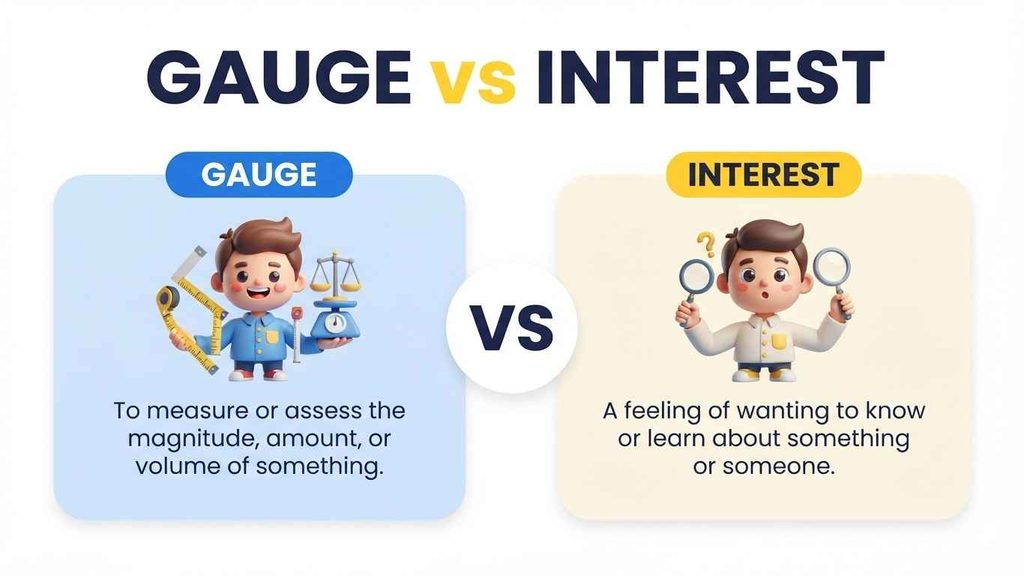
At its core, to gauge interest means to test the waters before making a bigger move. It’s checking, informally or formally, how much enthusiasm exists around an idea, event, or product. Businesses do it constantly, and so do regular people planning a group dinner.
- Gauge interest means checking enthusiasm before committing fully.
- It can be formal, like a survey, or casual, like a group chat poll.
- The goal is to avoid wasted effort on something nobody wants.
- It often happens before launching, pitching, or scheduling something.
- The word carries a sense of careful, thoughtful estimation.
Example in chat: Friend 1: should I gauge interest before booking the whole cabin? Friend 2: yes, send a quick poll first, don’t book blind
Meaning and Definition of Each Word
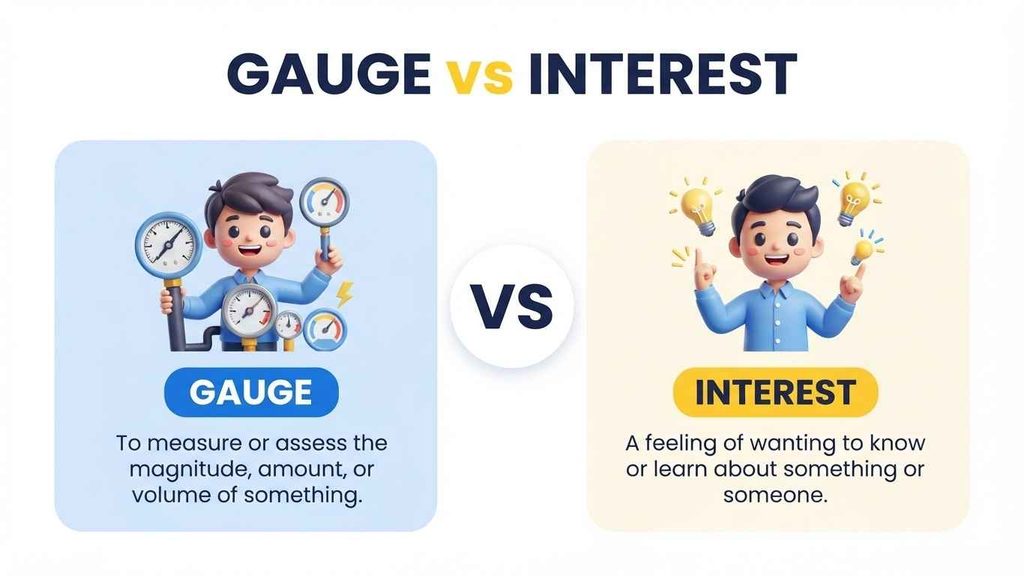
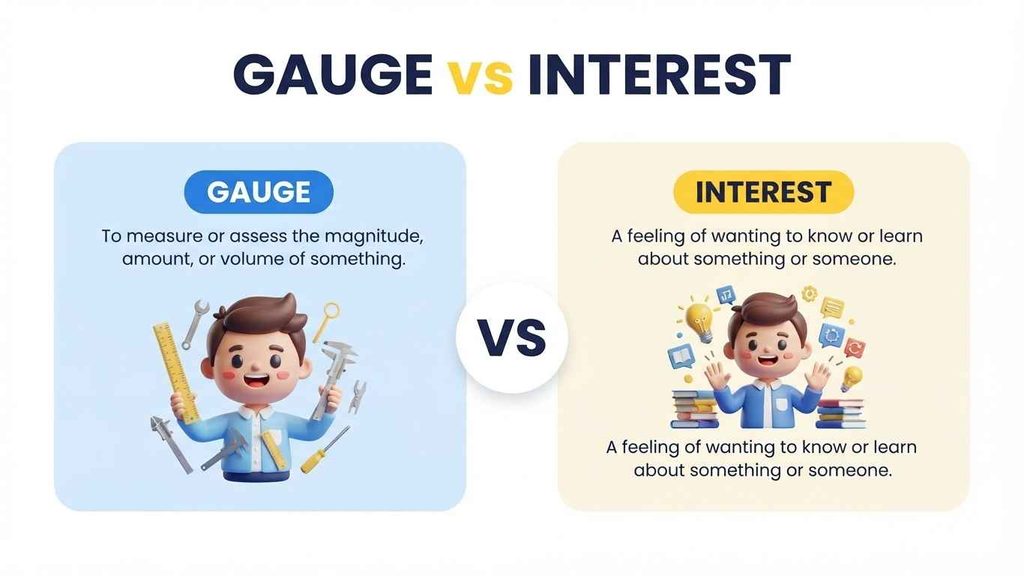
Understanding gauge interest starts with knowing exactly what each half of the phrase brings to the table. “Gauge” carries the action, and “interest” carries the emotion or curiosity being measured. Together they form one of the most useful expressions in modern English.
- Gauge (verb): to measure, estimate, or judge something accurately.
- Gauge (noun): an instrument used for measuring, like a fuel gauge.
- Interest (noun): curiosity, attention, or enthusiasm someone shows toward something.
- Interest can also mean a stake or investment in an outcome.
- Combined, “gauge interest” means measuring people’s enthusiasm or curiosity.
| Word | Part of Speech | Core Meaning | Common Example |
| Gauge | Verb / Noun | To measure or assess | We tried to gauge her reaction. |
| Interest | Noun | Curiosity or enthusiasm | There’s real interest in the new app. |
| Gage | Noun (rare) | Pledge or guarantee | He offered his ring as a gage. |
How Is Gauge Interest Used in Everyday Conversations?
People use this phrase far more casually than they realize, from group chats to office emails. It slips naturally into questions like “should we gauge interest first?” before anyone commits time or money to a plan.
- Friends gauge interest before planning a trip or event.
- Managers gauge interest before announcing a new project.
- Teachers gauge interest to shape a lesson plan.
- Marketers gauge interest through polls, ads, and landing pages.
- Even casual texts use it: “let’s gauge interest first.”
Key Differences Between the Words
Once you line “gage” and “gauge” up side by side, the differences become obvious and easy to remember. This section breaks down exactly where each word belongs so you never mix them up in writing again.
- Spelling: “Gauge” is standard; “gage” is a rare variant.
- Meaning: “Gauge” measures things; “gage” pledges or guarantees things.
- Frequency: “Gauge” appears constantly; “gage” almost never does.
- Formality: “Gage” survives mainly in legal or historical texts.
- Safety net: When unsure, default to “gauge” every single time.
Why Do People Use Gauge Instead of Gage Today?
Language evolves, and “gauge” simply won the popularity contest over the centuries. English speakers gravitated toward the spelling that felt more intuitive and visually distinct from other words, leaving “gage” behind in specialized fields.
- Gauge became standardized through dictionaries and style guides.
- Gage survived mostly in legal and engineering jargon.
- Modern spellcheckers flag “gage” far less often as an error.
- Publishers and editors almost always choose gauge by default.
- This shift makes “gauge” the safer, smarter everyday choice.
Gage or Gauge in English
In modern English, gauge dominates nearly every context you’ll encounter, from technical manuals to casual texts. “Gage” hasn’t disappeared completely, but it lives in a much smaller, more specialized corner of the language.
- Gauge appears in business, science, tech, and daily speech.
- Gage survives mainly in historical fiction or legal documents.
- English teachers almost always mark “gage” as incorrect in essays.
- Dictionaries list “gage” as a variant, not a preferred spelling.
- For 99% of writing situations, gauge is the right call.
Gage or Gauge Meaning
The deeper meaning behind “gauge” is all about precision measuring something carefully instead of guessing blindly. Whether it’s a physical tool or an abstract feeling like interest, the word always implies a deliberate act of assessment.
- Gauge means to measure, estimate, evaluate, or determine something.
- It applies to physical things: pressure, temperature, thickness, distance.
- It also applies to feelings: reactions, opinions, moods, and interest.
- “Gage,” by contrast, means a pledge, promise, or piece of collateral.
- Knowing this meaning difference prevents almost every common mistake.
When Should You Use Gauge Interest in a Sentence?
Reach for this phrase whenever you want to describe testing enthusiasm before taking a bigger step forward. It fits naturally in planning conversations, business pitches, and even casual group decisions among friends.
- Use it before launching a product, event, or campaign.
- Use it when planning a group activity or trip.
- Use it in surveys asking about customer satisfaction or demand.
- Use it in emails proposing a new idea to a team.
- Use it whenever you need honest feedback before committing.
Gage or Gauge Interest
The winning phrase, without question, is “gauge interest,” and it shows up constantly in marketing, HR, and everyday planning. Businesses use it to test demand, while individuals use it to avoid wasted effort on unwanted plans.
- The correct expression is always “gauge interest,” never “gage interest.”
- Companies gauge interest through polls, waitlists, and pre-orders.
- Event planners gauge interest before booking venues or catering.
- HR teams gauge interest in new benefits or policies.
- Getting this phrase right instantly makes your writing look professional.
Example in DM: Friend 1: gonna gauge interest before I plan the whole birthday thing Friend 2: smart move, don’t want to plan for nobody 😅
Gage or Gauge Example
Real examples make abstract grammar rules stick far better than definitions alone. Below are natural, everyday sentences showing exactly how gauge and, occasionally, gage appear in genuine writing.
- The startup ran a poll to gauge interest before the launch.
- She tried to gauge his interest by his tone of voice.
- The teacher used a quick quiz to gauge student interest.
- We’re sending a short survey to gauge customer interest.
- He offered his watch as a gage of good faith.
| Sentence Type | Example |
| Business | The brand ran ads to gauge interest in the new flavor. |
| Casual | Let’s gauge interest before booking the whole group trip. |
| Formal | The board will gauge interest before approving the budget. |
| Rare (gage) | He pledged his land as a gage against the debt. |
How to Gauge Interest Effectively
Knowing the phrase is one thing, but actually measuring real enthusiasm takes a bit of strategy. Whether you’re a founder, a teacher, or a friend planning a party, the method matters just as much as the words.
- Ask direct, simple questions instead of vague ones.
- Use short polls or surveys with 2-3 clear options.
- Watch behavior, like clicks, RSVPs, or repeat questions.
- Offer a low-commitment first step, like a waitlist signup.
- Follow up personally with people who showed early curiosity.
What’s the Best Way to Gauge Interest Online?
Digital tools make this easier than ever, letting you test an idea before spending real time or money on it. A simple landing page, social poll, or email teaser can reveal genuine demand within days.
- Create a landing page with a signup form before building anything.
- Post a poll on social media to test quick reactions.
- Send a teaser email and track open and click rates.
- Run a small ad budget to see who actually responds.
- Track comments and shares as a sign of real curiosity.
Gauge Interest vs Gage Interest: Which Is Right?
This comparison settles the debate once and for all, side by side, so there’s zero confusion left afterward. Only one version belongs in professional writing, and it’s not the one many people accidentally type first.
- “Gauge interest” is grammatically correct and widely accepted.
- “Gage interest” is a spelling mistake, not an alternate form.
- Dictionaries confirm “gauge” as the standard spelling for measuring.
- Autocorrect tools increasingly flag “gage interest” as an error.
- Choosing “gauge interest” protects your credibility in formal writing.
| Version | Correct? | Where You’ll See It |
| Gauge interest | ✅ Yes | Business, marketing, everyday writing |
| Gage interest | ❌ No | Common typo, rarely intentional |
Comparison Table
A side-by-side comparison makes the entire “gage or gauge” debate easy to settle in seconds. Bookmark this table if you ever second-guess yourself while writing.
| Feature | Gauge | Gage |
| Meaning | Measure or estimate | Pledge or guarantee |
| Common Use | Everyday, business, science | Legal, historical writing |
| Part of Speech | Verb and noun | Mostly noun |
| Frequency | Very common | Very rare |
| Correct in “interest” phrase | ✅ Always | ❌ Never |
Examples in Sentences
Seeing the words in action across different tones formal, casual, and business helps the correct usage stick permanently. Read through these naturally written examples slowly.
- The manager wanted to gauge interest before scheduling the meeting.
- It’s hard to gauge her interest just from a text message.
- We ran a quick survey to gauge public interest in the policy.
- The app’s beta signup helped the team gauge real user interest.
- He pledged his car title as a gage for the short-term loan.
Why Is Gauging Interest Important Before Launching Anything?
Skipping this step often leads to wasted budgets, empty events, and products nobody actually wanted. A little early feedback saves enormous time, money, and disappointment later on.
- It prevents wasted resources on unwanted ideas or products.
- It builds confidence before making a bigger financial commitment.
- It reveals honest feedback you might not get otherwise.
- It helps prioritize which ideas deserve more attention.
- It reduces the risk of an awkward, empty launch day.
Common Mistakes
Even confident writers slip up here, usually without realizing it until someone points it out. Here are the most frequent errors people make with this exact phrase.
❌ Incorrect: We need to gage interest before the event. ✅ Correct: We need to gauge interest before the event.
❌ Incorrect: The survey helps gage customer interest. ✅ Correct: The survey helps gauge customer interest.
❌ Incorrect: Can you gage how interested they are? ✅ Correct: Can you gauge how interested they are?
- Mixing up homophones is the single biggest cause of this error.
- Autocorrect sometimes fails to catch the wrong spelling.
- Copy-pasting from older documents can spread the mistake further.
- Rushing through emails often skips a quick spell-check.
- Reading your sentence aloud rarely catches this specific error.
Tips to Remember the Difference
A few simple memory tricks can lock this rule into your brain permanently. Try one or two of these until the correct spelling becomes second nature.
- Remember: “gauge” has a “u,” just like the word “measure.”
- Think “gauge = you gauge,” since both use “u.”
- Use “gauge” 99% of the time unless writing legal history.
- If your sentence involves feelings, data, or measurement, choose “gauge.”
- When in doubt, always default confidently to “gauge interest.”
When to Use Each Word
Knowing exactly when each spelling applies removes all future guesswork from your writing. Here’s a clean breakdown for quick reference.
Use “Gauge” When:
- Measuring temperature, pressure, size, or distance.
- Estimating someone’s reaction, mood, or opinion.
- Referring to tools, like a fuel or rain gauge.
- Testing interest, demand, or enthusiasm for something.
Use “Gage” When:
- Writing legal or historical documents.
- Referring to a pledge, promise, or collateral.
- Quoting older texts that used the original spelling.
Gauge Interest in Business and Marketing
Few phrases matter more in the business world, where testing demand before investing money can make or break a launch. Marketers, founders, and sales teams rely on this exact strategy constantly.
- Startups gauge interest through pre-launch waitlists and email signups.
- Marketers gauge interest using A/B tested ad campaigns.
- Sales teams gauge interest through discovery calls and follow-ups.
- Product teams gauge interest with beta tests and feedback forms.
- Investors often ask founders how they gauged interest before funding.
| Method | Best For |
| Surveys | Quick, broad feedback from many people |
| Waitlists | Measuring genuine, low-effort demand |
| Beta testing | Deep feedback from real early users |
| Social polls | Fast, casual interest checks |
Grammar Rules (If Applicable)
A quick grammar refresher helps you use both words correctly in any sentence structure. This section covers the technical side without getting overly complicated.
- “Gauge” functions as both a verb and a noun.
- As a verb: “I will gauge the interest.”
- As a noun: “The gauge shows low pressure.”
- “Gage” is almost exclusively used as a noun.
- Modern style guides recommend “gauge” in nearly all writing.
Idioms and Phrases With Gauge
Beyond the basic definition, “gauge” pops up in several useful expressions worth knowing. These phrases add nuance to everyday speech and professional writing alike.
- “Gauge the mood” sensing how a room or group feels.
- “Gauge the reaction” checking how someone responds to news.
- “Gauge public opinion” measuring what a wider audience thinks.
- “Gauge the market” testing demand before a business move.
- “Gauge interest levels” a slightly more formal version of the phrase.
Synonyms or Related Words
Expanding your vocabulary around this phrase makes your writing feel richer and less repetitive. Here are close alternatives for both gauge and interest.
For “Gauge”:
- Measure
- Estimate
- Assess
- Evaluate
- Determine
For “Interest”:
- Curiosity
- Enthusiasm
- Engagement
- Demand
- Appetite
Frequently Asked Questions (FAQs)
Is it “gauge interest” or “gage interest”?
It’s always gauge interest. “Gage” is a spelling mistake in this phrase and doesn’t fit the intended meaning at all.
What does it mean to gauge interest in something?
To gauge interest means checking how curious or enthusiastic people are before committing time or money to it.
Is “gage” ever correct instead of “gauge”?
Rarely “gage” only appears in legal or historical writing, never in phrases about measuring interest or feelings.
How do businesses gauge interest before a launch?
Companies gauge interest using surveys, waitlists, beta tests, and social media polls before fully committing to a launch.
Can I use “gauge interest” in a formal email?
Yes, gauge interest is professional, clear, and perfectly appropriate for formal emails, proposals, and reports.
Why do so many people misspell “gauge” as “gage”?
Because the two words are homophones that sound identical, making it an easy, common typing mistake.
What’s a simple way to gauge interest among friends?
A quick group chat poll or casual question is often the easiest way to gauge interest among friends or family.
Conclusion
At the end of the day, the phrase you want is gauge interest, not “gage interest,” and now you know exactly why. Gauge means to measure or estimate, while “gage” is a rare word tied to pledges and old legal writing. Whenever you’re testing enthusiasm for an event, product, or idea gauge interest is the correct, professional choice every time.
Next time you catch yourself typing “gage,” pause for a second and remember the “u” for “you measure.” Getting this right in your writing instantly builds trust with readers, and it shows real attention to detail. So go ahead gauge interest confidently before your next big move, and let this small grammar win boost your writing today.

Amelia Brooks is a US-based author known for inspiring stories on meaning, growth, and hope, blending insight with simple, engaging storytelling.