

Introduction
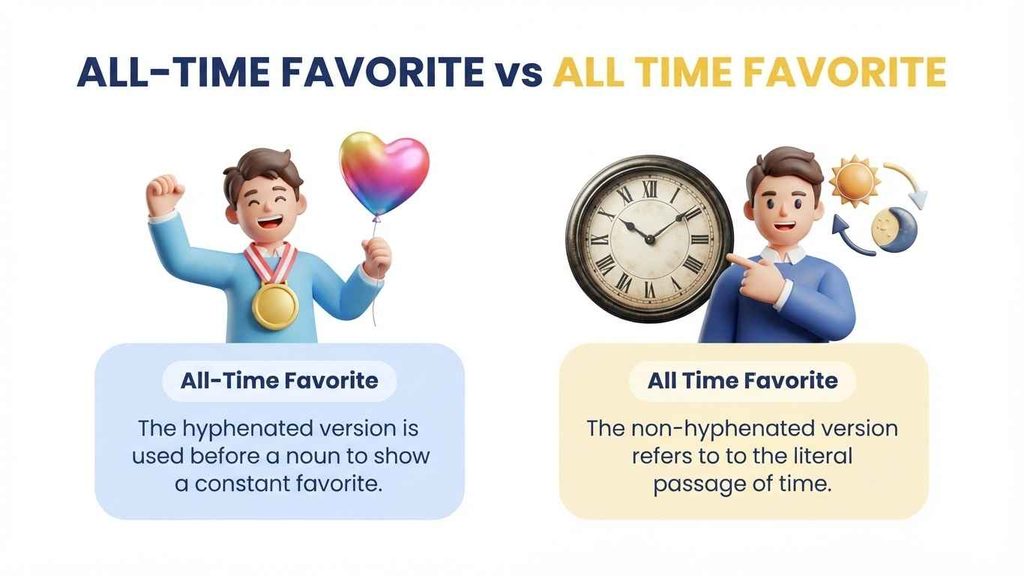
Pizza is my all-time favourite food, but every time I type that sentence, I freeze for a second. Is the hyphen supposed to be there? Should “time” even be singular? If you have ever paused mid-sentence wondering the same thing, you are far from alone, and honestly, it is kind of comforting to know so many of us trip over the same tiny phrase.
This article breaks down the all time favourite meaning, the grammar behind it, and exactly when and how to use it with confidence. You will get real examples, quick tables, and answers to the questions people actually type into Google. By the end, you will never second-guess this phrase again, so let’s get into it.
All-Time Favorite or All Times Favorite: Which Is Correct?
This is the question that started it all, and the meaning behind it matters more than most people realize when they type it into a text. All-time favorite is the only grammatically correct version, and once you see why, you will never write it wrong again.
What Makes “All-Time Favorite” the Standard Form?
- The word time must stay singular, never “times.”
- A hyphen is required to join the two describing words.
- The phrase acts as a single compound adjective.
- It works before nouns like movie, song, or meal.
- Dropping the hyphen makes the sentence unclear.
- Native speakers instinctively expect the hyphenated form.
- Style guides consistently favor the hyphenated version.
- Search engines and spellcheckers both flag “all times” as wrong.
Example in texting: Friend 1: is the godfather ur all-time favorite movie fr? Friend 2: 100%, nothing else has ever come close
What Does “All-Time Favorite” Really Mean?
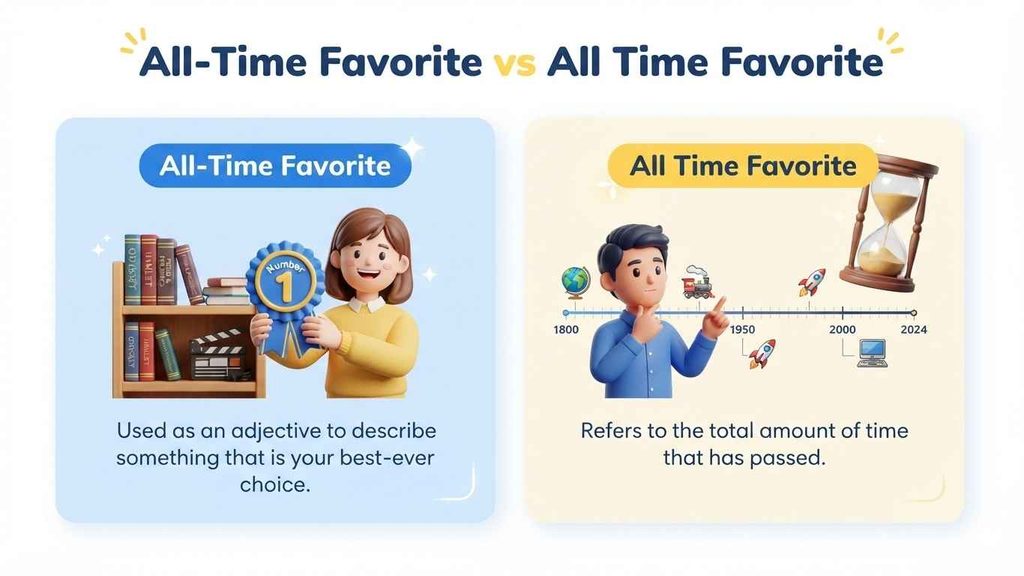
People search this exact question daily, and the meaning is simpler than it sounds. Your all-time favorite is the one thing, ever, that beats everything else you have loved.
Understanding the Core Idea Behind the Phrase
- It points to your number one pick, period.
- It is not about what you like right now.
- It covers your entire lifetime of experiences.
- It applies to movies, songs, foods, people, and places.
- It signals something has stayed unbeaten over time.
- It is more emotional than a simple preference.
- It works the same whether spoken casually or written formally.
Example in chat: Friend 1: what’s ur all-time favorite show, no thinking just answer Friend 2: friends. always has been, always will be
Why Is “All-Time Favorite” the Correct Usage?
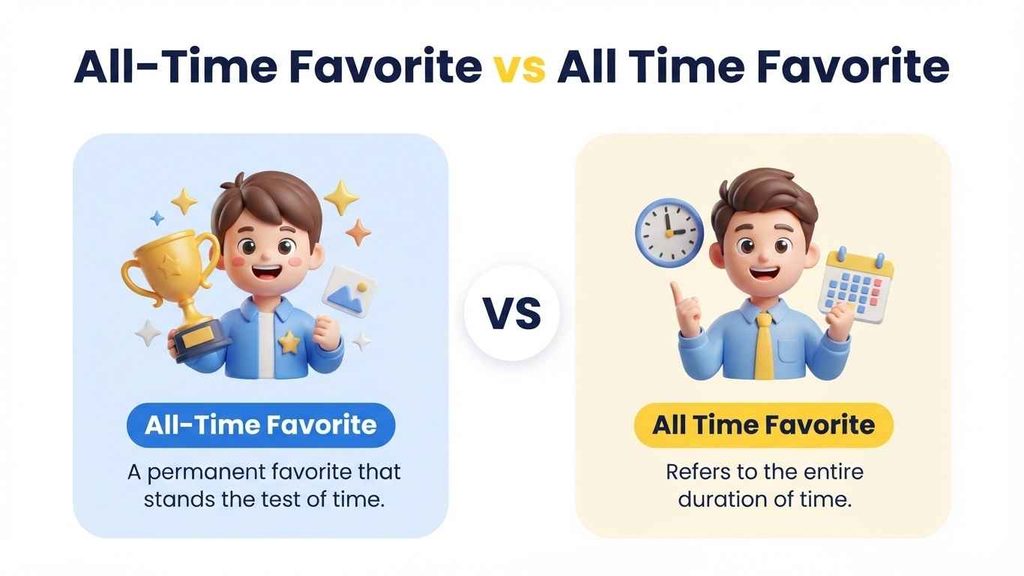
Grammar rules can feel dry, but this one has a clear, human logic behind it, and the all time favourite meaning only makes sense once you understand the compound adjective rule properly.
How Compound Adjectives Shape This Phrase
- Two words joining to describe a noun need a hyphen.
- “All” and “time” merge into one describing unit.
- Removing the hyphen breaks the modifier’s job.
- English generally keeps such compounds in singular form.
- “All times favorite” reads as grammatically broken.
- The rule stays constant across formal and casual writing.
- Editors and teachers will always correct the unhyphenated version.
| Correct Form | Incorrect Form | Why |
| all-time favorite | all times favorite | wrong plural, missing hyphen |
| my all-time favorite song | my all time favourite song | missing hyphen |
| her all-time favorite meal | her all-times favorite meal | plural “times” is wrong |
Example in texting: Friend 1: wait is it “all time” or “all-time” favorite lol Friend 2: all-time, with the dash, always
The Meaning Behind “All-Time Favorite” Explained
Beyond grammar, this phrase carries real emotional weight, and understanding its meaning helps you use it with more intention the next time you talk about something you truly love.
What This Phrase Communicates Emotionally
- It shows deep, lasting attachment to something.
- It ranks above every temporary trend or obsession.
- It reflects a choice made across years, not days.
- It carries more weight than saying you simply “like” something.
- It often gets used when people feel nostalgic.
- It works for people, memories, books, and even smells.
- It tells others something genuinely matters to you.
Example in chat: Friend 1: honestly bohemian rhapsody is my all-time favorite song Friend 2: same energy, that song never gets old
Simple Breakdown Table
Sometimes a quick visual clears up confusion faster than paragraphs ever could, and this table lays the all-time favorite rule out in the simplest way possible.
A Fast Way to Check Your Own Sentences
- Hyphen goes between “all” and “time,” always.
- Time stays singular, never becomes “times.”
- The phrase sits before the noun it describes.
- Both American and British spellings follow the same rule.
- Texting slang can skip the hyphen, formal writing cannot.
- The phrase never changes meaning across dialects.
- Consistency across your own writing is what matters most.
| Element | Rule | Example |
| Hyphen | Required | all-time favorite |
| “Time” | Singular only | not “all times” |
| Position | Before the noun | all-time favorite movie |
| Spelling | US vs UK | favorite / favourite |
| Casual use | Hyphen optional | all time fav |
Common Mistakes People Make With “All-Time Favorite”
Even confident writers slip up here, and knowing the meaning behind each mistake makes it much easier to catch yourself before hitting send or submit.
Where This Phrase Usually Goes Wrong
- Writing “all times favorite” instead of the singular form.
- Forgetting the hyphen in formal essays or emails.
- Mixing American and British spelling in the same document.
- Using the phrase for something only liked briefly.
- Placing it awkwardly after the noun instead of before.
- Overusing it until it loses its emotional impact.
- Confusing it with “favorite of all time,” a different structure.
Example in texting: Friend 1: is it wrong if i write all time favorite no hyphen Friend 2: yeah technically, but nobody’s grading ur texts lol
Using “All-Time Favorite” in Different Situations
Once you know the rule, the fun part is actually using it, and the all-time favorite meaning shifts slightly depending on what you are describing in the moment.
Everyday Places This Phrase Shows Up
- Movies: your all-time favorite film you rewatch yearly.
- Music: the one song you never skip on shuffle.
- Food: a dish nothing else has ever topped.
- Books: a story you recommend to everyone you meet.
- Holidays: the celebration you look forward to most.
- People: a teacher, friend, or family member you cherish.
- Memories: a single moment that outshines every other one.
| Category | Example Sentence |
| Movie | The Godfather is his all-time favorite movie. |
| Song | Bohemian Rhapsody is her all-time favorite song. |
| Food | Karahi is my all-time favorite meal, hands down. |
| Holiday | Thanksgiving is our all-time favorite holiday. |
Example in chat: Friend 1: what’s ur all-time favorite holiday, be honest Friend 2: eid, no contest, the food alone wins it
Why Do People Get Confused Between “All Time” and “All-Time”?
This mix-up trips up even careful writers, and the meaning genuinely does shift depending on whether that tiny hyphen is sitting there or missing.
The Real Difference Between the Two Forms
- “All-time” describes a noun, like favorite or record.
- “All time” without a hyphen can stand alone differently.
- “All time” alone often means throughout history generally.
- The hyphen changes the phrase from description to modifier.
- Autocorrect sometimes strips the hyphen without you noticing.
- Reading the sentence aloud can reveal the missing hyphen.
- Context almost always makes the intended meaning obvious anyway.
Example in texting: Friend 1: so is “all time” ever correct without the dash Friend 2: only if it’s not directly describing “favorite” right after
What About “All Time Fav” and “All Time Fave”?
Texting culture bends the rules a little, and understanding this casual meaning helps you know when it is fine to relax the grammar and when it really is not.
When Shortened Slang Versions Are Acceptable
- “All time fav” works fine in texts and DMs.
- “Fave” is simply slang shorthand for favorite.
- Neither version needs the hyphen in casual chat.
- Formal writing should still use the full phrase.
- Social media captions tolerate the shortened forms easily.
- Job applications and essays should avoid the slang entirely.
- The shortened form still carries the same emotional weight.
Example in chat: Friend 1: pizza is legit my all time fav, no debate Friend 2: same, could eat it literally every single day
How to Use “All-Time Favorite” in Writing and Speech
Knowing the rule is one thing, applying it naturally is another, and this section shows exactly how the all-time favorite phrase fits into real, everyday communication.
Practical Ways to Apply This Phrase Correctly
- Place it directly before the noun it describes.
- Use “my,” “her,” or “his” before the phrase.
- Keep the hyphen in every formal document you write.
- Pair it with a reason to add emotional context.
- Avoid stacking it with other superlatives unnecessarily.
- Use it sparingly so it keeps its special meaning.
- Read your sentence aloud to catch missing hyphens.
Example in texting: Friend 1: how do i even use “all-time favorite” in an essay Friend 2: just write “my all-time favorite author is…” then explain why
American vs British English: Usage of “All-Time Favorite”
Spelling differences confuse plenty of writers, but the meaning of this phrase never actually changes between American and British English, no matter which version you choose.
How Spelling Changes Without Changing Meaning
- Americans write favorite, without the extra “u.”
- British English uses favourite, following its usual spelling pattern.
- The hyphen rule applies identically in both dialects.
- Neither version allows the plural “times” form.
- Choosing one spelling and sticking with it looks more professional.
- Mixing spellings within one document looks inconsistent.
- Readers in both regions understand either spelling instantly.
| Region | Spelling | Example |
| American English | favorite | all-time favorite song |
| British English | favourite | all-time favourite song |
| Meaning | Identical | top choice, no matter when |
Example in chat: Friend 1: do brits actually spell it favourite with a u Friend 2: yep, all-time favourite, still means the exact same thing
Is “All-Time Favourite” the Same as “All-Time Favorite”?
This question pops up constantly, and the short answer protects the all time favourite meaning completely, regardless of which spelling shows up on your screen.
Clearing Up the Spelling Confusion for Good
- Both spellings mean the exact same thing.
- Only the letter “u” separates the two versions.
- Neither spelling changes the grammar rule around it.
- Pick the spelling that matches your target audience.
- UK, Australian, and Canadian readers expect “favourite.”
- US readers expect “favorite” without the extra letter.
- Sticking with one choice keeps your writing polished.
Example in texting: Friend 1: is favourite with a u even correct spelling Friend 2: yeah it’s just the british version, same meaning tho
Alternative Ways to Say “All-Time Favorite”
Repeating the same phrase gets stale fast, and knowing a few alternatives keeps your writing fresh while still capturing the same meaning you are going for.
Fresh Phrases That Carry the Same Weight
- “Timeless classic” for movies, music, or literature.
- “Perennial favorite” for something loved across many years.
- “Number one pick” for a quick, casual alternative.
- “Go-to choice” for something you consistently return to.
- “Top of the list” for a simple, clear swap.
- “Forever favorite” for a warmer, more emotional tone.
- “Gold standard” when comparing against everything else.
| Alternative Phrase | Best Used For |
| Timeless classic | Movies, music, literature |
| Perennial favorite | Long-term preferences |
| Number one pick | Casual conversation |
| Forever favorite | Emotional, personal context |
Example in chat: Friend 1: is there another way to say all-time favorite so i don’t repeat it Friend 2: try “timeless classic” or “forever favorite,” both work great
Examples of “All-Time Favorite” in Pop Culture
Pop culture loves this phrase, and seeing it in real context makes the all-time favorite meaning click even faster than reading definitions ever could.
Where You’ll Spot This Phrase Most Often
- Music charts calling a song an all-time favorite hit.
- Film critics naming an all-time favorite classic movie.
- Sports fans debating their all-time favorite player.
- Cookbooks labeling a recipe someone’s all-time favorite dish.
- Magazines ranking all-time favorite albums of a decade.
- Fans online arguing over their all-time favorite show finale.
- Interviews where celebrities share their own all-time favorite memories.
Example in texting: Friend 1: the magazine ranked queen as an all-time favorite band again Friend 2: honestly deserved, they never miss
Quick Reference Table
For anyone who just wants the short version, this table sums up the entire all time favourite meaning discussion in one quick, scannable glance.
Your One-Stop Grammar Cheat Sheet
- Correct: all-time favorite (hyphen, singular “time”).
- Incorrect: all times favorite (plural, no hyphen).
- Casual: all time fav or all time fave.
- British: all-time favourite, same meaning as American.
- Placement: always directly before the noun.
- Tone: emotional, lasting, above every other option.
- Rule: never changes across formal or casual writing.
| Form | Status | Notes |
| all-time favorite | Correct | Standard American form |
| all-time favourite | Correct | Standard British form |
| all times favorite | Incorrect | Wrong plural, no hyphen |
| all time fav | Casual | Fine for texting only |
FAQs
What is the all time favourite meaning?
It means the one thing you love most, above everything else, forever. It’s your permanent number one pick, not a passing trend.
Is “all-time favorite” always hyphenated?
Yes, in formal writing the hyphen is required. Casual texting sometimes drops it, but the correct grammar form always keeps it.
Can I say “all time favorite” without a hyphen?
You can in texts, but it’s technically incorrect. Your all-time favorite phrase needs the hyphen in essays, emails, or professional writing.
Is “all times favorite” ever correct?
No, this form is always wrong. Your all-time favorite should never use the plural “times” under any circumstance at all.
Does British English change the meaning?
No, “all-time favourite” means exactly the same as the American spelling. Only the letter “u” separates these two identical, correct forms.
What’s a good synonym for “all-time favorite”?
Try “timeless classic” or “perennial favorite” instead. Both phrases capture the all-time favorite feeling without repeating the exact same wording.
Why do people mix up “all time” and “all-time”?
Autocorrect and casual habits often drop the hyphen unnoticed. Remembering your all-time favorite always needs that hyphen solves the confusion instantly.
Conclusion
So, the next time you catch yourself typing “all time favorite” without that little hyphen, you’ll know exactly why it matters. The all time favourite meaning really is simple once it clicks: it’s your number one pick, forever, no contest. Your all-time favorite movie, song, or meal deserves the correct grammar just as much as it deserves your love.
Getting the hyphen right, keeping “time” singular, and choosing your spelling based on your audience are all small habits that add up. Whether you write favorite or favourite, the meaning behind it never changes. So go ahead, tell someone about your all-time favorite thing today, and write it with confidence this time.

Amelia Brooks is a US-based author known for inspiring stories on meaning, growth, and hope, blending insight with simple, engaging storytelling.