You hit send, then freeze. Did that sound too pushy, or too soft? We have all stared at a draft wondering if at your earliest convenience sounds polite or quietly demanding, especially when a deadline is already breathing down your neck. Why does one phrase feel so loaded?
This guide explains the meaning of at your earliest convenience, shows when it works, and gives you 11 smart alternatives with real examples. You will also learn how to respect the other person’s convenience without losing urgency. It matters because tone shapes trust. Keep reading, and your next request will land perfectly.
Earliest Convenience
Ever wondered why two words carry so much weight? Earliest convenience sits at the heart of at your earliest convenience, and your convenience is what makes the request sound polite.
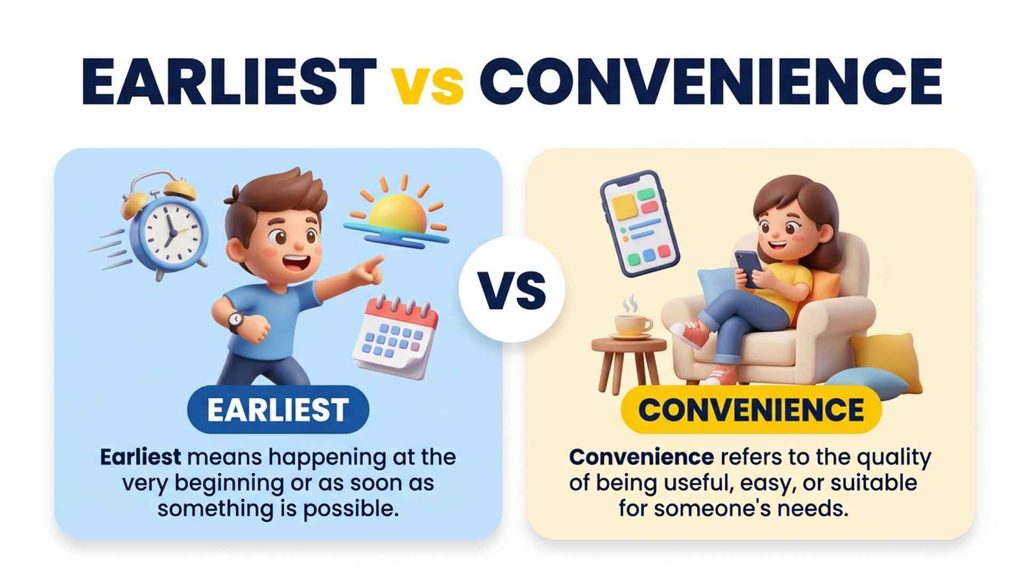
The phrase earliest convenience blends two ideas: speed and courtesy. “Earliest” signals urgency, while “convenience” hands the timing back to the reader. Together they form a polite request that expects action soon, without sounding like a demand. That balance explains why it appears in so much business correspondence.
What Does “Earliest Convenience” Actually Signal?
- Speed matters, but the reader keeps some control over timing.
- Courtesy softens the request without removing the deadline.
- Formality makes it common in letters, emails, and legal notices.
- Expectation of action within days, not weeks, is usually implied.
- Ambiguity can cause delays when no real date is given.
- Context decides whether it sounds warm or quietly pushy.
| Word | Role | Effect |
| Earliest | Speed signal | Suggests urgency |
| Convenience | Courtesy signal | Gives the reader control |
| At your | Politeness frame | Softens the ask |
Example in chat: Friend 1: “Can you send me the invoice at your earliest convenience?” Friend 2: “Sure, I’ll get it over to you this afternoon.”
As Soon as Possible
Need something fast without sounding rude? As soon as possible is the classic swap for at your earliest convenience, and it keeps the convenience of both sides firmly in mind.
This phrase works almost everywhere, from a formal email to a quick Slack message. It names the timeframe clearly, shows urgency, and keeps your professional tone intact. Because it feels familiar, readers rarely take offense, which makes it a dependable synonym for the longer, more ceremonial phrase.
How Do You Use As Soon as Possible in a Sentence?
- Place it at the end of the request for a natural flow.
- Add a polite “please” to keep the tone friendly.
- Pair it with a date when the deadline is firm.
- Avoid repeating it more than once in a single email.
- Choose it for clients, teammates, and managers alike.
- Replace it with ASAP only in casual or fast chats.
| Phrase | Urgency | Best For |
| At your earliest convenience | Medium | Formal emails |
| As soon as possible | High | Everyday work requests |
| Whenever you can | Low | Casual favors |
Example in chat: Friend 1: “Can you review my slides as soon as possible? The meeting is at noon.” Friend 2: “Yes, I’ll send my notes within the hour.”
As Quickly As Possible
Sometimes soon is not soon enough. As quickly as possible pushes the pace a little harder than at your earliest convenience, so use it when your reader’s convenience can wait.
Where “soon” leaves room for interpretation, “quickly” speaks to the pace of the work itself. It asks the reader to prioritize your task and move fast. That makes it perfect for tight deadlines, time-sensitive requests, and moments when waiting would delay an important outcome.
When Is As Quickly As Possible the Better Choice?
- Use it when delays could cost money or trust.
- Pick it for time-sensitive tasks with a visible deadline.
- Soften it with “please” so it feels like a request.
- Skip it when the reader is already overloaded.
- Explain why speed matters to earn goodwill.
- Combine it with a thank-you to protect the relationship.
Example in chat: Friend 1: “Can you book the venue as quickly as possible? Prices go up tonight.” Friend 2: “On it. I’ll call them right now.”
At The Earliest Opportunity
Want a gentle nudge that still sounds professional? At the earliest opportunity is a close cousin of at your earliest convenience, trading personal convenience for a simple sense of timing.
Many people see this phrase as the formal cousin of “when you can.” It sounds courteous, official, and a bit old-fashioned, which suits legal letters, customer service, and government forms. It signals timing without pressure, which helps you keep a calm, respectful tone.
Where Does At the Earliest Opportunity Sound Most Natural?
- Use it in letters, notices, and polished business emails.
- Pair it with a clear action, like “reply” or “confirm.”
- Expect a response within a few working days.
- Avoid it in quick chats where it sounds stiff.
- Keep the sentence short so the request stays clear.
- Match it with a courteous closing line.
Example in chat: Friend 1: “Please confirm your booking at the earliest opportunity.” Friend 2: “Done! I just sent the confirmation to your inbox.”
At Your Convenience
Dropping one word changes everything. At your convenience sounds softer than at your earliest convenience, because it removes the hurry and leaves the convenience entirely in the reader’s own hands.
Without the word “earliest,” the request loses its time pressure. It becomes an open invitation: act when it suits you. That makes it a softer and more flexible option for non-urgent tasks, scheduling, and follow-ups where you value goodwill more than speed.
What Is the Difference Between At Your Convenience and At Your Earliest Convenience?
- Earliest adds urgency, while the shorter phrase adds flexibility.
- Deadlines feel firmer with the longer, more pointed version.
- Customer-facing teams often prefer the softer form.
- Appointments are commonly offered “at your convenience.”
- Vague timing can slow replies without a clear date.
- Both phrases stay polite when written with care.
| Phrase | Meaning | Urgency |
| At your convenience | Whenever it suits you | Low |
| At your earliest convenience | As soon as you can | Medium |
| As soon as possible | Right away | High |
Example in chat: Friend 1: “Call me at your convenience, there’s no rush today.” Friend 2: “Perfect, I’ll ring you after lunch.”
Whenever You Can
Picture asking a busy friend for a favor. Whenever you can feels relaxed where at your earliest convenience feels formal, and it respects their convenience while keeping the request light.
This friendly phrase belongs to everyday conversation. It feels warm, casual, and low pressure, which helps when you are asking colleagues, friends, or family. Although it sounds relaxed, it still carries a gentle implied expectation that the task will happen soon.
Is Whenever You Can Too Casual for Work Emails?
- Use it with teammates you already know well.
- Avoid it with senior leaders or new clients.
- Add a soft deadline if timing actually matters.
- Keep the tone light, warm, and encouraging.
- Swap it for “when you have a moment” in semi-formal notes.
- Remember that low urgency may lead to slower replies.
Example in chat: Friend 1: “Can you send me that photo whenever you can?” Friend 2: “Sure, I’ll dig it up tonight.”
When It Pleases You
Here is a phrase that sounds straight out of an old letter. When it pleases you is gentler than at your earliest convenience, though its convenience angle feels quite dated.
Rooted in old-fashioned English, this phrase sounds courtly and gracious. It passes control completely to the reader, which makes it gentle but also vague. Today you will mostly see it in formal letters, period dramas, or playful writing rather than in modern, fast-moving offices.
Does When It Pleases You Still Work in Modern English?
- Reserve it for ceremonial or very polite occasions.
- Expect some readers to find it slightly theatrical.
- Avoid it when a firm deadline is attached.
- Try it in invitations, thank-you notes, and speeches.
- Replace it with “when you’re able” for modern emails.
- Use humor carefully so the tone stays kind.
Example in chat: Friend 1: “Reply to the invitation when it pleases you, my friend.” Friend 2: “Ha, very fancy! I’ll answer tomorrow.”
What Does At Your Earliest Convenience Really Mean?
Let us settle the question once and for all. The meaning of at your earliest convenience is simple: please act soon, whenever your convenience allows, but do not wait forever.
Think of it as a courteous deadline. It tells the reader to act promptly, without delay, at the first practical moment. It never names a date, so it feels soft, yet the word “earliest” quietly adds pressure. That mix of politeness and urgency is its real definition.
How Quickly Should You Respond to At Your Earliest Convenience?
- Reply within one or two business days whenever possible.
- Acknowledge the message quickly, even if full action takes longer.
- Ask for clarification if the timeline feels unclear.
- Avoid waiting weeks, because that can seem careless.
- Offer a realistic date when you cannot act at once.
- Treat it as a request, never an insult.
| Situation | Expected Response Time | Tone |
| Customer email | 1 to 2 business days | Polite |
| Manager request | Same or next day | Professional |
| Friend favor | Within a few days | Relaxed |
Example in chat: Friend 1: “Please review the contract at your earliest convenience.” Friend 2: “Got it. I’ll read it tonight and reply tomorrow.”
If You Don’t Mind
Politeness can be a strategy. If you don’t mind softens a request more than at your earliest convenience, though it carries less urgency and puts your reader’s convenience firmly first.
This phrase is a verbal cushion. It softens a request by asking for permission first, which makes it feel respectful and considerate. You will hear it mostly in spoken English, face-to-face conversations, and polite requests, where tone of voice carries extra warmth.
When Should You Say If You Don’t Mind?
- Use it when asking for a small favor.
- Pair it with “please” for extra courtesy.
- Avoid it in written deadlines because it feels uncertain.
- Expect a polite yes when the request is reasonable.
- Watch your tone, since sarcasm can change the meaning.
- Switch to a firmer phrase when time is short.
Example in chat: Friend 1: “If you don’t mind, could you send me the notes?” Friend 2: “Not at all, sending them over now.”
As Soon As You Get A Chance
Friendly, flexible, and a little casual. As soon as you get a chance works when at your earliest convenience feels too stiff and you still want to respect their convenience.
Flexible and kind, this phrase assumes the reader is busy and trusts them to find a free moment. It suits team chats, friendly emails, and casual follow-ups. Because it acknowledges the other person’s schedule, it often feels thoughtful and less demanding than harder-edged alternatives.
How Do You Ask Politely As Soon As You Get a Chance?
- Start with a friendly greeting before the request.
- Add one clear task so nothing gets missed.
- Mention the reason, which helps people prioritize.
- Say thank you before they even reply.
- Offer help if the task looks complicated.
- Keep the whole message short and warm.
Example in chat: Friend 1: “Text me the address as soon as you get a chance.” Friend 2: “Just found it. Sending it now!”
ASAP
Four letters, zero patience. ASAP is the shortest stand-in for at your earliest convenience, but it trades a little convenience and courtesy for speed, so choose your moment very carefully.
ASAP is an acronym that most people know instantly. It is concise, direct, and widely understood in workplace communication. However, it can sound abrupt or stressful because it removes the soft wrapping of polite phrasing, so tone, context, and relationship matter.
Is It Rude to Write ASAP in an Email?
- Use it with close colleagues who value speed.
- Avoid it with clients or people you barely know.
- Add “please” so the request feels respectful.
- Explain the reason behind the urgency.
- Spell out “as soon as possible” in formal letters.
- Skip it if every message becomes an emergency.
Example in chat: Friend 1: “Can you send the file ASAP? I’m presenting soon.” Friend 2: “Sending it now, give me two minutes.”
When Should You Use At Your Earliest Convenience?
Timing is everything. Knowing when to use at your earliest convenience keeps your tone professional, protects the reader’s convenience, and avoids sounding vague when a deadline is what you need.
The sweet spot is professional communication where you want action soon but do not want to sound bossy. It works for follow-ups, document requests, appointments, and polite reminders. When urgency is high, a specific deadline will always outperform a vague phrase.
What Situations Call for At Your Earliest Convenience?
- Request documents, signatures, or confirmations from busy people.
- Follow up on an unanswered message without sounding sharp.
- Schedule a call or meeting with a client.
- Invite feedback on a draft or proposal.
- Remind someone gently about an overdue payment.
- Close a formal letter with a polite call to action.
| Situation | Good Fit? | Better Option |
| Overdue invoice | Yes | Add a due date |
| Urgent emergency | No | As soon as possible |
| Casual favor | No | Whenever you can |
Example in chat: Friend 1: “Please send the signed form at your earliest convenience.” Friend 2: “Will do. You’ll have it by Thursday.”
Expedite
Short, sharp, and business-like. Expedite shifts the focus from the reader’s convenience to the task itself, making it a stronger option than at your earliest convenience when time is tight.
As a verb, “expedite” means to speed up a process. It is professional, efficient, and common in logistics, customer service, and project management. Instead of asking the person to act, you ask for the process itself to move faster, which feels strong yet neutral.
How Do You Use Expedite in a Professional Request?
- Pair it with a noun: “expedite the order,” “expedite approval.”
- Explain the reason so the request feels fair.
- Thank the team for their extra effort.
- Avoid overusing it, or it loses real force.
- Choose it for shipping, approvals, and urgent paperwork.
- Keep the tone calm, clear, and respectful.
Example in chat: Friend 1: “Could you expedite my refund? The trip is next week.” Friend 2: “Absolutely, I’ll flag it as priority today.”
Sharpish
A little cheeky, very British. Sharpish asks for speed in one word, and it feels less formal than at your earliest convenience, with almost no thought for convenience at all.
Popular in British English, “sharpish” is a colloquial adverb meaning fairly quickly. It sounds informal, playful, and slightly bossy, so it belongs in spoken English and friendly banter. In formal writing, it can look out of place, which makes it risky in official emails.
Can You Use Sharpish in American English?
- Expect confusion because sharpish is rare in American speech.
- Keep it for friends who know British slang.
- Avoid it in contracts, applications, and client emails.
- Pair it with a smile in tone and emoji.
- Choose “quickly” when the audience is international.
- Remember that humor can soften its bossy edge.
Example in chat: Friend 1: “Get here sharpish, the film starts in ten minutes!” Friend 2: “Running now, save me a seat.”
At Your Earliest Convenience in Email Examples
Words land differently in an inbox. Seeing at your earliest convenience inside real emails shows how convenience and urgency work together, and how a clear deadline can strengthen your message.
Seeing a phrase in action beats memorizing rules. Each sample below shows how at your earliest convenience fits into a subject line, opening, or closing. Notice how a clear deadline and a thank-you line keep the message warm, specific, and easy to act on.
What Are Good Email Examples Using At Your Earliest Convenience?
- Subject: “Report review needed at your earliest convenience.”
- Opening: “Could you confirm the schedule at your earliest convenience?”
- Closing: “Please reply at your earliest convenience, and thanks again.”
- Client: “Kindly share the invoice at your earliest convenience.”
- Follow-up: “Just checking in; please update me at your earliest convenience.”
- Add a date such as “by Friday” to remove the guesswork.
| Email Type | Sample Line | Tone |
| Client request | Please send the invoice at your earliest convenience. | Formal |
| Team update | Share your update at your earliest convenience, please. | Friendly |
| Job follow-up | Kindly confirm the interview at your earliest convenience. | Polite |
Example in chat: Friend 1: “Can you sign the form at your earliest convenience?” Friend 2: “Sure, I’ll print it and sign it tomorrow.”
Formal vs Informal Ways to Say At Your Earliest Convenience
Your audience decides your words. Matching at your earliest convenience to the setting protects your tone, and it shows you value the other person’s convenience as much as your schedule.
Register matters. In formal writing, at your earliest convenience sounds polished and respectful. In informal conversation, it can sound stiff or even sarcastic. Matching the phrase to your audience, setting, and relationship keeps your tone of voice natural and your message easy to accept.
How Do You Choose Between Formal and Informal Phrases?
- Check your relationship with the reader first.
- Match the formality of the message you received.
- Choose formal phrases for new clients and senior leaders.
- Switch to casual phrases with trusted teammates and friends.
- Read your message aloud to hear the tone.
- Edit anything that sounds stiff, sharp, or sarcastic.
| Level | Phrase | Where It Fits |
| Formal | At your earliest convenience | Letters, contracts, clients |
| Neutral | As soon as possible | Work emails |
| Informal | Whenever you can | Chats, friends |
| Casual | Sharpish | British banter |
Example in chat: Friend 1: “Should I write ‘at your earliest convenience’ to my boss?” Friend 2: “Yes, but ‘as soon as possible’ is fine for friends.”
Is At Your Earliest Convenience Rude or Passive-Aggressive?
Does it ever feel a bit sharp? Whether at your earliest convenience sounds polite or passive-aggressive depends on tone, timing, and how much real convenience you leave for the reader.
The phrase is usually courteous, yet tone can flip its meaning. When a deadline has already passed, at your earliest convenience may sound like a veiled complaint. Context, word choice, and punctuation decide whether the reader feels respected or quietly pressured.
Why Does At Your Earliest Convenience Sometimes Sound Passive-Aggressive?
- Overdue requests make the polite wording feel sarcastic.
- Repeated use in follow-ups can sound like nagging.
- Cold greetings and short sentences change the mood.
- Missing thank-yous leave the message feeling stiff.
- Add warmth with a friendly opening line.
- Offer help so the reader feels supported, not judged.
Example in chat: Friend 1: “She wrote ‘at your earliest convenience’ three times. Is she upset?” Friend 2: “Probably frustrated. A friendly follow-up would calm things down.”
Common Mistakes With At Your Earliest Convenience
Small slips can undo good intentions. Avoiding common mistakes with at your earliest convenience keeps your request clear, and it also protects the convenience of the person reading your message.
Even simple phrases can trip us up. Writers often add redundant words, use the phrase with vague deadlines, or forget a polite closing. Fixing these grammar, tone, and clarity issues makes your email etiquette sharper and your requests more likely to get a timely reply.
What Mistakes Should You Avoid With At Your Earliest Convenience?
- Skip “at your earliest convenience ASAP”; it contradicts itself.
- Avoid pairing it with an already overdue deadline.
- Never use it for real emergencies.
- Check the spelling of “convenience” before you send.
- Stop repeating it inside one message.
- Add a date whenever timing truly matters.
Example in chat: Friend 1: “I wrote ‘at your earliest convenience, ASAP, please!’ Is that bad?” Friend 2: “Yes, pick one phrase and add a clear date.”
At Your Earliest Convenience Meaning in Business Writing
In the workplace, tone travels. The meaning of at your earliest convenience in business writing is polite urgency, and it works best when you respect the reader’s convenience and workload.
Workplaces run on clear communication. In business writing, at your earliest convenience acts as a courteous nudge that fits cover letters, client emails, meeting requests, and formal notices. Used with care, it builds trust, credibility, and a professional image over time.
How Does At Your Earliest Convenience Work in Business Writing?
- Open with context before making the request.
- State the action you need in one sentence.
- Include a deadline when the task is critical.
- Close with thanks and your contact details.
- Keep paragraphs short for busy readers.
- Proofread carefully to protect your credibility.
Example in chat: Friend 1: “I’ll end my email with ‘reply at your earliest convenience.’ Good?” Friend 2: “Perfect. Add a thank-you and a date.”
FAQs
What does at your earliest convenience mean?
It means please act soon. People use at your earliest convenience to ask politely.
Is at your earliest convenience formal?
Yes, it suits formal emails. At your earliest convenience sounds polished and professional.
Is at your earliest convenience rude?
Not usually. At your earliest convenience turns rude only when tone feels cold.
How soon should I reply to at your earliest convenience?
Aim for two business days. At your earliest convenience implies action within days, not weeks.
What is the difference between at your convenience and at your earliest convenience?
The earliest version adds urgency. Only at your earliest convenience asks for speed.
Can I use at your earliest convenience in text messages?
You can, though it sounds stiff. In texts, at your earliest convenience feels overly formal.
What is a good synonym for at your earliest convenience?
Try as soon as possible. It replaces at your earliest convenience when speed matters.
Conclusion
Language shapes how people feel about our requests. At your earliest convenience is a polite way to say “please act soon,” and now you know its meaning, its limits, and its best uses. Choose it for formal emails, and reach for as soon as possible, whenever you can, or expedite when the situation calls for something different.
The smartest writers pair at your earliest convenience with a clear date, because kindness works best with clarity. Respecting someone’s convenience while naming a deadline builds trust and gets answers faster. Next time you draft a request, read it aloud, picture the reader, and pick the phrase that fits. And remember that at your earliest convenience works best when your tone is warm and your deadline is honest.
Meta Description
At your earliest convenience means “please act soon.” Learn its meaning, polite uses, and 11 smart alternatives for emails and chats.

Amelia Brooks is a US-based author known for inspiring stories on meaning, growth, and hope, blending insight with simple, engaging storytelling.