Have you ever stared at a long word and felt your tongue tie itself in knots? I still remember sounding out “responsibilities” in class and feeling like I had climbed a mountain. Long words can seem scary, yet they become satisfying once you crack the rhythm.
This guide shares clear, accurate 6 syllable words with meanings, tables, and a printable list. Students, teachers, and curious readers will find the 6 syllable words they need here. Knowing them sharpens your reading, writing, and speaking. Keep reading and make long words feel easy.
What Are Some Good 6 Syllable Words?
Some long words feel like tiny adventures, and the best 6 syllable words carry big ideas inside them. Here are the ones worth knowing first, with meanings that make sense.
How Do You Break Down a Long Word Into Syllables?
Every syllable has one vowel sound at its center, so counting vowel sounds is the quickest shortcut. Say the word slowly and tap the table on each beat. Take “bioluminescence”: bi, o, lu, mi, nes, cence. Six taps equal six syllables, no guessing needed.
- Abiogenesis: life arising naturally from non-living matter.
- Bioluminescence: light produced by living things, like fireflies.
- Responsibilities: duties or obligations a person must handle.
- Nationalization: bringing a private industry under government ownership.
- Insubordination: refusing to obey authority or follow orders.
- Excommunication: official exclusion from a religious community.
- Counterrevolution: a movement opposing the changes a revolution brought.
- Parthenogenesis: reproduction from an unfertilized egg.
| Word | Syllable Breakdown | Quick Meaning |
| Abiogenesis | a-bi-o-gen-e-sis | Life from non-living matter |
| Bioluminescence | bi-o-lu-mi-nes-cence | Natural glow in living things |
| Responsibilities | re-spon-si-bil-i-ties | Duties someone must carry out |
| Insubordination | in-sub-or-di-na-tion | Refusal to follow orders |
| Counterrevolution | coun-ter-rev-o-lu-tion | Opposition to a revolution |
| Parthenogenesis | par-the-no-gen-e-sis | Reproduction without fertilization |
Example in texting: Friend 1: “Did you see that glowing jellyfish? Apparently it’s called bioluminescence.” Friend 2: “Say that three times fast. I can barely get through it once.”
Two other rare entries deserve a mention. “Abarticulation” is an old term for a dislocated joint, and “abolitionary” describes anything related to abolition. Together, these examples show how a single six-beat word can hold a whole concept, from biology to politics to everyday duty.
Printable PDF List of 6 Syllable Words
Nothing beats a sheet on your desk when new vocabulary refuses to stick. A printable list of 6 syllable words turns practice into something real you can hold, words included.
How Can You Use a Printable List of 6 Syllable Words?
Copy the complete list at the end of this guide into a document, then print it on one page. Stick it on a fridge, a desk, or the inside of a notebook. Short, repeated glances build vocabulary faster than one long cram session.
- Copy the complete list into any word processor or notes app.
- Print it single-sided so you can mark words you already know.
- Highlight words you struggle to pronounce, then revisit them weekly.
- Cut the page into cards for quick flashcard drills.
- Laminate a copy for classroom walls and shared reading corners.
Example in chat: Friend 1: “Can you send me that long-word sheet before class?” Friend 2: “Printing it now. I’m taping the hard ones above my desk.”
Shortest 6 Syllable Words
Long does not always mean huge. Among 6 syllable words, some are surprisingly compact, and these shorter words are the perfect place to start building real confidence with long vocabulary.
Which 6 Syllable Words Are the Easiest to Say?
The shortest examples run only eleven or twelve letters, yet they still hold six full beats. Because many end in familiar suffixes like “-ity,” your mouth quickly learns the pattern. Start here before tackling the heavy scientific terms later in this guide.
- Familiarity: knowing something well because you have met it often.
- Reliability: the quality of being dependable and consistent.
- Megalomania: an obsessive belief in your own power or importance.
- Abecedarius: an alphabetical arrangement, or a person learning the alphabet.
- Invisibility: the state of being impossible to see.
- Divisibility: the ability to be divided without a remainder.
- Adaptability: how easily someone adjusts to new conditions.
- Bilaterality: having two sides, as in bilateral symmetry.
| Word | Letters | Syllable Breakdown |
| Familiarity | 11 | fa-mil-i-ar-i-ty |
| Reliability | 11 | re-li-a-bil-i-ty |
| Megalomania | 11 | meg-a-lo-ma-ni-a |
| Abecedarius | 11 | a-be-ce-dar-i-us |
| Invisibility | 12 | in-vis-i-bil-i-ty |
| Divisibility | 12 | di-vis-i-bil-i-ty |
| Adaptability | 12 | a-dapt-a-bil-i-ty |
| Bilaterality | 12 | bi-lat-er-al-i-ty |
Example in texting: Friend 1: “Our new manager’s biggest strength is reliability.” Friend 2: “Honestly, that’s the best compliment a coworker can get.”
Longest 6 Syllables Words
Some 6 syllable words stretch across the page like a train that never ends. They look intimidating, but these long words are technical, precise, and absolutely worth learning and practicing.
Which Long Words Still Have Only Six Syllables?
Length in letters and length in syllables are two different things. A word can sprawl across seventeen letters and still have six beats. Most of the longest examples come from medicine, science, and law, where precise terminology matters more than short spelling.
- Maladministration: poor or dishonest management of an organization or system.
- Pharyngealization: pronouncing a sound with the throat narrowed.
- Ultraconservative: extremely resistant to change or new ideas.
- Photocomposition: setting type using photographic methods.
- Undiscriminating: lacking good judgment or taste in choosing.
- Acclimatization: adjusting to a new climate or environment.
- Discombobulated: confused, flustered, and thrown off balance.
- Immunoglobulin: an antibody protein that helps the body fight infection.
| Word | Letters | Field |
| Maladministration | 17 | Law and government |
| Pharyngealization | 17 | Phonetics |
| Ultraconservative | 17 | Politics |
| Photocomposition | 16 | Printing |
| Undiscriminating | 16 | Everyday description |
| Acclimatization | 15 | Biology and travel |
| Discombobulated | 15 | Casual speech |
| Immunoglobulin | 14 | Medicine |
Example in chat: Friend 1: “After that flight, I was completely discombobulated.” Friend 2: “Give yourself a day for acclimatization before you decide anything.”
6 Syllable Words For Kindergarten
Little learners love big sounds, and clapping out 6 syllable words feels like a game. Young kids may not read these words yet, but they can absolutely enjoy saying them.
How Can Kids Practice Long Words at Home?
Children learn long words by chunking them into small pieces. Let them clap each beat, whisper it, then shout it. This builds phonemic awareness, which supports later reading and spelling. Keep sessions short, playful, and free of pressure so the habit feels fun.
- Clap each syllable together before saying the whole word.
- Stomp the beats while walking around the room for movement.
- Draw a picture for words like astrobiology or valedictorian.
- Sing the word slowly, one note per syllable.
- Reward effort with stickers rather than perfect pronunciation.
- Read a science picture book aloud and point out long words.
Kid-friendly examples include superiority, astrobiology, unconditionally, misappropriation, accessibility, disorganization, impossibility, valedictorian, and disqualification.
Example in chat: Friend 1: “My daughter just said ‘astrobiology’ perfectly. She’s five!” Friend 2: “Wow, she’ll be reading space books before first grade.”
6 Syllable Words About Nature
Nature has a name for everything, and many names run long. These 6 syllable words describe animals, weather, and living systems, and each of these words paints a vivid picture.
Which Science Words Describe Nature?
Biology and earth science borrow heavily from Greek and Latin roots, which is why their terms stretch so long. Learning one root word unlocks many others. “Bio” means life, so you will spot it in bioluminescence, biodegradable, and astrobiology. Scientists also coin new terms whenever they find something unnamed, which is why nature vocabulary keeps getting longer and why curious readers rarely run out of fresh examples to learn.
- Ovoviviparous: animals whose eggs hatch inside the mother’s body.
- Basidiolichen: a lichen formed with a basidiomycete fungus.
- Interplanetary: existing or traveling between planets.
- Acetification: the process of turning into vinegar.
- Acidification: becoming more acidic, as ocean water can.
- Humidification: adding moisture to the air.
- Biodegradable: able to be broken down naturally by living organisms.
- Parthenogenesis: development of offspring from an unfertilized egg.
| Word | Field | Where You May See It |
| Ovoviviparous | Zoology | Sharks and some snakes |
| Interplanetary | Astronomy | Space missions |
| Acidification | Ecology | Ocean and soil studies |
| Humidification | Weather and home | Air quality discussions |
| Biodegradable | Environment | Packaging and waste labels |
| Parthenogenesis | Biology | Certain insects and reptiles |
Example in texting: Friend 1: “Are these shopping bags biodegradable?” Friend 2: “Yes, the label says they break down naturally in soil.”
6 Syllable Words To Describe Someone
Describing a person well takes the right vocabulary. These 6 syllable words pack personality, beliefs, and attitude into a single term, and they make your words feel much more precise.
How Do You Describe a Person With Advanced Vocabulary?
Strong descriptions rely on adjectives and nouns that capture character in one breath. Instead of saying someone never changes their mind, you could call them ultraconservative. Use these terms carefully, since some carry strong connotations that may sound harsh in conversation.
- Unapologetic: refusing to feel or show regret for one’s actions.
- Irremediable: impossible to fix, cure, or correct.
- Authoritarian: demanding strict obedience and discouraging personal freedom.
- Ultraconservative: strongly opposed to change and traditional in outlook.
- Egalitarian: believing everyone deserves equal rights and opportunities.
- Utilitarian: focused on usefulness and practical benefit.
- Agriculturalist: a person skilled in farming and crop science.
- Valedictorian: the top-ranking student who gives the graduation speech.
| Word | Part of Speech | Describes |
| Unapologetic | Adjective | Someone who feels no regret |
| Irremediable | Adjective | A problem that cannot be fixed |
| Authoritarian | Adjective or noun | A strict, controlling leader |
| Egalitarian | Adjective | A fairness-minded person |
| Utilitarian | Adjective | A practical thinker |
| Agriculturalist | Noun | A farming expert |
Example in chat: Friend 1: “Our new coach is totally unapologetic about early practices.” Friend 2: “Sounds authoritarian, but at least the team is improving.”
6 Syllable Words Ending In “-ing”
The “-ing” ending is a handy way to turn actions into ongoing moments. Many 6 syllable words use it, and these words often work as verbs, nouns, or vivid adjectives.
Why Do So Many Long Verbs End in -ing?
English adds “-ing” to a verb stem to show action in progress, which is called the present participle. When a long verb already carries several syllables, that ending can push the total to six. The result sounds formal, but it is simply grammar doing its job.
- Familiarizing: making yourself well acquainted with something new.
- Bioengineering: designing living systems or materials using biology and engineering.
- Undiscriminating: not careful or selective when choosing.
- Emotionalizing: making a topic more emotional or sentimental.
- Rehabilitating: restoring someone or something to good health or condition.
- Misappropriating: dishonestly taking money or property meant for another purpose.
- Dehumidifying: removing moisture from the air.
- Discombobulating: confusing or disturbing someone’s calm.
Example in texting: Friend 1: “I’m spending the weekend familiarizing myself with the new software.” Friend 2: “Good call. It will save you hours next week.”
6 Syllable Sentences
Words are not the only things with six beats. A whole sentence can too, and these short lines show how 6 syllable words and simple words combine in real speech.
What Is a Six-Syllable Sentence?
A six-syllable sentence has exactly six spoken beats, no more and no less. These lines are short enough for poetry practice, speech drills, or a quick pronunciation warm-up. Counting them is a great way to train your ear before you tackle longer vocabulary.
- “I don’t think she was right.” has six syllables.
- “You are the greatest, thanks.” has six syllables.
- “I was working with them.” has six syllables.
- “We were in the airplane.” has six syllables.
- “He was editing it.” has six syllables.
- “Please open the window.” has six syllables.
- “The puppy was sleeping.” has six syllables.
| Sentence | Syllable Breakdown |
| I don’t think she was right. | I-don’t-think-she-was-right |
| You are the greatest, thanks. | you-are-the-great-est-thanks |
| We were in the airplane. | we-were-in-the-air-plane |
| Please open the window. | please-o-pen-the-win-dow |
| The puppy was sleeping. | the-pup-py-was-sleep-ing |
Example in texting: Friend 1: “Please open the window.” Friend 2: “Done. That sentence had exactly six syllables, by the way.”
Complete List Of 6 Syllable Words
Having everything in one place saves time. Here is the full collection of 6 syllable words from this guide, so you can scan, study, and save these words with ease.
How Should You Study a Long Word List?
Break the list into small groups of five or ten and review one group per day. Say each word aloud, tap the syllables, and use it in a sentence. Spaced repetition, meaning short reviews across several days, beats one long session every time.
- Group words by theme, such as science, people, or actions.
- Tap every syllable to confirm the count of six.
- Write one original sentence for each new word you learn.
- Review older words weekly so they stay fresh.
- Test yourself by covering the list and recalling words from memory.
A quick note on accuracy: some popular lists include “gastroenterologist,” “behaviorism,” and “bioinstrumentation.” Those words have seven, four, and seven syllables, so they are left out here.
- Abarticulation
- Abiogenesis
- Abolitionary
- Responsibilities
- Bioluminescence
- Parthenogenesis
- Nationalization
- Insubordination
- Excommunication
- Counterrevolution
- Bilaterality
- Abecedarius
- Megalomania
- Familiarity
- Reliability
- Adaptability
- Invisibility
- Divisibility
- Maladministration
- Acclimatization
- Discombobulated
- Cardiovascular
- Rehabilitation
- Dependability
- Biodegradable
- Accelerometer
- Superiority
- Astrobiology
- Unconditionally
- Misappropriation
- Accessibility
- Disorganization
- Impossibility
- Valedictorian
- Disqualification
- Ovoviviparous
- Basidiolichen
- Immunoglobulin
- Interplanetary
- Photocomposition
- Acetification
- Pharyngealization
- Acidification
- Humidification
- Agriculturalist
- Irremediable
- Unapologetic
- Authoritarian
- Ultraconservative
- Egalitarian
- Utilitarian
- Familiarizing
- Bioengineering
- Undiscriminating
- Emotionalizing
- Rehabilitating
- Misappropriating
- Dehumidifying
- Discombobulating
- Responsibility
- Availability
- Sustainability
- Vulnerability
- Compatibility
- Individuality
- Originality
- Municipality
- Spirituality
- Reorganization
- Industrialization
- Decontamination
- Individualize
- Intellectualize
- Institutionalize
- Operationalize
Example in chat: Friend 1: “I’m learning five new long words every day this month.” Friend 2: “By the end, you’ll have the whole list memorized.”
Easy 6 Syllable Words for Students
School and work already use many long terms. These easy 6 syllable words show up in essays, meetings, and tests, so mastering these words pays off quickly in every class.
Which 6 Syllable Words Do Students Use Most Often?
The friendliest examples end in “-ility,” which makes them predictable to spell and say. Teachers often assign them in vocabulary quizzes because they appear in essays, reports, and academic writing. Learn the ending once and you gain a whole word family at the same time.
- Responsibility: a duty you are expected to handle.
- Availability: whether someone or something is ready to use.
- Sustainability: meeting present needs without harming the future.
- Compatibility: how well two things work together.
- Originality: the quality of being new and creative.
- Individuality: what makes one person different from others.
- Accessibility: how easy something is to reach or use.
- Dependability: being trustworthy and consistent.
| Word | School Subject | Sample Use |
| Responsibility | Civics | Voting is a civic responsibility. |
| Sustainability | Science | Sustainability protects future resources. |
| Compatibility | Technology | Check software compatibility first. |
| Originality | Writing | Teachers reward originality. |
| Individuality | Social studies | Art celebrates individuality. |
Example in texting: Friend 1: “Did you finish the sustainability essay?” Friend 2: “Almost. I’m just polishing the conclusion.”
What Counts as a 6 Syllable Word in English?
People often ask where the line is drawn. A true word of this kind has six distinct vowel beats, and learning that rule makes 6 syllable words easier to recognize.
How Do Dictionaries Define a Syllable?
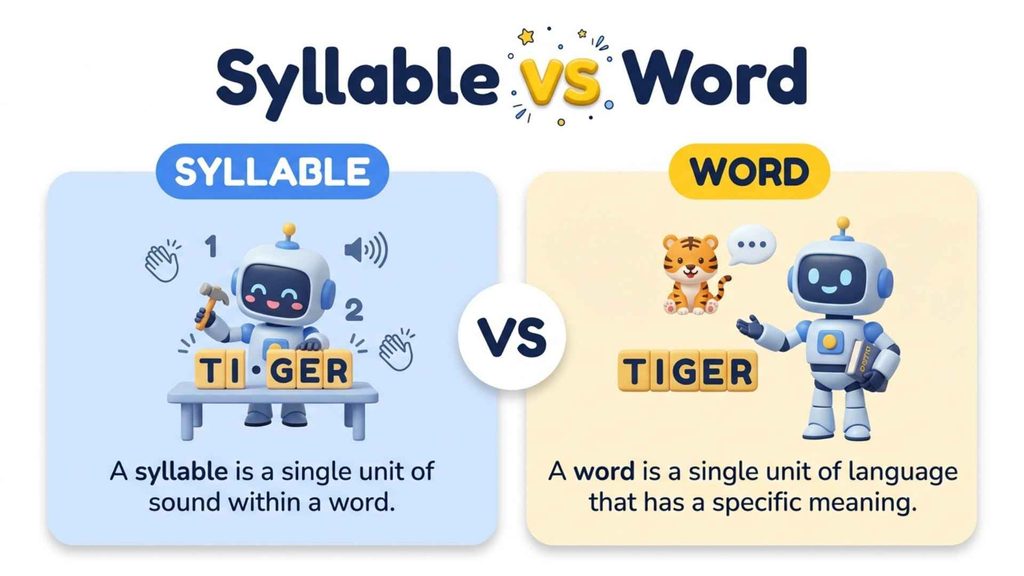
A syllable is a unit of sound built around a vowel, sometimes with consonants before or after it. Dictionaries mark these units with dots or hyphens. When dictionary entries disagree, trust the spoken beat: if your mouth makes six distinct pulses, you have found a six-syllable word.
- Vowel sounds create syllable peaks, not just vowel letters.
- Silent letters do not add syllables, as in “biodegradable.”
- Dictionaries show breaks with dots between each syllable.
- Accent varies by region, so some words shift by one beat.
- Counting aloud is more reliable than counting vowels on paper.
Example in chat: Friend 1: “Is ‘familiarizing’ really six syllables?” Friend 2: “Say it slowly: fa-mil-i-ar-iz-ing. Yep, six beats.”
6 Syllable Words Ending in -ity and -ation
Suffixes are the secret code behind long vocabulary. Two endings in particular produce a huge share of 6 syllable words, and spotting them helps you decode unfamiliar words on sight.
Which Suffixes Create the Most 6 Syllable Words?
The endings “-ity” and “-ation” turn adjectives and verbs into abstract nouns, which are naturally long. Add a prefix like “re-” or “de-,” and the word grows even more. Recognizing these word parts makes spelling and pronunciation far less stressful.
- Vulnerability: being open to harm or emotional exposure.
- Municipality: a town, city, or district with local government.
- Spirituality: a focus on the spirit rather than material things.
- Reorganization: arranging something again in a new structure.
- Industrialization: developing industries on a large scale.
- Decontamination: removing harmful substances from a person or place.
- Nationalization: transferring private assets to government control.
- Disqualification: being ruled ineligible, often in a competition.
| Suffix | Meaning | Six-Syllable Example |
| -ity | Quality or state | Vulnerability |
| -ity | Quality or state | Municipality |
| -ation | Action or result | Reorganization |
| -ation | Action or result | Industrialization |
| -ation | Action or result | Decontamination |
Example in chat: Friend 1: “The company announced a total reorganization.” Friend 2: “Hopefully that means clearer roles for everyone.”
Why Are 6 Syllable Words So Hard to Pronounce?
Long words can feel like tongue twisters. The difficulty is only habit, not talent, and most 6 syllable words become easy once your mouth learns the rhythm of these words.
What Makes Long Words Tricky to Say?
Two things make them hard: syllable stress and unfamiliar sound clusters. English places stress on one beat, and the others soften. If you stress the wrong beat, even a simple word sounds strange. Slow practice, then speed, fixes almost every problem.
- Stress usually falls on the third or fourth beat of long words.
- Chunking the word into two or three parts reduces mental load.
- Listening to a native speaker model the word helps your ear.
- Recording yourself exposes small mistakes you cannot hear live.
- Repeating the word ten times locks in muscle memory.
Example in texting: Friend 1: “I always stumble on ‘responsibilities.’” Friend 2: “Try three chunks: re-SPON-si, bil-i, ties. It gets easier.”
6 Syllable Adjectives, Nouns, and Verbs
Grammar shapes how long words behave in a sentence. Knowing the part of speech helps you use 6 syllable words correctly, and it makes your words feel natural, not forced.
What Parts of Speech Can Long Words Be?
Six-syllable words appear across parts of speech, though nouns dominate. Adjectives often carry the suffixes “-able” or “-ic.” Verbs are rarer and usually end in “-ize.” Even an adverb like “unconditionally” can reach six syllables.
- Adjectives: biodegradable, cardiovascular, unapologetic, irremediable.
- Nouns: accelerometer, immunoglobulin, valedictorian, agriculturalist.
- Verbs: individualize, intellectualize, institutionalize, operationalize.
- Adverbs: unconditionally is a clear six-syllable example.
- Participles: rehabilitating and dehumidifying work as action words.
| Part of Speech | Example | Sample Sentence |
| Adjective | Cardiovascular | She follows a cardiovascular exercise plan. |
| Noun | Accelerometer | The phone contains an accelerometer. |
| Verb | Individualize | Teachers individualize lessons for each learner. |
| Adverb | Unconditionally | They loved him unconditionally. |
Example in chat: Friend 1: “Does this phone have an accelerometer?” Friend 2: “Yes, that’s how it counts your steps.”
How to Count Syllables in 6 Syllable Words
Counting is a skill you can learn in minutes. With a few simple tricks, you can check any suspect word, and that confidence makes 6 syllable words much less scary.
What Is the Easiest Way to Count Syllables?
Use the clap method: say the word at normal speed and clap once per beat. Then try the chin method, resting a hand under your chin and counting how often your jaw drops. Both techniques rely on spoken sound, not spelling, so they work even for strange words.
- Clap once per beat while saying the word aloud.
- Chin drops mark vowel sounds as your jaw opens.
- Split the word at prefixes, roots, and suffixes first.
- Check a dictionary for a final confirmation of the count.
- Ignore silent endings like the “e” in biodegradable.
| Word | Clap Pattern | Total |
| Familiarity | fa-mil-i-ar-i-ty | 6 |
| Cardiovascular | car-di-o-vas-cu-lar | 6 |
| Accelerometer | ac-cel-er-om-e-ter | 6 |
| Rehabilitation | re-ha-bil-i-ta-tion | 6 |
Example in texting: Friend 1: “Quick check: how many syllables in ‘cardiovascular’?” Friend 2: “Clap it out: car-di-o-vas-cu-lar. Six.”
How Can You Learn 6 Syllable Words Faster?
Speed comes from smart habits. A few routines can lock in dozens of 6 syllable words in a month, and these words will start showing up in your own writing.
What Are the Best Ways to Remember Long Words?
Link each new word to a picture, a person, or a story. Context makes memory stick, so use new words in real sentences within a day. Reading widely, especially science and news, exposes you to long vocabulary naturally and repeatedly.
- Read a few pages of science or news every day.
- Connect each word to a vivid image or personal memory.
- Practice using one new word in a sentence daily.
- Teach a friend, because explaining cements your own understanding.
- Revisit your list weekly with short, relaxed review sessions.
- Track your progress in a simple notebook or app.
Example in chat: Friend 1: “I used ‘sustainability’ in my presentation today.” Friend 2: “Nice! New words only stick when you actually use them.”
FAQs
What is the longest 6 syllable word?
Maladministration and pharyngealization are among the longest 6 syllable words, with seventeen letters each. Letter count never changes how many syllables a word has.
How many 6 syllable words are there?
There is no official total, because 6 syllable words keep growing with new technical terms. Most everyday writers only meet a handful regularly.
What are some easy 6 syllable words?
Reliability, responsibility, and accessibility are friendly 6 syllable words used in school and work. Tap each beat aloud to confirm the count.
Are there 6 syllable words for kids?
Yes, kids enjoy 6 syllable words like astrobiology and valedictorian. Clapping the beats turns learning into a playful game.
What are 6 syllable words that end in -ing?
Familiarizing, bioengineering, and rehabilitating are 6 syllable words ending in “-ing.” Each pairs a long root with that familiar ending.
How do you count syllables in 6 syllable words?
Say the word slowly and clap once per vowel beat. This trick works for all 6 syllable words, regardless of spelling.
Is gastroenterologist a 6 syllable word?
No, it has seven syllables, so it falls outside lists of 6 syllable words. The correct split is gas-tro-en-ter-ol-o-gist.
Conclusion
Long vocabulary stops feeling scary once you understand how it works. 6 syllable words follow clear patterns: familiar suffixes, Greek and Latin roots, and a steady rhythm you can clap out. From the shortest examples like “reliability” to the giants like “maladministration,” each one rewards patience and practice.
Remember that 6 syllable words appear everywhere, from science classrooms to everyday conversations, and mastering them builds real confidence. Start small, review often, and use every new word in a sentence of your own. Pick three words from the list today, say them aloud, and write one sentence for each. Do that daily, and you will own all 6 syllable words before you know it.
Meta Description
Master 6 syllable words with meanings, easy syllable breakdowns, and real examples. Build a sharper vocabulary today with this friendly guide.
Keyword Extraction (Reference Only, Not Part of the Article)
LSI and NLP keywords: syllable, six-syllable words, polysyllabic words, multisyllabic words, syllable count, vowel sound, stressed syllable, syllable stress, long words, big words, complex words, advanced vocabulary, English vocabulary, word list, printable PDF, prefix, suffix, root word, Greek and Latin roots, word parts, word family, pronunciation, phonemic awareness, chunking, clap method, reading and writing, spelling, dictionary, linguistic, complex ideas, technical terms, scientific terms.
Entities and related phrases: kindergarten, kids, students, teachers, nature, animals, biology, medicine, astronomy, ecology, adjectives, nouns, verbs, adverbs, present participle, “-ing,” “-ity,” “-ation,” “-ize,” six-syllable sentences, conversation, bioluminescence, abiogenesis, parthenogenesis, immunoglobulin, valedictorian, accelerometer.

Amelia Brooks is a US-based author known for inspiring stories on meaning, growth, and hope, blending insight with simple, engaging storytelling.