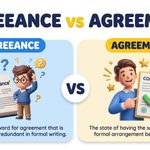
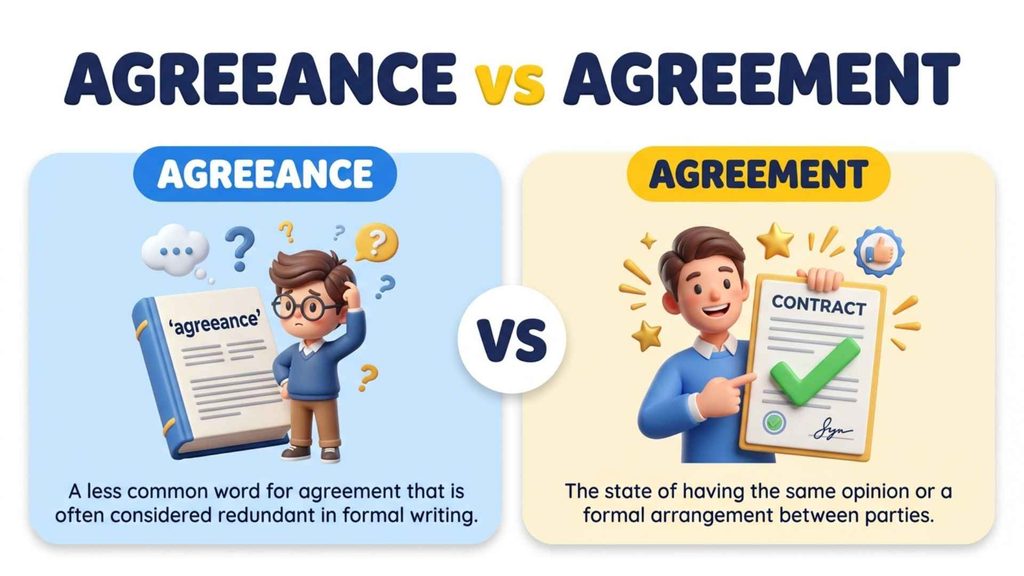
You type a word you have heard before, and your screen underlines it in angry red. Frustrating, right? That is how most of us meet “agreeance,” and it leaves a nagging question about agreeance meaning and origin: is it even real?
This guide breaks down agreeance meaning and origin in plain English, with examples, suffix rules, synonyms, and quick answers. The origin story is more interesting than that red squiggle suggests. Getting it right matters in emails, essays, and job interviews, so keep reading.
Is “Agreeance” A Proper Word In English?
Ever typed a word and watched a red squiggle appear? That tiny moment starts the whole story of agreeance meaning and origin, and the origin behind it surprises most people.
Short answer: yes, it exists, but it sits at the edge of standard English. Some dictionaries record agreeance as a rare noun that means the same as agreement, while many editors and style guides treat it as nonstandard. People understand it, yet careful writers usually reach for the safer word.
A useful test is audience. A friend reading your text will not blink at the word, but an editor, professor, or hiring manager might. Matching your word choice to the reader keeps your credibility intact, and that habit matters more than winning a vocabulary debate.
Is Agreeance a Real Word or a Spelling Mistake?
- Real but rare: people recognize it, though it appears far less than agreement.
- Dictionary status: some references list it as a variant, others skip it.
- Spellcheck: most tools flag it, which signals nonstandard usage.
- Formal writing: avoid it in essays, contracts, and business emails.
- Casual speech: you may hear it in phrases like “in agreeance.”
| Question | Quick answer |
| Do readers understand it? | Usually yes |
| Is it standard English? | Generally no |
| Safer choice | Agreement |
Example in chat: Friend 1: Is “agreeance” actually a word? Friend 2: Sort of, but “agreement” is the safer pick.
Agreeance Etymology – Where Does That Word Come From?
Words carry old family stories, and this one is no different. The origin of agreeance reaches back through French to Latin, which makes agreeance meaning and origin a rich topic.
The verb agree entered English from Old French agreer, which grew out of the phrase a gré, meaning “to one’s liking.” That phrase traces back to the Latin gratus, which means pleasing or welcome. At heart, to agree is to find something pleasing enough to accept. Add the suffix -ance, which forms nouns of state or quality, and you get agreeance: the state of being agreed. Some word-history writers cite an Old French form “agreance,” but treat that detail carefully, since major dictionaries focus on the verb and the ending.
Seeing the word family helps. Agree, agreeable, agreement, and agreeance all grow from the same root idea of pleasing acceptance. Knowing this makes the vocabulary feel connected instead of random, and it makes the whole word history easier to remember.
What Does the Word Agreeance Come From Exactly?
- Latin gratus: the ancient root meaning pleasing or welcome.
- Old French agreer: the verb meaning to please or to accept.
- A gré: the French phrase that literally means “to one’s liking.”
- Suffix -ance: attaches to verbs to name a state or quality.
- English adoption: noun forms of agree have been recorded for centuries.
| Word part | Language | Basic meaning |
| gratus | Latin | pleasing |
| agreer | Old French | to accept, to please |
| -ance | Latin via French | state or quality |
| agreeance | English | state of agreeing |
Example in texting: Friend 1: Wait, agree comes from “pleasing”? Friend 2: Yep, Latin gratus. Agreeing means finding something pleasing enough.
Agreeance Vs Agreement: The Difference Explained
Two words, one idea, endless debate. Within agreeance meaning and origin, the question is whether the origin of each word gave them different jobs. Let us sort fact from folklore.
One popular rule of thumb says agreeance describes people who happen to share a view, while agreement needs one person to state something and another to accept it. Picture two strangers who both love chocolate ice cream. They are in agreeance without ever speaking. Now picture one saying it and the other replying “I agree.” That is agreement. Keep in mind this is a handy distinction some writers use, not an official dictionary rule. Most references treat the two as near-synonyms.
In practice, everyday speakers rarely draw this line. They say agreement for almost everything, and nobody is confused. The split is mostly a language nerd pastime, which is fun, but it should not make you nervous about ordinary conversation.
How Do Agreeance and Agreement Differ in Everyday Use?
- Shared view: agreeance, in the popular distinction, means matching opinions.
- Spoken exchange: agreement involves one statement and a reply.
- Contracts: agreement also names a formal deal or arrangement.
- Frequency: agreement dominates real-world writing by a wide margin.
- Clarity: agreement is understood everywhere, so it rarely confuses readers.
| Feature | Agreeance | Agreement |
| Core idea | Shared view | Accepted statement or deal |
| Needs communication? | No, in this view | Yes |
| Standard status | Rare, often nonstandard | Standard |
| Best for | Casual or stylistic use | Almost everything |
Example in chat: Friend 1: We both think pineapple on pizza is great. Friend 2: Agreeance by coincidence, agreement the second you reply.
4 Examples Of Agreeance
Seeing a word in action beats any definition. These sentences show agreeance at work, and they make agreeance meaning and origin feel real, since the origin idea is shared thinking.
Here are four original examples. Notice that none of them needs a conversation between the people involved. Each one just states that views match.
- The two researchers were in agreeance that the data needed another review.
- The writers had never met, yet their essays showed agreeance on the main point.
- Our whole team is in agreeance about the new schedule.
- Critics on opposite coasts found agreeance on one thing: the ending felt rushed.
If you want to test your own sentence, read it aloud. Does it flow, or does it sound like a costume? When the word feels natural to say, it will usually feel natural to read, and your sentence structure will carry it.
How Can You Use Agreeance in a Sentence?
- In agreeance with: the pattern you will hear most often.
- Subject pairing: link two or more people who share a view.
- Tone: it sounds slightly formal, even a little old-fashioned.
- Risk: some readers will mark it as a mistake.
- Backup plan: swap in agreement or accord for strict audiences.
Example in texting: Friend 1: We’re all in agreeance on pizza tonight. Friend 2: Ha, fancy. Agreement works too, but I’m in.
4 Examples Of Agreement
Agreement is the word you will meet everywhere, from rental contracts to family dinners. Comparing it with agreeance meaning and origin shows how each origin shaped a different everyday feel.
These four examples show agreement as something reached, signed, or spoken aloud. Someone offers a point, and someone else accepts it. That back-and-forth is exactly why agreement became the go-to noun for settled decisions.
- After two hours of talks, the neighbors reached an agreement about the fence.
- I said the movie ran too long, and she replied, “Total agreement.”
- Both companies signed the agreement on Friday morning.
- We have an agreement: you cook, I wash the dishes.
Agreement also shows up in business English, where it names contracts, treaties, and informal understandings. That broad reach is a big reason the word stayed dominant, since one familiar term can serve many situations.
What Are the Most Common Ways to Use Agreement?
- Reach an agreement: the classic phrase for settling a disagreement.
- In agreement: says two sides hold the same position.
- Written agreement: a signed document that sets out terms.
- Verbal agreement: a spoken deal, often informal.
- Grammar agreement: subject and verb matching, a separate technical meaning.
Example in chat: Friend 1: Deal? You drive, I pay for gas. Friend 2: Agreement reached. Shake on it.
The Difference Between Agreement And Agreeance
Let us put the two words side by side one more time. This quick agreeance meaning and origin recap, with the shared origin in mind, should lock the difference in.
Think of it with drinks. Maya in Lahore and Tom in Leeds both believe tea beats coffee, and they have never met. In the popular distinction, that is agreeance. If Maya says it and Tom replies “I agree,” that is agreement. The main difference is simple: agreeance is about holding the same view, while agreement is about acknowledging one. Remember, though, that this is a usage convention and not a universal rule.
If a rule has to be memorized, keep this one: when in doubt, pick agreement. You lose nothing, readers understand you instantly, and you avoid the red underline problem completely.
Agreement vs Agreeance: What Is the Simple Rule?
- Same view, no contact: that fits agreeance in the popular distinction.
- Statement plus reply: that fits agreement.
- Formal deals: always call these an agreement.
- When unsure: choose agreement and move on.
- Dictionary reality: most references blur the two, so context matters.
| Scenario | Better word |
| Two strangers share an opinion | Agreeance, or simply “shared view” |
| A colleague says yes to your plan | Agreement |
| A signed contract | Agreement |
| A formal essay | Agreement |
Example in texting: Friend 1: Maya and Tom both prefer tea, but never met. Friend 2: Agreeance. Once they chat and nod, it becomes agreement.
Why Don’t We Use Agreeance?
If agreeance is real, why does it feel so rare? The answer sits inside agreeance meaning and origin, because the origin of agreement gave that word a clear head start.
Language drifts. Words compete, and the one that feels more useful usually wins. Over time, agreement became the default noun for nearly every sense of agreeing, while agreeance faded into a rare variant. Today, spellcheckers underline agreeance, textbooks skip it, and many readers assume it is a slip. There is also a clarity problem: if agreement covers both ideas, a writer can add a few words, such as “we hold the same view,” to remove any doubt.
Think of it like two similar apps competing for downloads. Once one becomes the default, newcomers stick with it, and the other slowly fades. Words follow the same popularity cycle, shaped by habit more than by strict logic.
Why Did Agreement Replace Agreeance in Modern English?
- Language change: words compete, and one form often takes over.
- Familiarity: readers trust the word they see most often.
- Spellcheck: red underlines train writers to avoid agreeance.
- Style guides: editors usually recommend the standard noun.
- Flexibility: agreement covers contracts, opinions, and grammar in one word.
Example in texting: Friend 1: Why does my phone underline “agreeance”? Friend 2: Because everyone moved on to “agreement” ages ago.
Ment Vs Ance: Two Suffixes With Similar Meanings
Suffixes quietly steer meaning, and these two are close cousins. They sharpen agreeance meaning and origin by showing how the origin of each ending shapes the feel of a noun.
The ending -ment usually names the result of an action. Enlarge a photo and you get an enlargement. The ending -ance usually names a state or quality. Accept an offer and you have acceptance. Apply that logic, and agreement is the result of agreeing, while agreeance is the quality of agreeing. That lines up neatly with the popular distinction, although plenty of English words use the two endings almost interchangeably. Think of “appearance” and “disappointment,” which follow no tidy pattern.
Other pairs show the same flavor. Appointment names a result, while attendance names a state of being present. These word endings are patterns, not laws, but they give you a helpful compass when meanings feel fuzzy.
What Is the Difference Between the Suffixes -ment and -ance?
- -ment: usually marks the result or outcome of an action.
- -ance: usually marks a state, quality, or condition.
- Enlargement: the result of making something larger.
- Acceptance: the state of having accepted something.
- Overlap: many nouns blur the line, so rules are only guides.
| Suffix | Typical meaning | Example |
| -ment | Result of an action | Enlargement, settlement |
| -ance | State or quality | Acceptance, resistance |
| Both | Noun-forming endings | Agreement, agreeance |
Example in chat: Friend 1: So -ment is the result and -ance is the state? Friend 2: Exactly. Agreement is the outcome, agreeance is the vibe.
Synonyms For Agreeance And Agreement
A rich vocabulary keeps your writing fresh. Since agreeance meaning and origin point to shared thinking, many words in the family share that origin idea and work as handy swaps.
Choose the synonym by tone. Accord, concurrence, and accordance suit formal writing. Consensus fits group decisions. Harmony, unison, and unity carry warmth, while rapport and sympathy describe emotional closeness. Assent means a formal yes, and concord sounds poetic. If you want a plain option, “like-minded” always works.
When you write, vary your choices to avoid repetition, but keep clarity first. A fancy vocabulary word that confuses readers is worse than a plain one that lands. Match the synonym to the mood of the sentence.
What Are the Best Synonyms for Agreeance and Agreement?
- Accord: formal, peaceful agreement between people or groups.
- Concurrence: a polite way to say you hold the same view.
- Consensus: general agreement reached by a whole group.
- Harmony: a smooth, friendly state of getting along.
- Assent: an official yes or approval.
- Unison: acting or speaking together at the same moment.
| Synonym | Best used for | Tone |
| Accord | Treaties, peace talks | Formal |
| Concurrence | Opinions, legal rulings | Formal |
| Consensus | Group decisions | Neutral |
| Harmony | Relationships | Warm |
| Rapport | Personal connection | Friendly |
Example in texting: Friend 1: So are we in agreement on the budget? Friend 2: Total accord. Send it over.
Agreeance Definition And Part Of Speech
Grammar labels make a word feel less mysterious. On the grammar side, agreeance meaning and origin point to a noun built from a verb, and that origin explains its job.
Agreeance is an abstract noun. It names a state, so you rarely say “an agreeance” or “two agreeances.” It is built from the verb agree plus the suffix -ance, and it is pronounced roughly uh-GREE-uhns. Most definitions give its meaning as agreement, or a state of being in accord.
Because it is abstract, agreeance behaves like words such as freedom or happiness. You can be in it, reach it, or lack it, but you cannot hold it in your hand. That abstract noun quality shapes how it fits into sentences.
What Is the Definition of Agreeance?
- Noun: it names an idea, not an action or a describing word.
- Uncountable: you rarely add a plural or the article “an.”
- Root verb: agree supplies the core sense of consent or match.
- Pronunciation: say it as uh-GREE-uhns, with stress on the middle.
- Typical phrase: “in agreeance” is the pattern people use most.
| Detail | Answer |
| Part of speech | Noun |
| Base verb | Agree |
| Suffix | -ance |
| Pronunciation | uh-GREE-uhns |
| Core meaning | A state of being in accord |
Example in chat: Friend 1: Is agreeance a noun or a verb? Friend 2: Noun. The verb is just “agree.”
What Does Agreeance Mean In A Sentence?
Definitions are nice, but sentences make meaning stick. Seeing agreeance meaning and origin inside real lines shows how the origin idea of shared thinking appears in everyday speech and writing.
In a sentence, agreeance usually follows “in” and sits before “with” or “about.” For instance, “The board was in agreeance with the new plan” means the board shared the same view as the plan’s author. Swap in agreement, and the sentence still works, which tells you how close the two words are. Context decides whether a reader hears a tiny nuance or just an old-fashioned flavor.
Keep the surrounding sentence plain. When a rare word appears, the rest of the line should be easy, so readers can enjoy the word choice without stumbling. Short, clear sentences make an unusual term feel intentional.
How Do You Use Agreeance Correctly in a Sentence?
- Start with “in”: most natural uses follow the phrase “in agreeance.”
- Add “with”: name the person, idea, or plan that matches.
- Add “about”: name the topic where the views line up.
- Keep it simple: one clear subject makes the meaning obvious.
- Test it: replace it with agreement; if the sentence holds, you are fine.
Example in texting: Friend 1: Are you in agreeance with the new rules? Friend 2: Fully. Honestly, “in agreement” sounds cleaner, though.
Agreeance Meaning And Origin In A Timeline
Word histories feel like detective stories, with clues scattered everywhere. Here is agreeance meaning and origin as a clear, simple timeline showing exactly how the origin unfolds across the centuries.
Exact dates vary between dictionaries, so treat this as a map of stages and not a stopwatch. The pattern is what matters: a Latin idea of pleasing, a French verb of accepting, and an English family of noun forms that eventually crowned agreement as the standard choice.
How Did Agreeance Travel From Latin to Modern English?
- Latin roots: gratus planted the idea of pleasing or welcome.
- French shaping: agreer added the sense of accepting willingly.
- English borrowing: the verb agree arrived and grew several noun forms.
- Competition: agreement and agreeance coexisted, but agreement spread widely.
- Modern status: agreeance survives mainly as a rare variant.
| Stage | What happened |
| Ancient Latin | gratus means pleasing |
| Old French | agreer and a gré mean to please or accept |
| Middle English | The verb agree enters English and noun forms appear |
| Later English | Agreement becomes the standard noun |
| Today | Agreeance is rare and often flagged as nonstandard |
Example in chat: Friend 1: So it started as “pleasing” in Latin? Friend 2: Yep, then French, then English. Words really do travel.
Is Agreeance In The Dictionary?
Nothing settles an argument like a quick dictionary check. So is agreeance meaning and origin something reference books recognize, and does the origin story really earn it a permanent place?
Coverage differs. Some dictionaries list agreeance as a rare noun synonymous with agreement, often with a usage note. Others leave it out, and many editors treat it as a nonstandard form. Because entries change over time, check a current edition of the reference you rely on, such as Merriam-Webster or the Oxford English Dictionary, before you decide.
Do Major Dictionaries List Agreeance as a Word?
- Mixed coverage: some references include it, and others skip it.
- Usage notes: entries often call it rare or nonstandard.
- Check editions: dictionaries update, so verify in a current source.
- Style guides: your publisher or school may have its own rule.
- Safest path: write agreement unless you have a specific reason not to.
Example in texting: Friend 1: Quick, look it up. Is agreeance in the dictionary? Friend 2: Some list it as rare. I’d still write agreement.
In Agreeance With And Other Phrases You Will Hear
Phrases are where words really live. A look at common agreeance meaning and origin patterns shows exactly how the origin idea of shared thinking turns into small, repeatable everyday expressions.
Most phrases pair “in” with agreeance. “In agreeance with” links a person to an idea. “In agreeance on” links people to a topic. These patterns mirror “in agreement with” and “in agreement on,” which readers recognize instantly. If your audience is wide or formal, the agreement versions are the dependable choice. If you enjoy a slightly vintage tone, the agreeance versions add personality, provided you accept a small risk of raised eyebrows.
What Phrases Use Agreeance in Everyday English?
- In agreeance with: matches someone’s opinion, plan, or decision.
- In agreeance on: matches views about a specific topic.
- Come to agreeance: rare, usually replaced by “come to an agreement.”
- Total agreeance: emphasizes that everyone’s views match.
- Mutual agreeance: stresses that both sides feel the same way.
Example in chat: Friend 1: Are we in agreeance on Friday’s plan? Friend 2: Yes, in agreement and ready to go.
Should You Use Agreeance Or Agreement In Formal Writing?
Formal writing leaves little room for doubt. Knowing agreeance meaning and origin helps you judge risk, because the origin of each word affects how readers react in essays and contracts.
For academic papers, legal documents, résumés, and business emails, use agreement. It is standard, universally understood, and free of spellcheck drama. Agreeance can appear in casual blogs, dialogue, or creative writing where voice matters more than polish. If you do use it deliberately, make sure the sentence stays clear without it.
When Is It Safe to Use Agreeance?
- Formal papers: choose agreement every time.
- Legal documents: precision matters, so avoid nonstandard words.
- Business emails: agreement keeps your message professional and clear.
- Creative writing: agreeance can add character to dialogue.
- Casual chat: friends will rarely mind either word.
| Context | Recommended word |
| Academic essay | Agreement |
| Contract | Agreement |
| Business email | Agreement |
| Fiction dialogue | Either |
| Text with friends | Either |
Example in texting: Friend 1: Writing a cover letter. Agreeance or agreement? Friend 2: Agreement. Always agreement for job stuff.
Common Mistakes With Agreeance And Agreement
Everyone slips sometimes, and these two words trip up plenty of writers. Spotting the classic errors around agreeance meaning and origin helps you use the origin facts with real confidence.
Most errors come from overthinking. Writers either force a tiny nuance where none is needed or treat agreeance as a grammar crime. Reality sits in the middle: it is understood, but rarely welcome in polished writing. A quick proofreading pass for these slips will save you from awkward moments.
What Mistakes Should You Avoid With Agreeance?
- Plural forms: avoid “agreeances,” which sounds wrong almost everywhere.
- Verb confusion: agree is the verb, never agreeance.
- Overclaiming: do not insist the distinction is an official rule.
- Mixing grammar: subject-verb agreement is a different idea entirely.
- Wrong register: skip agreeance in formal documents and applications.
| Mistake | Better version |
| “We agreeance on this” | We are in agreement on this |
| “Two agreeances” | Two agreements |
| “Agreeance” in grammar lessons | Agreement |
| Agreeance in a contract | Agreement |
Example in chat: Friend 1: I wrote “we agreeance.” Is that fine? Friend 2: Nope. Try “we agree” or “we’re in agreement.”
FAQs
Is agreeance a real word?
Yes, but it is rare and often marked nonstandard. Understanding agreeance meaning and origin shows why editors prefer agreement.
What does agreeance mean?
Agreeance means a state of agreement or a shared view. The full agreeance meaning and origin trace back through French to Latin.
Where does agreeance come from?
It comes from the verb agree, which came through Old French. That path is central to the agreeance meaning and origin story.
Is agreeance the same as agreement?
Mostly yes, though some writers see a small nuance. The agreeance meaning and origin point to a state, while agreement points to a result.
Why is agreeance flagged as incorrect?
Spellcheckers follow modern standard usage, and agreement dominates it by a wide margin. Agreeance meaning and origin are well documented, yet the word is simply rare.
Can you say “in agreeance with”?
Yes, people say it, and readers usually understand it. Agreeance meaning and origin do not forbid it, but “in agreement with” is safer.
Should I use agreeance in an essay?
No, choose agreement for formal essays, reports, and job applications. Knowing agreeance meaning and origin helps you explain that choice if asked.
Conclusion
So, what have we learned about agreeance meaning and origin? Agreeance is a rare noun built from the verb agree plus the suffix -ance, and its roots run from Latin gratus through Old French. Many writers say it means a shared view, while agreement means an accepted statement or deal, though dictionaries rarely enforce that split. That is the heart of agreeance meaning and origin, and it explains why agreement won the everyday race. The origin story is rich, but the practical rule is simple: use agreement in formal writing, and save agreeance for casual moments. Next time that red squiggle appears, you will know the full story of agreeance meaning and origin. Try writing one sentence with each word today and see which feels right.
Meta Description
Agreeance meaning and origin explained: what it means, where it comes from, and why agreement won out. Learn which word to use today.

Amelia Brooks is a US-based author known for inspiring stories on meaning, growth, and hope, blending insight with simple, engaging storytelling.