
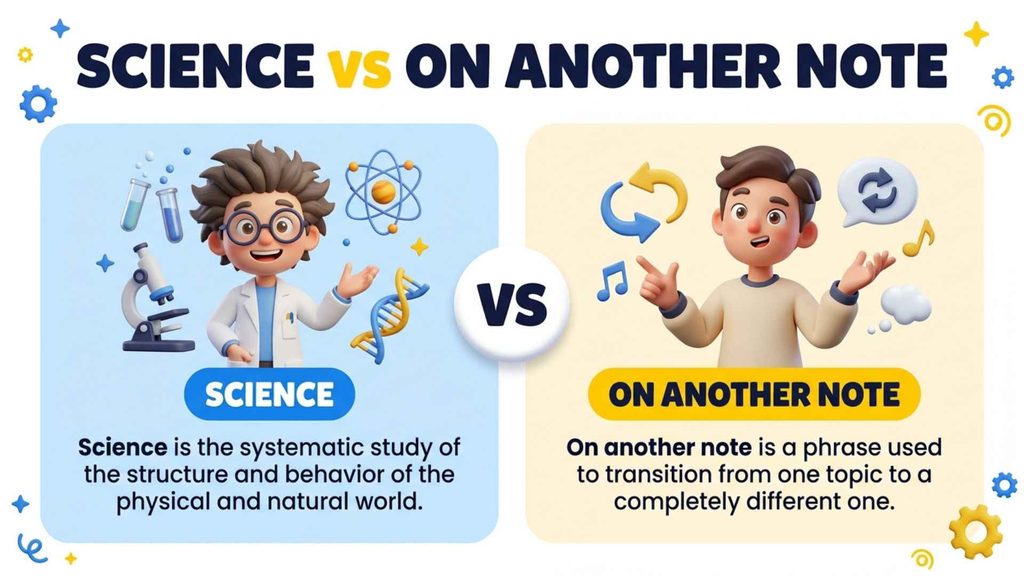
You’re mid-conversation, the topic has run its course, and suddenly you freeze. Which words move things forward without sounding abrupt? Everyone has felt that awkward pause, and it matters because clumsy transitions confuse readers.
This guide explains on another note meaning, shares real examples, and offers smooth alternatives for emails and chats. Every note here is practical. Whether you’re writing a report or texting a friend, on another note will feel natural. Keep reading and make your next topic change effortless.
What Does “On Another Note” Mean?
Ever stopped mid-conversation and wondered how to shift gears without sounding awkward? On another note is the phrase that does it, and every careful note below shows you exactly why.
This phrase works as a transition phrase that lets you change the subject politely. It tells your listener that the next idea is separate from the last one. Writers and speakers have relied on it for years because it feels clear and calm.
What Does On Another Note Mean in a Sentence?
- Signals a topic shift without announcing a dramatic break.
- “Another” tells listeners the next idea stands apart.
- “Note” invites the reader to remember what follows.
- Works as a segue in both speech and writing.
- Shows no hierarchy between the old and new points.
- Usually follows a full stop or a clear pause.
| Word | Role | What it adds |
| On | Preposition | Sets the position of the new idea |
| Another | Determiner | Marks a different or additional topic |
| Note | Noun | Flags a point worth remembering |
Think of it as a friendly road sign for your reader. It warns them that the topic is about to turn, so nobody feels lost. That small courtesy is a big reason the phrase has stayed popular in everyday formal English and relaxed talk alike.
Example in texting: Friend 1: The landlord finally fixed the sink. Friend 2: Great! On another note, are you coming Friday?
on a different note
Ever noticed how a small word swap can change the whole mood? On a different note feels almost identical to on another note, and each note it introduces can lean friendly or professional.
The word “different” puts extra emphasis on contrast. Use it when your next point really does feel unlike the last, such as moving from a complaint to good news.
How Do You Use On a Different Note Correctly?
- Place it at the start of a new sentence.
- Add a comma right after the phrase.
- Choose it when the contrast is obvious.
- Pair it with polite wording in emails.
- Avoid stacking it with other transition phrases.
- Keep the next point short and clear.
| Phrase | Tone | Best use |
| On a different note | Neutral | Emails and meetings |
| On another note | Neutral | Writing and speech |
Many writers swap between the two phrases to avoid repetition inside one document. That is perfectly fine, because the meaning barely changes. Variety keeps your conversational tone fresh, and your reader stays engaged instead of noticing the same transition twice.
Example in chat: Friend 1: The deadline moved again, ugh. Friend 2: Annoying. On a different note, did you try that new café?
Anyhow
Ever wished you could brush off an awkward moment and move forward? Anyhow does that gently, and it pairs nicely with on another note whenever a casual note just fits.
It is more colloquial than most options here. You will hear it in relaxed spoken English, but it can feel too loose for a strict formal email.
When Should You Use Anyhow Instead of On Another Note?
- Use it in casual talks with friends.
- Skip it in formal emails and reports.
- It works well to restart a stalled chat.
- It can soften a heavy subject.
- Pair it with a question to invite replies.
- Avoid it before serious announcements.
A good rule is to read your sentence aloud before sending it. If it sounds like something you would say over coffee, anyhow probably fits. If it sounds like a board meeting, choose a more polished synonym and keep your message professional.
Example in texting: Friend 1: Sorry, I rambled about my commute forever. Friend 2: Anyhow, how did the interview go?
Anyway
Everyone has been stuck in a rambling chat that needs rescuing. Anyway is the exit, and it can replace on another note when you want to drop a friendly note.
It behaves like “anyhow,” but it is far more common and sits better in written English. Many people use it to wrap up one idea and begin another.
Is Anyway a Good Substitute for On Another Note?
- Yes, it handles a topic shift smoothly.
- It suits both speech and writing.
- It can signal you are ready to move on.
- It fits casual and semi-formal settings.
- It works well to return to the main point.
- Keep it short and follow it with a clear idea.
| Feature | Anyway | On another note |
| Formality | Casual to neutral | Neutral to formal |
| Length | One word | Three words |
| Frequency | Very common | Common |
Because it is so common, anyway rarely draws attention to itself. That makes it perfect for smooth, invisible topic shifts. Readers barely register it, which lets your next idea take center stage without any awkward pause or stiff formal register.
Example in chat: Friend 1: That movie was way too long. Friend 2: Anyway, are we still on for dinner?
But I Digress
We all wander off topic when a story gets exciting. But I digress pulls everyone back with humor, much like on another note does when you add one more note.
“Digress” means stepping away from the main subject for a moment. You can then return to the original idea or begin something brand new.
What Does But I Digress Really Mean?
- It admits you drifted off topic.
- It adds a touch of humor to speech.
- It lets you circle back to your main point.
- It works best in spoken conversation.
- It can feel literary in short writing.
- Use it sparingly so it stays charming.
Timing matters here. Say it right after a tangent, not before one, or the joke loses its charm. Used well, it shows self-awareness, and listeners usually smile because they recognize the same habit in themselves during long, wandering stories.
Example in texting: Friend 1: You went on a long tangent about cheese again. Friend 2: Ha, but I digress. What time is the meeting?
Apart From That
Bad news hangs heavy in the air until someone steers toward brighter things. Apart from that does the steering, similar to on another note, and keeps each closing note hopeful.
“Apart” suggests distance between two ideas. It tells your listener that what comes next sits away from the earlier topic and may bring better energy.
How Does Apart From That Change the Subject?
- It separates the new idea from the old.
- It often introduces positive updates.
- It works well in spoken formal talks.
- It pairs naturally with an update question.
- Place a comma after it in writing.
- Avoid it when the previous topic is urgent.
| Phrase | Feels like | Typical follow-up |
| Apart from that | Distance | Good news |
| On another note | Fresh start | Any new topic |
This phrase works especially well when you want to reassure someone. After hearing a problem, a calm follow-up shows you care about the whole person, not just the issue. It quietly says that one bad moment does not define the entire situation.
Example in chat: Friend 1: The flight got delayed twice. Friend 2: Rough. Apart from that, how was the trip?
Aside From That
Ever finished a hard topic and needed a gentle bridge forward? Aside from that gives you one, and it closely echoes on another note while adding a kind, thoughtful note.
It means almost the same as “apart from that,” though it is slightly less common. It suggests setting one subject to the side before picking up another.
Where Does Aside From That Fit Best?
- It suits polite conversation at work.
- It signals you have finished the old topic.
- It works as an opening for new updates.
- It can ease tension after complaints.
- It sounds natural in meetings.
- Use a comma before the next sentence.
Pay attention to rhythm when you use it. A short pause before the phrase gives the previous point room to breathe. That tiny gap helps your listener process the old topic before they follow you toward a new subject.
Example in texting: Friend 1: The printer broke again this morning. Friend 2: Aside from that, how is the new project going?
On an Unrelated Note
Random thoughts pop up at the strangest times, usually quite unannounced. On an unrelated note warns people a surprise is coming, just as on another note does for any note.
This is the most direct way to change the subject. “Unrelated” tells everyone that your next point has no link to the previous one, so nobody tries to connect them.
Why Do People Say On an Unrelated Note?
- It gives a clear warning before a jump.
- It prevents confusion about connections.
- It helps you lighten a heavy mood.
- It works great in group chats.
- It can reset a tense meeting.
- It sounds honest and straightforward.
| Phrase | Link to old topic | Directness |
| On an unrelated note | None | High |
| On another note | Loose or none | Medium |
Use it when honesty about the jump matters more than smoothness. Hiding a sudden shift can confuse people, but naming it builds trust. Readers appreciate clarity, and a plain announcement often feels kinder than forcing a weak connection between ideas.
Example in chat: Friend 1: I can’t decide on a color for the wall. Friend 2: On an unrelated note, did you pay the electric bill?
On a Separate Note
Keeping topics in neat boxes makes conversations easier to follow. On a separate note opens a new box politely, and it feels like on another note with a tidy note.
It sounds formal and polished, which makes it popular in business writing. People also treat it as interchangeable with “on a different note.”
Can You Use On a Separate Note in Emails?
- Yes, it fits professional emails well.
- It marks a clean break between topics.
- It keeps your message organized.
- It pairs well with bullet lists.
- Add a comma right after it.
- Avoid it in casual texts.
Because it sounds tidy, this phrase suits documents with several distinct points. Teachers, managers, and project leads often use it in newsletters and updates. It helps readers scan quickly and find the section that matters most to them.
Example in texting: Friend 1: The report is nearly done. Friend 2: Great. On a separate note, can you join Thursday’s call?
Other Than That
Sometimes a rough update deserves a cheerful follow-up. Other than that softens the whole mood, and like on another note, it lets you gracefully slip in a single positive note.
It works as an introductory clause that closes one topic and opens another. People often use it when asking how things are going after sharing a problem.
How Does Other Than That Work in Conversation?
- It closes a negative topic gently.
- It invites the listener to share good news.
- It sounds friendly and relaxed.
- It works in speech more than formal writing.
- It can add a little optimism.
- Keep the tone warm, not dismissive.
Tone is everything here. Said warmly, it opens a door for good news; said flatly, it can sound like you are dismissing the problem. Add a caring follow-up question so the shift feels supportive instead of rushed.
Example in chat: Friend 1: The car needs a new battery. Friend 2: Ouch. Other than that, how’s the new job?
But Enough About That
Nobody enjoys dwelling on a bad day for too long. But enough about that closes the gloomy chapter kindly, similar to on another note, and invites a happier note instead.
You say it after sharing a worry, a complaint, or a long story. It tells the listener you have said enough and want to shift toward something lighter.
When Is But Enough About That the Right Choice?
- Use it after a long complaint.
- It helps you lighten a heavy chat.
- It shows consideration for the listener.
- It works well with close friends.
- Follow it with a cheerful question.
- Skip it in serious professional talks.
Notice that this phrase puts the speaker in control of the mood. You are choosing to stop dwelling and start connecting. That small act of closure can make heavy chats feel lighter and more balanced for everyone involved.
Example in texting: Friend 1: Anyway, my week was a mess. Friend 2: But enough about that. Tell me about your trip!
Moving Right Along
Meetings drag when nobody knows how to push forward. Moving right along keeps the energy high, and on another note does the same when you happily attach a fresh note.
This phrase suggests momentum. It tells everyone that the group has covered one item and should now glide into the next, making it ideal for agendas.
Why Is Moving Right Along Popular in Meetings?
- It keeps the agenda moving.
- It signals progress to the group.
- It gives a polite nudge to wrap up.
- It adds an upbeat tone.
- It works in presentations too.
- Use it when the previous point is settled.
| Phrase | Energy | Best setting |
| Moving right along | High | Meetings |
| On another note | Moderate | Emails and chats |
It carries a bit of playful authority, so use it when you are leading the conversation. In a classroom or a team call, the phrase keeps attention on the next item and quietly reminds everyone that time is limited.
Example in chat: Friend 1: I think the budget is settled. Friend 2: Perfect, moving right along. What’s next on the list?
How Do You Use On Another Note in a Sentence?
Seeing a phrase in action beats memorizing rules every time. These real sentences show how on another note works, and each note proves how smoothly one topic can quietly change.
Place the phrase after a complete thought, add a comma, and then start your next idea. That simple pattern keeps your writing clean and your meaning easy to follow.
What Are Some Everyday Examples of On Another Note?
- Work: use it to move from a task to an announcement.
- School: shift from homework talk to club news.
- Family: switch from chores to weekend plans.
- Friends: jump from gossip to dinner ideas.
- Emails: pivot from a project update to scheduling.
- Speeches: introduce a fresh segment gracefully.
A helpful trick is to name the old idea first, then pivot. Acknowledging the earlier point shows respect and prevents the shift from feeling abrupt. This habit alone makes your writing sound thoughtful, organized, and genuinely considerate.
Example in texting: Friend 1: I finished the slides last night. Friend 2: Nice. On another note, did you book the room?
How to Use On Another Note in Professional Emails
Writing a professional email can feel stressful when you must change topics fast. On another note keeps things polished, and one clear note at the right moment saves your message.
Keep the shift short, state the new point right away, and avoid long apologies. Clear structure makes busy readers trust your message.
Is On Another Note Appropriate in Formal Emails?
- It reads as polite and neutral.
- Place it at the start of a paragraph.
- Follow it with one clear request.
- Keep the subject line aligned with the main topic.
- Avoid using it more than twice per email.
- Close with a clear call to action.
| Email part | Example use |
| Opening | Thank you for the update. |
| Shift | On another note, could we reschedule Friday? |
| Closing | Please confirm when convenient. |
Think about your reader’s inbox. They may skim, so make the pivot obvious and the next step easy. A short sentence, a clear question, and a friendly closing do more for your response rate than any clever transition phrase.
Example in chat: Friend 1: I sent the invoice yesterday. Friend 2: Thanks. On another note, are you free for Monday’s review?
On Another Note in Texting and Social Media
Texting moves fast, and topic jumps happen in a heartbeat. On another note helps friends follow along, and a quick note can keep the whole chat feeling calm and relaxed.
Online, people often shorten phrases or skip punctuation. Even so, this phrase remains clear, because it quickly signals a new idea in group chats and comment threads.
Do People Still Say On Another Note in Chats?
- Yes, it keeps group chats organized.
- It prevents mixed-up replies.
- It works in captions and posts.
- Pair it with an emoji for tone.
- Skip the comma in fast texts if needed.
- Avoid it in emotional conversations.
Remember that tone can vanish in short messages. A friendly emoji or an extra word of warmth keeps the shift from sounding cold. That small effort helps your conversation feel human, even when everything happens in a few quick taps.
Example in texting: Friend 1: Ugh, traffic was terrible today. Friend 2: Same. On another note, movie night at 8?
Is On Another Note Formal or Informal?
Wondering whether a phrase suits your audience is a smart habit. On another note sits comfortably in between, and every note you add can lean formal or casual as needed.
Most style guides treat it as neutral to semi-formal. Your tone, punctuation, and surrounding words decide how stiff or relaxed the phrase feels.
Can On Another Note Be Used in Both Formal and Casual Writing?
- It is neutral in most contexts.
- Add polite wording for formal settings.
- Use a lighter tone with friends.
- It works in reports and memos.
- It is safe for mixed audiences.
- Choose “anyway” for very casual speech.
| Setting | Suitable? | Better alternative |
| Business email | Yes | On a separate note |
| Close friend chat | Yes | Anyway |
| Formal speech | Yes | Moving right along |
If you are unsure, imagine your audience. A teacher, a manager, and a best friend all understand the phrase, which is why it travels so well. Adjust the surrounding words, and the same transition fits almost any context.
Example in chat: Friend 1: Is that phrase too stiff for a text? Friend 2: Not at all. On another note, want pizza?
What Is the Difference Between On Another Note and By the Way?
Two phrases, one tricky difference, and plenty of confusion among writers. On another note and by the way look alike, yet each note they introduce carries a slightly different purpose.
“By the way” usually adds a small, passing detail. “On another note” moves to a fully separate topic that may deserve its own discussion.
How Is On Another Note Different from By the Way?
- By the way adds a quick side detail.
- On another note starts a distinct topic.
- “By the way” feels more casual.
- “On another note” suits structured writing.
- Both work as a discourse marker.
- Pick based on the weight of the new idea.
| Phrase | Purpose | Weight of new idea |
| By the way | Passing remark | Light |
| On another note | Topic change | Medium to heavy |
One easy test helps: ask whether the new idea could stand alone as its own paragraph. If yes, choose the bigger topic change. If it is a quick aside, the lighter option keeps the flow natural and your message easy to read.
Example in texting: Friend 1: Thanks for covering my shift. Friend 2: Anytime. By the way, you left your jacket here.
On Another Note Punctuation Rules
Tiny punctuation marks cause big hesitation, and that is completely understandable. On another note follows a simple pattern, and every note you write becomes cleaner once you know it well.
Treat the phrase as an introductory element. That means it normally takes a comma, and it often starts a sentence after a full stop.
Do You Put a Comma After On Another Note?
- Yes, add a comma after the phrase.
- Start the sentence with a capital letter.
- End the previous idea with a period.
- Avoid a semicolon before the phrase.
- Use a dash only in informal writing.
- Never place two commas back to back.
| Correct | Incorrect |
| On another note, I loved the talk. | On another note I loved the talk |
| She left early. On another note, lunch is ready. | She left early; on another note lunch is ready. |
Reading your sentence aloud is the fastest check. Where you naturally pause, a comma usually belongs. This trick works for almost every introductory phrase, so you can trust it whenever you are editing a quick message before pressing send.
Example in chat: Friend 1: Should there be a comma there? Friend 2: Yes. On another note, you’re improving fast!
Common Mistakes With On Another Note
Even confident writers slip when changing topics. Avoiding common errors with on another note protects your credibility, and each polished note you send builds real trust with every single reader.
Most mistakes come from overuse, wrong tone, or linking ideas that actually belong together. A quick review before sending can fix almost all of them.
What Mistakes Should You Avoid With On Another Note?
- Using it when the topics are connected.
- Repeating it several times in one message.
- Forgetting the comma after it.
- Using it after sad news without empathy.
- Mixing it with “anyway” in one sentence.
- Skipping a clear acknowledgment of the old topic.
The best fix is empathy first. If someone shares bad news, respond to it before moving on. A sentence of care costs almost nothing, and it keeps your transition from sounding careless, rushed, or disconnected from how the other person feels.
Example in texting: Friend 1: I lost my keys. On another note, pizza? Friend 2: Wait, first, are you okay? Then pizza.
FAQs
What does on another note mean?
On another note means you are moving to a separate topic. Think of it as a polite signal that something new follows.
Is on another note formal?
On another note is neutral to semi-formal in most settings. It suits emails, meetings, and casual chats equally well.
Can you start a sentence with on another note?
Yes, on another note works well as a sentence opener. Just make sure the previous thought feels complete first.
Do you put a comma after on another note?
Yes, on another note normally takes a comma afterward. That small pause helps the new idea land clearly.
What can I say instead of on another note?
Alternatives to on another note include anyway, on a separate note, and other than that. Choose by tone and audience.
Is on another note the same as by the way?
Not exactly; on another note signals a bigger topic change. “By the way” usually adds a light, passing remark.
Can I use on another note in an email?
Yes, on another note is perfectly acceptable in professional emails. Keep the new point brief and clearly stated.
Conclusion
Changing topics doesn’t have to feel clumsy. Now you know that on another note signals a clean shift, carries no ranking of importance, and fits both formal emails and relaxed chats. You’ve also seen how on another note compares with eleven alternatives, from anyway to moving right along, each with its own tone and best setting.
The smartest habit is matching the phrase to your audience. Choose casual options with friends, polished ones with managers, and always acknowledge the earlier point before pivoting. When in doubt, on another note is a safe, friendly bridge.
Next time a conversation needs a turn, pick your phrase on purpose, add a thoughtful note, and watch the exchange flow.

Amelia Brooks is a US-based author known for inspiring stories on meaning, growth, and hope, blending insight with simple, engaging storytelling.