You finish the meeting, the room goes quiet, and your cursor blinks. Do you type “thank you everyone” or thank you all? That tiny choice somehow feels huge when real people are reading.
Gratitude only lands when it sounds sincere, so wording matters. This guide breaks down the thank you all meaning, the tone each phrase carries, and clear examples you can copy today. Stick around, and you will never second-guess your closing line again.
Everyone Thank You All
Ever noticed how a room softens when someone says thank you all with real warmth? Even the odd order, everyone thank you all, feels heartfelt when the tone is sincere.
What Does “Everyone Thank You All” Mean in Speech?
- Word order flips, but the gratitude stays the same.
- Spoken English often stacks both words for extra emphasis.
- Speakers use it to double down on appreciation.
- It sounds warm rather than grammatically careful.
- In writing, the single phrase alone is cleaner.
Example in chat:
Friend 1: Everyone thank you all, seriously, the party was perfect!
Friend 2: Aww, anytime. You deserved every bit of it.
Thank You Everyone
Saying thank you everyone feels personal because each listener hears their own name inside it. Compared with thank you all, it carries a slightly more formal and quietly individual warmth.
Is “Thank You Everyone” Really More Personal?
- Everyone points to each person individually.
- It suits speeches and closing remarks.
- It stands alone easily as a closing line.
- A comma after “you” keeps it polished.
- It feels slightly formal in casual chats.
Example in texting:
Friend 1: Thank you everyone for coming to my talk today.
Friend 2: Loved it! You owned that stage.
Thank You to All
Some speakers prefer thank you to all because it sounds like a gift handed to a crowd. It works well, though thank you all remains the shorter, friendlier everyday choice.
How Is “Thank You to All” More Formal?
- Thank you to all adds a formal, ceremonial feel.
- It usually pairs with a reason or group name.
- The shorter form stays more conversational.
- Both are grammatically correct in standard English.
- Use it in announcements and printed programs.
Example in chat:
Friend 1: Should the banner say thank you to all volunteers?
Friend 2: Perfect, it sounds official but still kind.
Thank You One and All
Picture a wedding toast ending with thank you one and all, glasses raised and hearts full. It is the warm, slightly old-fashioned cousin of thank you all, loved at events.
When Should You Say “Thank You One and All”?
- It suits weddings, farewells, and heartfelt toasts.
- The phrase carries a slightly old-fashioned charm.
- It stresses that nobody was left out.
- Skip it in quick work emails.
- The shorter version works when you need something brief.
Example in texting:
Friend 1: Ending my speech with thank you one and all. Too much?
Friend 2: Not at all, it’s perfect for a wedding.
Are “Thank You Everyone” and “Thank You All” Grammatically Correct?
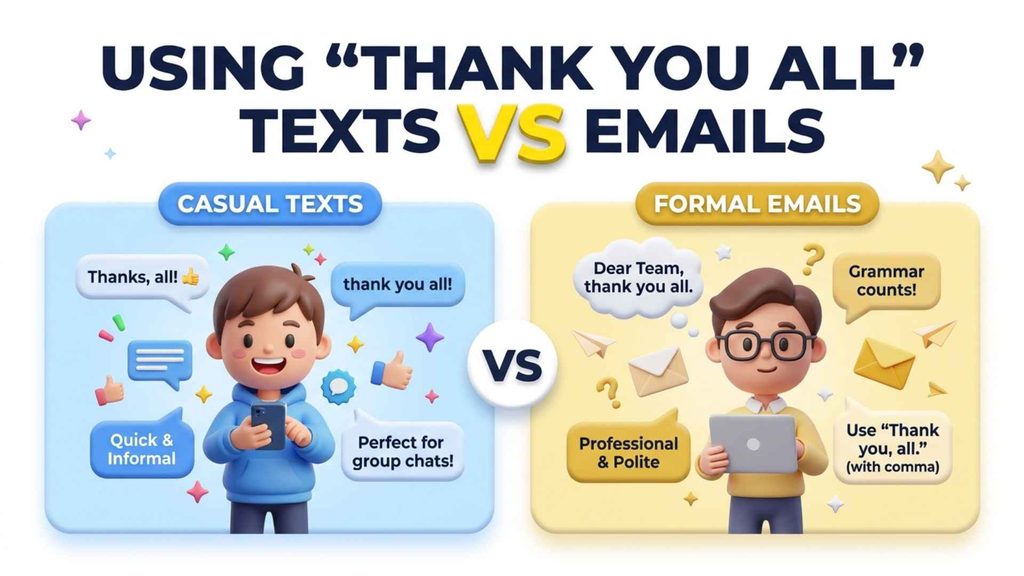
Nobody wants to hit send and wonder if their grammar is wrong. Good news: thank you all and thank you everyone are both correct, natural, and used by professionals daily.
Why Do Both Phrases Pass Every Grammar Check?
- Both use indefinite pronouns correctly.
- Neither phrase counts as slang.
- Professionals use them in emails and speeches.
- The right choice depends on tone, not rules.
- A comma in “thank you, everyone” is optional in casual writing.
Example in chat:
Friend 1: Is that closing line actually correct grammar?
Friend 2: Yes, totally fine in emails and everyday talk.
The Real Difference Between “Thank You Everyone” and “Thank You All”
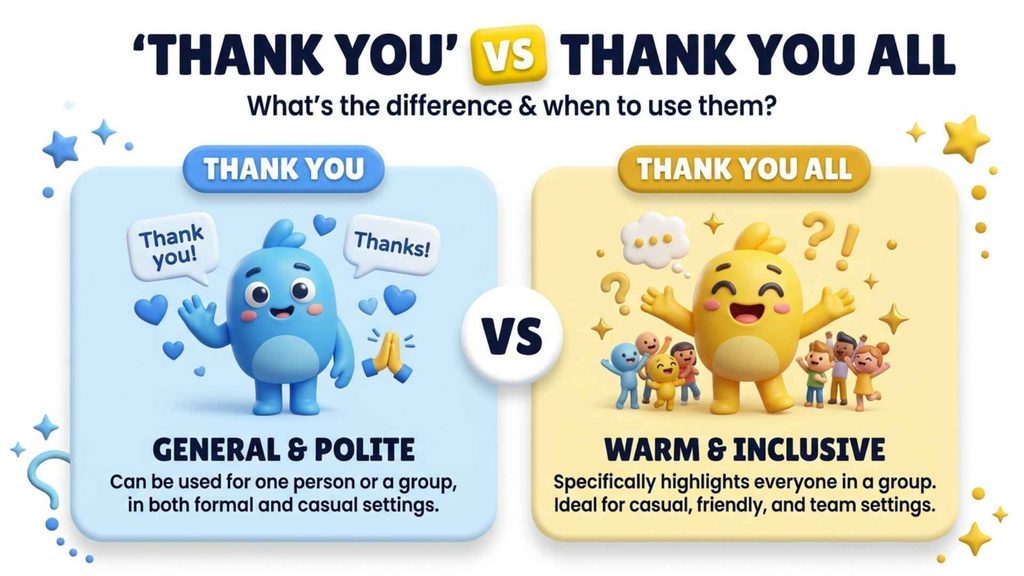
The gap between these phrases is tiny, yet it changes how your gratitude feels. Think of thank you all as a big, warm group hug and everyone as individual handshakes.
How Do “Everyone” and “All” Work Differently?
- Everyone addresses people one by one.
- All treats the group as one body.
- The difference is subtle, never a grammar error.
- Tone shifts slightly, not the meaning.
- Context decides which feels natural.
| Word | Role | Feel |
| Everyone | Indefinite pronoun, individuals | Personal |
| All | Indefinite pronoun, collective | Inclusive |
Example in texting:
Friend 1: Which sounds warmer, everyone or all?
Friend 2: Honestly, all feels cozier to me.
“Thank You Everyone”
Hearing thank you everyone at the end of a long day feels like being seen. Unlike thank you all, it quietly points to each individual person in the entire room.
What Makes “Thank You Everyone” Feel Personal?
- Individual recognition sits inside the word everyone.
- Large audiences still feel seen.
- The tone leans formal but kind.
- It closes a presentation gracefully.
- Pair it with a comma in formal writing.
Example in chat:
Friend 1: Thank you, everyone, for staying until the end.
Friend 2: Wouldn’t have missed it for anything!
“Thank You All”
Few phrases feel as welcoming as thank you all said with a smile. It treats the audience as one connected circle, which is why it sounds natural in friendly settings.
Why Does “Thank You All” Sound So Inclusive?
- All wraps the group into one circle.
- It sounds relaxed and welcoming.
- It leads smoothly into for coming or similar reasons.
- Perfect for group chats and social posts.
- It travels well across age groups and platforms.
Example in texting:
Friend 1: Thanks, everyone, for the birthday wishes!
Friend 2: You earned every single one, happy birthday!
How Native Speakers Choose Without Thinking
Native speakers rarely pause to debate this. Their choice happens in a heartbeat, shaped by habit, setting, and mood, and thank you all often wins in relaxed and casual moments.
What Shapes a Native Speaker’s Instinct?
- Group size nudges the choice.
- Setting matters more than any rule.
- Medium, such as speech or chat, changes the feel.
- Sentence structure favors the shorter phrase before a clause.
- Exposure builds instinct over years of listening.
| Factor | Leans toward |
| Large formal audience | Thank you everyone |
| Group chat | Thank you all |
| Standalone closing | Thank you everyone |
| Before a reason | Thank you all |
Example in chat:
Friend 1: How did you pick the wording so fast?
Friend 2: Habit. I just know the shorter one fits chats.
When to Use “Thank You Everyone”
Picture standing at a podium while every eye is on you. That is the moment to reach for thank you everyone, while thank you all waits patiently for friendlier rooms.
Which Moments Call for “Thank You Everyone”?
- Closing speeches feel complete with it.
- Client emails sound respectful and personal.
- Webinars end gracefully on this line.
- Award ceremonies suit its quiet formality.
- Individual effort deserves this acknowledgment.
| Situation | Why it fits |
| Formal speech | Sounds polished |
| Client email | Feels respectful |
| Presentation close | Stands alone well |
Example in chat:
Friend 1: How should I end the webinar?
Friend 2: Try thank you everyone for joining, it’s clean.
Ideal Situations for “Thank You Everyone”
Some moments simply call for a more polished goodbye. In those formal, structured settings, thank you everyone fits perfectly, even though thank you all is certainly never wrong there either.
What Are the Best Situations for “Thank You Everyone”?
- Formal meetings with senior colleagues.
- Stakeholder updates and quarterly reports.
- Public speeches with mixed audiences.
- Training sessions that end on a standalone note.
- Group emails that recognize each person’s effort.
Example in texting:
Friend 1: Emailing the whole department about the launch.
Friend 2: Close with thank you everyone, it’s professional.
Why It Feels More Intentional
Why does one small word make gratitude feel deliberate? Because everyone points to individuals, a quiet but powerful detail that thank you all usually blends gently into the wider crowd.
Why Does “Everyone” Signal Individual Appreciation?
- Everyone implies each person was noticed.
- It adds weight to a company-wide message.
- It signals recognition without naming names.
- Managers use it to motivate teams after hard projects.
- It feels deliberate, not automatic.
Example in chat:
Friend 1: Did the boss’s email feel real to you?
Friend 2: Yes, thank you everyone made me feel noticed.
Examples of “Thank You Everyone” Used Naturally
Real, everyday sentences make the difference click much faster than any rule. Here are ways people say thank you everyone naturally, plus where thank you all might easily replace it.
What Are Natural Sentences Using “Thank You Everyone”?
- “Thank you, everyone, for joining this morning’s workshop.”
- “None of this happens alone. Thank you everyone.”
- “Thank you everyone for staying patient during the update.”
- “Before we wrap up, thank you, everyone.”
- “Thank you everyone for the effort behind this quarter’s results.”
Example in chat:
Friend 1: Wrapping up my seminar now.
Friend 2: Say thank you everyone and take a bow.
When to Use “Thank You All”
Imagine a lively group chat buzzing after a surprise party. Nothing fits better there than thank you all, short, warm, friendly, and ready to be followed by a clear reason.
Which Moments Call for “Thank You All”?
- Group chats feel natural with it.
- Parties and gatherings deserve its warmth.
- Social posts need its brevity.
- Team wins sound joyful with it.
- Replies to many comments work best with one line.
| Setting | Best fit |
| Group chat | Thank you all |
| Party | Thank you all for coming |
| Social post | Thank you all for the support |
Example in texting:
Friend 1: Wrapping up the group chat with a quick note.
Friend 2: Perfect, a short thanks for the help works great.
Ideal Situations for “Thank You All”
Casual celebrations deserve casual gratitude. In relaxed, semi-formal settings, thank you all feels easy, inviting, and truly sincere, while the longer, more elaborate alternatives can sometimes feel a little heavy.
What Are the Best Situations for This Phrase?
- Casual team meetings with familiar faces.
- Community events with a friendly crowd.
- Online posts thanking many followers.
- Gift collections from friends and family.
- Semi-formal emails to a close team.
Example in chat:
Friend 1: Everyone chipped in for Mom’s gift.
Friend 2: Then a warm thanks for the gift is perfect.
Examples of “Thank You All” Used Naturally
Nothing teaches like real, everyday sentences. These examples show thank you all doing exactly what it does best, leading smoothly into a reason, a feeling, or a warm closing message.
What Are Natural Sentences Using “Thank You All”?
- “Thank you all for coming to tonight’s event!”
- “Thank you all for the hard work on this project.”
- “We did it! Thank you all for making this campaign shine.”
- “Thank you all for chipping in on the gift.”
- “Thank you all for your kind messages this week.”
Example in texting:
Friend 1: Thank you all for helping me move!
Friend 2: Anytime, but pizza is on you next time.
Thank You All for Your Support: How to Say It Sincerely
Support during a hard season leaves a mark. When you want to say thanks properly, thank you all for your support is a simple line that carries real, genuine feeling.
How Can You Say “Thank You All for Your Support” Sincerely?
- Be specific about what the support meant.
- Mention a moment or result they helped create.
- Keep the tone warm, not dramatic.
- Add a personal line to avoid sounding generic.
- End with a promise or hopeful next step.
Example in chat:
Friend 1: How do I thank my readers after the launch?
Friend 2: Say thank you all for your support, then share one specific win.
Thank You All Messages for Social Media Posts
Posting after a big moment feels vulnerable, so wording matters. A short thank you all message keeps things warm, honest, brief, and easy for followers to like, comment, and share.
What Is the Best “Thank You All” Caption Style?
- Keep it short enough to read at a glance.
- Add a photo or milestone for context.
- Tag key supporters when appropriate.
- Use one emoji at most for warmth.
- Reply to comments personally afterwards.
Example in texting:
Friend 1: Posting after the race. Thanks for cheering, everyone!
Friend 2: Perfect caption, add the finish-line photo.
Thank You All Reply for Birthday Wishes
Waking up to dozens of birthday messages is a lovely problem to have. A single thank you all reply lets you answer everyone without typing the same line fifty times.
How Do You Reply to Many Birthday Wishes at Once?
- Post one group reply early the next day.
- Mention how the wishes made you feel.
- Like each message to show you saw it.
- Add a personal note for close friends.
- Avoid copying the same line to everyone.
Example in chat:
Friend 1: I got fifty birthday messages. Help!
Friend 2: Post one group reply and heart every one.
Thank You All Speech Closing Lines
The last sentence of a speech is the one people remember. Ending with thank you all gives your audience a warm, confident, natural finish and a clear reason to applaud.
How Should You End a Speech With “Thank You All”?
- Pause briefly before the final line.
- Make eye contact with the audience.
- Add a reason after the closing thanks.
- Keep your voice steady and warm.
- Stay brief, since applause follows naturally.
Example in chat:
Friend 1: Practicing my closing line for tomorrow.
Friend 2: Try closing with a thank-you for listening, then smile.
Tone, Audience, and Medium: How to Choose Instantly
Great communicators read the room before they speak. Tone, audience, and medium decide whether thank you all or thank you everyone sounds right, and you can judge it in seconds.
How Do Tone, Audience, and Medium Change Your Choice?
- Tone sets the level of warmth and formality.
- Audience decides how personal you should sound.
- Medium, such as email or chat, shapes length.
- Formal settings lean toward thank you everyone.
- Casual settings lean toward the shorter phrase.
Example in texting:
Friend 1: Do I use all or everyone in Slack?
Friend 2: Slack is casual, so keep it short.
Ask Yourself Three Questions
Stuck on your closing line? Three questions can rescue you. They take under ten seconds and keep thank you all and thank you everyone from feeling like a coin toss.
Which Three Questions Settle the Choice Fast?
- How formal is the setting?
- Is it standalone or leading into a reason?
- Who exactly is the audience?
- Formal, standalone, official points to everyone.
- Casual, reason-led, friendly points to all.
Example in chat:
Friend 1: Three questions and I’m done?
Friend 2: Yep, formality, structure, audience. The casual one fits yours.
Quick Comparison Table
Sometimes you just need the answer at a glance. This table puts thank you all and thank you everyone side by side so you can compare tone, formality, and fit.
How Do the Two Phrases Compare at a Glance?
- Formality is the biggest visible gap.
- Standalone lines favor everyone.
- Clause-led lines favor all.
- Medium nudges the final decision.
- Both remain correct.
| Feature | Thank You Everyone | Thank You All |
| Formality | Slightly formal | Slightly casual |
| Tone | Individual | Collective |
| Standalone use | Very common | Less common |
| Before a clause | Less common | Very common |
| Best for | Speeches, emails | Chats, posts |
Example in texting:
Friend 1: Quick summary, please?
Friend 2: Formal means everyone, relaxed means all.
Common Mistakes People Make
Everyone slips up sometimes, and a thank-you note is no exception. Spotting these common writing mistakes early keeps thank you all sounding warm and sincere instead of rushed or robotic.
What Mistakes Do People Make With Thank-You Phrases?
- Stiff wording in casual chats.
- Casual wording in formal speeches.
- Overthinking a choice that is already correct.
- Generic thanks without a reason.
- Forgetting the comma in formal writing.
| Mistake | Better habit |
| Assuming one is politer | Focus on sincere tone |
| Repeating one phrase | Rotate by setting |
| Overthinking grammar | Trust context |
Example in chat:
Friend 1: My email sounded stiff, didn’t it?
Friend 2: A little. Try something warmer instead.
Thinking One Is Always Politer
Many people believe one phrase automatically sounds kinder. It does not. Warmth lives in your tone, so thank you all can feel just as genuinely respectful as any other alternative.
Is “Thank You Everyone” Really Politer?
- Politeness comes from sincerity.
- Tone of voice matters more than the pronoun.
- Hollow words sound cold either way.
- Genuine warmth beats formal wording.
- Context decides which feels kinder.
Example in texting:
Friend 1: Is everyone more polite than all?
Friend 2: Nope, sincerity wins every time.
Overusing One Phrase
Repeating the same closing line everywhere makes gratitude feel automatic. Rotating between thank you all and other friendly options keeps your messages fresh, human, and genuinely appreciated by your readers.
How Can You Avoid Repeating the Same Thank-You Line?
- Rotate between all, everyone, and alternatives.
- Match the phrase to the setting.
- Add a reason to keep it fresh.
- Read your message aloud before sending.
- Vary length across emails and posts.
Example in chat:
Friend 1: I’ve used the same thank-you in every email.
Friend 2: Switch it up. Try “thanks so much, everyone.”
Overthinking Grammar
Spending a full ten minutes debating two correct phrases helps nobody. Trust your own instinct, because thank you all is perfectly fine, and so is the alternative in most situations.
Why Is Overthinking Grammar Not Worth the Time?
- Both options are already correct.
- Instinct improves with regular practice.
- Time spent debating adds no value.
- Readers care about warmth, not rules.
- Confidence grows when you simply send.
Example in texting:
Friend 1: I’ve rewritten this line six times.
Friend 2: Send it, the line is perfect.
Polished Alternatives to “Thank You Everyone” and “Thank You All”
Sometimes you simply want something different to say. These polished alternatives to thank you all and thank you everyone help you sound fresh, thoughtful, and professional in almost any setting.
What Are Good Alternatives to “Thank You All”?
- Thanks so much, everyone works for casual moments.
- I appreciate each of you feels personal.
- We are grateful sounds formal and sincere.
- Many thanks suits quick emails.
- Sincere appreciation fits official letters.
Example in chat:
Friend 1: Any fresh way to thank the whole team?
Friend 2: Try “I appreciate each of you.”
Formal Alternatives
Formal moments ask for words with a little extra weight. These respectful alternatives replace thank you all when a boardroom, ceremony, or official letter truly needs a more dignified tone.
Which Formal Alternatives Sound Most Respectful?
- “I sincerely thank each of you.”
- “My appreciation to everyone involved.”
- “We extend our gratitude to all participants.”
- “Thank you to each member of the team.”
- “We are deeply grateful for your dedication.”
Example in chat:
Friend 1: Need something formal for the board letter.
Friend 2: Use “We extend our gratitude to all participants.”
Friendly Alternatives
Among close friends, stiff phrases fall flat. These relaxed alternatives sound like a real smile and work beautifully in group chats when thank you all feels a touch too plain.
What Are Friendly Ways to Thank a Group?
- “Thanks so much, everyone!”
- “You all are the best.”
- “Big thanks to you all!”
- “I appreciate all of you!”
- “Honestly, you made my day.”
Example in texting:
Friend 1: Thanks for the surprise, you all are the best!
Friend 2: We love you, happy birthday!
Professional Email Alternatives
Inboxes are crowded, so your gratitude should be clear and brief. These polished, email-ready lines work when thank you all feels a little too casual for clients, managers, or stakeholders.
Which Email Lines Sound More Professional?
- “Thank you for your time and cooperation.”
- “Thank you for your continued support.”
- “We appreciate your efforts on this project.”
- “Your contribution has not gone unnoticed.”
- “I am grateful for your timely responses.”
Example in chat:
Friend 1: Client email closing line, any ideas?
Friend 2: “Thank you for your continued support” works well.
Situational Alternatives Table
Matching your words carefully to the moment saves you guesswork. This table pairs everyday situations with the best replacement, so thank you all appears only where it truly fits best.
How Do You Match the Alternative to the Situation?
- Formal events need respectful, complete sentences.
- Emails benefit from clear, action-linked thanks.
- Social posts reward short, warm lines.
- Classrooms need encouraging, specific praise.
- Volunteer work calls for personal gratitude.
| Situation | Best alternative |
| Formal presentation | “My sincere thanks to each of you.” |
| Project wrap-up email | “Thank you for your cooperation and time.” |
| Event recap post | “Big thanks to you all!” |
| Classroom | “I truly appreciate everyone’s effort today.” |
| Volunteer drive | “We are grateful for every helping hand.” |
Example in texting:
Friend 1: What do I say to the volunteers?
Friend 2: “Grateful for every helping hand.” Simple and kind.
Case Studies: How These Phrases Are Used in Real Life
Theory helps, but real stories stick. These case studies show thank you all and thank you everyone working in offices, classrooms, and community events with real people and feelings involved.
Why Do Real-Life Case Studies Teach More Than Rules?
- Real context shows tone in action.
- Workplace examples reveal formality cues.
- Community examples show warmth in public.
- Classroom examples reveal individual recognition.
- Patterns repeat across settings.
Example in chat:
Friend 1: Do these examples actually help?
Friend 2: Yes, seeing real posts made it click.
Case Study: Workplace Announcement
A tight deadline, a tired team, and one email to send. Here is how a manager used thank you everyone, and why thank you all might have worked well too.
What Did the Manager Say After the Deadline?
- Situation: a department met a tough deadline.
- Phrase used: “Thank you everyone for hitting the deadline together.”
- Why it works: it recognizes each person within a formal email.
- Alternative: the shorter phrase suits a casual team chat.
- Result: the team felt seen and appreciated.
Example in chat:
Friend 1: Boss emailed us a thank-you today.
Friend 2: Nice! Did thank you everyone feel genuine?
Case Study: Charity Event Post
After months of planning, the fundraiser finally succeeded and the organizer wanted to share the joy online. Here, thank you all was the perfect, most natural choice for the moment.
How Did the Organizer Thank Supporters Online?
- Situation: a fundraiser exceeded its goal.
- Phrase used: “Thank you all for the incredible support today!”
- Why it works: the crowd was wide, so a collective tone fits.
- Flow: the phrase leads smoothly into a reason.
- Result: followers shared the post widely.
Example in texting:
Friend 1: Posted the fundraiser thank-you. Thoughts?
Friend 2: That line about support is perfect.
Case Study: Classroom Setting
After a long day of student presentations, one teacher wanted every child to feel noticed. Her careful word choice shows how thank you all and everyone differ in a classroom.
How Did the Teacher Recognize Each Student?
- Situation: a day of student presentations ended.
- Phrase used: “Thank you everyone for your thoughtful presentations.”
- Why it works: each child’s effort felt noticed.
- Alternative: the shorter phrase works for a casual wrap-up.
- Result: students felt proud and encouraged.
Example in chat:
Friend 1: Teacher said thank you everyone after presentations.
Friend 2: Aww, that makes everyone feel noticed.
What Style Guides and Usage Experts Agree On
Writers often ask what the experts say. Style guides and usage experts agree on one calm point: thank you all and thank you everyone are both perfectly acceptable modern English.
What Do Style Guides Say About These Phrases?
- Style guides do not mark either phrase wrong.
- Clarity matters more than rigid rules.
- Tone should match the audience.
- British, Australian, and Canadian English accept both.
- Sincerity is what readers remember.
| Source | Position |
| Major style guides | Neither phrase marked wrong |
| Usage experts | Match tone to audience |
| International English | Both widely accepted |
Example in texting:
Friend 1: Does any style guide ban either phrase?
Friend 2: Nope, it’s perfectly standard English.
What Does “Thank You All” Really Mean in a Message?
When a message ends with thank you all, what is the sender really saying? Behind those three simple words sits appreciation, recognition, and a genuine wish to include everyone there.
What Does “Thank You All” Mean in Texting and Email?
- Appreciation shared with a whole group.
- Inclusion, since nobody is left out.
- Warmth, even in short messages.
- Closure, signaling a polite ending.
- Recognition of effort without naming individuals.
Example in texting:
Friend 1: She ended with thank you all. What does that mean?
Friend 2: It means she’s grateful to the whole group.
Why Do People Say “Thank You All” Instead of “Thanks”?
Why do people choose a longer phrase when a quick thanks would do? Because thank you all feels warmer, more complete, and clearly meant for a whole group of people.
Is “Thank You All” Warmer Than “Thanks All”?
- Full wording sounds more respectful.
- Thanks all feels hurried and informal.
- Thank you all works across age groups.
- Group focus makes everyone feel included.
- Habit reinforces its popularity online.
Example in chat:
Friend 1: Why not just say thanks all?
Friend 2: The full version sounds warmer and less rushed.
When Should You Use “Thank You All” in a Professional Email?
Writing to colleagues can make you overthink every word. In a professional email, thank you all works best when the tone is friendly and the audience is a familiar team.
Is “Thank You All” Acceptable in Business Emails?
- Yes, with familiar teams and a friendly tone.
- Switch to everyone for senior stakeholders.
- Add a reason for better clarity.
- Avoid overusing it in long threads.
- Check the company culture first.
Example in texting:
Friend 1: Can I write thank you all in a team email?
Friend 2: Sure, it’s friendly and professional.
FAQs
Is “thank you all” grammatically correct?
Yes, thank you all is correct standard English. Use it confidently.
Is “thank you all” formal or informal?
Thank you all is semi-formal. It suits teams, events, and friendly emails.
What is the difference between “thank you all” and “thank you everyone”?
Thank you all feels collective and casual. Everyone feels more personal and formal.
Do you need a comma in “thank you all”?
Thank you all needs no comma. Add one only for “thank you, everyone.”
Can I use “thank you all” in a business email?
Yes, thank you all suits friendly team emails. Choose everyone for formal clients.
Is “thank you all” the same as “thanks all”?
Close, but thank you all sounds warmer. “Thanks all” feels quicker and more casual.
How do you reply to many messages with “thank you all”?
Post one warm thank you all note. Then add personal replies to close friends.
Conclusion
At the end of the day, thank you all and thank you everyone are both correct, kind, and widely used. The real difference is tone. Everyone feels personal and formal, while thank you all feels collective and warm. Neither one is better by default.
What matters most is sincerity. Read the room, pick the phrase that fits your audience, and add a real reason for your gratitude. When you mean it, thank you all can lift someone’s whole day. Next time you finish a meeting or post an update, try this: write your closing line, say it out loud, and if it sounds like you, send it. If you want a final reminder, thank you all is a safe, friendly choice whenever you are unsure.
Meta Description
Not sure when to say thank you all? Learn its meaning, tone, and how it differs from thank you everyone, with easy examples.
Extracted LSI, NLP Keywords, and Entities (from the competitor article)
Core phrases: thank you everyone, thank you all, thank you, everyone, all, thank you to all, thank you one and all, thanks everyone, thanks all
Semantic and topical terms: gratitude, appreciation, acknowledgment, recognition, indefinite pronoun, collective, individual, direct address, comma, punctuation, grammar, grammatically correct, tone, formality, formal, informal, casual, semi-formal, audience, medium, context, sincerity, warmth, instinct, native speakers
Related phrases: closing line, standalone phrase, before a clause, group email, team chat, group chat, social media post, professional email, speech, presentation, announcement, classroom setting, charity event, workplace announcement, polished alternatives, formal alternatives, friendly alternatives, I sincerely thank each of you, big thanks, thank you for your time and cooperation
Entities: style guides, usage experts, Associated Press, Chicago Manual of Style, British English, Australian English, Canadian English, international English, colleagues, clients, stakeholders, managers, students, teachers, volunteers

Amelia Brooks is a US-based author known for inspiring stories on meaning, growth, and hope, blending insight with simple, engaging storytelling.