
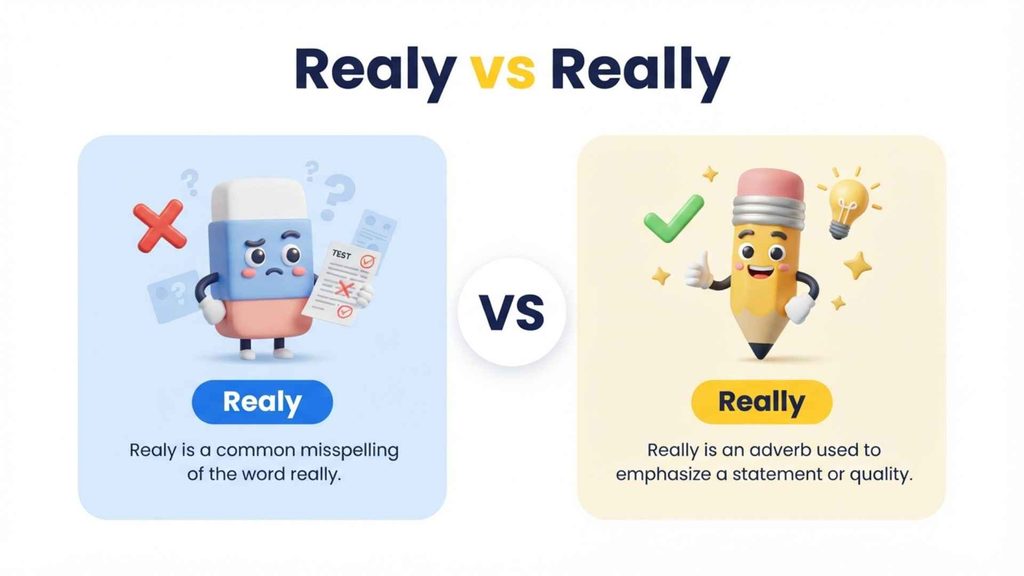
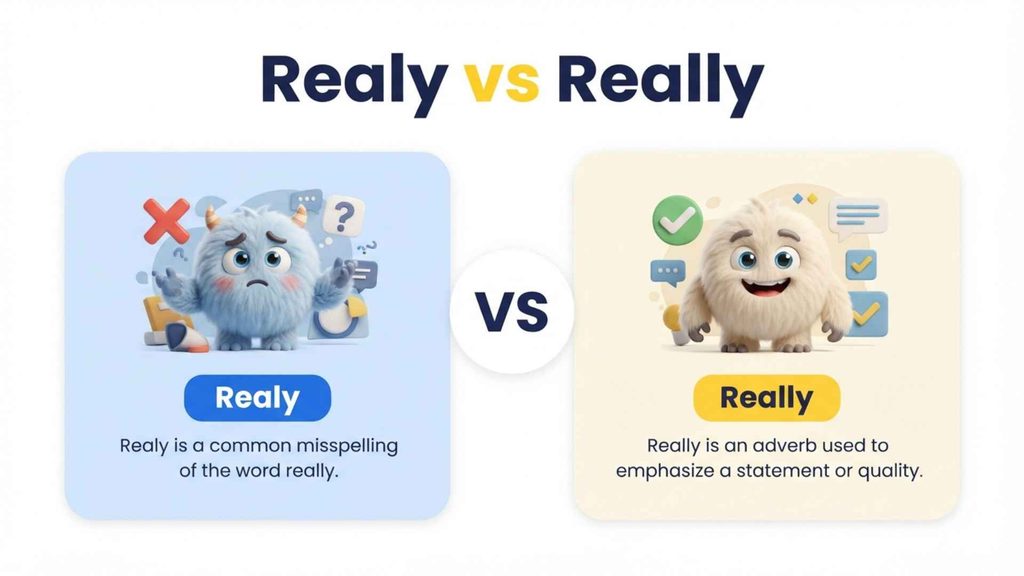
Ever typed a message, paused, and stared at the word “really” wondering if it actually needs two L’s? You’re not imagining things this tiny word trips up more people than you’d expect, and it usually happens in the middle of a fast text or a heated argument when you need to sound convincing, not confused.
That’s exactly why this guide exists. Below, you’ll get a clear answer on realy or really, the meaning behind the word, where the confusion comes from, and simple memory tricks so the correct spelling sticks for good. By the end, you won’t just know the answer you’ll never doubt yourself again.
Realy or Really – Quick Answer
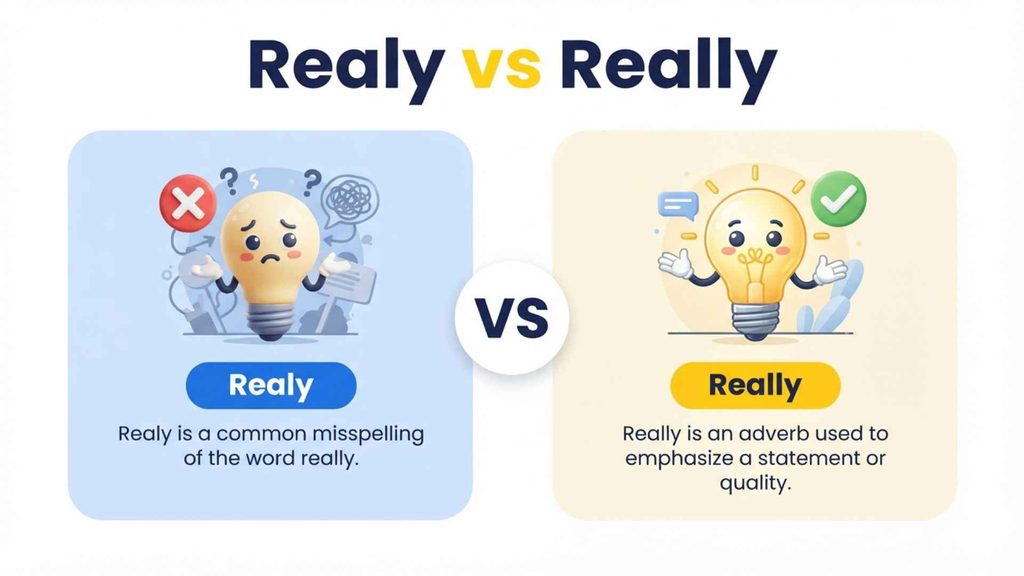
Really is the only correct spelling in standard English. Realy is a common misspelling with no accepted use in dictionaries or formal writing anywhere.
- Really is spelled with two L’s: r-e-a-l-l-y
- Realy is always incorrect, regardless of context
- The mistake happens because “real” already ends in one L
- Spell check will flag realy in nearly every app
- Dictionaries list zero entries for realy as a word
Example in texting:
Friend 1: “Are you really coming tonight?”
Friend 2: “Yes, I promise, I’m really on my way.”
What Is “Realy”?
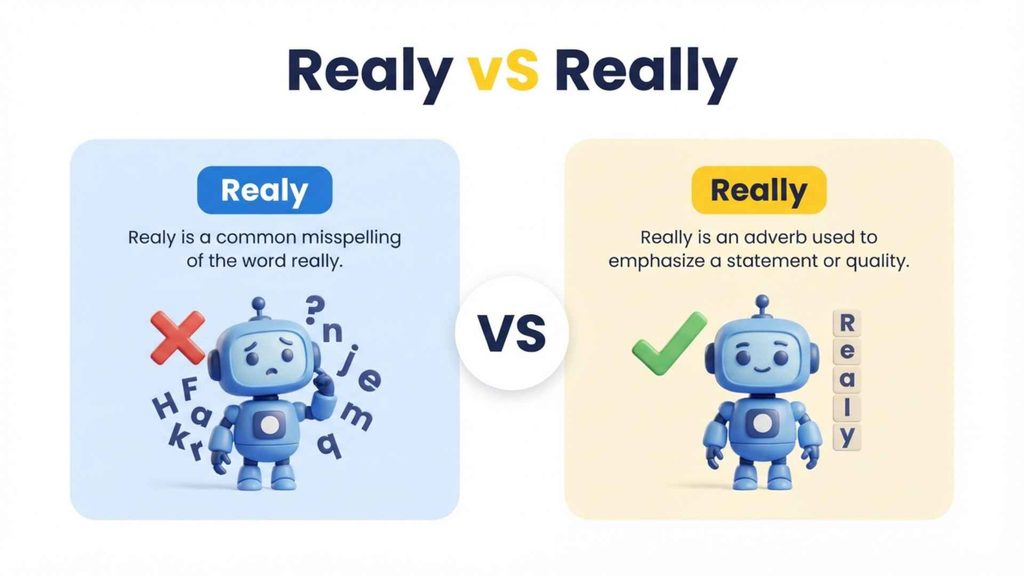
Curious why this spelling shows up so often if it’s technically wrong? Here’s the honest truth behind it. Realy is not a recognized English word it’s simply a typo of really caused by dropping one L.
- Realy appears in casual texts and fast typing
- It has no dictionary definition anywhere
- Autocorrect usually catches and fixes it
- Non-native speakers misspell it most often
- It’s never acceptable in essays or professional writing
What Is “Really”?
Now let’s flip it what does the correct word actually mean and do in a sentence? Really is an adverb used to add emphasis, confirm truth, or express genuine surprise or intensity.
- Really means “in reality” or “truly”
- It intensifies adjectives, like “really tired”
- It can express doubt, like “Really? No way.”
- It confirms facts: “It’s really happening.”
- It softens or strengthens tone depending on context
How Is “Really” Used in Everyday Conversations?
People lean on really constantly to react, to emphasize, to question, or simply to sound more human instead of flat and robotic in daily talk.
| Use Case | Example Sentence |
| Emphasis | I’m really proud of you. |
| Surprise | You got the job? Really?! |
| Confirmation | It really did happen last night. |
| Intensity booster | That movie was really good. |
| Polite disagreement | I really don’t think that’s true. |
Example in chat:
Friend 1: “I passed the exam!”
Friend 2: “Wait, really?? That’s amazing!”
Really Spelling
Getting the really spelling locked in permanently just takes one small mental trick, and then you’ll never hesitate over this word again.
- Correct spelling: r-e-a-l-l-y
- Remember: “real” + “ly” = really
- Two L’s because the suffix “-ly” attaches to “real”
- Common typo drops the second L by accident
- Spell-check tools almost always auto-correct it
Really or Realy
When people search really or realy, they’re really just double-checking a word they already suspect is wrong and that instinct is correct.
- Really wins every single time, no exceptions
- Realy is not a regional or British variant
- No dictionary Oxford, Merriam-Webster, Cambridge lists realy
- It’s a spelling error, not a style choice
- Confusing it with “real” is the root cause
Why Do People Use “Realy” Instead of “Really”?
Most people aren’t ignoring grammar rules on purpose they’re typing fast, thinking about tone, and the second L just gets lost in the rush.
- Speed typing on phones causes dropped letters
- Muscle memory from typing “real” interferes
- Autocorrect fatigue leads people to ignore red squiggly lines
- Non-native speakers may not double the L instinctively
- Casual texting culture normalizes small errors
Example in texting:
Friend 1: “I’m realy tired today lol”
Friend 2: “Same, I’m really dragging too 😩”
Spelling of Really
The full spelling of really breaks down cleanly once you separate the root word from its ending, and it becomes almost impossible to forget.
- Base word: real (meaning genuine or true)
- Suffix added: -ly (turns adjectives into adverbs)
- Combined: real + ly = really
- Double L happens naturally at the word boundary
- No silent letters or irregular spelling involved
Realy or Really Meaning
Beyond spelling, understanding the meaning behind really helps you use it with more confidence in writing and conversation alike.
- Really signals truth, emphasis, or genuine emotion
- It can replace “truly,” “genuinely,” or “very”
- Tone shifts based on punctuation: “Really.” vs “Really?!”
- It’s used in both formal and informal English
- Realy carries no meaning it’s simply an error
What Does “Really” Mean in Texting?
In texts and DMs, really does a lot of emotional heavy lifting, often carrying more feeling than the actual sentence around it.
- Shows genuine interest: “That’s really cool!”
- Expresses disbelief: “Really? No way.”
- Adds weight to apologies: “I’m really sorry.”
- Signals sarcasm depending on tone: “Oh, really.”
- Confirms sincerity in emotional messages
Example in chat:
Friend 1: “I really miss hanging out with you.”
Friend 2: “Aw, I really miss you too.”
How to Pronounce “Realy” vs. How to Pronounce “Really”
Since realy isn’t a real word, it has no official pronunciation but people often say it exactly like really out loud, which is part of why the spelling confusion sticks.
- Really: pronounced REE-uh-lee or REE-lee
- Realy: has no standard pronunciation (it’s a typo)
- Fast speech often blends the middle sounds together
- Regional accents shorten it to a two-syllable sound
- Spoken language rarely reveals the spelling mistake
The Origin of “Really”
Word history nerds, this one’s for you really has roots stretching back centuries, and its story explains exactly why it’s built the way it is.
- Derived from Middle English “real” (genuine, actual)
- “Real” traces to Latin “realis,” meaning “actual”
- The suffix “-ly” was added to form the adverb
- First recorded adverbial use dates to the 14th century
- The spelling has stayed stable for hundreds of years
| Era | Form | Meaning |
| Latin | realis | actual, factual |
| Middle English | real | genuine |
| Modern English | really | truly, in fact |
British English vs. American English Spelling
Good news here this is one grammar rule that doesn’t split across the Atlantic, unlike “colour” versus “color” or “theatre” versus “theater.”
- Really is spelled identically in both dialects
- No British variant like “realy” or “reallie” exists
- Pronunciation differs slightly, not the spelling
- Both dialects treat realy as a plain error
- Dictionaries on both sides confirm the same spelling
Which Spelling Should You Use?
If you’re still unsure which version to type into that next message, here’s the simple rule to lock in permanently.
- Always use really in every context
- Realy is never correct, casual or formal
- Job applications, essays, and emails need really
- Texts and DMs are fine with really too
- There’s no scenario where realy is acceptable
Common Mistakes with “Really”
Beyond the spelling itself, people stumble in a few other predictable ways with this small but mighty word.
- Overusing really as a filler word repeatedly
- Confusing it with “real” as an adjective
- Dropping the second L under typing pressure
- Using it to replace stronger, more precise words
- Forgetting punctuation changes its tone entirely
When Should You Use “Really” in a Sentence?
Knowing when to reach for really instead of overusing it makes your writing and texting sound sharper and more intentional.
- Use it to emphasize a strong feeling or fact
- Use it to question something surprising
- Avoid it as a lazy filler in formal writing
- Swap it for stronger adverbs when precision matters
- Use it sparingly in professional emails
Example in texting:
Friend 1: “Was the concert good?”
Friend 2: “It was really amazing, best night ever.”
Why Do People Misspell “Really” as “Realy”?
This comes down to habit more than lack of grammar knowledge, and it’s more common than most people admit out loud.
- Real is typed constantly, creating auto-habit
- Fast typing skips the repeated letter
- Some assume “-ly” only needs one L from “real”
- Voice-to-text errors occasionally drop letters too
- Lack of proofreading lets the typo slip through
How to Remember the Correct Spelling of “Really”
A few small mental tricks make this spelling permanent, even for people who’ve misspelled it for years.
- Think: “real + ly” = really
- Say it slowly and notice the double L sound
- Picture the word “all” also double L
- Use spell-check as a backup, not a crutch
- Practice typing it in full sentences a few times
“Realy or Really” Synonyms
Sometimes you just want a different word entirely, and really has plenty of solid stand-ins depending on tone.
- Truly formal and sincere
- Genuinely emphasizes authenticity
- Actually corrects or clarifies
- Very simple intensity booster
- Honestly adds emotional weight
“Really” in Everyday Examples
Seeing really in action across different situations makes the correct usage click faster than any rule ever could.
- “I’m really excited for the weekend.”
- “Did that really happen at work today?”
- “She’s really talented at painting.”
- “I really appreciate your help.”
- “That was really unexpected news.”
Example in chat:
Friend 1: “I got promoted!”
Friend 2: “Wait, really?! Congrats, that’s huge!”
Realy or Really – Google Trends & Usage Data
Search behavior actually backs up everything above people type realy far less often than the correct spelling, and the gap keeps growing as autocorrect improves.
- Really dominates search volume worldwide
- Realy shows up mostly as a typo-correction search
- Mobile searches account for most misspelled queries
- Spell-check adoption has reduced realy searches over time
- English-learning regions show higher realy search rates
Comparison Table: Realy vs. Really
| Feature | Realy | Really |
| Correct spelling | ❌ No | ✅ Yes |
| Dictionary entry | None | Confirmed |
| Formal writing use | Never | Always acceptable |
| Common cause | Typing error | Standard word |
| Spell-check flag | Always flagged | Never flagged |
Frequently Asked Questions
Is “realy” ever correct in English?
No, realy is never correct it’s a spelling error of really with no dictionary support at all.
Why is “really” spelled with two L’s?
Because it’s built from “real” plus the suffix “-ly,” and combining them naturally creates the double L.
Is “realy” a British spelling of “really”?
No, British and American English both use really, and neither recognizes realy as valid.
Does autocorrect fix “realy” automatically?
Most apps flag or fix realy automatically, though it can slip through on fast typing.
Can “realy” be used casually in texts?
No, even in casual texting, really is still the correct and expected spelling.
What part of speech is “really”?
Really is an adverb, used to add emphasis, confirm truth, or express surprise.
How can I stop misspelling “really”?
Remember the pattern “real + ly,” and slow down slightly when typing to catch the double L.
Conclusion
So, realy or really the answer is simple and settled. Really is the only correct spelling, and really it’s an easy fix once you remember the pattern: “real” plus “ly.” Whether you’re texting a friend, writing an email, or drafting something formal, sticking with really keeps your writing clean and credible. Realy is nothing more than a common slip, not a valid alternative, and now that you know exactly why, there’s no reason for it to sneak into your typing again. Next time your fingers move fast, pause for half a second that one extra L makes all the difference.
Want this as a downloadable file (Markdown or Word doc) for your CMS?

Amelia Brooks is a US-based author known for inspiring stories on meaning, growth, and hope, blending insight with simple, engaging storytelling.