You typed the word, paused, and stared at the screen is it authorised or authorized? That tiny flicker of doubt has hit almost every writer, student, and professional at some point, and it’s more common than you’d think.
Here’s the good news: by the end of this guide, you’ll know exactly what the authorised meaning is, where the spelling came from, and which version fits your writing every single time. You’ll walk away with real examples, a few handy tricks, and zero more second-guessing. Let’s get into it.
Authorized or Authorised
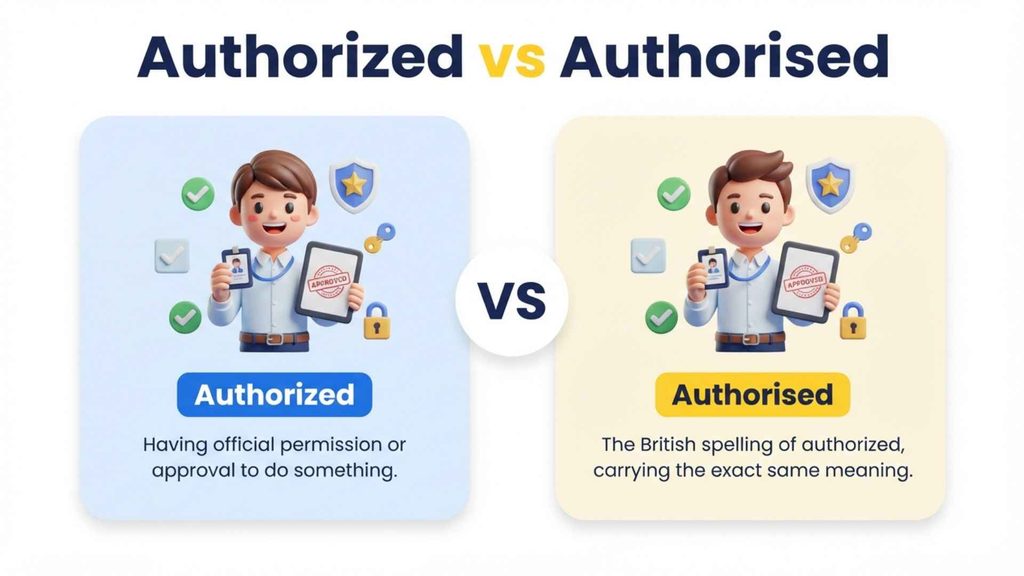
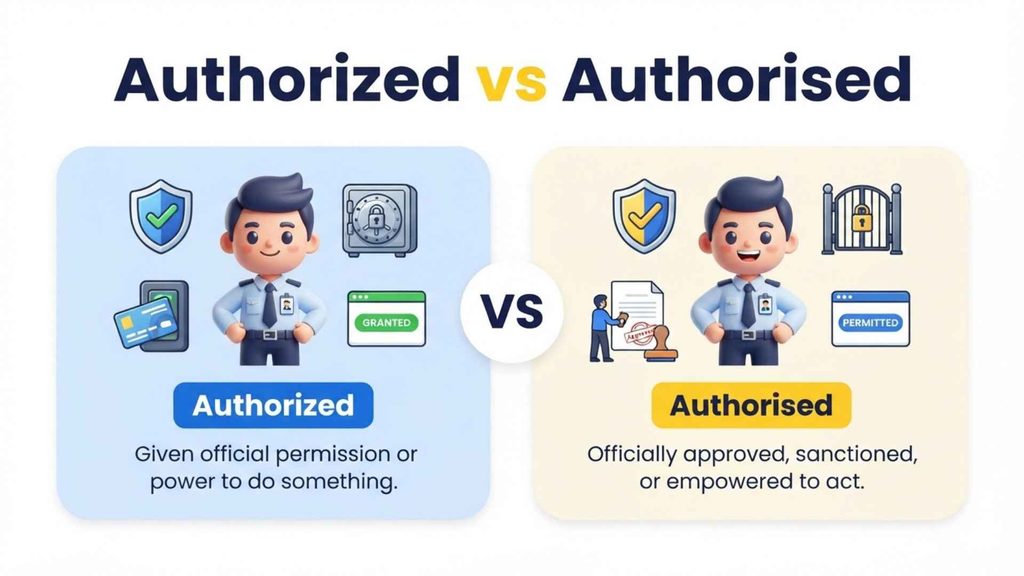
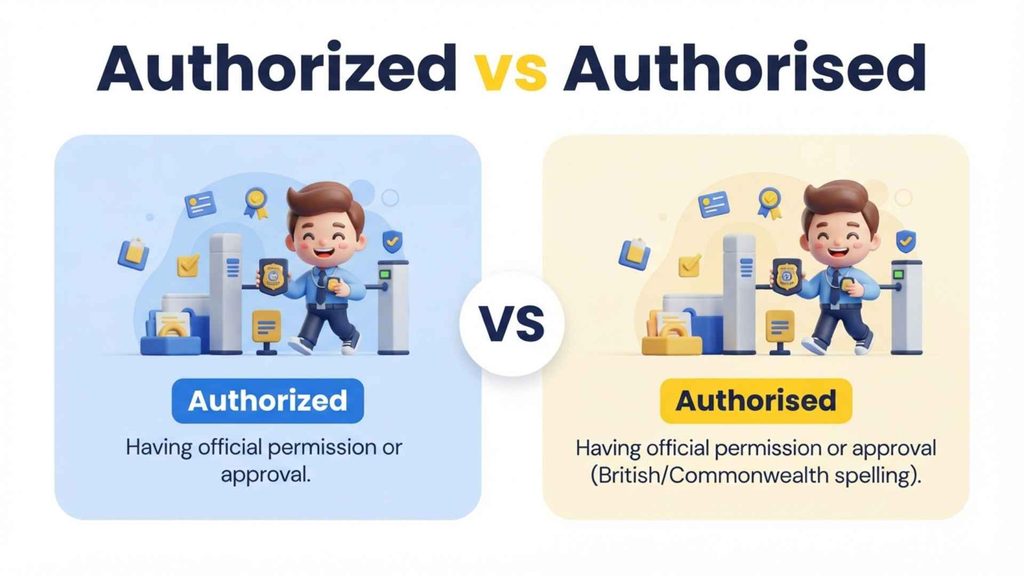
Getting the authorized or authorised question settled starts with one simple fact: this isn’t a typo debate, it’s a geography debate. Both spellings are grammatically correct the only thing that changes is which side of the Atlantic your reader is standing on.
What Does Authorised Really Mean?
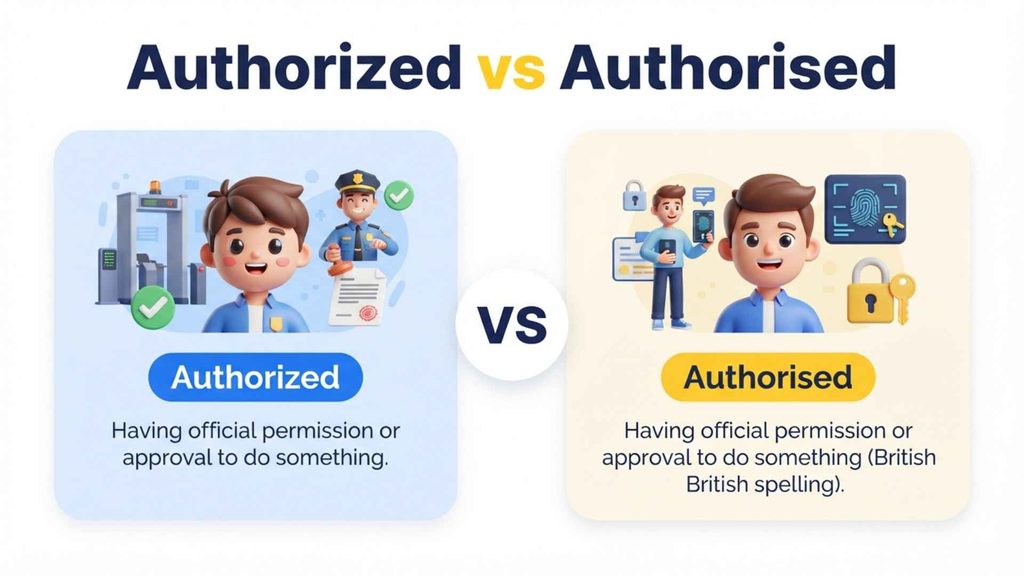
- Permission: it signals that official approval has been granted.
- Region matters: “authorised” leans British, “authorized” leans American.
- Same meaning: both describe someone or something with official approval.
- Context clues: legal, financial, and tech writing use both interchangeably by region.
- Consistency counts: pick one spelling and stay with it throughout a document.
Example in texting: Friend 1: Are you authorised to sign for the package? Friend 2: Yep, I’ve got the paperwork right here.
Authorised or Authorized UK
In the UK, the choice isn’t really a choice at all authorised is the expected, standard spelling across British schools, newspapers, and workplaces. Anyone writing for a UK audience should default to it without a second thought.
Why Does the UK Prefer Authorised Over Authorized?
- Tradition: British spelling drifted toward “-ise” endings over the last century.
- Media influence: UK newspapers and publishers standardised on “-ise” forms.
- Education system: British schools teach and grade “-ise” as the norm.
- Government use: UK legal and public documents almost always use authorised.
- Reader expectation: British audiences notice and flag the “-ize” spelling as odd.
| UK Context | Preferred Spelling | Example |
| Government forms | Authorised | “This form must be authorised by a manager.” |
| News publishing | Authorised | “The authorised report was released today.” |
| Banking | Authorised | “An authorised payment was processed.” |
| Education | Authorised | “The exam board authorised an extension.” |
Authorised UK Spelling
The authorised UK spelling follows a pattern you’ll find across dozens of everyday words, not just this one. Once the pattern clicks, you’ll never second-guess British spelling again.
How Consistent Is the Authorised UK Spelling Rule?
- Highly consistent: nearly every “-ize” verb has a British “-ise” twin.
- Applies broadly: organise, realise, recognise all follow the same shift.
- Noun forms shift too: authorisation, organisation, realisation.
- Oxford is the exception: the Oxford Dictionary still lists “-ize” first.
- Publishers choose sides: most UK press style guides mandate “-ise.”
- Spellcheck matters: UK English settings will flag “authorized” as incorrect.
Example in chat: Friend 1: My laptop keeps underlining authorised as wrong. Friend 2: Switch your spellcheck to UK English, it’ll stop flagging it.
How Do You Spell Authorised
If you’re wondering how do you spell authorised correctly, the answer is straightforward once you know the region you’re writing for but a few small mistakes trip people up constantly.
What’s the Easiest Way to Remember the Spelling?
- S for Sterling: British spelling uses “s,” just like the pound symbol.
- Z for the USA: American spelling keeps the “z” from “organize” and “realize.”
- Double-check the root: authoris(e) + ed = authorised, not “authorisied.”
- Watch the noun form: it’s “authorisation,” not “authorisization.”
- Use one spellchecker: set your document language to avoid mixed spellings.
| Word Form | British Spelling | American Spelling |
| Verb | Authorise | Authorize |
| Past tense | Authorised | Authorized |
| Gerund | Authorising | Authorizing |
| Noun | Authorisation | Authorization |
Authorized
Authorized, spelled with a “z,” is the standard American English form. It shows up in US laws, corporate policies, and everyday writing across North America, and it’s the version nearly every American reader expects to see.
Where Does Authorized Show Up Most in the US?
- Signage: “Authorized personnel only” on doors and restricted areas.
- Finance: banks confirm when a transaction was authorized.
- Government: Congress authorized funding through official legislation.
- Tech: devices display messages about authorized access.
- Retail: brands list their authorized dealers publicly.
Example in texting: Friend 1: Is this seller an authorized Apple dealer? Friend 2: Yeah, it says so right on their website.
Authorised
Authorised, spelled with an “s,” is the standard British English form, and it’s the version used across the UK, Australia, New Zealand, South Africa, and most Commonwealth nations.
Where Does Authorised Show Up Most Outside the US?
- Banking: UK banks confirm authorised payments before processing.
- Publishing: an “authorised biography” carries the subject’s approval.
- Law: British courts reference authorised signatories on documents.
- Retail: Commonwealth brands promote their authorised dealers.
- Government: British departments issue authorised statements.
Example in chat: Friend 1: Is she an authorised dealer for that brand? Friend 2: Yes, it’s listed on the official site.
Authorized or Authorised – Quick Answer
Short on time? Here’s the fast version of the authorised meaning debate, no scrolling required just the core facts laid out clearly so you can move on with your writing.
| Question | Answer |
| Are both spellings correct? | Yes |
| Which is used in the US? | Authorized (with “z”) |
| Which is used in the UK/Australia? | Authorised (with “s”) |
| Do they mean the same thing? | Absolutely yes |
| Which came first historically? | Authorized (with “z”) |
Bottom line: neither authorized nor authorised is wrong. The right pick depends entirely on the regional English you’re writing in.
The Origin of Authorized or Authorised
To really understand why authorised and authorized split apart, you have to travel back through centuries of language history it’s a far more interesting story than most people expect.
Where Did the Word Authorised Originally Come From?
- Latin roots: it traces to auctorizare, meaning “to give authority.”
- Greek influence: the “-ize” suffix comes from the Greek -izein.
- Original form: “authorize” was the accepted spelling everywhere, including Britain.
- Webster’s push: Noah Webster standardised “-ize” endings in American English.
- French influence: British English gradually drifted toward “-ise” spellings.
- Modern split: “authorised” became dominant in British print by the late 20th century.
Interestingly, the Oxford English Dictionary a British institution still lists “authorize” as the primary spelling, which surprises a lot of people who assume Oxford always favours “-ise.”
British English vs American English Spelling
The authorized or authorised split is just one example of a much bigger pattern between British and American spelling and once you see the rule, it applies to dozens of other words too.
Does This Spelling Rule Apply to Other Words Too?
- Broad pattern: American English favours “-ize,” British favours “-ise.”
- Common examples: organize/organise, realize/realise, recognize/recognise.
- Not universal: some British style guides still allow “-ize” as a variant.
- Consistency rule: never mix “-ize” and “-ise” in one document.
- Style guides decide: AP and Chicago prefer American forms; UK press prefers British.
| American English (-ize) | British English (-ise) |
| Authorized | Authorised |
| Organize | Organise |
| Recognize | Recognise |
| Realize | Realise |
| Customize | Customise |
| Prioritize | Prioritise |
Comparison Table
Sometimes a side-by-side view says more than paragraphs of explanation ever could here’s the full breakdown of authorised versus authorized in one place.
| Feature | Authorized | Authorised |
| Spelling | -ize | -ise |
| Region | USA, Canada | UK, Australia, NZ, South Africa |
| Formality | Standard | Standard |
| Historical origin | Earlier form | Later British adaptation |
| Oxford Dictionary | Listed as primary | Also accepted |
| Meaning | Officially permitted | Officially permitted |
How To Use “Authorised” In A Sentence
Knowing the authorised meaning is one thing using it correctly in a real sentence is where most writers actually get tested, especially in formal or legal contexts.
What Are the Different Grammatical Roles of Authorised?
- As a past tense verb: “The manager authorised the payment yesterday.”
- As a passive verb: “The document has been authorised by all parties.”
- As an adjective: “She is an authorised dealer for the brand.”
- In legal writing: “Mr. Smith is an authorised signatory for all contracts.”
- In tech contexts: “Only authorised users can access this database.”
Example in texting: Friend 1: Has the transfer been authorised yet? Friend 2: Yes, it went through about ten minutes ago.
Tip for writers: once you choose a spelling, stick with it throughout your document switching mid-piece looks careless and confuses readers.
Synonyms and Opposites
Leaning on synonyms keeps your writing from repeating authorised too many times, and knowing the opposites helps you spot the right word faster in context.
What Words Can Replace Authorised in a Sentence?
- Approved: a softer, more general alternative.
- Sanctioned: common in formal or governmental writing.
- Licensed: fits business and retail contexts well.
- Accredited: works for institutions and certifications.
- Empowered: useful when describing granted authority.
- Commissioned: fits official or ceremonial approval.
| Synonyms | Antonyms |
| Approved | Unauthorised |
| Permitted | Forbidden |
| Sanctioned | Prohibited |
| Licensed | Banned |
| Accredited | Rejected |
| Empowered | Denied |
Which Spelling Should You Use?
This is the question everyone’s actually asking: do you go with authorised or authorized? The answer comes down to your audience, not your personal preference.
How Do You Decide Which Spelling Fits Your Writing?
- US audience: use “authorized” for American readers and platforms.
- UK/Commonwealth audience: use “authorised” for British, Australian, or NZ readers.
- Global audience: pick one and remain fully consistent throughout.
- Academic writing: check your institution’s required English variant first.
- Company style guide: follow whatever your employer or client specifies.
Example in chat: Friend 1: Should I write authorised or authorized for this UK client? Friend 2: Go with authorised, that’s what they’ll expect.
Common Mistakes with Authorized or Authorised
Even confident writers slip up here. These are the errors that show up most often when people mix up authorised and its American twin.
What Are the Most Common Authorised Spelling Mistakes?
- Mixing spellings: using “authorized” in one paragraph and “authorised” in the next.
- Wrong audience fit: submitting UK legal documents with American spelling.
- Mismatched noun forms: pairing “authorised” with “authorization” instead of “authorisation.”
- Assuming formality differs: both spellings carry identical formal weight.
- Oxford myth: assuming Oxford always prefers “-ise” over “-ize.”
| Mistake | Correct Fix |
| Mixing “authorized” and “authorised” | Pick one spelling and keep it consistent |
| Pairing “authorised” with “authorization” | Use “authorisation” instead |
| Assuming one is more formal | Both carry equal formality |
Authorized or Authorised in Everyday Examples
Seeing real-world context makes the authorised meaning click faster than any rule ever could. Here’s how both spellings show up across daily life.
How Is Authorised Used in Everyday Conversations?
- Tech: “Your device is not authorized to access this network.” (US)
- Banking: “Only authorised accounts can initiate a transfer.” (UK)
- Business: “This document is signed by an authorized representative.” (US)
- Government: “The Secretary of State authorised the new policy.” (UK)
- Publishing: “An authorised biography” carries the subject’s approval.
Example in texting: Friend 1: Are you authorised to be in here? Friend 2: Yep, I’ve got clearance from security.
What Does Authorised Mean in Legal and Business Writing?
Legal and business documents lean on authorised constantly, and getting it wrong in a contract can actually raise real questions about validity and intent.
Why Does Legal Writing Care So Much About This Spelling?
- Contracts: an authorised signatory must match the document’s region.
- Compliance: regulators expect region-consistent spelling in filings.
- Corporate policy: internal style guides usually mandate one form.
- International firms: multinational contracts often pick British English by default.
- Clarity: consistent spelling avoids any appearance of tampering or error.
| Document Type | Common Region | Preferred Spelling |
| UK contracts | United Kingdom | Authorised |
| US contracts | United States | Authorized |
| International filings | Global | Either, but consistent |
Authorized or Authorised – Google Trends & Usage Data
Search data tells its own story about the authorised versus authorized split, and the pattern lines up almost perfectly with regional English usage.
What Does Search Data Reveal About Authorised?
- US and Canada: “authorized” dominates search interest by a wide margin.
- UK, Australia, NZ, India: “authorised” shows noticeably stronger interest.
- Global volume: “authorized” pulls more total searches due to US population size.
- British media: the “-ise” form appears roughly seven times more often than “-ize.”
- No convergence: both spellings remain firmly established in their regions.
Is Authorised More Common Than Authorized Worldwide?
Globally, raw search volume favours “authorized” simply because of audience size but that doesn’t mean authorised is losing ground in its own regions.
Which Regions Search Authorised the Most?
- United Kingdom: consistently the top searching region for authorised.
- Australia: strong, steady interest across major cities.
- New Zealand: mirrors UK search patterns closely.
- India: high interest due to British-influenced English education.
- South Africa: solid, consistent usage in formal writing.
Keyword Comparison Table
| Keyword Variant | Common Region | Typical Context |
| Authorized | USA, Canada | Legal, tech, government, business |
| Authorised | UK, Australia, NZ | Law, publishing, finance, government |
| Authorization | USA, Canada | Formal noun form in American documents |
| Authorisation | UK, Australia | Formal noun form in British documents |
| Authorized personnel | USA | Common signage and security context |
| Authorised signatory | UK | Common in British contract and finance |
| Authorized dealer | USA | Retail and product distribution |
| Authorised dealer | UK, Australia | Same meaning, British spelling |
More Heading Added: Authorised in Everyday Digital Life
Beyond legal paperwork, authorised shows up constantly in apps, banking alerts, and login screens small moments where the spelling still quietly signals a region.
Where Do You See Authorised Pop Up Online Daily?
- App permissions: “This app is not authorised to access your camera.”
- Banking alerts: “An authorised payment of £50 was made.”
- Two-factor logins: “Authorised device recognised, login approved.”
- Software licensing: “Only authorised copies receive updates.”
- Subscription services: “Authorised users can manage billing settings.”
Example in chat: Friend 1: My bank app flagged an authorised payment I didn’t make. Friend 2: Call them right away and get it reversed.
Frequently Asked Questions
Is “authorized” or “authorised” correct?
Both are correct. Authorized is standard American English, while authorised is standard British English, and the meaning is identical.
Which spelling does the Oxford Dictionary prefer?
The Oxford English Dictionary lists “authorize” as its primary spelling, even though authorised is far more common in everyday British use.
Can I use “authorised” in the United States?
You can, but American readers may find it unfamiliar. For US audiences, sticking with “authorized” instead of authorised is always the safer choice.
Does the spelling affect the meaning?
No. Authorised and authorized mean exactly the same thing officially permitted or approved with the spelling being purely regional.
What about “authorisation” vs “authorization”?
The same rule applies. “Authorisation” pairs with authorised in British English, while “authorization” pairs with “authorized” in American English.
Is “authorised” more formal than “authorized”?
No. Both authorised and “authorized” carry equal formality. Tone and context determine formality, not the regional spelling you choose.
Which spelling should I use for global content?
For global content, pick one and stay consistent. Authorised works perfectly for international readers, just like its American counterpart does.
Conclusion
The authorised meaning debate really comes down to one thing: geography, not grammar. Whether you write authorised or authorized, you’re using a word that means exactly the same thing officially approved or permitted just dressed in a different regional accent.
To recap: authorised belongs to UK, Australian, and Commonwealth English, while “authorized” belongs to American English. Neither is more correct, more formal, or more professional than the other. What actually matters is knowing your audience and staying consistent once you’ve made your choice.
So next time that flicker of doubt hits mid-sentence, you’ll already know the answer. Pick your region, pick your spelling, and write with confidence.

Amelia Brooks is a US-based author known for inspiring stories on meaning, growth, and hope, blending insight with simple, engaging storytelling.