
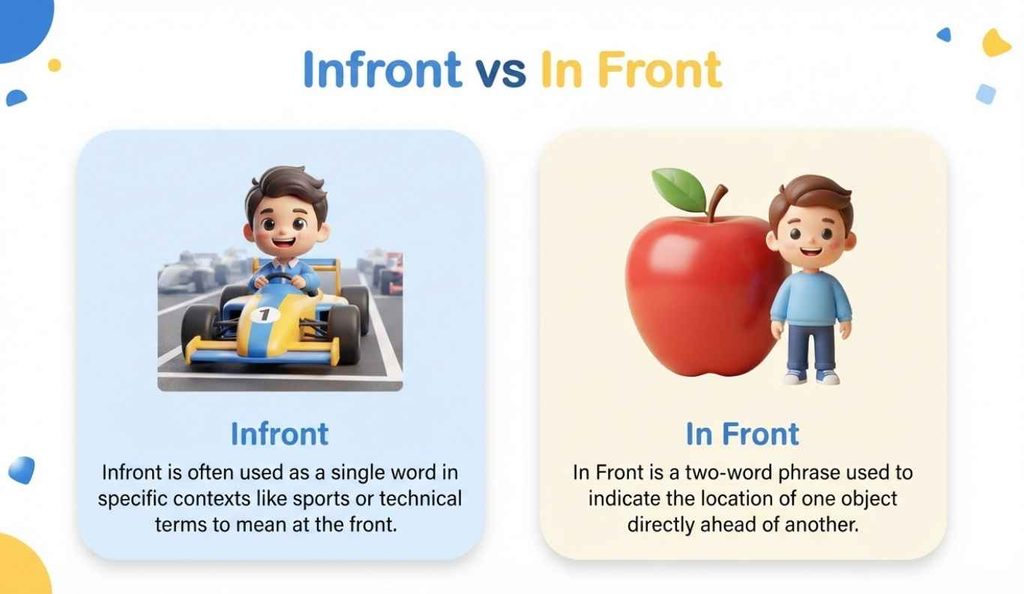
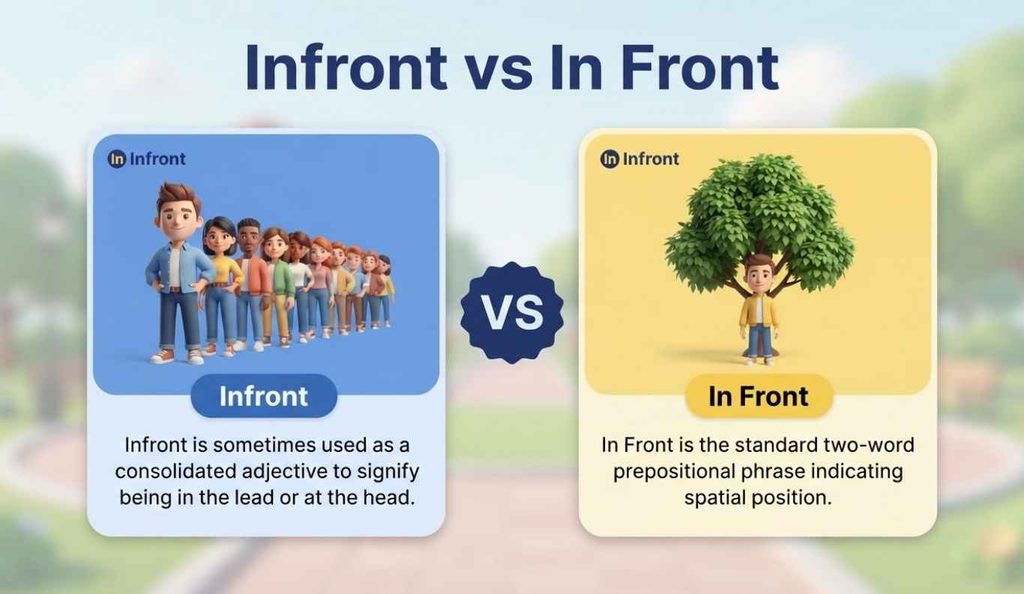
You are halfway through a sentence, your cursor is blinking, and suddenly you freeze: is it infront or in front? It happens to almost everyone, and it usually happens at the worst possible moment, like right before you hit send on an important email.
The good news is that this guide clears up the confusion for good. You will get the exact rule, plenty of real world examples, and a few memory tricks that make choosing between infront or in front an easy call every single time you write. By the end, you will not just know the answer, you will understand why it is the answer, which makes it stick for good.
Infront or In Front: Which Is Correct?
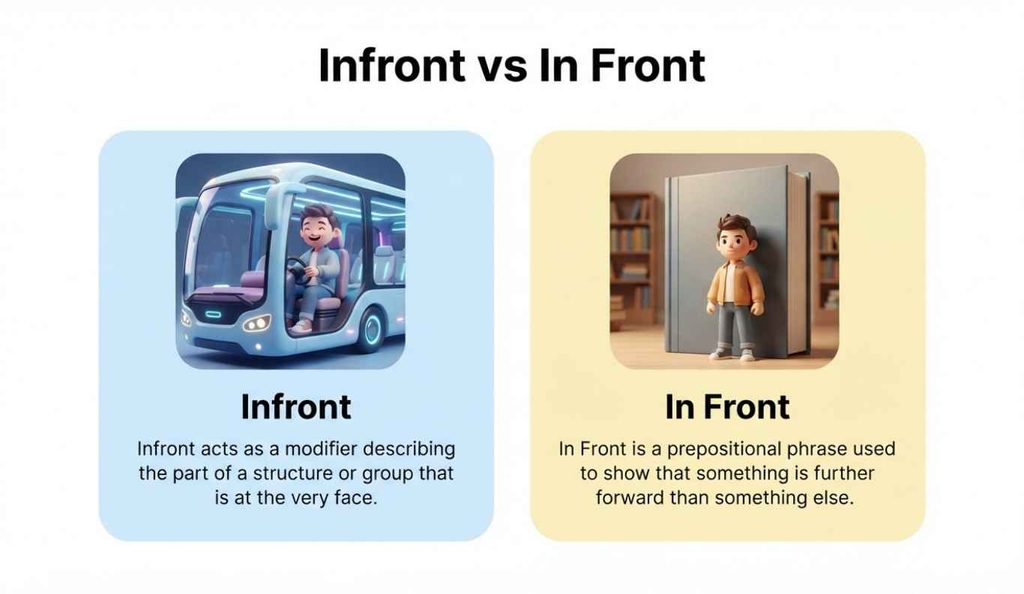
In front written as two separate words is the only correct form in standard English. Infront is not a recognized word in any major dictionary, and grammar checkers will flag it as an error every time.
This two word phrase describes position or location. When something is in front of another thing, it is placed ahead of it, closer to the front rather than behind. It is one of the most common prepositional phrases in everyday English, showing up in directions, descriptions, and casual conversation alike.
The confusion around infront or in front almost always comes from how the phrase sounds when spoken. Said quickly, in front blends together and sounds like a single word, which tricks people into typing it that way. But sound and spelling do not always match in English, and this is a perfect example.
Understanding In Front as a Phrase
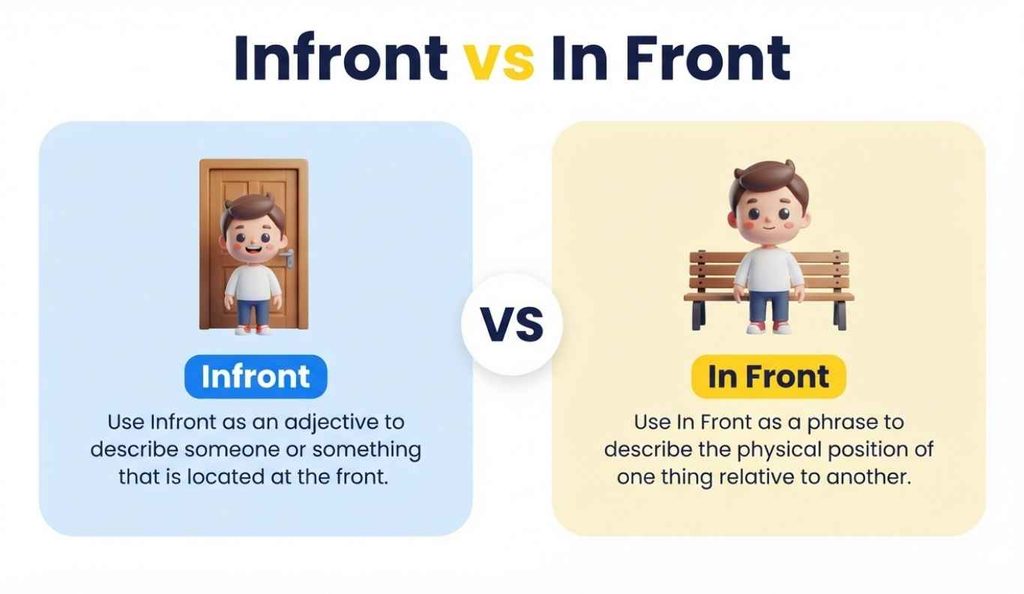
To really understand in front, it helps to break it into its two building blocks. In is a preposition, a small connecting word that links ideas together. Front is a noun, referring to the foremost part of something. Combined, they form a fixed prepositional phrase that tells you where something sits relative to something else.
This phrase almost always needs a companion, usually the word of, to complete its meaning. The dog sat in front of the fireplace tells you exactly where the dog was positioned. Without the second part of the sentence, in front is describing a relationship in space, not naming an object on its own.
What makes in front so useful is its flexibility. It works for physical positioning, like a car parked in front of a house, and it works just as well for abstract ideas, like a company staying ahead of its competitors or a runner staying in front of the pack. That range is part of why it shows up so often in both casual speech and formal writing.
Here are a few common ways the phrase appears:
- The mailbox is in front of the fence.
- He likes to sit in front during lectures.
- Keep the goal in front of you at all times.
- The statue stands in front of the museum entrance.
Grammatical Basis for Saying In Front and Not Infront
English has a small set of words formed by merging two smaller words into one, like into, inside, or onto. These compound words developed naturally over centuries of common usage, eventually earning their own dictionary entry as a single unit.
In front never went through that process. It remains a two word phrase, and no major dictionary, not Oxford, not Cambridge, and not Merriam-Webster, lists infront as an accepted spelling variant. That absence is the clearest possible signal: if a respected dictionary has not merged the words after centuries of use, it is not going to happen informally either.
Compare it to other common phrases that follow the exact same pattern of staying separated:
- In front stays two words, while infront is incorrect.
- In case stays two words, while incase is incorrect.
- In fact stays two words, while infact is incorrect.
- In between stays two words, while inbetween is incorrect.
The takeaway is simple. English grammar treats in as a standalone preposition that attaches to many different nouns, and none of those pairings collapse into single words. Recognizing this pattern is the fastest way to remember the rule for good.
Examples of Using In Front in a Sentence
Seeing in front used naturally across a range of situations is often the fastest way to lock the rule into memory. Here are real, everyday sentences showing how the phrase actually gets used:
- She stood in front of the mirror, practicing her speech one more time.
- The parking space in front of the building is reserved for visitors.
- There is a small garden in front of their house, full of tulips.
- The lead runner stayed in front for the entire final lap.
- She gets nervous speaking in front of a large crowd.
- The bodyguard walked in front of the celebrity through the lobby.
- Please wait in front of the conference room until we are ready.
- Our proposal puts sustainability in front of short term profit.
- A queue had already formed in front of the ticket booth.
- He parked his bike in front of the coffee shop.
Notice how the phrase adapts to both literal spatial situations like mirrors, buildings, and gardens, as well as more figurative ones like priorities, rankings, and competition. That versatility is exactly why in front appears so often in both casual messages and professional writing.
Other Correct Ways of Saying In Front
Repeating the same phrase over and over can make writing feel flat. Fortunately, English offers several strong synonyms and related phrases that carry a similar meaning while adding variety to your sentences.
Ahead works well for movement, time, or general positioning. She walked ahead of the group toward the trailhead. It also fits schedules nicely: We are ahead of schedule on the renovation.
At the forefront signals a leading role in ideas, research, or innovation. The lab is at the forefront of renewable energy research. This one carries a more formal, professional tone than a simple physical description.
Foremost emphasizes importance rather than literal position. Safety is foremost in our training program. It is less about location and more about priority.
Forward suggests direction and movement toward the front. The team pushed forward in the standings after their win streak.
Leading works especially well for rankings, competitions, or guidance. She is the leading candidate going into the final debate.
Common Mistakes and How to Avoid Them
The infront error persists mostly because of speed and habit. Fingers move faster than the brain double checks, and once a pattern gets typed a few times, it starts to feel normal even though it is wrong.
Understanding why the mistake happens makes it much easier to catch. Words like inside and into create a false pattern, tricking your brain into assuming in front should merge the same way. It does not, and recognizing that mismatch is half the battle.
A few practical habits make a real difference:
- Turn on spell check and grammar tools like Grammarly, which flag infront instantly.
- Read your writing out loud before sending it, because errors often sound off even when they look fine on screen.
- Keep a short personal list of words you tend to mix up, and glance at it before anything important.
- Practice typing the correct phrase a few times until the two word rhythm feels automatic.
- Compare it mentally to in between or in case whenever you are unsure.
Small checks like these, repeated consistently, turn a nagging uncertainty into a rule you simply do not think about anymore.
Frequently Asked Questions
Is infront a real word in the dictionary? No, infront does not appear as a valid entry in Oxford, Cambridge, Merriam-Webster, or any other major English dictionary. It is a common typing error, not a recognized alternate spelling.
Why is in front written as two words? In front stays as two words because it is a prepositional phrase, not a compound word. The preposition in pairs with dozens of nouns in English without ever merging into a single term.
Can you use in front and in front of interchangeably? Not quite, as they serve slightly different roles. In front alone often works as an adverb describing position without naming what it is relative to, like he walked in front. In front of is a full prepositional phrase that requires an object, like he walked in front of the class.
What is the opposite of in front? The most direct opposite of in front is behind, which describes something positioned at the back rather than the front. Other opposites depending on context include at the back, in the rear, or simply last when talking about rankings or races.
Is infront ever acceptable in informal writing? No, infront is incorrect in every type of writing, from casual texts and social media posts to formal reports and academic papers. The two word form, in front, is the only standard option.
Conclusion
In front is the correct form, always written as two separate words and never merged into infront. This small grammar rule matters more than it might seem, since consistent, accurate writing signals professionalism in emails, essays, and everyday messages alike. Once you understand why in front stays split because it is a prepositional phrase, not a compound word, the confusion around infront or in front tends to disappear for good.
Keep a few flexible alternatives in your back pocket too: ahead, foremost, forward, and leading all work well when you want variety instead of repeating in front too often. The next time your cursor pauses mid sentence, you’ll already know the answer. Practice it a few times, and writing in front correctly becomes second nature.

Amelia Brooks is a US-based author known for inspiring stories on meaning, growth, and hope, blending insight with simple, engaging storytelling.