
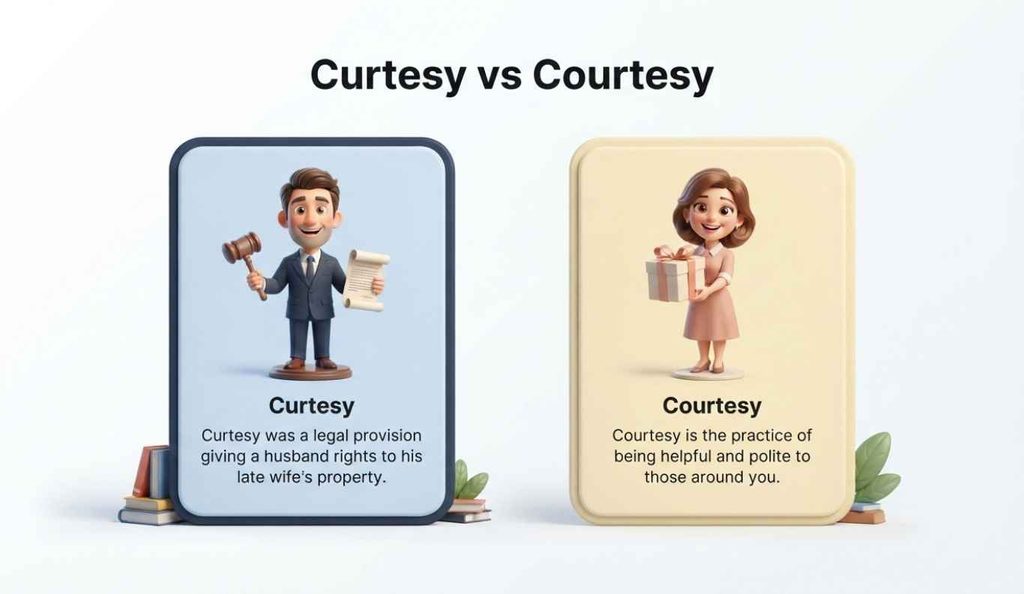
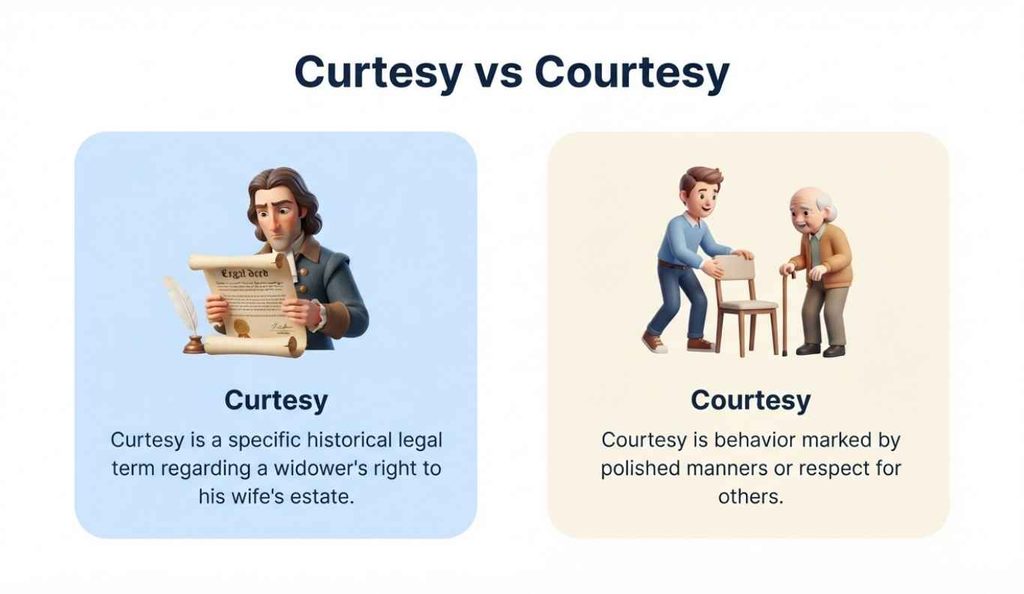
Ever typed a word, stared at it, and thought wait, is that even right? That’s exactly what happens to thousands of people every single day when they try to write courtesy and accidentally type curtesy instead. It feels small, but one letter can completely change what you’re actually saying.
Here’s the good news: by the end of this guide, you’ll fully understand the curtesy meaning, how it’s different from courtesy, and exactly when to use each one. We’ll walk through real examples, common slip-ups, and the true meaning behind both words so you never second-guess yourself again. Let’s clear this up together.
Define Courtesy
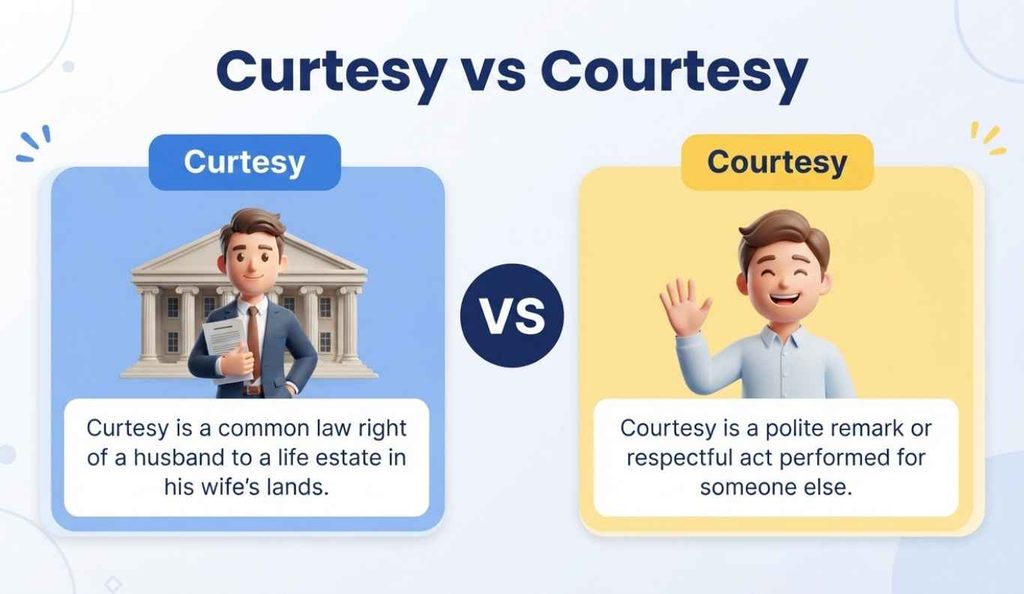
Politeness feels universal, but the word behind it has real weight. Courtesy and curtesy meaning get mixed up constantly, and this section untangles exactly why that happens.
What Does Courtesy Actually Mean In Everyday Life?
- Politeness is the core of courtesy it’s about basic respect.
- Good manners like saying “please” and “thank you” count as courtesy.
- Holding doors, offering a seat, or waiting your turn are courteous acts.
- Tone of voice and body language are part of showing courtesy.
- Professional courtesy means treating coworkers and clients with respect.
- Small gestures a nod, a smile often carry more weight than words.
- Consideration for others’ time and feelings sits at the heart of courtesy.
Example in texting:
Friend 1: “Thanks for holding the elevator, that was so nice of you 😊”
Friend 2: “Just basic courtesy lol, no big deal!”
Define Curtesy
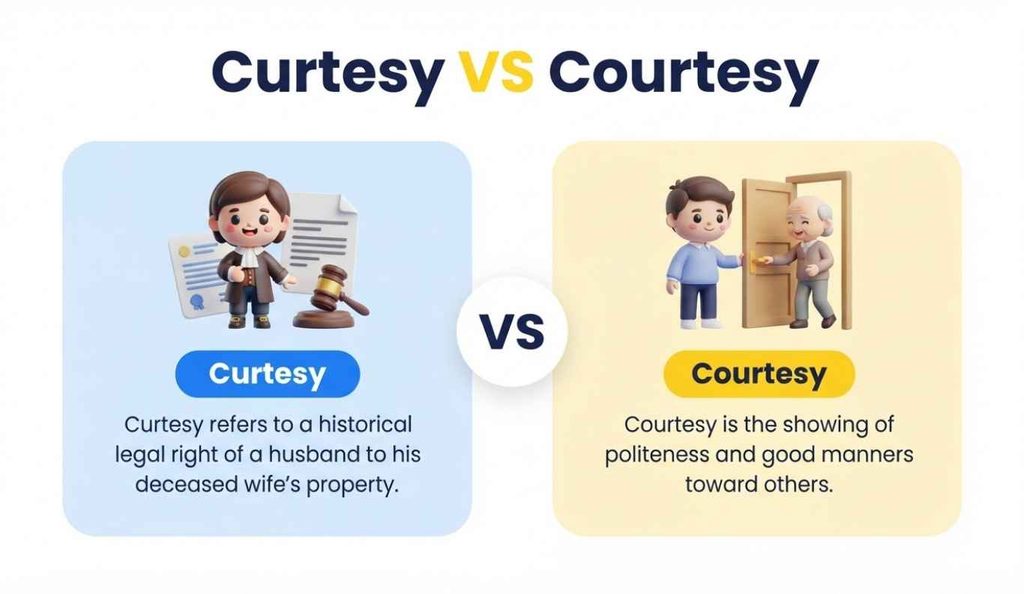
Now here’s where things get interesting. This is the word people almost never mean to use but once you know the real curtesy meaning, you’ll never confuse it with meaning-ful gestures of politeness again.
What Is The Legal Curtesy Meaning In Old English Law?
- Curtesy is a legal term, not a manners word at all.
- It refers to a husband’s right to his deceased wife’s property.
- The right applied under old English common law for centuries.
- Real estate and land were the main assets involved.
- The husband received a life estate, not permanent ownership.
- Modern inheritance laws have made curtesy almost entirely obsolete.
- It still appears in historical legal texts and law school lectures.
Example in texting:
Friend 1: “Why did my law professor keep saying ‘curtesy’ instead of ‘courtesy’?”
Friend 2: “Different word! It’s a legal term about a husband inheriting his wife’s property.”
How To Properly Use The Words In A Sentence
Grammar rules feel dry until you actually use them wrong in front of someone. Getting the curtesy meaning and courtesy usage right instantly makes your writing look more polished and confident.
How Do You Know Which Word Fits Your Sentence?
- Courtesy works in almost every social or professional sentence.
- Curtesy only belongs in legal or historical writing.
- Ask yourself: is this about manners or inheritance rights?
- Courtesy pairs naturally with verbs like “show” and “extend.”
- Curtesy usually appears alongside words like “rights” or “law.”
- When unsure, courtesy is almost always the safer, correct choice.
- Double-check spelling before sending anything formal or professional.
| Sentence Example | Correct Word | Why |
| “The hotel offers a courtesy shuttle.” | Courtesy | Refers to a free, polite service |
| “He inherited land through curtesy.” | Curtesy | Legal inheritance right |
| “She showed courtesy to every guest.” | Courtesy | Polite social behavior |
| “The court upheld his curtesy claim.” | Curtesy | Legal ruling on property |
Example in chat:
Friend 1: “Should I write ‘as a curtesy’ in this work email?”
Friend 2: “Nope, it’s ‘as a courtesy’ curtesy is a totally different legal term.”
What Does Curtesy Really Mean In Law?
This question gets searched constantly, and for good reason the legal curtesy meaning genuinely surprises most readers who assumed it was just a spelling variation.
- Curtesy grants a husband a life estate in his wife’s land.
- The right only activated if the couple had a living child.
- Dower, the wife’s equivalent right, worked slightly differently.
- Most jurisdictions have abolished curtesy through modern property statutes.
- Law students still study it as part of historical property law.
Example in texting:
Friend 1: “So curtesy isn’t just an old spelling of courtesy?”
Friend 2: “Nope, totally separate it’s a real historical inheritance law.”
More Examples Of Courtesy & Curtesy Used In Sentences
Seeing words in context beats memorizing definitions every time. These extra sentences reinforce the curtesy meaning while showing courtesy in action across everyday situations.
Where Do These Words Show Up Most Often?
- Courtesy appears constantly in customer service and hospitality writing.
- Curtesy shows up mainly in legal documents and case law.
- Courtesy calls are polite check-ins, common in business settings.
- Curtesy rights appear in wills, estates, and property disputes.
- Courtesy can describe a free item, like a courtesy car.
- Curtesy never describes free items or friendly gestures.
- News articles almost always mean courtesy, never curtesy.
| Context | Example Sentence |
| Hospitality | “The airline provided a courtesy meal during the delay.” |
| Legal | “His curtesy interest in the estate was contested in court.” |
| Workplace | “She extended courtesy to the new intern on his first day.” |
| Historical | “Curtesy law shaped inheritance patterns for centuries.” |
Example in chat:
Friend 1: “My grandma’s will mentioned ‘curtesy rights’ for my grandpa.”
Friend 2: “That’s the legal term he had a life estate in her property.”
Common Mistakes To Avoid
Almost everyone who mixes these words up doesn’t even realize they’re doing it. Spotting these patterns early protects your writing and sharpens your grasp of the curtesy meaning for good.
Why Do Writers Keep Swapping These Two Words?
- Autocorrect often changes courtesy to curtesy without warning.
- Similar spelling tricks the eye into skipping the difference.
- Curtsy (the bow/dance move) adds even more confusion.
- Curtesy is rarely taught outside legal or history classes.
- Courtesy is a noun and adjective, never used as a verb.
- Formal writing is where these mix-ups get noticed the most.
- Proofreading out loud catches most of these errors instantly.
Example in texting:
Friend 1: “I wrote ‘curtesy’ in my cover letter, is that bad?”
Friend 2: “Yeah, fix it to ‘courtesy’ before you send it different word entirely.”
Why Do People Confuse Curtesy With Courtesy?
This is one of the most searched questions about these two words, and understanding it fully locks in the curtesy meaning for the long run.
- Phonetic similarity makes both words sound nearly identical aloud.
- Rare usage of curtesy means most people never see it written.
- Spellcheck tools sometimes flag courtesy as the error instead.
- Historical fading of curtesy law removed it from daily vocabulary.
- Visual similarity between the letters “o” and “u” adds confusion.
Example in chat:
Friend 1: “Honestly I didn’t even know curtesy was a real word.”
Friend 2: “Same, I always thought it was just a typo for courtesy.”
Context Matters
Context is everything with these two words get it wrong, and your sentence sends a completely different message than you intended.
Does The Setting Change Which Word You Should Use?
- Social settings almost always call for the word courtesy.
- Legal documents are the only place curtesy truly belongs.
- Academic writing on law history may use curtesy correctly.
- Business emails should stick with courtesy in nearly every case.
- Heraldry uses courtesy in a specialized, formal sense too.
- News and blogs rarely have a valid reason to use curtesy.
- When in doubt, default to courtesy for everyday communication.
| Setting | Correct Word | Reason |
| Customer service | Courtesy | Politeness and service quality |
| Property law case | Curtesy | Inheritance and estate rights |
| Wedding etiquette | Courtesy | Social manners and hosting |
| Historical law lecture | Curtesy | Academic, legal terminology |
Example in texting:
Friend 1: “Is curtesy ever okay to use in a wedding speech?”
Friend 2: “No way, that’s a courtesy situation save curtesy for law class.”
Exceptions To The Rules
Every language rule has its edge cases, and these two words are no exception. Knowing the exceptions keeps you from over-correcting in the wrong direction.
Are There Situations Where Curtesy Is Actually Correct?
- Legal filings referencing historical inheritance law require curtesy.
- Heraldry courtesy grants coats of arms to non-entitled descendants.
- Textbooks on English legal history use curtesy accurately.
- Curtsy (the physical bow) is a separate word entirely.
- Fiction set in medieval times may use curtesy for authenticity.
Example in chat:
Friend 1: “My historical novel draft uses ‘curtesy law’ is that fine?”
Friend 2: “Yes, that’s actually the correct legal term for that time period.”
When Should You Use Curtesy Instead Of Courtesy?
People search this exact phrase constantly, and the honest answer narrows down to just a handful of specific, real-world situations.
- Discussing inheritance law from medieval or colonial England.
- Writing legal briefs referencing a husband’s historical property rights.
- Studying property law in a law school or bar exam context.
- Explaining dower and curtesy as a paired historical legal concept.
- Never in casual conversation, texting, or everyday professional writing.
Example in texting:
Friend 1: “So basically curtesy has like one narrow use case?”
Friend 2: “Pretty much legal and historical only, courtesy covers everything else.”
Practice Exercises
Nothing cements a lesson like testing yourself. These quick exercises put the curtesy meaning and courtesy usage directly into practice.
Can You Pick The Right Word Every Time?
- Fill-in-the-blank sentences train your instinct quickly.
- Reading answers aloud helps catch mistakes before submitting.
- Repetition across different contexts builds lasting memory.
- Checking a dictionary afterward confirms your reasoning was correct.
- Timing yourself adds a fun challenge to the practice.
Exercise Fill in the blank:
- It’s common ________ to say thank you. (courtesy)
- The widower held property through ________ law. (curtesy)
- She greeted guests with warmth and ________. (courtesy)
- The court upheld his ________ claim to the estate. (curtesy)
Example in chat:
Friend 1: “I got all four right on the first try!”
Friend 2: “Nice, the courtesy vs curtesy meaning is finally sticking for you.”
Curtesy Meaning In Legal Documents Explained
Legal writing has its own vocabulary, and curtesy sits firmly inside that specialized world rather than everyday speech.
- Wills and estates occasionally reference curtesy in older cases.
- Property deeds from centuries past may cite curtesy rights.
- Modern statutes have largely replaced curtesy with equal inheritance laws.
- Law reviews discuss curtesy as a historical legal doctrine.
- Bar exam prep materials still cover curtesy under property law.
Example in texting:
Friend 1: “My law textbook has a whole section on curtesy.”
Friend 2: “Yeah it’s a classic property law topic, comes up on exams a lot.”
Origin And History Of The Word Curtesy
Understanding where curtesy came from makes the modern curtesy meaning click into place far more naturally.
- Norman-influenced English law first established the curtesy doctrine.
- Feudal property systems shaped how inheritance rights were divided.
- A living child was originally required to activate the right.
- Colonial America adopted versions of curtesy law from England.
- Gradual abolition happened as gender-equal inheritance laws emerged.
Example in chat:
Friend 1: “Wait, curtesy law is actually centuries old?”
Friend 2: “Yep, it traces back to old English common law traditions.”
Synonyms For Courtesy And Curtesy
Knowing related words helps you avoid repetition and strengthens your overall vocabulary around politeness and legal rights.
| Word | Synonyms |
| Courtesy | Politeness, manners, respect, civility, graciousness |
| Curtesy | Life estate, inheritance right, property claim, legal entitlement |
- Civility works as a strong substitute for courtesy in formal writing.
- Graciousness highlights warmth alongside basic politeness.
- Life estate is the closest legal synonym for curtesy.
- Property claim captures the legal weight behind curtesy.
- Etiquette overlaps with courtesy in social and professional contexts.
Example in texting:
Friend 1: “Is there a fancier word for courtesy I can use in my essay?”
Friend 2: “Try ‘civility’ it sounds more formal and means the same thing.”
FAQs
Can I use curtesy instead of courtesy in everyday writing?
No. The curtesy meaning is strictly legal, so everyday politeness always calls for courtesy instead.
Is courtesy ever correct in legal documents?
Rarely. Legal documents about inheritance almost always require the true curtesy meaning, not courtesy.
Are courtesy and curtesy pronounced the same way?
They’re extremely close in pronunciation, which is exactly why the curtesy meaning gets confused so often.
Does curtesy still apply under modern law?
Mostly no. Most regions replaced the historical curtesy meaning with equal inheritance laws decades ago.
Is curtsy the same word as curtesy?
No. A curtsy is a physical bow, while the curtesy meaning refers strictly to a legal property right.
Why does autocorrect sometimes suggest curtesy?
Spellcheck tools occasionally misfire, but understanding the real curtesy meaning helps you catch and reject that suggestion.
What’s the easiest way to remember the difference?
Link courtesy to “manners” and the curtesy meaning to “inheritance law” that simple pairing rarely fails.
Conclusion
Getting the curtesy meaning right isn’t just a grammar technicality it’s the difference between sounding polished and sounding unsure. Courtesy covers the polite, everyday gestures that build trust and good manners, while the curtesy meaning stays locked into legal and historical inheritance rights. Mixing them up is common, but now you have clear examples, tables, and practice to back you up.
Next time you’re typing an email, a legal note, or even a casual text, pause for a second and ask which meaning fits. That small habit will save you from awkward corrections and make your writing feel noticeably more confident, one word at a time.

Amelia Brooks is a US-based author known for inspiring stories on meaning, growth, and hope, blending insight with simple, engaging storytelling.