
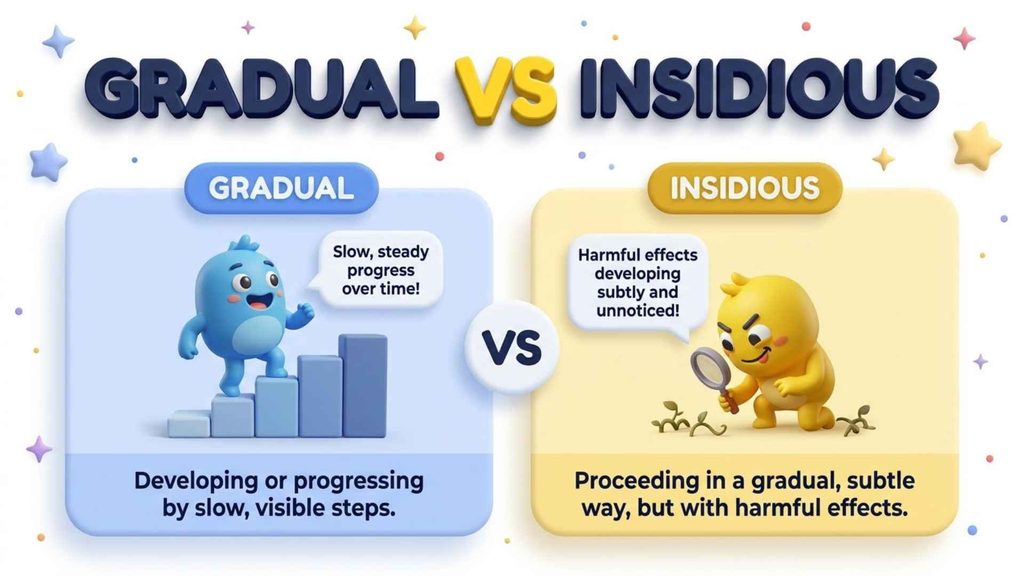
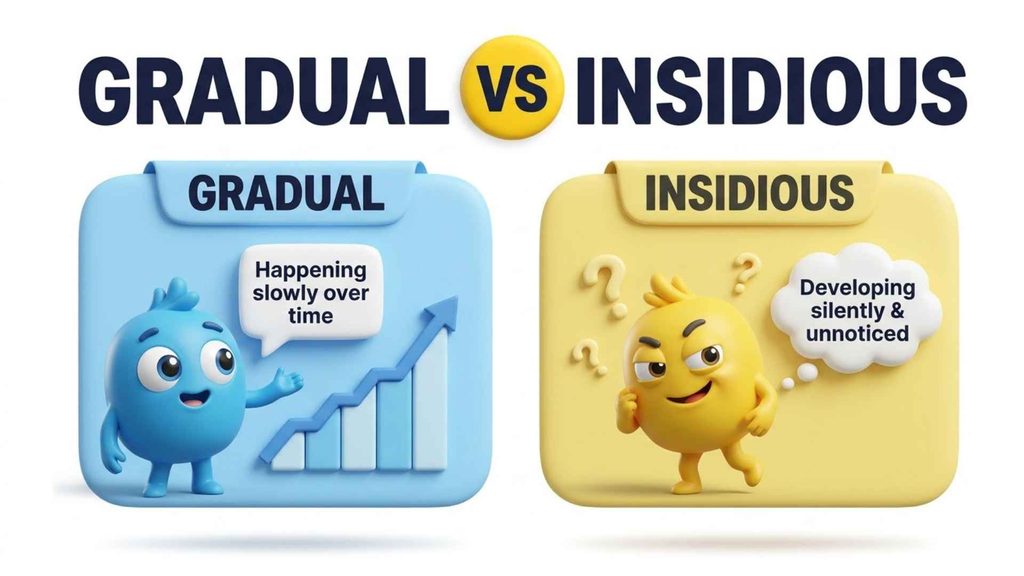
Ever read a sentence and felt a word was almost right, but something still felt off? That quiet doubt is why Gradual vs Insidious trips up students, writers, and professionals alike.
This guide settles Gradual vs Insidious with clear definitions, real examples, and one simple rule. You will also see why insidious carries a heavier punch. Stay with me, because this is easier than it looks.
What Does “Gradual” Mean?
Ever watched a plant grow and noticed nothing, yet it kept rising? That is gradual change, and it anchors the whole Gradual vs Insidious debate before insidious enters.
What Is the Simple Definition of Gradual?
- Moves slowly in small, steady stages
- Builds step by step over time
- Describes pace, not good or bad
- Applies to growth, decline, or neutral shifts
- Feels natural and easy to follow
Example in chat: Friend 1: My Spanish is getting better, but so slowly. Friend 2: That’s gradual progress. It still counts.
Characteristics of Gradual Change
Some changes arrive like a sunrise, not a siren. These traits explain why gradual feels calm in the Gradual vs Insidious comparison, while insidious feels like a warning.
What Are the Key Traits of Gradual Change?
- Progresses steadily without sudden jumps
- Remains mostly visible if you watch closely
- Stays neutral in emotional tone
- Can be positive, negative, or neither
- Feels predictable and often expected
| Trait | Gradual Change |
| Speed | Slow and steady |
| Visibility | Usually noticeable |
| Tone | Neutral |
| Predictability | Often expected |
Example in texting: Friend 1: Why does winter fade so slowly here? Friend 2: Temperatures change gradually, one warmer week at a time.
Examples of Gradual Changes
Think about a child learning to read, one letter at a time. These everyday cases show gradual growth clearly, which makes the Gradual vs Insidious contrast sharper when insidious harm appears later.
What Are Real-Life Examples of Gradual Change?
- Learning to read over several school years
- Shifting seasons moving from summer to autumn
- Growing a company’s market share slowly
- Healing from an injury across months
- Improving fitness with consistent weekly training
Example in chat: Friend 1: Are you fit yet? Friend 2: Getting there. My stamina improves gradually every week.
Example Sentence
A good sentence makes a word stick in memory. Here is gradual in action, a simple model for Gradual vs Insidious practice, with insidious waiting for its own turn later.
How Do You Use Gradual in a Sentence?
- Pair it with nouns like improvement or decline
- Use it for pace, never for hidden danger
- Place it before the change it describes
- Keep the tone neutral and clear
- Avoid it when harm is the main point
“The patient showed gradual improvement after several weeks of treatment.”
Example in texting: Friend 1: How’s your knee? Friend 2: Gradual improvement. Walking is easier each day.
What Does “Insidious” Mean?
Some problems whisper instead of shout. That is the heart of insidious, the sharper half of Gradual vs Insidious, where slow change hides real harm until damage is already done.
What Is the Definition of Insidious?
- Develops slowly in a harmful, sneaky way
- Hides behind normal-looking daily routines
- Carries a strongly negative connotation
- Causes damage before anyone notices
- Suggests deception, danger, or hidden threat
Example in chat: Friend 1: Why do you call his habit insidious? Friend 2: It crept in quietly and hurt everything before we noticed.
Characteristics of Insidious Processes
Picture a leak behind a wall, silent and steady. These traits explain why insidious earns its dark reputation in Gradual vs Insidious, unlike calm, neutral gradual change.
What Makes a Process Insidious?
- Starts small, quiet, and easy to ignore
- Stays hidden behind subtle, stealthy signs
- Harms people, systems, or surroundings
- Resists early detection and quick diagnosis
- Strikes hard once the damage shows
| Trait | Insidious Process |
| Speed | Slow and creeping |
| Visibility | Hidden or subtle |
| Tone | Negative |
| Outcome | Harmful |
Example in texting: Friend 1: Why didn’t anyone catch the mold sooner? Friend 2: It was insidious. Nothing looked wrong until the walls swelled.
Examples of Insidious Developments
Some dangers grow in the dark, like an unnoticed addiction. These cases show how insidious harm behaves in Gradual vs Insidious usage, far from the harmless pace of gradual progress.
What Are Real-Life Examples of Insidious Developments?
- Diseases with few early symptoms
- Toxic workplace culture draining morale slowly
- Financial fraud schemes built on small trusts
- Addiction forming quietly over many months
- Misinformation shaping public opinion over time
Example in chat: Friend 1: Did you see how fake news spread? Friend 2: Insidious. Nobody noticed until everyone believed it.
Example Sentence
Words stick when you see them used well. This example shows insidious at work inside Gradual vs Insidious, where insidious warns of danger that quietly builds in the background.
How Do You Use Insidious in a Sentence?
- Attach it to harm, threats, or damaging effects
- Choose it when the danger is hidden
- Pair it with nouns like spread, effect, or influence
- Skip it for good or neutral change
- Match the serious tone to the context
“The insidious effects of chronic stress can damage both physical and mental health.”
Example in texting: Friend 1: Why am I always so tired lately? Friend 2: Chronic stress is insidious. It drains you quietly.
Gradual vs Insidious: The Core Difference
Here is the moment everything clicks. The heart of Gradual vs Insidious is simple: every insidious process is slow, but only some slow processes are harmful, hidden, or deceptive.
What Is the Main Difference Between Gradual and Insidious?
- Gradual describes speed or manner of change
- Insidious adds hidden, harmful, deceptive qualities
- Every insidious process is gradual
- Not every gradual process is insidious
- Context decides which word fits
| Feature | Gradual | Insidious |
| Develops over time | Yes | Yes |
| Slow progression | Yes | Yes |
| Negative meaning | Not necessarily | Yes |
| Hidden or deceptive | Not usually | Often |
| Harmful effect | Optional | Usually present |
| Emotional tone | Neutral | Negative |
Example in chat: Friend 1: Slow and harmful, so which word? Friend 2: Insidious. If it’s just slow, say gradual.
Why People Confuse Gradual and Insidious
Both words involve time, so the mix-up feels natural. That overlap fuels the Gradual vs Insidious confusion, because many people forget insidious carries a heavy, negative layer on top of slow change.
Why Do People Mix Up Gradual and Insidious?
- Focus on slow speed alone causes errors
- Overlook the negative tone of insidious
- Assume every slow change is dangerous
- Rely on similar-sounding, formal vocabulary
- Skip checking the word’s connotation first
Example in texting: Friend 1: I wrote “insidious growth” about my savings. Friend 2: Savings growth is good. Gradual fits better.
Common Mistake
A single wrong word can flip a sentence’s mood. This mistake appears constantly in Gradual vs Insidious writing, and it happens when insidious is used for something positive.
What Is the Most Common Gradual vs Insidious Mistake?
- Using insidious for positive progress
- Calling healthy habits insidious by accident
- Ignoring the hidden-harm meaning completely
- Choosing words by sound, not meaning
- Forgetting gradual is the neutral option
Incorrect: “She made insidious progress in learning Spanish.” Correct: “She made gradual progress in learning Spanish.”
Example in chat: Friend 1: My essay says insidious improvement. Is that okay? Friend 2: Swap it for gradual. Improvement isn’t harmful.
When Insidious Fits Better
Sometimes only one word does the job. Knowing when insidious beats gradual is the final puzzle piece in Gradual vs Insidious, especially when danger hides inside slow, ordinary change.
When Should You Use Insidious Instead of Gradual?
- Pick it when harm is clearly present
- Use it when signs are subtle or hidden
- Choose it for threats that sneak in
- Reserve it for deception or danger
- Check that damage appears before awareness
“The insidious spread of misinformation influenced public opinion before experts could respond.”
Example in texting: Friend 1: Why insidious here and not gradual? Friend 2: Because it was slow, sneaky, and hurt people.
Gradual vs Insidious in Healthcare
Few fields show this contrast better than medicine. In Gradual vs Insidious discussions, doctors separate healing that builds slowly from insidious illness that quietly spreads without clear warning signs.
How Are Gradual and Insidious Used in Medicine?
- Doctors describe recovery as gradual improvement
- Clinicians call quiet illness an insidious condition
- Symptoms may appear slowly and progressively
- Diagnosis often comes late for insidious cases
- Screening helps catch hidden problems early
| Medical Context | Gradual | Insidious |
| Recovery | Steady healing | Not applicable |
| Illness | Slow, expected progression | Silent, hidden progression |
| Outlook | Positive or neutral | Concerning |
Example in chat: Friend 1: Dad’s recovery seems slow. Friend 2: Gradual is normal. The scary ones are the silent illnesses.
Gradual Medical Changes
Healing rarely happens overnight. These examples show gradual recovery in the Gradual vs Insidious medical picture, a hopeful contrast to any insidious disease that develops unnoticed.
What Are Examples of Gradual Medical Improvements?
- Muscle recovery after surgery
- Weight loss through diet and exercise
- Improved cardiovascular fitness over months
- Bone healing after a fracture
- Reduced pain with steady physical therapy
Example in texting: Friend 1: How’s the physio going? Friend 2: Slow but gradual. My shoulder moves a bit more weekly.
Insidious Medical Conditions
Some illnesses give almost no early warning. In Gradual vs Insidious terms, these are the insidious ones, developing quietly while people feel perfectly fine and daily life continues unchanged.
Which Medical Conditions Are Called Insidious?
- Type 2 diabetes often starts with mild symptoms
- Osteoporosis weakens bones without obvious pain
- High blood pressure rarely causes early symptoms
- Chronic kidney disease progresses quietly for years
- Some cancers grow silently before diagnosis
Example in chat: Friend 1: But I feel totally fine. Friend 2: High blood pressure is insidious. Get it checked anyway.
Example
A quick side-by-side removes any doubt. This healthcare example captures Gradual vs Insidious perfectly, showing how insidious illness differs from reassuring, slow recovery in tone and risk.
How Can One Example Show the Difference?
- Recovery that improves slowly is gradual
- Disease that spreads quietly is insidious
- Gradual feels reassuring and expected
- Insidious feels concerning and urgent
- Timing alone never decides the word
A gradual recovery is positive. An insidious disease progression is concerning because damage may occur before diagnosis.
Example in texting: Friend 1: Which one is scarier? Friend 2: Insidious. You don’t see it coming.
Gradual vs Insidious in Psychology
The mind changes slowly too, for better or worse. Within Gradual vs Insidious, psychologists separate healthy growth from insidious influences that reshape thinking without anyone realizing it happened.
How Do Psychologists Describe Gradual and Insidious Changes?
- Growth like confidence builds gradually
- Manipulation alters thinking insidiously
- Awareness often arrives only afterward
- Support from therapists helps spot patterns
- Context separates healthy change from harm
| Area | Gradual | Insidious |
| Confidence | Builds with practice | Erodes through criticism |
| Habits | Formed deliberately | Formed unnoticed |
| Awareness | High | Low |
Example in chat: Friend 1: I’ve changed so much this year. Friend 2: Gradual growth. You earned every bit of it.
Gradual Psychological Development
People rarely become confident or resilient overnight. These patterns show gradual growth in Gradual vs Insidious psychology, a healthy contrast to insidious mental pressure that works quietly beneath awareness.
What Does Healthy Psychological Growth Look Like?
- Building confidence through repeated small wins
- Learning coping skills during stressful periods
- Developing emotional maturity over many years
- Practicing self-awareness with patience
- Achieving personal growth step by step
Example in texting: Friend 1: You handle stress better now. Friend 2: Thanks. Therapy helped, and the change was gradual.
Insidious Psychological Effects
Some mental harm sneaks in disguised as normal life. In Gradual vs Insidious terms, these insidious effects slowly shift thoughts and behavior while the person stays unaware of what is happening.
What Are Insidious Psychological Effects?
- Emotional manipulation that wears down trust
- Gaslighting that makes people doubt themselves
- Chronic stress draining energy quietly
- Burnout building under constant pressure
- Negative self-talk repeating until it feels true
Example in chat: Friend 1: Why do I doubt myself so much? Friend 2: Constant criticism is insidious. It rewires how you think.
Gradual vs Insidious in Business and Organizations
Companies change slowly, yet not every shift is healthy. In Gradual vs Insidious business talk, gradual growth builds strength while insidious problems quietly weaken culture, trust, and performance.
How Do Gradual and Insidious Changes Affect Organizations?
- Healthy growth strengthens teams and revenue
- Hidden problems erode culture silently
- Leaders often miss early warning signs
- Regular feedback exposes quiet risks sooner
- Awareness protects long-term organizational health
| Business Area | Gradual | Insidious |
| Revenue | Steady increase | Slow, hidden leakage |
| Culture | Strengthening teamwork | Quiet toxicity |
| Risk | Low | High |
Example in texting: Friend 1: Why did half the team quit? Friend 2: Insidious culture issues. Nobody flagged them early.
Gradual Business Growth
Steady progress is the dream of every founder. These examples show gradual success in Gradual vs Insidious business use, with none of the hidden danger that makes insidious such a warning word.
What Does Gradual Business Growth Look Like?
- Expanding customer bases month after month
- Increasing revenue through consistent effort
- Developing employee skills over time
- Improving operational efficiency step by step
- Strengthening brand trust with steady delivery
Example in chat: Friend 1: How’s the startup doing? Friend 2: Gradual growth. No big spikes, just steady wins.
Insidious Organizational Problems
Trouble at work often starts quietly. In Gradual vs Insidious workplaces, these insidious issues hide in plain sight until morale, ethics, or security finally take serious, visible damage.
What Are Insidious Problems in the Workplace?
- Toxic workplace culture spreading unnoticed
- Ethical lapses normalized by small compromises
- Declining employee engagement over many months
- Hidden cybersecurity threats lurking in systems
- Corruption growing behind polite routines
Example in texting: Friend 1: Nobody speaks up in meetings anymore. Friend 2: That’s insidious. Silence grew slowly, then took over.
Gradual vs Insidious in Environmental Issues
Nature changes constantly, but not all change is equal. For Gradual vs Insidious in ecology, natural shifts are gradual while insidious threats quietly damage ecosystems long before anyone sounds the alarm.
How Do Gradual and Insidious Changes Shape the Environment?
- Natural processes shift slowly and predictably
- Human-driven harm accumulates quietly
- Visible damage often arrives too late
- Monitoring helps detect hidden pollution early
- Awareness drives better environmental choices
| Environment | Gradual | Insidious |
| Source | Natural cycles | Pollution, contamination |
| Effect | Neutral or renewing | Harmful, long-lasting |
| Detection | Easy | Difficult |
Example in chat: Friend 1: Why worry about tiny plastic bits? Friend 2: They build up insidiously. By the time we notice, it’s huge.
Gradual Environmental Changes
Landscapes shift like slow-moving paintings. These natural processes show gradual change in the Gradual vs Insidious environmental debate, calm and expected, unlike the quiet harm tied to insidious pollution.
What Are Examples of Gradual Environmental Change?
- Natural erosion reshaping riverbanks over decades
- Seasonal climate variations repeating each year
- Forest regeneration after a wildfire
- Slow shifts in coastal sand patterns
- Soil formation across thousands of years
Example in texting: Friend 1: Why is the canyon so wide? Friend 2: Gradual erosion. Millions of years of flowing water.
Insidious Environmental Threats
Some environmental damage stays invisible for years. In Gradual vs Insidious terms, these insidious threats spread quietly through air, soil, and water, showing real harm only after major ecological loss.
What Are Insidious Threats to the Environment?
- Microplastic accumulation in oceans and food
- Soil contamination from long-term chemical use
- Long-term pollution exposure harming communities
- Biodiversity loss that creeps in unnoticed
- Groundwater poisoning discovered years too late
Example in chat: Friend 1: The water looked fine for years. Friend 2: That’s the insidious part. Contamination hides until it’s severe.
How to Decide Which Word to Use
Choosing between two close words can feel stressful. This simple method settles Gradual vs Insidious in seconds, and it shows exactly when insidious is the right call and when it is not.
What Is the Easiest Way to Choose Between Gradual and Insidious?
- Ask whether the change is slow
- Check whether the change is harmful
- Decide if the harm is subtle
- Apply gradual when harm is absent
- Apply insidious when harm is hidden
Example in texting: Friend 1: I can never pick the right word. Friend 2: Slow? Gradual. Slow, harmful, and sneaky? Insidious.
Is the Change Happening Slowly?
Speed is always the first test. For Gradual vs Insidious, slowness qualifies both words, so this step simply opens the door before insidious needs further proof of harm.
How Do You Tell If a Change Is Slow Enough?
- Look for progress in small stages
- Compare the situation across weeks or months
- Notice the lack of sudden jumps
- Confirm the change builds over time
- Move to the next question if yes
Example in chat: Friend 1: Is this change slow enough? Friend 2: Yes. Now check whether it’s actually harmful.
Is the Change Harmful?
Harm is the real dividing line. In Gradual vs Insidious, harmless slow change stays gradual, and only harmful slow change can move toward insidious territory.
How Do You Know If a Change Is Harmful?
- Identify who or what suffers damage
- Weigh short-term and long-term consequences
- Separate healthy growth from quiet decline
- Use gradual when the effect is neutral
- Continue only when harm is clearly present
Example in texting: Friend 1: Is a slow salary raise harmful? Friend 2: No. That’s gradual. Insidious needs real damage.
Is the Harm Subtle or Difficult to Notice?
This final check makes the biggest difference. For Gradual vs Insidious, hidden harm earns the word insidious, while obvious, easily spotted harm usually needs another term entirely.
How Can You Spot Hidden or Subtle Harm?
- Watch for damage that appears late
- Notice warning signs people routinely ignore
- Ask whether anyone saw it coming
- Expect disguised, stealthy, quiet progression
- Choose insidious if the answer is yes
Example in chat: Friend 1: Nobody noticed the leak for months. Friend 2: Slow, harmful, hidden. Definitely insidious.
Quick Rule
Short rules beat long explanations. This cheat sheet makes Gradual vs Insidious easy to remember forever, and it keeps insidious reserved for the situations that truly deserve its serious, warning-like tone.
What Is the Quick Rule for Gradual vs Insidious?
- Gradual equals slow
- Insidious equals slow plus harmful plus subtle
- Test harm before choosing insidious
- Default to gradual for neutral change
- Memorize the formula for fast writing
| Word | Formula |
| Gradual | Slow |
| Insidious | Slow + Harmful + Subtle |
Example in texting: Friend 1: Give me a shortcut. Friend 2: Gradual is slow. Insidious is slow, harmful, and sneaky.
Common Examples Side by Side
Seeing both words together makes the lesson real. These pairings put Gradual vs Insidious in direct contrast, so the insidious side stands out clearly against its calmer, neutral cousin.
What Are Some Everyday Gradual vs Insidious Comparisons?
- Learning compares growth with self-doubt
- Health compares recovery with silent disease
- Workplace compares hiring with toxic culture
- Technology compares updates with hidden malware
- Pattern stays the same across every field
| Area | Gradual | Insidious |
| Learning | Studying a language for years | Self-doubt from repeated criticism |
| Health | Regaining strength | Silent high blood pressure |
| Workplace | Expanding a team | Toxic behavior hurting morale |
| Technology | Multiple software updates | Malware collecting data unnoticed |
Example in chat: Friend 1: Same word, different feeling? Friend 2: Exactly. Gradual is calm. Insidious sets off alarms.
Example 1: Learning
School shows this contrast daily. In Gradual vs Insidious learning, steady study is gradual, while repeated criticism that builds self-doubt can become insidious, harming confidence quietly.
How Do Gradual and Insidious Appear in Learning?
- Gradual: learning a new language over years
- Gradual: reading skills improving each term
- Insidious: self-doubt from constant criticism
- Insidious: quietly losing motivation to study
- Lesson: harm and subtlety make the difference
Example in texting: Friend 1: Why did you stop trying? Friend 2: Years of small criticisms. The doubt crept in slowly.
H2: Example 2: Health
Your body sends signals, and sometimes none at all. For Gradual vs Insidious health talk, strength returning is gradual, while silent damage that grows unnoticed is insidious.
How Do Gradual and Insidious Appear in Health?
- Gradual: regaining strength after physical therapy
- Gradual: blood sugar improving with lifestyle change
- Insidious: high blood pressure without obvious symptoms
- Insidious: bone loss before any fracture
- Tip: routine checkups catch hidden problems
Example in chat: Friend 1: I feel healthy, so why a checkup? Friend 2: Insidious conditions hide. Testing finds them early.
Example 3: Workplace
Offices can change without anyone saying a word. In Gradual vs Insidious workplace terms, steady hiring is gradual, while toxic habits that quietly drag morale down are insidious.
How Do Gradual and Insidious Appear at Work?
- Gradual: expanding a team over several quarters
- Gradual: improving processes through small updates
- Insidious: toxic behavior eroding trust slowly
- Insidious: disengagement spreading unnoticed
- Fix: honest feedback and visible leadership
Example in texting: Friend 1: Morale dropped out of nowhere. Friend 2: Not out of nowhere. It was insidious, building for months.
Example 4: Technology
Devices quietly change too. For Gradual vs Insidious in tech, steady software updates are gradual, while malware collecting data in the background is insidious, because it hides while harming users.
How Do Gradual and Insidious Appear in Technology?
- Gradual: apps improving through regular updates
- Gradual: battery capacity fading with normal use
- Insidious: malware stealing data unnoticed
- Insidious: tracking scripts collecting private information
- Habit: update software and review permissions
Example in chat: Friend 1: My phone feels slower every month. Friend 2: Could be gradual wear. Or hidden malware. Scan it.
Gradual vs Insidious Synonyms and Antonyms
Vocabulary gets richer with alternatives. These related words sharpen your grasp of Gradual vs Insidious, and they help you swap in precise phrases when insidious feels too strong or too repetitive.
What Are Synonyms and Antonyms for Gradual and Insidious?
- Gradual synonyms: steady, progressive, incremental
- Insidious synonyms: stealthy, sly, treacherous
- Gradual antonyms: sudden, abrupt, rapid
- Insidious antonyms: harmless, open, benign
- Check connotation before swapping any synonym
| Word | Synonyms | Antonyms |
| Gradual | Steady, incremental, progressive | Sudden, abrupt |
| Insidious | Stealthy, creeping, subtle, treacherous | Harmless, benign, obvious |
Example in texting: Friend 1: Another word for insidious? Friend 2: Stealthy or creeping, when harm sneaks in.
Gradual vs Insidious in Technology and Cybersecurity
Digital threats rarely announce themselves. In Gradual vs Insidious cybersecurity, steady system upgrades are gradual, while stealthy attacks that quietly collect data show exactly why insidious is the right word.
Why Are Cyber Threats Often Called Insidious?
- Malware can sit undetected for months
- Phishing exploits trust with small, believable steps
- Data theft often happens quietly in the background
- Monitoring tools detect unusual, hidden behavior
- Updates and strong passwords reduce long-term risk
Example in chat: Friend 1: How did they steal the data? Friend 2: Insidious malware. It collected everything quietly for months.
Gradual vs Insidious in Relationships
Relationships shift in small steps, good or bad. For Gradual vs Insidious, trust grows gradual over time, while controlling patterns that creep in unnoticed are insidious, hurting people before they realize.
How Do Gradual and Insidious Changes Affect Relationships?
- Trust builds gradually through consistent actions
- Control can grow insidiously through small demands
- Isolation from friends often happens quietly
- Honest conversations expose unhealthy patterns early
- Boundaries protect long-term emotional wellbeing
Example in texting: Friend 1: When did things get this bad? Friend 2: It was insidious. Small changes added up over time.
Gradual vs Insidious Word Origin and Etymology
Words carry history inside them. Looking at the roots behind Gradual vs Insidious explains the tone, since insidious comes from a root tied to ambush, while gradual traces back to steps.
Where Do the Words Gradual and Insidious Come From?
- Gradual traces back to the Latin word for step
- Insidious comes from Latin meaning ambush or deceit
- Steps explain the slow, staged feel of gradual
- Ambush explains the sneaky, harmful feel of insidious
- Roots make each connotation easy to remember
Example in chat: Friend 1: Why does insidious sound so sinister? Friend 2: Its Latin roots are about ambush and deceit.
What Does Insidious Mean in a Sentence?
People search for this constantly, and it is easy to answer. Within Gradual vs Insidious, insidious appears in sentences about hidden, harmful, slow-building problems that people fail to notice early.
How Is Insidious Used in Everyday Sentences?
- Describe hidden dangers like “an insidious plot”
- Warn about slow harm like “insidious effects”
- Label quiet threats such as insidious misinformation
- Pair it with disease, doubt, or manipulation
- Avoid it for positive or neutral change
Example in texting: Friend 1: Use insidious in a sentence. Friend 2: “Insidious rumors slowly ruined the team’s trust.”
Is Insidious Always Negative?
Tone matters more than most people expect. In Gradual vs Insidious usage, insidious is almost always negative, while gradual can stay neutral, positive, or negative depending on the situation.
Can Insidious Ever Be Used Positively?
- Standard usage keeps insidious firmly negative
- Playful exaggeration may exist but is rare
- Formal writing should always treat it as harmful
- Gradual is the safer word for neutral change
- Readers expect danger when they see insidious
| Word | Usual Tone |
| Gradual | Neutral |
| Insidious | Negative |
Example in chat: Friend 1: Can I say insidious beauty? Friend 2: That reads as hidden danger. Try subtle beauty.
What Is the Opposite of Insidious?
Opposites help meaning settle in. In Gradual vs Insidious, the opposite of insidious is something open, harmless, or sincere, not simply fast change, which is a different contrast altogether.
What Words Mean the Opposite of Insidious?
- Harmless describes safe, nonthreatening change
- Benign fits medical or mild situations
- Obvious describes visible, easy-to-spot problems
- Honest suits open, sincere behavior
- Sudden opposes gradual, not insidious
Example in texting: Friend 1: Opposite of insidious? Friend 2: Harmless or obvious. Sudden is the opposite of gradual.
Key Takeaways
Short lists help memory last. Here is the essence of Gradual vs Insidious, a quick recap that keeps insidious and its calmer cousin separate every time you write or speak.
What Should You Remember About Gradual vs Insidious?
- Both words describe change over time
- Gradual focuses on pace and stays neutral
- Insidious always implies harm or danger
- Detection is usually difficult for insidious processes
- Context guides the correct word choice
Example in chat: Friend 1: One-line summary? Friend 2: Gradual is slow. Insidious is slow, sneaky, and harmful.
Frequently Asked Questions
What is the main difference in Gradual vs Insidious?
Gradual means slow and steady, while insidious means slow, hidden, and harmful. The main difference in Gradual vs Insidious is harm.
Can something be both gradual and insidious?
Yes, many insidious processes develop gradually. In Gradual vs Insidious, the extra element is hidden harm.
Is insidious always a negative word?
Almost always. In Gradual vs Insidious, insidious signals danger, deception, or damage that grows quietly.
What does insidious onset mean in medicine?
It means symptoms begin slowly and subtly. In Gradual vs Insidious, doctors use it for hard-to-notice illness.
Is gradual a positive word?
Not necessarily. In Gradual vs Insidious, gradual is neutral and describes pace, not good or bad.
Why do writers choose the word insidious?
Writers use it to stress hidden danger. In Gradual vs Insidious, it adds tension and warning.
How do you quickly choose between the two words?
Check for slow pace, harm, and subtlety. In Gradual vs Insidious, all three point to insidious.
Conclusion
Choosing between the two words is really about more than speed. Gradual vs Insidious comes down to whether a slow change is simply steady or quietly harmful. Gradual describes pace, while insidious adds hidden danger and deception.
Now you have the quick rule, the examples, and the context from healthcare to business. Next time you describe a slow change, ask whether it carries concealed risk. That one question settles Gradual vs Insidious every time, and it makes your writing sharper and more trustworthy.
Meta Description
Gradual vs Insidious explained simply: learn when slow change is harmless and when it hides real harm, with clear examples and a quick rule.
Extracted LSI, NLP, and Semantic Keywords (from competitor article)
- Core terms: gradual, insidious, gradual change, insidious process, insidious onset, slow progression
- Related phrases: step by step, steadily over time, hidden harm, subtle and difficult to notice, damage before diagnosis, negative connotation, neutral in meaning
- Entities and fields: healthcare, psychology, business, organizations, environment, technology, doctors, psychologists, leaders
- Medical terms: type 2 diabetes, osteoporosis, high blood pressure, chronic kidney disease, some cancers, early symptoms
- Psychology terms: gaslighting, emotional manipulation, chronic stress, burnout, negative self-talk, emotional maturity
- Business and tech terms: toxic workplace culture, ethical lapses, corruption, cybersecurity threats, malware, financial fraud, market share
- Environmental terms: microplastic accumulation, soil contamination, long-term pollution, biodiversity loss, natural erosion, forest regeneration
- Semantic extras: subtle, deceptive, stealthy, creeping, incremental, progressive, treacherous, harmless, benign, sudden, abrupt

Amelia Brooks is a US-based author known for inspiring stories on meaning, growth, and hope, blending insight with simple, engaging storytelling.