
You’ve been there. You’re halfway through a report, and suddenly you freeze: is it “the analysis shows” or “the analyses show”? That split-second hesitation feels small, but it can shake your confidence in a sentence you were otherwise proud of.
Here’s the good news: the analysis vs analyses confusion has a clean, learnable rule behind it. This guide walks you through the definitions, the grammar logic, common mistakes, and a few memory tricks that make the difference stick for good. Keep reading, and you’ll never second-guess this pair again.
Analysis vs Analyses: What’s the Difference?
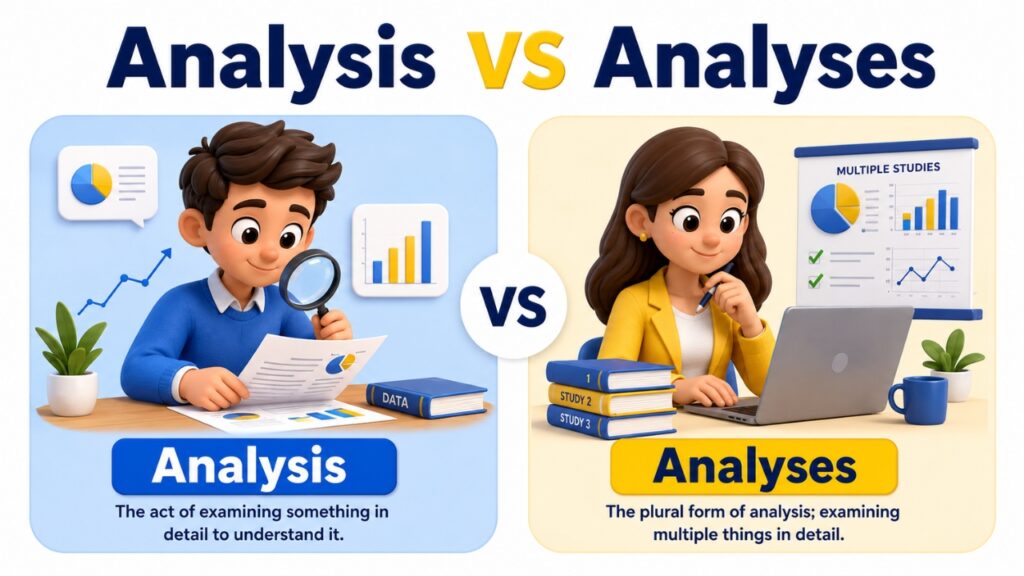
Here’s the short version: analysis is one examination. Analyses is more than one. Both words describe breaking something down to study it closely, but the count changes the spelling entirely.
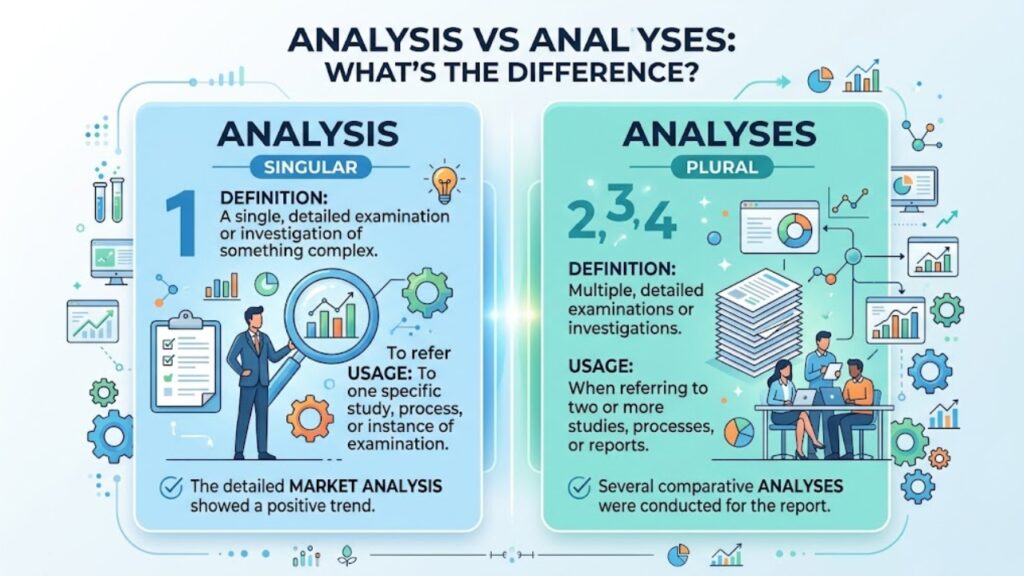
- One report, one study, one deep dive → analysis
- Two or more reports, studies, or breakdowns → analyses
That’s really it. The tricky part isn’t the meaning, it’s the shape the word takes when it shifts from one to many. Unlike most English nouns, this pair doesn’t just tack on an “s.”
What Makes This Word Pair Confusing?
A lot of writers assume every plural in English follows the same pattern, so they reach for the familiar “add an -s” instinct. Analysis breaks that expectation completely, which is exactly why so many people pause mid-sentence.
- The word looks like it should follow regular rules
- It comes from Greek, not native English roots
- Spellcheck doesn’t always catch the wrong form
- Verb agreement changes along with the noun
- Even confident writers second-guess it in emails
Core Definitions
Getting the core meaning locked in solves most of the confusion instantly. Analysis and analyses share a root, but the number attached to each one is what decides which word belongs in your sentence.
What Does “Analysis” Mean? (Singular)
Analysis describes a single, detailed look at something: a set of data, a document, a situation, or a problem broken into pieces so you can understand it better. It’s the word you reach for when you’re talking about one specific examination.
- “The analysis revealed a sharp drop in customer retention.”
- “Her analysis of the contract flagged two risky clauses.”
- “This quarterly analysis is due by Friday.”
- “The lab’s analysis confirmed the results.”
- “A quick analysis of the numbers tells the whole story.”
Example in chat: Friend 1: Did you finish the analysis for the meeting? Friend 2: Yep, sending it over now.
What Does “Analyses” Mean? (Plural)
Analyses simply means more than one analysis: multiple examinations, studies, or evaluations looked at together. You’ll see this plural form most often in research, comparative studies, or reports referencing several separate breakdowns.
- “The researchers ran three independent analyses before publishing.”
- “Competing analyses of the same dataset reached different conclusions.”
- “Several analyses contradicted the original study.”
- “Her analyses span a decade of research.”
- “All prior analyses were reviewed before the vote.”
Example in texting: Friend 1: The two analyses don’t match up at all Friend 2: Yeah I noticed that too, weird
Analysis vs Analyses Comparison Table
| Feature | Analysis | Analyses |
| Grammatical number | Singular | Plural |
| Meaning | One detailed examination | Multiple detailed examinations |
| Pronunciation | uh-NAL-uh-sis | uh-NAL-uh-seez |
| Example sentence | “The analysis is complete.” | “The analyses are complete.” |
| Common fields | Business reports, single case studies | Meta-studies, comparative research |
| Verb agreement | Singular verb (“is,” “was”) | Plural verb (“are,” “were”) |
Grammar Rules
Once you understand why the word changes shape, the whole analysis vs analyses debate stops feeling random. There’s a clear pattern at work here, and it’s borrowed straight from Greek.
Singular vs Plural: The Rule Behind the Change
Most English nouns become plural by adding “-s” or “-es.” Analysis skips that pattern entirely because it isn’t a native English word. Nouns ending in “-is” that come from Greek typically swap that ending for “-es” instead.
| Singular | Plural |
| analysis | analyses |
| crisis | crises |
| thesis | theses |
| hypothesis | hypotheses |
| diagnosis | diagnoses |
- Spot the “-is” ending as your first clue
- Swap “-is” for “-es” instead of adding one
- Apply the rule across the whole word family
- Never default to a plain “add -s” guess
- Trust the pattern once you’ve seen it a few times
Why “Analysises” Is Never Correct
Because the standard English instinct is to add “-s,” plenty of learners write “analysises.” That form simply doesn’t exist. If a word ends in “-is” and traces back to Greek or Latin, check the “-is → -es” swap before defaulting to a regular plural.
- “Analysises” is not a real word, ever
- The correct plural is always analyses
- Autocorrect won’t always flag this mistake
- The same trap catches “crisises” and “thesises”
- Memorizing the swap prevents repeat errors
What Are Other Similar Greek Plurals in English?
Analysis isn’t alone in following this unusual pattern, and a handful of academic words share the same Greek or Latin logic. Recognizing them builds your confidence with unfamiliar vocabulary fast.
| Pattern | Singular | Plural |
| -is → -es | basis | bases |
| -on → -a | phenomenon | phenomena |
| -um → -a | datum | data |
| -a → -ae | formula | formulae |
| -us → -i | syllabus | syllabi |
Origin of the Word “Analysis”
Analysis comes from the Greek term análysis, meaning “a loosening” or “a breaking apart.” Its Greek plural, analýseis, is the direct ancestor of the English word “analyses.” English kept that Greek plural shape instead of inventing a new one, which explains why “analyses” looks nothing like a typical English plural.
- The root traces back to ancient Greek
- “Loosening” or “breaking apart” is the core sense
- English borrowed the plural pattern directly
- No new plural rule was ever invented
- The Greek origin explains the odd spelling
American vs British English Usage
There’s genuinely no split here: American and British English spell and use both analysis and analyses identically. The only related difference sits with the verb form. British writers use “analyse,” while American writers use “analyze,” but the nouns stay the same everywhere.
Common Mistakes
Even careful writers slip up with this pair, usually because the words look so similar on the page. Spotting these patterns early saves you from an awkward correction later.
Using “Analyses” as a Singular
❌ “The analyses shows a clear trend.” ✔ “The analysis shows a clear trend.”
If you’re describing one study, the singular noun and singular verb need to match. Mixing a plural noun with a singular verb reads as an error every time.
Using “Analysis” for Multiple Studies
❌ “We conducted three analysis last quarter.” ✔ “We conducted three analyses last quarter.”
Once the count goes above one, the plural form is required, no exceptions and no shortcuts around it.
Pronouncing Them Incorrectly
Because the words look nearly identical in writing, many speakers blur the pronunciation too. That mix-up causes just as much confusion out loud as it does on paper, especially in meetings and presentations.
How to Use “Analysis” Correctly
Reach for analysis whenever you’re describing a single act of examining something: one dataset, one report, one situation.
- “This analysis explains why sales dipped in March.”
- “Our financial analysis supports expanding into new markets.”
- “The lab’s analysis confirmed the sample was contaminated.”
- “A careful analysis usually reveals the real issue.”
- “Send me your analysis by end of day.”
How to Use “Analyses” Correctly
Reach for analyses when you’re referring to two or more separate examinations, whether they come from the same author or different sources entirely.
Example Sentences
| Sentence | Correct Form |
| “The quarterly ______ is attached.” | analysis |
| “Several ______ contradicted the original study.” | analyses |
| “His ______ of the poem impressed the professor.” | analysis |
| “The committee reviewed all prior ______ before voting.” | analyses |
| “Independent ______ from three universities confirmed the result.” | analyses |
Is Analyses Just the Plural of Analysis?
Mostly yes, but there’s a small twist worth knowing. “Analyses” is the standard plural noun, and it’s also the British spelling of the verb “analyses” (as in “she analyses data weekly”).
- Analyses as a noun means multiple studies
- Analyses as a verb is the British form of “analyzes”
- Context tells you which one you’re reading
- The pronunciation actually differs between the two
- American English keeps “analyzes” for the verb
Pronunciation Guide
Getting the sound right matters just as much as getting the spelling right, especially in a meeting where nobody can see how you typed it.
| Word | Phonetic Spelling | Sounds Like |
| analysis | /əˈnæl.ə.sɪs/ | uh-NAL-uh-sis |
| analyses (plural noun) | /əˈnæl.əˌsiːz/ | uh-NAL-uh-seez |
| analyses (verb, British) | /əˈnæl.əˌsaɪz/ | uh-NAL-uh-syz |
That last row trips people up the most. The plural noun and the British verb share a spelling but not a sound, which is a subtle detail that catches even confident speakers off guard.
What’s the Difference Between Analysis and Analyzes?
“Analyzes” is a verb form, not a plural noun at all. It’s what you use with “he,” “she,” or “it” in the present tense, as in “she analyzes the report every Monday.”
- Analysis is always a noun
- Analyzes is the American verb form
- Analyses can be a noun or a British verb
- Swapping these three causes real confusion
- Reading the sentence’s role clears it up fast
Tips to Remember the Difference
A few small mental shortcuts make this pair stick without any memorization drills.
Simple Memory Trick
If the word describes one thing, it ends on that soft, closed “-is” sound. If it describes many things, it stretches into a longer “-eez” sound, much like how “trees” signals more than one.
Visual Cue
Picture analysis as a single thread. Now picture it splitting into several strands, and that’s analyses. The visual mirrors the actual meaning: one thing branching into many.
Pronunciation Trick
Say both words out loud, back to back, to train your ear:
- Analysis → uh-NAL-uh-sis (short, closed ending)
- Analyses → uh-NAL-uh-SEEZ (long, open ending)
That longer “eez” sound is your signal you’re dealing with more than one.
Which Form Should You Use in a Research Paper?
Academic writing leans heavily on this distinction, so getting it right matters more here than almost anywhere else. Use analysis for a single study’s findings, and analyses the moment you’re comparing multiple sources.
- A single dissertation chapter usually needs analysis
- A literature review comparing five papers needs analyses
- Peer reviewers notice this mistake quickly
- Style guides like APA expect strict number agreement
- Reading your verb choice back often reveals the error
Analysis vs Analyses in Business Reports
Workplace writing has its own rhythm, and this pair shows up constantly in quarterly reviews, memos, and client decks. Getting the number right keeps your report looking sharp and professional.
- A single dashboard review is one analysis
- Comparing three quarters’ data needs analyses
- Executive summaries often default incorrectly to singular
- Financial teams should double-check plural agreement
- Client-facing documents get scrutinized for this error
Quick Practice Quiz
Fill in the blanks with the correct word.
- The ______ shows a strong correlation between the two variables.
- Multiple ______ confirmed the same result across different labs.
- Their ______ disagrees with earlier published research.
- We need a deeper ______ before finalizing the report.
Answers: 1. analysis, 2. analyses, 3. analysis, 4. analysis
FAQs
What is the difference between analysis and analyses?
Analysis is singular and refers to one examination. Analyses is plural and refers to two or more studies combined.
Is “analyses” a correct English word?
Yes, it’s the standard plural of analysis, and it’s also the British verb form of “to analyse.”
How do you pronounce analysis and analyses?
Analysis sounds like “uh-NAL-uh-sis,” while the plural analyses sounds like “uh-NAL-uh-seez.”
Why isn’t the plural “analysises”?
Because analysis follows a Greek “-is → -es” plural pattern, not the regular English “add -s” rule.
Can “analysis” ever refer to more than one study?
No. If you mean more than one, analyses is the only correct choice to use.
Do American and British English spell these words differently?
No, both nouns are spelled the same everywhere. Only the related verb, “analyze” versus “analyse,” differs.
What’s the easiest way to remember analysis vs analyses?
Picture one thread splitting into many strands. One thread is analysis; the branching strands are analyses.
Conclusion
Sorting out analysis vs analyses really comes down to counting: one examination calls for analysis, and two or more call for analyses. The confusion feels bigger than it is because English usually just adds an “s” for plurals, but this pair follows a Greek pattern instead, swapping “-is” for “-es.”
Once that pattern clicks, you’ll stop hesitating over analysis or analyses in every report, email, or paper you write. The next time you’re staring at a sentence and wondering which form fits, count first, then write. That one habit will keep this grammar pair from ever tripping you up again.

Amelia Brooks is a US-based author known for inspiring stories on meaning, growth, and hope, blending insight with simple, engaging storytelling.


