
Ever reread your draft and noticed the same tired verb on every page? Most of us reach for “shows” without thinking, and it quietly flattens our academic writing.
Finding another word for this shows in an essay is one of the fastest ways to sound sharper. This guide gives you 25 alternatives, clear examples, and simple rules for choosing the right one. Whether you’re polishing a thesis statement or shows in an essay body paragraphs, you’ll find what you need. Let’s get into it.
What Does “Shows” Mean?
“Shows” is a simple verb meaning to make something visible, clear, or known. It works for a chart, a quotation, a character’s behavior, or a research result. That flexibility is exactly why writers overuse it.
The trouble is that it doesn’t say how something is being shown. Does the evidence prove, hint, or reveal? Choosing another word for this shows in an essay lets you name the exact relationship between your claim and your supporting evidence.
When to Use “Shows”
“Shows” isn’t wrong. It’s a plain, honest verb, and sometimes plain is right. Use it when you’re pointing to something visible, like a table, a figure, or a quoted line, and you don’t need extra nuance.
The problem starts with repetition. If shows in an essay appears four times in one page, your sentence variety suffers. A quick guide:
| Situation | Keep “shows”? | Better option |
| Pointing to a figure or table | Yes | Displays, presents |
| Proving a strong claim | No | Demonstrates, proves |
| Describing emotion in a character | Sometimes | Reveals, conveys |
| Hinting at a trend | No | Suggests, indicates |
| Formal research writing | Rarely | Illustrates, evidences |
Benefits of Using “Shows”
Used sparingly, “shows” keeps your writing readable. Teachers and editors don’t want every sentence stuffed with fancy vocabulary, and a simple verb gives the reader a rest between heavier ones.
It also feels honest and direct. When you’re describing something literal, like “the map shows the river,” the plain verb is the clearest choice. Save the strong verbs for moments when your argument needs them.
Is It Professional or Polite to Say “Shows”?
Yes, it’s perfectly polite and acceptable in professional and academic settings. Nobody will mark you down for one use. It just sits in a neutral register, neither formal nor slangy.
The catch is precision. In a university paper or business report, readers expect word choice that reflects careful analysis. Replacing a vague verb with a specific one signals confidence and clarity, which builds trust in your writing.
25 Alternatives to “Shows” — Complete List
Here’s the full list at a glance, with a quick note on the best use for each. Every one of these is a solid another word for this shows in an essay option. The sections below give examples for each.
| # | Alternative | Best used when |
| 1 | Demonstrates | Proving with evidence |
| 2 | Displays | Presenting visible data |
| 3 | Reveals | Uncovering something hidden |
| 4 | Indicates | Pointing to a trend |
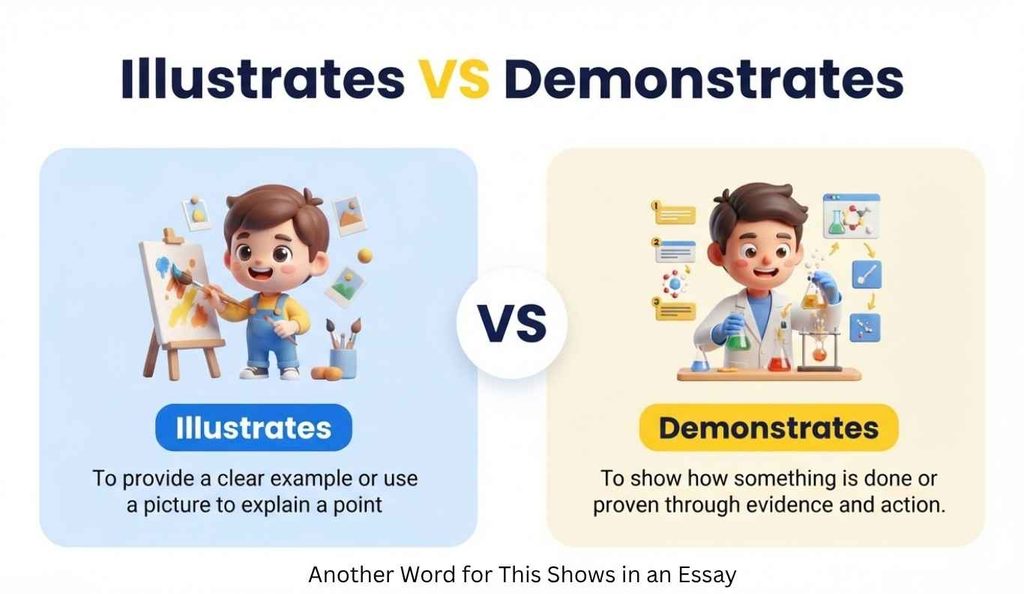
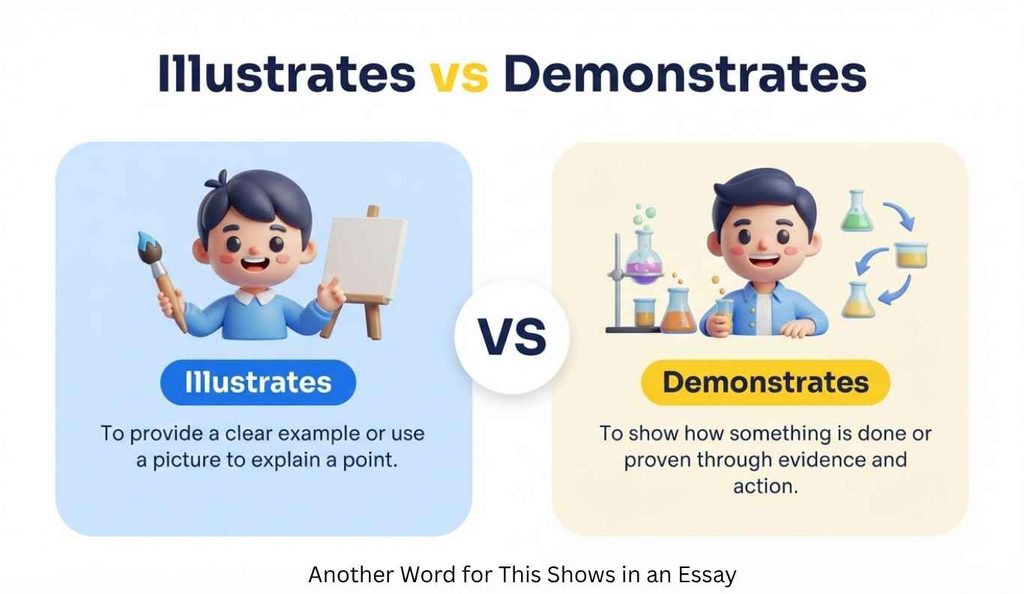
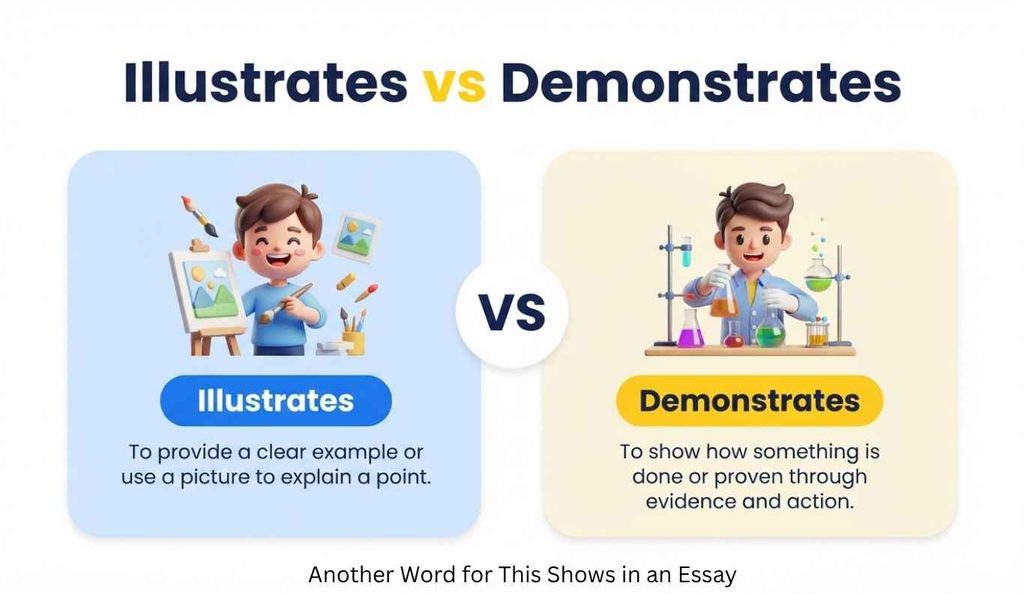
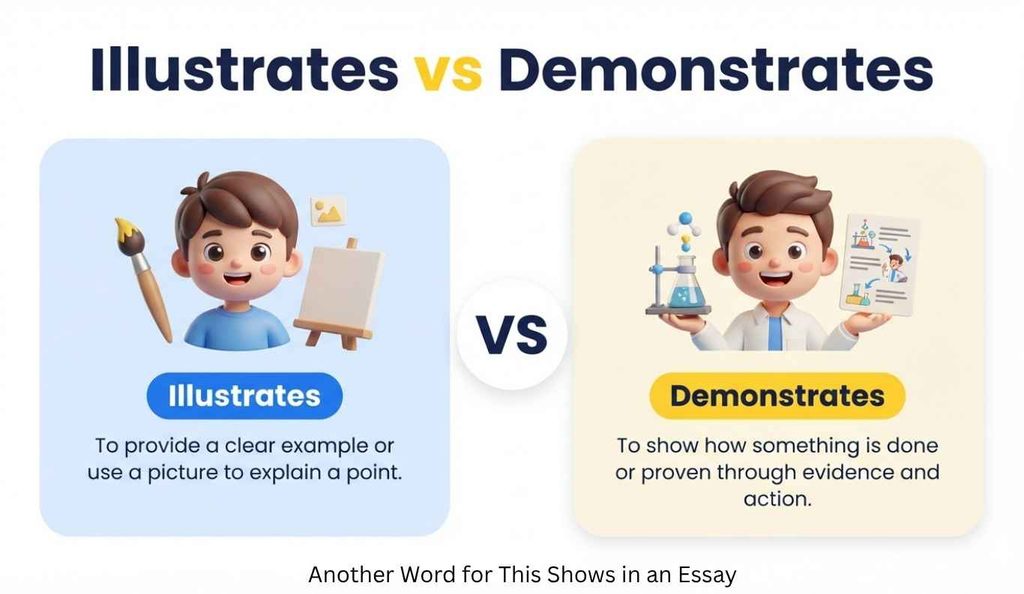
| 5 | Illustrates | Explaining through example |
| 6 | Presents | Laying out information |
| 7 | Exhibits | Showing traits or features |
| 8 | Reflects | Mirroring an idea or attitude |
| 9 | Expresses | Conveying feeling |
| 10 | Communicates | Delivering a message |
| 11 | Highlights | Emphasizing a key point |
| 12 | Proves | Establishing certainty |
| 13 | Suggests | Hinting cautiously |
| 14 | Signifies | Giving symbolic meaning |
| 15 | Represents | Standing for something |
| 16 | Depicts | Portraying visually or in words |
| 17 | Describes | Explaining in detail |
| 18 | Conveys | Transmitting meaning |
| 19 | Uncovers | Finding what was buried |
| 20 | Manifests | Making an idea visible |
| 21 | Evidences | Supporting with proof |
| 22 | Makes Clear | Removing confusion |
| 23 | Points Out | Drawing attention |
| 24 | Brings to Light | Exposing new facts |
| 25 | Makes Evident | Stating the obvious formally |
1. Demonstrates
“Demonstrates” is the go-to upgrade when your evidence actively proves a point. It suggests a step-by-step showing, like an experiment or a worked example. It suits science, history, and any argument built on data.
- “The experiment demonstrates how temperature affects the rate of reaction.”
- “Her final chapter demonstrates that small reforms can change entire communities.”
- “The graph demonstrates a steady rise in student stress after 2020.”
- “This case demonstrates why clear contracts protect both parties.”
2. Displays
“Displays” fits when information is laid out visibly, like a chart, table, or diagram. It’s a neutral, tidy alternative that keeps the visual sense of the original verb without repeating it. It works well for describing figures in reports.
- “The table displays average test scores across five school districts.”
- “Figure 2 displays the change in population over three decades.”
- “The museum map displays every major trade route of the period.”
- “The chart displays monthly sales without any distracting detail.”
3. Reveals
“Reveals” carries a little drama. Use it when your textual evidence uncovers something that wasn’t obvious before, like a hidden motive or an unexpected result. It’s excellent for literary analysis and investigative essays.
- “The final scene reveals the narrator’s deep fear of being forgotten.”
- “The survey reveals a gap between what students say and do.”
- “Her diary reveals a side of the general history ignored.”
- “The data reveals that most errors happen during the final hour.”
4. Indicates
“Indicates” is perfect when the evidence points toward a conclusion without fully proving it. It’s careful and measured, which academic readers appreciate. Use it for trends, patterns, and early findings in your analysis.
- “The trend indicates that online learning will keep growing.”
- “Early results indicate a strong link between sleep and memory.”
- “The author’s tone indicates growing frustration with the government.”
- “Rising prices indicate that demand is outpacing supply.”
5. Illustrates
“Illustrates” works when you’re using an example to explain a bigger idea. Think of it as painting a picture for the reader. It’s especially handy in body paragraphs where a story or case clarifies your claim.
- “The Dust Bowl illustrates how poor land use can destroy livelihoods.”
- “This example illustrates the difference between correlation and causation.”
- “Her childhood memory illustrates the theme of lost innocence.”
- “The chart illustrates how quickly small savings can grow.”
6. Presents
“Presents” is a smooth, professional choice when a source or author sets out information or a viewpoint. It sounds calm and objective, which suits research summaries. It’s also a good way to introduce a source without judging it.
- “The report presents three possible solutions to urban traffic.”
- “The author presents a balanced view of the trade dispute.”
- “This chapter presents the main findings of the field study.”
- “The study presents new evidence about how children learn to read.”
7. Exhibits
“Exhibits” suits writing about traits, behavior, or features. It’s common in science and psychology, where subjects exhibit patterns. It also fits character analysis when someone repeatedly displays a quality.
- “The main character exhibits remarkable courage throughout the novel.”
- “Patients in the trial exhibited faster recovery times.”
- “The species exhibits unusual social behavior during migration.”
- “The essay exhibits strong command of persuasive technique.”
8. Reflects
“Reflects” links a detail to a bigger idea, like a mirror. Use it when a piece of evidence mirrors an attitude, value, or era. It’s a favorite in social and cultural essays that connect small details to large themes.
- “The poem reflects the anxiety of a generation facing war.”
- “His word choice reflects deep respect for tradition.”
- “The city’s architecture reflects its long history of trade.”
- “These results reflect broader changes in consumer habits.”
9. Expresses
“Expresses” is ideal for feelings, opinions, and emotions. When an author, speaker, or character puts an inner state into words, this verb captures it well. It helps your analysis sound thoughtful rather than mechanical.
- “The letter expresses the writer’s regret more clearly than any speech.”
- “The painting expresses loneliness through its muted colors.”
- “She expresses hope even when facing enormous challenges.”
- “The speech expresses a clear desire for lasting peace.”
10. Communicates
“Communicates” focuses on delivering a message effectively to an audience. It works well when you’re analyzing rhetoric, media, or design. It reminds the reader that meaning has to travel from creator to viewer.
- “The poster communicates urgency through bold, simple lettering.”
- “The author communicates complex ideas in everyday language.”
- “This advertisement communicates trust without making any big promises.”
- “The film communicates grief mostly through silence.”
11. Highlights
“Highlights” calls attention to a key detail or problem. It’s a strong choice when you want the reader to notice one point among many. Use it in topic sentences or when you’re summing up important evidence.
- “The report highlights serious flaws in the current funding model.”
- “This passage highlights the tension between duty and desire.”
- “The study highlights the importance of early intervention.”
- “Her example highlights how small habits shape big outcomes.”
12. Proves
“Proves” is the strongest option here, so use it with care. Reserve it for cases where the evidence truly settles the question. Overusing it can make an argument sound overconfident, especially in the humanities.
- “The lab result proves that the compound is safe at low doses.”
- “This document proves the treaty was signed before the war.”
- “Her success proves that persistence can outweigh early disadvantage.”
- “The math proves the theorem holds for every positive integer.”
13. Suggests
“Suggests” is the polite, cautious cousin of “proves.” It tells the reader the evidence leans in a direction without claiming certainty. Academic readers like it because it shows honesty about the limits of your data.
- “The evidence suggests that early reading habits improve later success.”
- “Her hesitation suggests she doubts the plan will work.”
- “The pattern suggests a link between income and health outcomes.”
- “This trend suggests that habits are changing faster than expected.”
14. Signifies
“Signifies” gives an object, event, or symbol a deeper meaning. It’s a formal tone verb that shines in literary essays. Use it when something stands for an idea beyond its literal form.
- “The broken clock signifies the family’s refusal to move forward.”
- “The green light signifies hope that stays just out of reach.”
- “A rise in exports signifies growing confidence in the economy.”
- “His silence signifies far more than any argument could.”
15. Represents
“Represents” works when one thing stands in for another. It’s clean, widely understood, and ideal for symbols, characters, and data categories. It can also describe what a figure or percentage covers.
- “The river represents the passage of time in the story.”
- “This figure represents nearly half of all reported cases.”
- “The main character represents the struggles of working families.”
- “Each bar represents the average income of a region.”
16. Depicts
“Depicts” is perfect for portraying scenes, people, or events in art, film, or writing. It leans visual but adds a sense of craft. Use it when the creator’s choices matter to your analysis.
- “The novel depicts a city slowly losing its sense of community.”
- “The mural depicts farmers gathering after a long harvest.”
- “The film depicts the war without glorifying either side.”
- “Her essay depicts childhood as both magical and frightening.”
17. Describes
“Describes” is plain, accurate, and versatile. It works when a source explains how something looks, works, or happened. It’s less dramatic than “reveals,” which makes it great for straightforward summaries.
- “The author describes the journey in careful, almost scientific detail.”
- “This section describes how the new policy was introduced.”
- “The article describes three methods for reducing waste.”
- “She describes the village as quiet, cold, and strangely welcoming.”
18. Conveys
“Conveys” is about carrying meaning, mood, or tone from the writer to the reader. It’s a natural fit for rhetorical analysis. It signals that you’re paying attention to how an idea is delivered, not just what it says.
- “The narrator’s short sentences convey a sense of rising panic.”
- “The photograph conveys the exhaustion of a long shift.”
- “Her tone conveys respect even while she disagrees.”
- “The chart conveys the scale of the problem at a glance.”
19. Uncovers
“Uncovers” suggests digging beneath the surface to find something hidden. It’s lively and works well in research or investigative writing. Use it when your analysis turns up a fact or pattern that others missed.
- “The investigation uncovers a pattern of neglect across several schools.”
- “Her research uncovers surprising links between diet and mood.”
- “The archive uncovers letters no historian had studied before.”
- “A closer reading uncovers a second, darker meaning in the poem.”
20. Manifests
“Manifests” is a formal verb meaning to become visible or clear in practice. It suits abstract ideas, like fear, prejudice, or ambition, appearing in real behavior. Use it with care, since it can sound heavy if overused.
- “The character’s anger manifests in small, sudden acts of cruelty.”
- “Stress often manifests as headaches and trouble sleeping.”
- “Inequality manifests in access to education and healthcare.”
- “The theme of loyalty manifests in every major decision.”
21. Evidences
“Evidences” is a rare, formal verb, meaning to support or prove with concrete signs. It appears in scholarly writing, though some editors find it stiff. Use it sparingly and only when the tone allows.
- “The archaeological record evidences a thriving trade network.”
- “Her careful footnotes evidence years of thorough research.”
- “The steady decline in errors evidences the value of training.”
- “The letters evidence a friendship that lasted several decades.”
22. Makes Clear
“Makes clear” is a friendly phrase for moments when something removes confusion or settles a question. It sounds natural and confident without being stiff. It’s a good choice when your reader needs a firm takeaway.
- “The author makes clear that reform cannot succeed without public trust.”
- “This paragraph makes clear why the first theory failed.”
- “The results make clear that the program is worth continuing.”
- “Her closing lines make clear where her loyalties truly lie.”
23. Points Out
“Points out” is direct and conversational. It fits when a writer draws attention to a fact or problem. It’s less formal than most options here, so use it in argument-driven essays where a natural voice helps.
- “The critic points out that the plot ignores its own rules.”
- “The report points out several gaps in current safety training.”
- “She points out that most students never see these costs.”
- “The author points out how easily statistics can mislead.”
24. Brings to Light
“Brings to Light” is a vivid phrase for exposing facts, problems, or overlooked ideas. It suits essays on social issues, history, and media. Because it’s a phrase, it also adds rhythm and helps with sentence variety.
- “The documentary brings to light abuses that officials tried to hide.”
- “Her study brings to light a forgotten chapter of local history.”
- “The audit brings to light serious problems in the budget.”
- “This passage brings to light the hidden cost of ambition.”
25. Makes Evident
“Makes evident” is a slightly formal way to say something becomes obvious through evidence. It works in policy papers, reports, and academic essays, where a clear conclusion matters more than a dramatic verb.
- “The data makes evident how unevenly resources are shared.”
- “Her argument makes evident the flaws in the earlier model.”
- “The results make evident the need for better training.”
- “The timeline makes evident how quickly the situation changed.”
Weak vs Strong Verbs: Quick Comparison
Choosing a swap gets easier when you see verbs by strength. A weak verb states, a strong verb interprets. Matching the verb to your level of certainty keeps your claims honest and your writing persuasive.
| Certainty level | Verbs | Example use |
| Very strong | Proves, demonstrates | Settled facts and experiments |
| Strong | Reveals, establishes, makes clear | Clear textual evidence |
| Moderate | Indicates, illustrates, reflects | Trends and examples |
| Cautious | Suggests, implies | Early or partial evidence |
Formal vs Informal Synonyms for Shows
Your register matters as much as the verb itself. A lab report wants a formal, precise word, while a personal essay welcomes something warmer. Match the verb to the assignment and your tone stays consistent.
| Tone | Good choices |
| Formal | Demonstrates, evidences, manifests, signifies |
| Neutral | Displays, presents, describes, indicates |
| Conversational | Points out, makes clear, brings to light |
Common Mistakes When Replacing “Shows”
Swapping verbs isn’t just a matter of picking the fanciest one from a list. Some words carry extra meaning, and using them carelessly can change your claim. Watch for a few common traps.
| Mistake | Why it hurts | Fix |
| Using “proves” for weak evidence | Overstates your claim | Use “suggests” or “indicates” |
| Picking “manifests” for a simple chart | Sounds stiff and odd | Use “displays” |
| Repeating one new verb constantly | Same problem, new word | Rotate several options |
| Ignoring the subject | Some verbs need a person | Match verb to subject |
Sample Sentences Using Better Verbs
Seeing the change in action helps. Here are before-and-after sentences that show how a precise verb sharpens shows in an essay writing without adding extra words.
Before: “The graph shows that sales dropped.” After: “The graph illustrates a steep drop in sales.”
Before: “This quote shows she was afraid.” After: “This quote reveals her hidden fear.”
Before: “The study shows a link between sleep and grades.” After: “The study suggests a link between sleep and grades.”
What Is a Better Word for Shows in an Essay?
The best single replacement depends on context, but demonstrates is the safest all-round choice. It works for most types of evidence, sounds academic, and keeps the meaning close to the original.
For quick swaps, keep three in your pocket: demonstrates for proof, illustrates for examples, and suggests for cautious claims. That trio covers most sentences you’ll write.
Which Verb Should You Use Instead of Shows in a Thesis Statement?
A thesis statement needs a confident, specific verb. “Demonstrates,” “argues,” and “reveals” work best because they signal a clear position. Avoid vague verbs here, since your thesis sets the tone for the whole essay.
If your thesis is an interpretation rather than a proven fact, “suggests” or “illustrates” keeps you safe. Match the verb to how strong your evidence really is.
How Do You Avoid Repeating “Shows” in an Essay?
Start by circling every use during your revision pass. If a verb appears more than twice on a page, replace some. Aim for sentence variety, not just a bigger word list.
Restructure sentences too. Instead of “The chart shows growth,” write “Growth is clear in the chart.” Mixing verbs and structures makes your word choice feel natural.
Conclusion:
Finding another word for this shows in an essay is a small change with a big payoff. The right verb makes your argument clearer, your analysis sharper, and your writing more professional. Whether you choose “demonstrates,” “reveals,” or “suggests,” match the verb to your evidence and your tone.
Remember that shows in an essay isn’t wrong, just overused. Keep this list handy, and when you next find another word for this shows in an essay, try one new verb in your next draft.
FAQs:
What is another word for this shows in an essay?
Demonstrates is the best another word for this shows in an essay, since it fits most evidence.
Can I use “shows” in academic writing?
Yes, another word for this shows in an essay is optional; “shows” is acceptable when used sparingly.
What is a formal replacement for “shows” in a thesis statement?
For another word for this shows in an essay thesis, choose demonstrates, reveals, or argues.
Which verb is best when evidence isn’t conclusive?
Another word for this shows in an essay with partial evidence is “suggests” or “indicates.”
How do I avoid repeating “shows” in one paragraph?
Rotate synonyms; another word for this shows in an essay keeps paragraphs varied and fresh.
Is “illustrates” better than “shows”?
Illustrates is another word for this shows in an essay that works well with examples.
Should I use fancy words instead of “shows”?
Pick another word for this shows in an essay that fits your tone, not the fanciest.

Amelia Brooks is a US-based author known for inspiring stories on meaning, growth, and hope, blending insight with simple, engaging storytelling.