

You typed the sentence, then stopped. Should it be “in line,” “in-line,” or “inline”? You stared at the screen for a second too long, deleted it, retyped it, and still weren’t sure you got it right.
Here’s the good news: this guide breaks down in line vs inline (and the hyphenated cousin nobody talks about) in plain, simple terms. By the end, you’ll know exactly which one to use no guessing, no second-guessing, and no more staring at your cursor. Understanding inline vs in line really is easier than it looks. Let’s get into it.
In Line or Inline
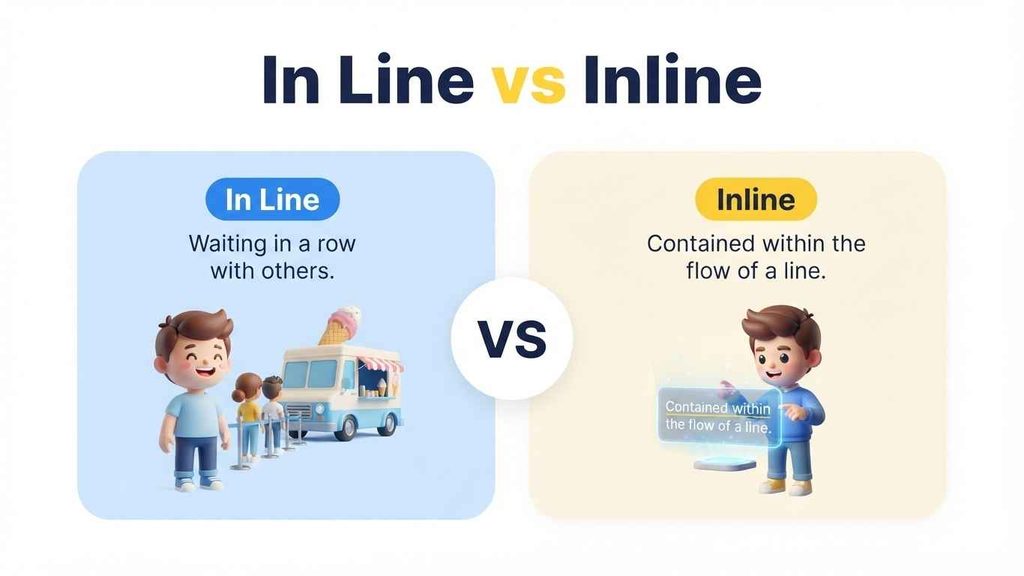
Short answer first, because you’re probably in a hurry: it depends entirely on what you’re describing. In line (two words) is for people, rules, and agreement. Inline (one word) is for computers, code, and web design. In-line (hyphenated) sits in between, describing technical objects like engines and skates. None of the three is “wrong” they’re just built for different jobs, and picking the right one is really about matching the word to the context.
Is In Line Hyphenated
Usually not. “In line” stays as two separate words in almost every everyday sentence waiting in line, staying in line with a policy, keeping your numbers in line with the budget. The hyphen only shows up when the phrase turns into a compound modifier sitting directly in front of a noun, like “an in-line engine” or “in-line skates.” So the honest rule is: two words by default, hyphen only when you’re describing a technical noun, and one word only in tech and coding contexts.
In Line or In-Line
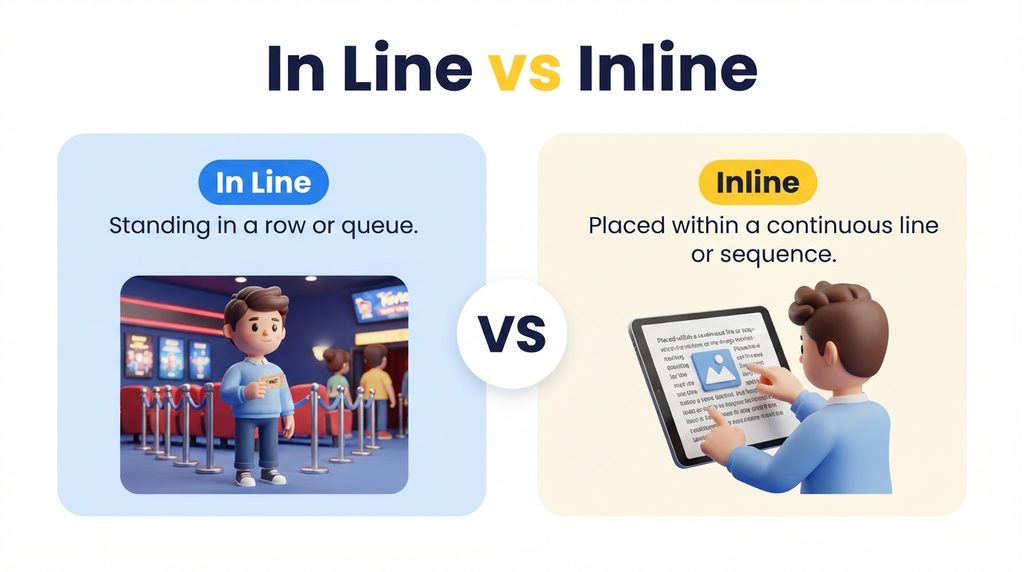
The difference comes down to grammar function. “In line” is a phrase it describes an action, a location, or a relationship (“she stood in line,” “his numbers are in line with expectations”). “In-line” is an adjective it describes a noun directly, almost always in technical or mechanical writing (“an in-line six-cylinder engine,” “an in-line water filter”). If you can replace the phrase with “aligned with” or “queued,” you probably want two words. If you’re naming a type of equipment, reach for the hyphen.
In Line or Inline or In-Line? Which is Correct?
Here’s the part that trips almost everyone up at least once: all three spellings are correct, but they’re not interchangeable. Each one belongs to a different usage category, and mixing them up is one of the most common small errors in professional writing.
| Version | Word Count | Typical Use | Example |
| In line | Two words | People, rules, alignment | “Stay in line with the plan.” |
| In-line | Hyphenated | Technical nouns, machinery | “An in-line engine.” |
| Inline | One word | Tech, code, web design | “Add an inline style.” |
Use “in line” when talking about people waiting or things matching expectations. Pick “in-line” when describing a piece of hardware or a technical process that sits directly before a noun. Choose “inline” when you’re writing about programming, HTML, CSS, or anything digital. Once you see it laid out this way, in line vs inline stops being confusing and starts being intuitive.
A quick test that works surprisingly well: try swapping the phrase for “aligned” or “queued.” If either word fits naturally, you almost certainly want the two-word “in line.” If the sentence is instead naming a specific object a filter, a skate, a function check whether that object belongs to machinery or to software, and let that decide between the hyphen and the single word. This tiny mental checklist covers the overwhelming majority of real-world sentences you’ll ever need to write.
It also helps to remember that none of these three forms is more “correct” in some absolute grammatical sense. Language evolves around use case, and this is a textbook example the same underlying idea (things arranged one after another) branched into three separate spellings because three very different professional communities needed it. Grammarians settled on the two-word phrase centuries before computers existed, engineers added the hyphenated compound as machinery got more complex, and developers streamlined it into one word because code favors brevity. Knowing that history makes the choice feel less like a trivia question and more like common sense.
In Line: Meaning and Usage
Picture the last time you waited somewhere a coffee shop, an airport, a concert gate. That everyday image is exactly what “in line” captures, and it’s also the version businesses reach for when talking about staying within rules or expectations.
What Does “In Line” Mean?
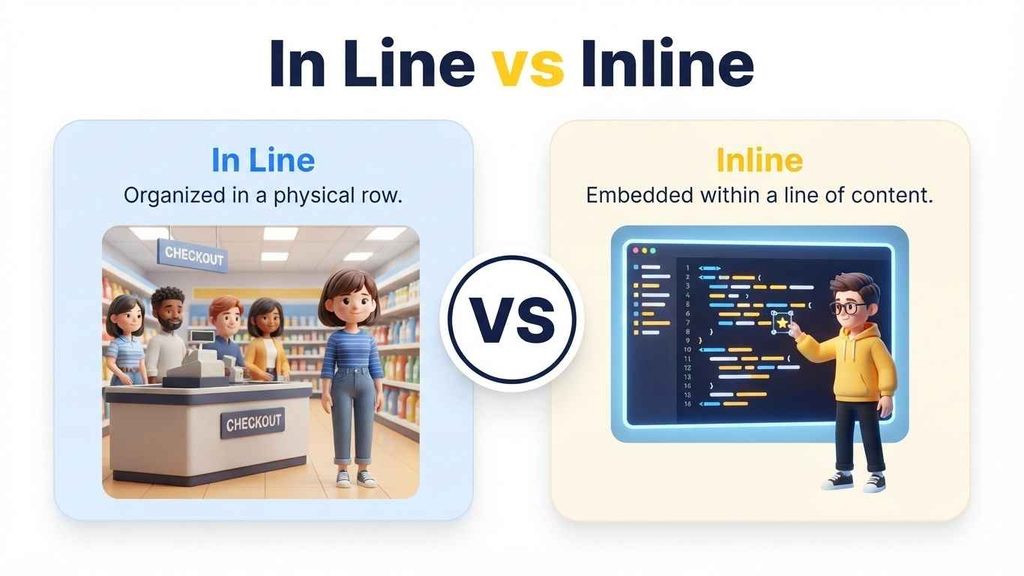
This two-word version has two closely related meanings. The first is literal: people or objects arranged one behind another in sequence. The second is figurative: matching up with rules, standards, or expectations. A team’s results being “in line with” projections uses this second sense.
- Queuing people standing one behind another
- Alignment matching a standard, rule, or plan
- Agreement decisions that fit expectations
- Order items arranged in sequence
- Compliance following a policy correctly
How It Works in Sentences
“In line” almost always functions as an adverbial phrase, describing where or how something happens rather than naming a thing. It tells you the location of an action (“we waited in line”) or the relationship between two ideas (“this stays in line with our goals”).
- It modifies verbs, not nouns directly
- It often follows stay, stand, wait, keep, fall
- It links two ideas through comparison
- It rarely needs a hyphen in this form
- It reads naturally in both casual and formal writing
Where You’ll Use It
The most familiar use is physical: any place people queue, you’ll describe them as standing “in line.” The second use shows up constantly in offices and meetings, where managers talk about staying “in line” with budgets, policies, or targets.
- Retail customers waiting in line at checkout
- Business spending kept in line with budget
- Sports players lining up in line for drills
- Education grades in line with expectations
- Government policies kept in line with law
Real Examples of “In Line”
- The children waited in line for lunch, keeping a neat formation as they entered the cafeteria.
- Your proposal is perfectly in line with what the team discussed last week.
- People stood patiently in line despite the rain, waiting for tickets to go on sale.
- Her approach stays in line with industry best practices, which explains her strong results.
Example in a message: Friend 1: “Ugh, I’ve been standing in line at the DMV for an hour.” Friend 2: “At least tell me the wait time is in line with what the website said.”
In-Line: Meaning and Usage
The hyphen might look small, but it does real work. It fuses two words into a single descriptive unit that sits right in front of a noun and it’s the version you’ll meet most often in engineering, manufacturing, and product design.
Understanding the Hyphenated Version
A compound adjective like “in-line” exists to remove ambiguity. Without the hyphen, a reader might briefly wonder whether you mean a location or a type of object. With it, the meaning locks into place instantly this is one unit, describing the noun that follows.
- Fuses two words into one modifier
- Precedes the noun it describes
- Clarifies meaning instantly
- Signals technical or mechanical context
- Prevents momentary misreading
When You Need That Hyphen
The rule is consistent: when two words team up to modify a noun, connect them with a hyphen. This isn’t unique to “in-line” it’s the same logic behind “well-known author” or “state-of-the-art design.” Skipping the hyphen here creates a small but real readability gap.
- Use it before a noun, not after
- Skip it when the words are separated (“the engine runs in line”)
- Apply it in technical manuals consistently
- Match your house style guide if one exists
- Reconsider automatically if a spellchecker flags it
Where This Version Appears
Engineers reach for this spelling constantly. “In-line engine” and “in-line assembly” both describe components arranged in a single row, one behind the other, inside a larger system. The phrase carries the same “single-file” logic as the everyday version, just applied to hardware.
- Automotive in-line four-cylinder engines
- Manufacturing in-line quality inspection stations
- Sports equipment in-line skates
- Plumbing in-line water filters
- Industrial design in-line component layout
Sample Sentences Using “In-Line”
- The car features an in-line engine design that saves space and improves performance.
- Factories rely on in-line quality checks to catch defects before products reach customers.
- She bought professional in-line skates after outgrowing her beginner pair last summer.
- Installing an in-line filter protects the plumbing system from debris and buildup.
Example in a message: Friend 1: “My skates finally arrived got the in-line pair with the bigger wheels.” Friend 2: “Nice! Did you check if the engine on that go-kart is in-line or V-shaped?”
Inline: Meaning and Usage
Technology built its own version of this word, and it stuck. “Inline” as a single word belongs almost entirely to programming, web development, and digital design a spelling shaped by decades of code and documentation rather than traditional grammar rules.
The Modern One-Word Form
As computing culture grew, developers and technical writers settled on the single-word spelling for speed and consistency. It’s now the standard across coding communities, style guides for software documentation, and virtually every web development resource.
- Standard in programming documentation
- Consistent across coding communities
- Faster to type in code comments
- Recognized by developer tools and linters
- Distinct from the hyphenated technical version
Computer and Web Contexts
Web developers use “inline styles” to apply formatting directly inside an HTML tag, rather than pulling from a separate stylesheet. Programmers use “inline functions” to describe code that executes without the overhead of a separate function call, which can improve speed.
- HTML inline styles inside a tag
- CSS inline vs block-level elements
- Programming inline functions for performance
- Web design inline images within text
- Documentation inline comments in code
Where You’ll See It
Computer science courses default to the one-word spelling for anything code-related, and web design tutorials frequently compare “inline” elements against “block” elements to explain page layout. Occasionally, casual tech writing borrows this spelling for car engines too, though engineers still prefer the hyphen there.
- Tutorials on HTML/CSS layout basics
- Coding bootcamps teaching syntax
- Developer forums like Stack Overflow
- Software documentation for APIs
- Style guides for tech content teams
Examples Using “Inline”
- The developer added inline styles directly to the HTML tag instead of a separate stylesheet.
- Writing inline functions can help a program run faster by avoiding extra function calls.
- Inline elements flow naturally within text without breaking into a new line.
- Overusing inline CSS makes a codebase harder to maintain over time.
Example in a message: Friend 1: “Can you just add an inline style to fix that button color for now?” Friend 2: “Sure, quick fix I’ll clean it up and move it out of the inline CSS later.”
In Line vs Inline in Professional Writing
Workplace writing rewards precision, and mixing up these two spellings is a small but noticeable slip in a report, proposal, or client email. Knowing which one fits your sentence signals real attention to detail.
- Use “in line” in performance reviews and budget language
- Use “inline” only in technical or IT documentation
- Check style guides before publishing external content
- Run a find-and-replace pass before sending final drafts
- Keep usage consistent across an entire document
This kind of consistency matters more than it might seem. A single client-facing document that switches between “in line” and “inline” without a technical reason reads as careless, even if every individual sentence is otherwise well written. Editors and proofreaders often flag this exact inconsistency, because it’s one of the easiest errors to catch and one of the easiest to avoid once you know the rule. If your organization publishes a lot of external content, it’s worth adding a one-line note about in line vs inline to your internal style guide so every writer on the team makes the same call.
In Line or Inline: Grammar Rules That Actually Help
Grammar rules exist to remove guesswork, and this pair has a genuinely simple one hiding underneath the confusion: word count follows word function, not personal preference or habit.
- A phrase (verb + preposition) stays two words
- A compound adjective in tech contexts stays one word
- A compound adjective in mechanical contexts takes a hyphen
- Dictionaries list all three as valid, context-dependent
- Consistency matters more than personal preference
In Line vs Inline in Business Emails
A quick scan of most inboxes shows the two-word version doing almost all the heavy lifting, since business communication talks about alignment and expectations far more often than it talks about code.
- “Your numbers are in line with forecast” alignment
- “Please add the notes inline” only in dev/IT threads
- Avoid switching spellings mid-email
- Match the spelling your recipient uses first, when unsure
- Default to two words unless the topic is clearly technical
In Line or Inline: Dictionary and Style Guide Comparison
Major dictionaries and style guides broadly agree on the pattern described here, though wording differs slightly between sources which is exactly why context, not memorization, should drive the final choice.
| Source Type | Preferred Spelling | Context |
| General dictionaries | in line (two words) | Everyday phrases |
| Technical/engineering guides | in-line (hyphenated) | Machinery, hardware |
| Software/web documentation | inline (one word) | Code, HTML, CSS |
| Style guides (AP-style leaning) | in line | Business and news writing |
None of these sources contradict each other in any meaningful way they simply reflect the vocabulary of the field they serve. A journalism style guide has little reason to weigh in on compound adjectives for car engines, and an engineering manual has no reason to define “fall in line.” Reading them side by side just confirms the same core pattern this whole guide has been building toward: match the spelling to the subject matter, not to whichever version you happened to see most recently.
Is “In Line” Two Words or One?
Almost always two. The single-word “inline” belongs to programming and web design, so unless your sentence is about code, HTML, or software, “in line” as two separate words is the safer and more standard choice.
Why Do People Confuse In Line and Inline?
The confusion mostly comes from how similar the words sound when spoken aloud there’s no audible difference between “in line,” “in-line,” and “inline,” so writers default to whichever version they’ve seen most recently in unrelated content.
Key Differences Explained Simply
Once you strip away the jargon, the differences between these three spellings are actually straightforward each one answers a different question about what you’re describing and where it sits in the sentence.
How They Work Differently
“In line” behaves like an adverb, describing an action or a relationship. “In-line” and “inline” behave like adjectives, describing a noun directly. That single grammatical difference explains almost every usage rule covered so far.
- In line = describes actions/relationships
- In-line = describes technical nouns, hyphenated
- Inline = describes tech nouns, one word
- All three are grammatically valid
- Context, not preference, decides the right pick
This is really the same grammar principle you already use without thinking about it in other compound phrases. “Well known” stays two words when it follows the noun (“the author is well known”) but becomes hyphenated when it precedes one (“a well-known author”). “In line” and “in-line” follow that exact same logic, just applied to a phrase about position and alignment instead of reputation. Once you notice the pattern in one pair of words, it becomes much easier to spot in every other compound modifier you write.
Choosing the Right One
Ask what you’re actually talking about before you type. Waiting, rules, or agreement point to two words. Machinery and hardware point to a hyphen. Code, websites, or software point to one word.
- People or rules → in line
- Hardware or machinery → in-line
- Code or web design → inline
- Unsure? → default to two words
- Formal writing? → double-check with a style guide
Quick Decision Guide
| Question | Answer | Use |
| Is it about people waiting? | Yes | in line |
| Is it about rules or standards? | Yes | in line |
| Is it a technical object or engine? | Yes | in-line |
| Is it about code, HTML, or CSS? | Yes | inline |
| Still unsure? | Default to “in line” |
Which Version Should You Use in Formal Writing?
For reports, resumes, and formal correspondence, “in line” is almost always the safer choice, since formal writing rarely discusses machinery or code directly reserve “in-line” and “inline” strictly for technical documents.
Common Phrases You Should Know
A handful of set phrases built around this word cause more mistakes than any single grammar rule, mostly because they get typed quickly, in emails and chats, without a second thought.
Understanding “In Line With”
This phrase signals agreement or alignment. Saying a plan is “in line with” expectations is simply a more natural way of saying it matches or follows them. It’s a fixture of business, finance, and workplace writing.
- Common in performance reviews
- Common in financial reporting
- Always written as two separate words
- Never hyphenated, even before a noun
- Interchangeable with “consistent with” or “aligned with“
The Right Way: “Fall In Line”
Only one spelling is correct here: three separate words, no hyphen. “Fall inline” is a common typing mistake that instantly reads as unpolished, especially in professional or published writing.
- Means to start following rules or authority
- Common in military and organizational contexts
- Always three words, never hyphenated
- Never shortened to two words
- A frequent target of spellcheck confusion
Other Useful Expressions
| Phrase | Correct Form | Meaning |
| Wait in line | Two words | Queue physically |
| Stand in line | Two words | Queue physically |
| Fall in line | Three words | Obey or conform |
| Step out of line | Four words | Break rules |
| Keep in line with | Multiple words | Stay aligned |
Avoiding Common Mistakes
Even confident writers slip on this one occasionally, usually because the three spellings look so close on the page. Catching the pattern once tends to fix it permanently.
Mistakes People Make Often
- Writing “inline” for people or rules instead of “in line”
- Dropping the hyphen in technical phrases like “in line engine”
- Hyphenating everyday phrases that should stay two words
- Switching spellings mid-document inconsistently
- Trusting autocorrect without double-checking context
Simple Memory Tricks
- Computers and code → one word, no hyphen
- People and rules → two words, no hyphen
- Technical gear before a noun → hyphenated
- Read the sentence aloud if unsure
- When truly stuck, “in line” is the safest default
None of these mistakes are permanent, and most writers who mix up in line vs inline fix the habit almost immediately once they see the pattern spelled out clearly. The trick is training yourself to pause for half a second before typing the phrase ask what you’re actually describing, run through the quick decision guide above, and the right spelling will usually surface on its own. Over time, that half-second pause disappears entirely, and the correct choice becomes automatic.
Frequently Asked Questions
What does “in line with” mean in business?
It means following the rules or matching expectations closely. When results are “in line” with a forecast, they meet the required standard without major deviation, which is why the phrase shows up so often in reports.
Is “fall in line” or “fall inline” correct?
“Fall in line” is correct. It means obeying rules or following authority, and it’s always written as three separate words “fall inline” is a common typo, not an accepted alternative spelling.
How do I use hyphens with “on line”?
Modern writing prefers “online” as one word for internet contexts. It doesn’t follow the same rule as in line vs inline, so don’t apply the same logic directly, even though the two pairs look structurally similar.
Can these three terms be used interchangeably?
No, they’re not interchangeable, even though a spellchecker might not flag the “wrong” one. Each spelling fits a specific context, so in line vs inline ultimately comes down to what you’re describing, not personal preference or habit.
How do I quickly pick the right version?
Look at your topic first. Code and software need “inline.” People or rules need “in line.” Machinery or hardware needs the hyphenated “in-line.” When genuinely unsure, the two-word form is the statistically safer default.
Does “in line” ever need a hyphen?
Rarely, and only when it functions as a compound adjective directly before a noun, which mostly happens in in-line technical writing rather than everyday phrases about people or rules.
Why does this distinction matter for SEO content writers?
Search engines and readers both notice inconsistency across a page. Getting in line vs inline right consistently signals editorial quality, improves readability scores, and builds the kind of trust that keeps readers on the page longer.
Conclusion
Choosing between in line vs inline really comes down to one simple question: what are you actually describing? People, rules, and agreement stay two words. Machinery and hardware take a hyphen. Code, websites, and software collapse into one word. Once that pattern clicks, inline vs in line stops feeling like guesswork and starts feeling automatic. The next time your cursor hovers over that decision, you won’t hesitate you’ll already know exactly which version belongs in your sentence, and your writing will read a little sharper because of it.

Amelia Brooks is a US-based author known for inspiring stories on meaning, growth, and hope, blending insight with simple, engaging storytelling.


