
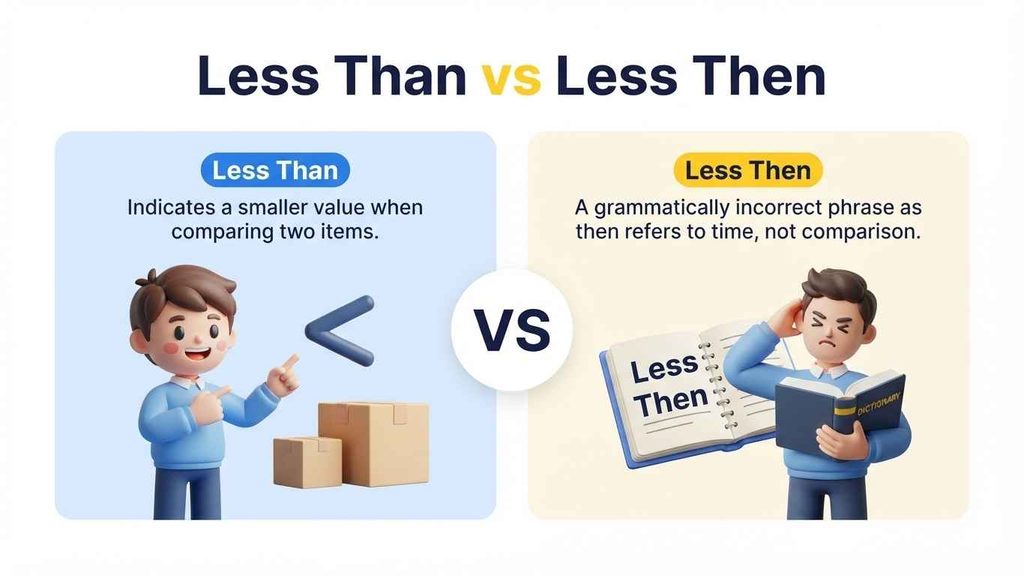
You typed it, paused, and stared at the screen for a second too long. Was it “less than,” or was it “less then”? That tiny flicker of doubt hits almost everyone, even people who write every single day, and it’s more common than you’d think.
Here’s the good news: by the end of this guide, you won’t have to pause again. We’ll walk through the real meaning, show you clean examples, and settle is it less than or less then once and for all including why so many people accidentally reach for less then instead. Keep reading, because clarity is closer than you think.
Is It Less Than or Less Then? Meaning at a Glance
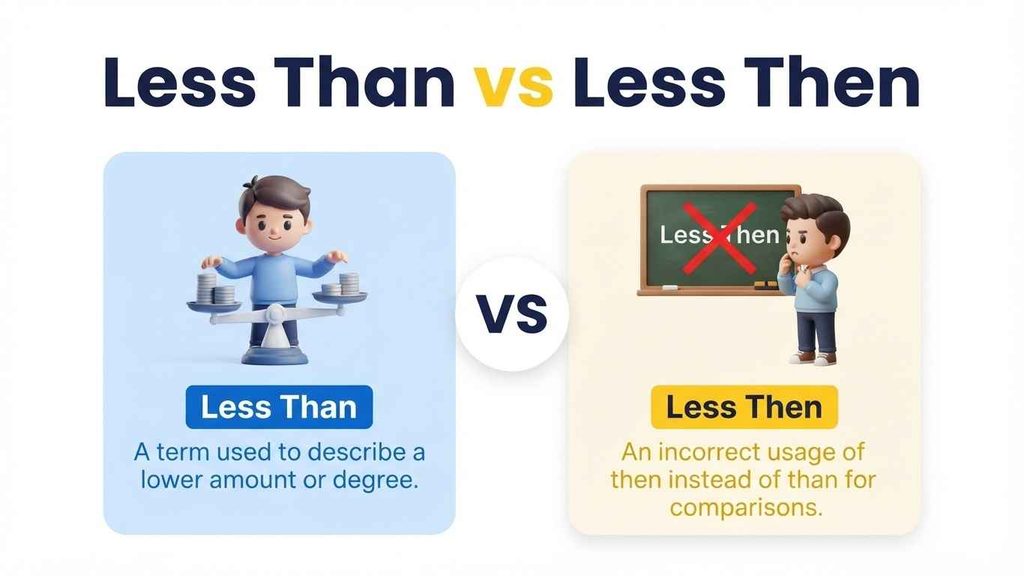
Before anything else, here’s the short answer: less than is correct, and less then is not. This section gives you the quick meaning so you can walk away confident even if you read nothing else.
- Less than compares two amounts, numbers, or quantities.
- Less then is not a standard phrase in English grammar.
- Than is used for comparison; then is used for time or sequence.
- Spell-check often misses it because both words are real words.
- Native speakers make this slip too, especially when typing fast.
- Autocorrect and voice-to-text tools sometimes make it worse, not better.
What’s the Fastest Way to Check Which One You Need?
Ask yourself if you’re comparing two things. If yes, you need than. If you’re talking about “after that” or a moment in time, you need then. That one test solves almost every mix-up instantly.
Example in texting: Friend 1: I have less than five minutes before the meeting starts. Friend 2: Okay, send the file now, then I’ll call you right after.
Less than or less than
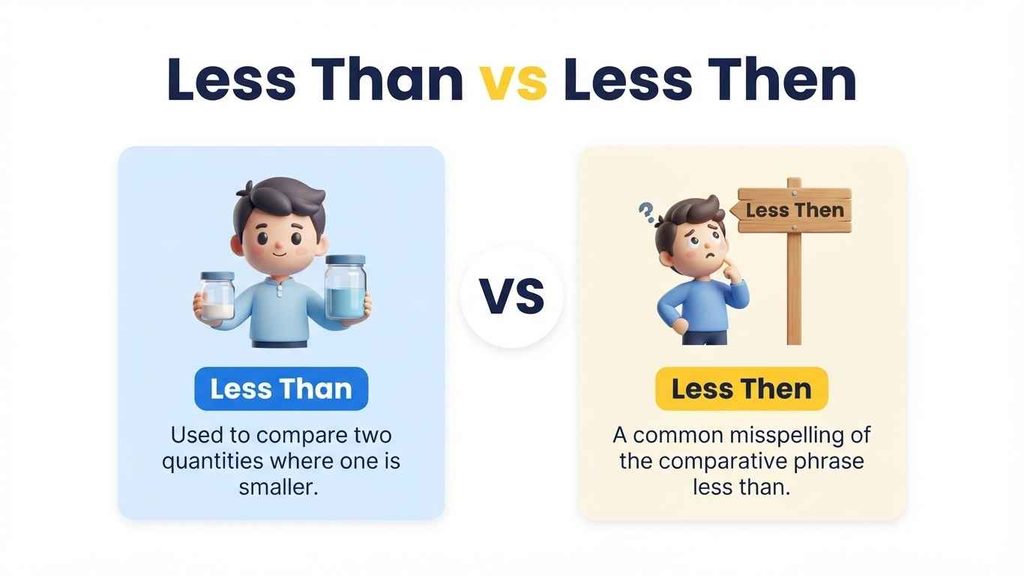
Yes, you read that section title correctly it’s a nod to how often this exact phrase gets typed twice, misspelled once, and searched constantly. People aren’t just unsure about less then; they’re unsure enough to type the correct version twice just to be safe.
- The correct spelling is always less than, with an “a.”
- Less than signals a comparison between two values or ideas.
- It appears constantly in math, contracts, reports, and casual chat.
- Repetition in search habits shows real, widespread confusion.
- Getting it right builds instant credibility in professional writing.
- The mix-up rarely changes meaning enough to confuse a reader, but it does look careless.
| Search Habit | What It Reveals |
| Typing “less than” twice | Uncertainty, double-checking instinct |
| Typing “less then” | Direct misuse, most common grammar slip |
| Searching “is it less than or less then” | Wants a fast, clear confirmation |
Example in chat: Friend 1: Wait, is it less than or less then in this sentence? Friend 2: Less than you’re comparing numbers, not talking about time.
Less than vs less then
Side by side, the difference becomes obvious. Less than belongs to the world of comparison words like “more than,” “greater than,” or “fewer than.” Less then, on the other hand, isn’t part of that family at all; it’s simply a typo dressed up as a real phrase.
- Comparison words like less than, more than, and greater than follow the same pattern.
- Then never pairs correctly with less in standard grammar.
- Confusing the two can weaken otherwise strong, professional writing.
- The error is visual, not logical the words just look similar.
- Reading your sentence aloud often reveals the mistake instantly.
- Grammar checkers catch it more reliably today than they did a few years ago.
- Teachers and editors flag less then as an automatic correction.
Why Do These Two Words Get Mixed Up So Easily?
Both words start with the same three letters and sit right next to the space bar’s most-used keys. Add fast typing and low attention, and the swap becomes almost automatic a habit, not a knowledge gap.
Example in texting: Friend 1: My order was less than $20, which felt like a win. Friend 2: Nice! Mine was more, then I used a coupon to fix it.
Less Then or Less Than – Which Is Correct?
This is the exact question most people are really asking, and the answer stays simple: less than is correct in every comparison sentence, full stop. Less then is not an accepted alternative, no matter how casual the writing is.
- Correct usage always pairs less with than, never then.
- Comparisons involving numbers, money, time spans, or size need than.
- Then only belongs in sentences about sequence or time, like “and then.”
- This rule holds true in emails, essays, texts, and reports.
- Style guides, dictionaries, and grammar resources agree without exception.
Example in chat: Friend 1: Is it less than or less then when I mean “not as much”? Friend 2: Less than, always save “then” for what happens next.
What Does “Less Then” Actually Mean?
Technically? Nothing on its own. Less then has no accepted grammatical meaning as a phrase, which is exactly why it trips people up there’s no rule to memorize, only a habit to unlearn.
- Less then is not a recognized grammatical structure.
- People usually mean less than when they type this by accident.
- It sometimes appears when someone means “less, then [something happens].”
- In that rare case, a comma changes everything: “less, then more.”
- Without punctuation, readers assume it’s simply a typo.
- Search engines treat it as a misspelling of the correct phrase.
- Editors will almost always flag and correct it on sight.
| Phrase | Meaning | Correct? |
| Less than 10 | Fewer than ten, a comparison | Yes |
| Less, then more | Less now, followed by more later | Yes (with comma) |
| Less then 10 | Intended comparison, wrong word | No |
Example in texting: Friend 1: I want less, then more toppings after I taste it. Friend 2: Got it less than five toppings to start, then we adjust.
Less Then
Less then is a common mistake people make in everyday English. Many confuse it with less than, and using then here implies time instead of comparison. This small slip can make a sentence feel weaker or less polished than it should.
- Less then is grammatically incorrect as a comparison phrase.
- It is one of the most common misspellings of less than.
- Readers may briefly pause, unsure what you actually meant.
- Then always signals time, sequence, or a result never comparison.
- Swap it for less than anywhere you’re measuring or comparing.
- Avoid it completely in resumes, emails, and formal writing.
- Spell-check may not catch it since both words are spelled correctly.
Is Less Then Ever Acceptable in Any Context?
Only if you’re using less and then as two separate ideas joined by punctuation, such as “eat less, then rest.” Otherwise, in a direct comparison, less then is simply incorrect and should be rewritten.
Example in chat: Friend 1: I typed less then five people showed up is that right? Friend 2: Nope, it’s less than five people. Then is for time!
Less Than
Less than is the correct phrase for comparing numbers, amounts, or quantities, and it’s the one you want in nearly every situation. Choosing less than over less then keeps your writing clean, accurate, and instantly easier to trust.
- Less than compares two values, sizes, or amounts directly.
- It pairs naturally with numbers: “less than 100 dollars.”
- Use it in math, budgets, deadlines, and measurements confidently.
- Formal writing always favors less than over any alternative.
- It works in casual texts just as well as business reports.
- Replacing every less then with less than instantly improves clarity.
- Reading a sentence aloud helps confirm the comparison is correct.
| Sentence | Correct Word | Why |
| We have _____ ten minutes left. | less than | Comparing time remaining |
| It cost _____ she expected. | less than | Comparing an amount to expectation |
| Eat dinner, _____ relax. | then | Describing sequence, not comparison |
Example in texting: Friend 1: This project took less than an hour, honestly. Friend 2: That’s fast! Send it over, then I’ll review it tonight.
Why Do People Confuse Less Than With Less Then?
Mostly muscle memory. Fingers move faster than thought, “then” feels familiar from everyday speech, and both words look nearly identical at a glance a perfect setup for an honest, forgettable slip.
- Fast typing skips the brain’s usual spelling check.
- Then is used constantly in speech, so it feels natural.
- Autocorrect sometimes fails to catch the swap entirely.
- Non-native speakers may not have learned the than vs then rule directly.
- Similar spelling makes the error easy to miss while proofreading.
- Reading silently, rather than aloud, hides the mistake more often.
How to Remember the Difference Between Less Than and Less Then
A simple memory trick fixes this for good: “than” is for comparison, and it has an a, just like “amount” and “average.” “Then” is for time, and it rhymes with “when,” which is also about time.
- Than = comparison; think “amount,” “average,” “than.”
- Then = time; think “when,” “next,” “then.”
- If you can replace the word with “compared to,” use than.
- If you can replace it with “next” or “after that,” use then.
- Reading your sentence out loud catches most less then errors instantly.
- Bookmark this trick so it becomes automatic within a few uses.
Example in chat: Friend 1: I finished less than half the list. Friend 2: Nice finish the rest, then treat yourself to coffee.
Less Then or Less Than – Which Is Correct?
Coming back to the core question one more time because it’s worth reinforcing: less than wins every time a comparison is being made, and less then should be treated as an error to fix, not a casual variation to keep.
- Always default to less than when in doubt.
- Treat less then as a red flag during proofreading.
- Use grammar tools as a backup, not your only check.
- Practicing the correct form builds long-term writing confidence.
- Consistency across emails, chats, and documents builds trust with readers.
Example in texting: Friend 1: Just double-checking is it less than or less then here? Friend 2: Less than. You’re comparing prices, so than is the one.
Which Is Used the Most?
When comparing less than and less then across everyday writing, less than is used far more often. People write it correctly in articles, emails, and messages, while less then appears rarely and mostly by accident.
- Less than dominates formal writing, journalism, and business content.
- Less then shows up mostly in rushed texts or casual typos.
- Search data confirms far higher interest in the correct spelling.
- Style guides and dictionaries only recognize less than as standard.
- Frequency alone is a strong signal of which phrase is correct.
| Context | Preferred Phrase | Typical Use |
| Academic writing | less than | Comparing data, statistics |
| Business emails | less than | Comparing budgets, deadlines |
| Casual texting | less than (should be) | Comparing plans, prices |
| Accidental typing | less then | Almost always a mistake |
When Should You Use Less Than in a Sentence?
Use less than any time you’re placing two amounts side by side and one is smaller. It fits numbers, time, money, distance, and even feelings when you’re measuring degree, like “less worried than before.”
- Use it for money: “less than fifty dollars.”
- Use it for time: “less than an hour left.”
- Use it for quantity: “less than three items in stock.”
- Use it for distance: “less than a mile away.”
- Use it for degree: “less nervous than last time.”
- Avoid it when describing sequence that’s when’s job.
Example in chat: Friend 1: We’re less than ten minutes from the venue. Friend 2: Perfect, park close, then text me the gate number.
Less Than vs Fewer Than: A Quick Related Note
Since we’re already deep into comparison words, it’s worth clearing up a close cousin of this mix-up. Less than and “fewer than” often get swapped too, even though they follow a slightly different rule than less then does.
- Less than pairs with things you measure, like water or money.
- “Fewer than” pairs with things you can count individually, like apples.
- Both are still correct English unlike less then, which never is.
- Everyday speech blends the two more than formal writing allows.
- Getting this distinction right adds extra polish to careful writing.
| Type of Noun | Correct Comparison Word |
| Countable (people, items, books) | fewer than |
| Uncountable (water, money, time) | less than |
| Any noun, informally | less than (common in speech) |
Common Mistakes With Less Then and Less Than
Beyond the basic swap, a few related habits keep this error alive. Recognizing them makes it far easier to catch less then before it ever reaches a reader, whether it’s a text, email, or full report.
- Typing then out of speech habit instead of writing habit.
- Trusting autocorrect to catch every grammar issue automatically.
- Skipping a final read-through before hitting send.
- Copy-pasting old sentences that already contained the error.
- Assuming both spellings are interchangeable because they sound alike.
- Rushing through casual writing, where standards quietly slip.
Final Thoughts
At this point, the confusion between less than and less then should feel much smaller than when you started reading. Less than is the correct choice whenever you’re comparing numbers, amounts, or quantities, while less then simply doesn’t hold up as standard grammar.
Remembering that than relates to comparison and then relates to time gives you a quick mental shortcut for every sentence going forward. With a little practice, choosing correctly becomes automatic, and your writing starts to read with more confidence and polish.
Conclusion
So, is it less than or less then? By now, the answer feels obvious: less than is correct, and it’s the phrase you should reach for anytime you’re comparing amounts, numbers, or time. Less then isn’t a real grammatical option it’s simply an easy typo that’s worth catching before you hit send.
The fix is small but the payoff is real. Once you remember that than compares and then sequences, this mistake tends to disappear from your writing for good. Next time your fingers hesitate over the keyboard, trust the rule, not the habit and let less than do its job.
FAQs
Is it less than or less then?
It’s always less than when comparing numbers or amounts. Less then is incorrect and should be avoided in any comparison.
Why do people write less then instead of less than?
Fast typing and speech habits cause the slip. Less than is correct; then simply sounds familiar from everyday talk.
Does less then ever mean something different?
Only with a comma, as in “less, then more.” Without one, it’s a mistaken version of less than.
Is less than used in formal writing?
Yes, less than is standard in reports, emails, and academic work. It’s the accepted phrase in professional English.
Can grammar checkers catch less then automatically?
Most modern tools flag it, but not always. Proofreading manually still helps confirm less than is used correctly.
What’s an easy trick to remember less than vs less then?
Link than to comparison words like “amount.” Link then to time words like “when” for quick recall.
Is less than or fewer than more correct?
Both are correct depending on the noun. Less than fits uncountable amounts; fewer than fits countable items precisely.

Amelia Brooks is a US-based author known for inspiring stories on meaning, growth, and hope, blending insight with simple, engaging storytelling.