
You typed hopeing, stared at it for a second too long, and something felt off but you couldn’t say why. That tiny pause, that flicker of doubt before you hit send, is something almost every writer has felt at least once.
This guide clears up the confusion for good. You’ll get the real meaning behind the hoping or hopeing debate, the simple rule that explains it, and practical examples so you never second-guess how to spell hopeing again. Keep reading the answer is easier than you think.
Hoping or Hopeing: Which Is Correct?
Only one of these words actually exists in English, and knowing which one carries real meaning saves you from an easy, avoidable mistake. This section settles it clearly.
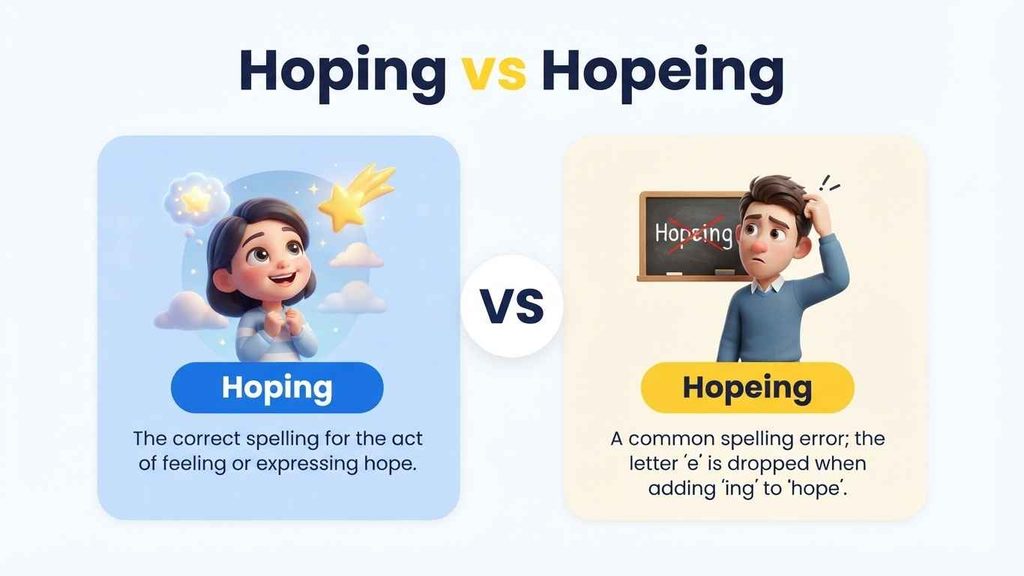
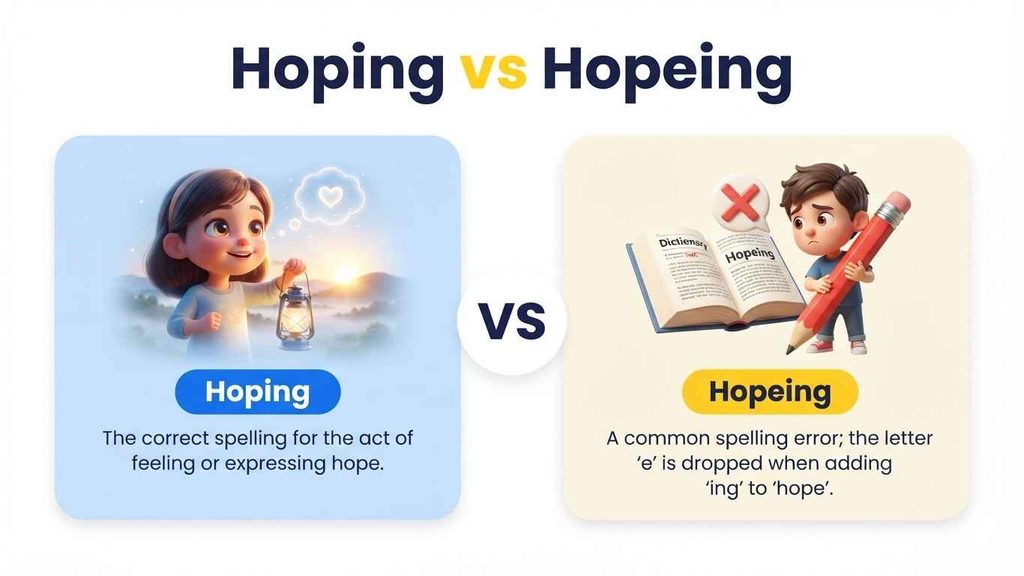
- Hoping is the only correct spelling of this word.
- Hopeing is a common misspelling, not a real word.
- The confusion happens because both look phonetically reasonable.
- Spell check tools don’t always catch it in casual writing.
- Getting this right instantly makes your writing look more polished.
What Does “Hoping” Actually Mean in Everyday Use?
Hoping is the present participle of the verb “hope,” meaning to want something to happen with a sense of optimism. It shows up in sentences like “I’m hoping you can join us” or “She’s hoping for good news.” Understanding this meaning helps you use the word with confidence, not just spell it correctly.
Quick Answer
If you’re in a rush, here’s the short version so you can get back to writing without losing your train of thought.
- The correct word is hoping.
- Hopeing is always wrong, in every context.
- This applies in texts, emails, essays, and formal writing alike.
- The rule comes from a basic English spelling pattern.
- No exceptions apply to the word “hope.”
| Spelling | Status | Where It’s Used |
| Hoping | ✅ Correct | Everywhere formal and casual |
| Hopeing | ❌ Incorrect | Nowhere it’s not a real word |
Why “Hopeing” Is Incorrect
There’s a reason hopeing feels tempting to type, even though it’s wrong, and it comes down to how our brains process spelling versus sound. Once you see the logic, the mistake stops making sense.
- English keeps the base word’s sound through spelling patterns, not letter-by-letter copying.
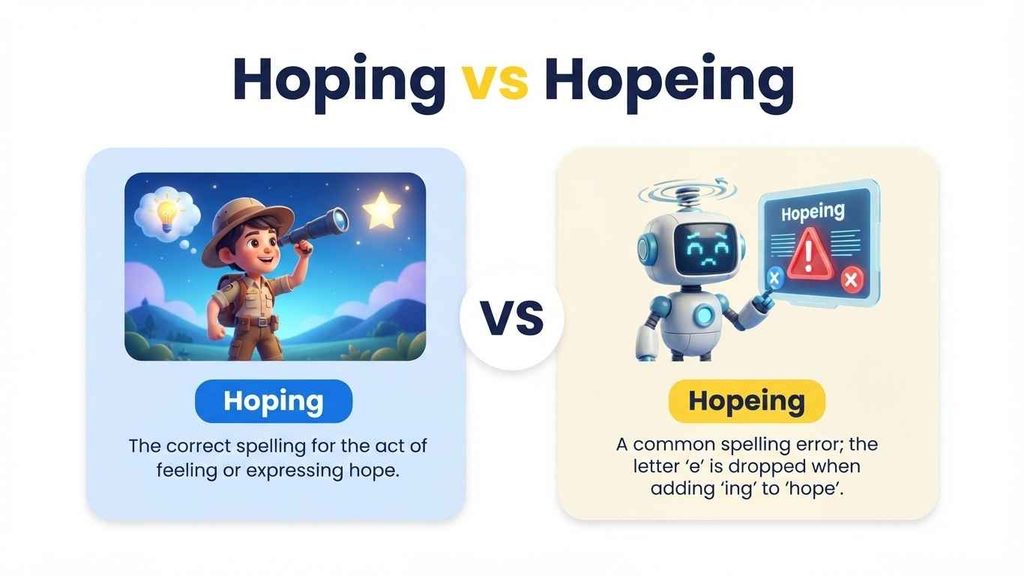
- Adding “-ing” to “hope” while keeping the “e” breaks a core spelling rule.
- Hopeing would actually suggest a different pronunciation if read literally.
- Many learners assume every letter in a root word stays put.
- This assumption fails for most verbs ending in a silent “e.”
The Rule (Very Simple)
Hoping follows one of the most predictable patterns in English grammar, and once it clicks, you’ll never misspell it again. The rule is short enough to memorize in seconds.
- Drop the silent “e” at the end of the verb.
- Add “-ing” directly to what’s left.
- “Hope” becomes “hop” + “ing” = “hoping.”
- This rule applies to hundreds of common English verbs.
- It exists purely to keep spelling consistent and readable.
Formula: Verb ending in silent e → remove e → add -ing → correct form
Examples
Seeing the rule applied across different words makes it far easier to remember than reading the rule alone. Here are some quick side-by-side comparisons.
- Hope → Hoping ✅ (not hopeing)
- Make → Making ✅ (not makeing)
- Write → Writing ✅ (not writeing)
- Love → Loving ✅ (not loveing)
- Drive → Driving ✅ (not driveing)
- Bake → Baking ✅ (not bakeing)
- Smile → Smiling ✅ (not smileing)
The Origin of the Word “Hope”
Understanding where “hope” comes from adds real depth to how you use it, beyond just getting the spelling right. Its roots trace back over a thousand years of English history.
- “Hope” comes from the Old English word “hopa,” meaning expectation or trust.
- It’s related to Old Frisian and Middle Dutch words with similar meanings.
- The core sense of optimism has stayed remarkably stable over centuries.
- As a verb, it has always described a forward-looking feeling.
- The modern spelling settled once English spelling became more standardized.
Why the “E” Disappears
The vanishing “e” isn’t random it follows a logic rooted in pronunciation, not just tradition. This section explains exactly why it happens.
- A silent “e” at a word’s end often softens the vowel before it.
- Adding “-ing” already supplies a vowel, so the silent “e” becomes unnecessary.
- Keeping the “e” would create an awkward, non-standard spelling.
- This pattern keeps English verbs visually consistent across tenses.
- It’s one of the most reliable rules in English spelling.
Why Do People Keep Getting Hoping or Hopeing Wrong?
Most people misspell hoping because they’re spelling by ear rather than by rule, and phonetically “hopeing” doesn’t sound unreasonable. Fast typing, autocorrect gaps, and unfamiliarity with the silent-e rule all combine to make this a surprisingly persistent, widespread mistake.
Common Mistakes
Even confident writers slip up here, usually for one of a few predictable reasons. Recognizing the pattern in your own writing makes it easier to catch.
- Spelling by sound instead of by rule.
- Overcorrecting, assuming root spelling must always stay intact.
- Typing quickly and not proofreading before posting or sending.
- Autocorrect gaps, since some tools miss this specific error.
- Confusing it with words that do keep their “e” (like “seeing”).
| Mistake Type | Example | Fix |
| Spelling by sound | Hopeing | Hoping |
| Rule confusion | Makeing | Making |
| Typing too fast | Hopeing for u | Hoping for you |
Hoping or Hopeing in Everyday Examples
Real-world context makes any grammar rule stick better than theory alone, so here’s hoping in action across different everyday writing situations.
- Texts and DMs: “hoping we can hang out this weekend.”
- Emails: “I am hoping to hear back from you soon.”
- Captions: “Just hoping for sunshine on vacation.”
- Reviews: “Hoping this product lives up to the hype.”
- Comments: “Hoping someone can explain this better.”
Example in texting: Friend 1: hopeing you’re doing okay today 💛 Friend 2: aww thank you! and it’s actually spelled “hoping” 😄
Emails
Professional emails are one of the easiest places for this mistake to slip through, since we often type them quickly between other tasks.
- Use “hoping” in polite, forward-looking requests.
- Example: “I’m hoping to schedule a call this week.”
- Avoid casual shortcuts when writing to clients or coworkers.
- A misspelled word here can undermine professionalism instantly.
- Always proofread subject lines and closing lines specifically.
News
Journalists and content writers face higher stakes with spelling, since published errors are visible to thousands of readers.
- News writing demands strict adherence to standard spelling.
- “Hoping” appears often in quotes and forward-looking statements.
- Editors typically catch “hopeing,” but it still slips through occasionally.
- Spelling errors in headlines damage a publication’s credibility fast.
- Style guides like AP consistently confirm “hoping” as correct.
Social Media
Casual platforms are where “hopeing” shows up most often, since people type fast and skip proofreading.
- Captions and comments are the most common places for this error.
- Autocorrect on mobile keyboards doesn’t always flag it.
- Hashtags with the misspelling still occasionally trend, spreading the error further.
- Influencers and brands should still double-check captions before posting.
- Small spelling slips can affect how credible a post feels.
Formal Writing
Academic papers, resumes, and business documents leave zero room for this kind of mistake.
- Formal writing is judged more strictly on spelling accuracy.
- “Hopeing” in a resume can cost you a callback.
- Always run formal documents through a grammar checker before submitting.
- Professors and employers notice small, repeated spelling errors.
- Consistency in spelling reflects attention to detail overall.
Hoping vs Hopeing – Comparison Table
A side-by-side view makes the difference impossible to forget, so here’s everything hoping vs hopeing in one simple table.
| Feature | Hoping ✅ | Hopeing ❌ |
| Real English word | Yes | No |
| Follows spelling rule | Yes | No |
| Appropriate in formal writing | Yes | Never |
| Recognized by dictionaries | Yes | No |
| SEO and readability friendly | Yes | No |
Hoping – Grammar Rule Explained Simply
Grammar rules feel intimidating until they’re broken down into plain, everyday language, and this one is genuinely simple once explained clearly.
- “Hope” is a base verb describing optimism or desire.
- The silent “e” rule governs how it changes form.
- “Hoping” is the present participle, used for ongoing action.
- “Hoped” is the past tense, following a similar drop-e pattern.
- Knowing this rule unlocks dozens of similar verbs at once.
Step by Step
Breaking the rule into clear steps makes it something you can apply instantly, without memorizing anything complicated.
- Step 1: Start with the base verb “hope.”
- Step 2: Identify the silent “e” at the end.
- Step 3: Remove that final “e” completely.
- Step 4: Add “-ing” to what remains.
- Step 5: Confirm the result reads “hoping,” never “hopeing.”
Words Like Hoping
Once you understand this pattern, you’ll start spotting it everywhere in English. These words all follow the exact same silent-e rule.
- Hope → Hoping
- Care → Caring
- Dance → Dancing
- Move → Moving
- Type → Typing
- Shine → Shining
- Trace → Tracing
| Base Word | Correct -ing Form | Incorrect Form |
| Care | Caring | Careing ❌ |
| Move | Moving | Moveing ❌ |
| Shine | Shining | Shineing ❌ |
Why This Mistake Is So Common
This isn’t a rare typo it’s one of the most repeated spelling errors in casual English, and there are clear reasons why.
- English spelling doesn’t always match pronunciation intuitively.
- Non-native speakers often learn words phonetically first.
- Fast digital communication discourages careful proofreading.
- The rule is rarely taught explicitly after early schooling.
- Visual similarity between correct and incorrect forms increases confusion.
What Does MYF-Style Confusion Teach Us About Hoping or Hopeing?
Just like abbreviations and slang cause confusion online, silent-e words like hoping confuse people because visual pattern-matching often beats memorized rules. The lesson is the same: familiarity with a word doesn’t guarantee accurate spelling, especially under time pressure.
Common Search Questions About “Hoping or Hopeing”
People search this topic in several different ways, and understanding those variations helps clarify the full picture.
- “Is hopeing a real word?”
- “How to spell hoping or hopeing correctly?”
- “How do you spell hopeing, or is it hoping?”
- “Why isn’t ‘hopeing’ correct if it sounds right?”
- “What’s the rule for words like hope, love, and make?”
How Do You Spell Hopeing Correctly Every Time?
You don’t the correct spelling is always hoping, never “hopeing,” in any context. To spell it correctly every time, remember one simple trick: drop the silent “e” in “hope” before adding “-ing,” and the mistake disappears for good.
Frequently Asked Questions (FAQs)
Is hopeing ever an accepted spelling variation?
No, hopeing is never accepted in standard English. Hoping or hopeing debates always resolve in favor of “hoping” as the only correct form.
Why do we drop the “e” when spelling hoping?
English drops the silent “e” before “-ing” endings. This keeps hoping consistent with similar verbs like making and writing.
Is hoping considered a formal or casual word?
Hoping works in both formal and casual writing. It’s appropriate for emails, essays, texts, and everyday conversation alike.
How can I remember hoping or hopeing correctly?
Picture removing the “e” before adding “-ing.” Practicing this trick makes hoping easy to spell without hesitation.
Does autocorrect always fix hopeing automatically?
Not always. Some keyboards miss it, so double-checking hoping manually is still a smart writing habit.
Are there exceptions to the silent-e dropping rule?
A few exist, like “seeing,” but “hope” isn’t one of them. Hoping always follows the standard silent-e pattern.
Does misspelling hoping actually affect writing quality?
Yes, small errors like this reduce credibility. Consistently spelling hoping correctly signals attention to detail and professionalism.
Conclusion
At the end of the day, the answer to hoping or hopeing is refreshingly simple: hoping is correct, and hopeing never has been. The rule behind it drop the silent “e” before adding “-ing” applies to dozens of everyday verbs, not just this one.
Once you understand how to spell hopeing correctly, the confusion disappears for good. Whether you’re writing a quick text, a professional email, or a formal document, hoping is the word you want every time.
So next time your fingers start typing “hopeing,” pause for half a second, drop that extra “e,” and keep writing with confidence.

Amelia Brooks is a US-based author known for inspiring stories on meaning, growth, and hope, blending insight with simple, engaging storytelling.