
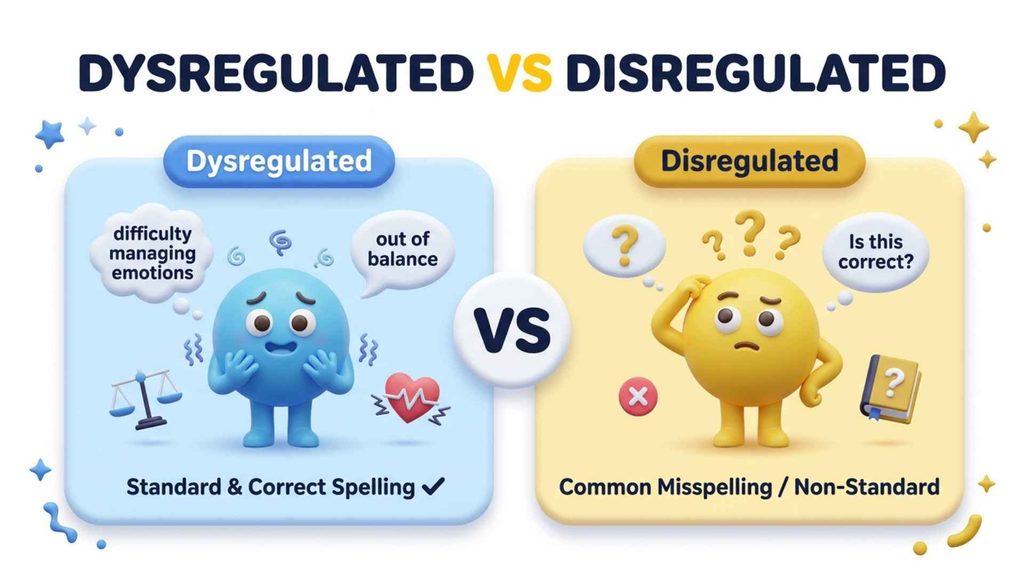
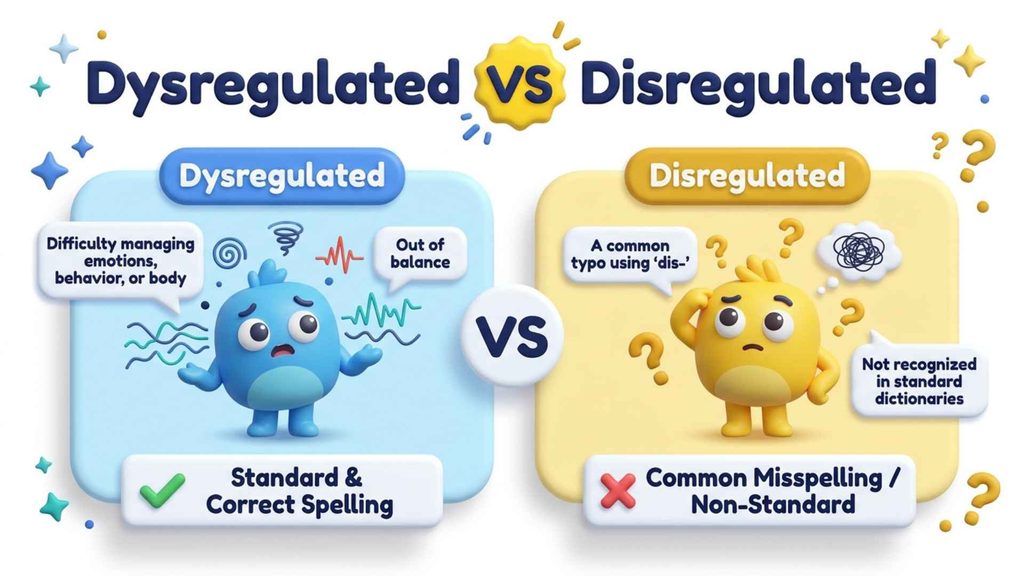
Have you ever typed a sentence about stress or feelings, then froze because the spelling looked wrong? That tiny doubt is exactly why dysregulated vs disregulated keeps showing up in searches, and honestly, it makes sense.
This guide gives you clear definitions, real examples, simple tables, and practical tips so the dysregulated vs disregulated question finally stops nagging you. We also look closely at disregulated, where it shows up, and why people use it. Keep reading, you are in the right place.
What Does Dysregulated Mean?
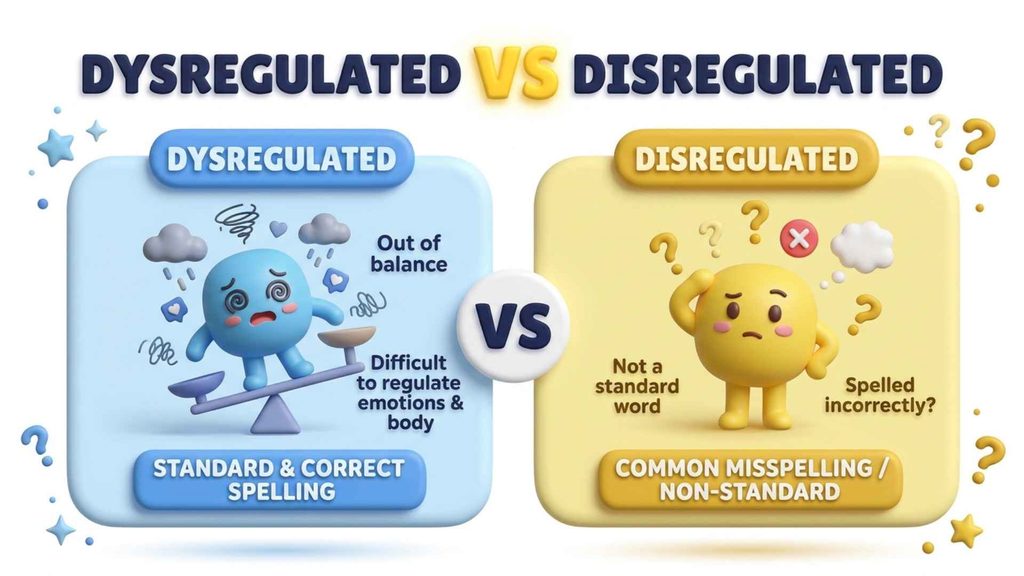
Ever felt like your emotions were driving while you sat helpless? That is dysregulated in a nutshell, and it anchors the whole dysregulated vs disregulated question, including where disregulated fits.
What Does Dysregulated Mean in Simple Words?
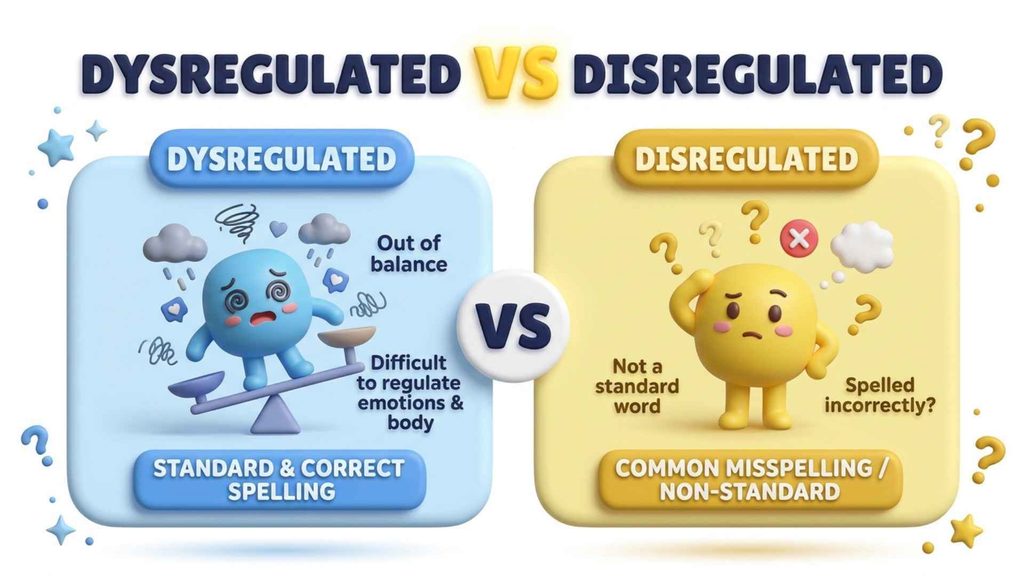
- Loss of control over emotions, body systems, or behavior
- Difficulty calming down after stress or a strong trigger
- Imbalance between the brain’s alarm system and its calming system
- Disrupted regulation in hormones, sleep, or the nervous system
- Clinical term used by therapists, doctors, and researchers
- Temporary or ongoing, depending on the cause
Example in chat: Friend 1: I totally lost it at work today, I couldn’t calm down. Friend 2: Sounds like you were dysregulated, that happens when stress piles up.
What Does Disregulated Mean?
Maybe you saw this spelling in a tweet and wondered if it was a typo. Here is the honest truth about disregulated within the dysregulated vs disregulated conversation, explained simply.
What Does Disregulated Mean in Everyday Use?
- Same idea, a loss of normal regulation or control
- Informal spelling that many people type by instinct
- Not standard in medical or psychology journals
- Understood by most readers, even though it looks off
- Common in casual posts, comments, and quick messages
- Better swapped for the standard spelling in formal writing
Example in texting: Friend 1: My sleep schedule is so disregulated lately. Friend 2: Same, but maybe write dysregulated if you post it publicly.
Dysregulated or Disregulated: Which One Is Correct?
Short answer first, because you deserve it. In the dysregulated vs disregulated showdown, one spelling clearly wins in professional writing, while disregulated hangs around in casual language and everyday chatter.
Which Is Correct: Dysregulated or Disregulated?
- Dysregulated is the accepted spelling in science and medicine
- Disregulated is a nonstandard variant, so avoid it in formal work
- Dictionaries list dysregulation, not disregulation, as the main entry
- Editors will usually correct the informal version
- Context matters, but formal writing always favors dysregulated
| Spelling | Accepted in formal writing? | Best used in |
| Dysregulated | Yes | Research, therapy, medical notes |
| Disregulated | No | Casual speech, quick messages |
Example in chat: Friend 1: Which spelling goes in my essay, dysregulated or disregulated? Friend 2: Dysregulated, every time. Your teacher will thank you.
What Does Disregulation vs Dysregulation Mean?
Nouns confuse people even more than adjectives, so let’s sort them out. The dysregulated vs disregulated puzzle has a noun version too, and the disregulated side has a casual cousin.
What Is the Difference Between Disregulation and Dysregulation?
- Dysregulation names the breakdown of regulation itself
- Disregulation is the informal, nonstandard twin of that noun
- Emotional dysregulation describes trouble managing feelings
- Physiological dysregulation describes body systems falling out of balance
- Both nouns point to the same basic idea
- Only one belongs in academic papers
| Form | Part of speech | Status |
| Dysregulation | Noun | Standard |
| Dysregulated | Adjective | Standard |
| Disregulation | Noun | Informal |
| Disregulated | Adjective | Informal |
Example in chat: Friend 1: Is it emotional disregulation or dysregulation? Friend 2: Dysregulation. The “dys” version is the one therapists use.
Where Is the Term Dysregulated Commonly Used?
You will hear this word in more places than you expect. Knowing where dysregulated lives helps you settle dysregulated vs disregulated, and it shows why disregulated feels out of place.
Where Do People Use the Word Dysregulated?
- Psychology and counseling sessions about emotional balance
- Medicine for hormones, blood sugar, and immune responses
- Education when teachers describe students who struggle to settle
- Parenting books and child development resources
- Wellness content about the nervous system and stress
- Research papers on mood, attention, and behavior
Example in texting: Friend 1: My therapist said my nervous system is dysregulated. Friend 2: That word is everywhere now, even my pediatrician used it.
Why Do People Say Disregulated Instead of Dysregulated?
Language follows ears before spellings. That is why the dysregulated vs disregulated mix-up happens, and why disregulated feels natural to so many people who only hear the word spoken aloud.
Why Do People Mix Up Dys- and Dis-?
- Sound alike, since both prefixes sound almost identical in speech
- Prefix habit: “dis-” already means “not,” as in disorganized
- Few people see the word written before they say it
- Social media spreads spellings without anyone checking them
- Autocorrect sometimes accepts the wrong version silently
- Rarity of “dys-” words makes the spelling harder to remember
Example in chat: Friend 1: Why does everyone write disregulated? Friend 2: Because “dis” feels like “not,” even though “dys” is the right one.
Real-Life Examples of Dysregulated Behavior
Sometimes a definition feels abstract until you picture it. Here are simple everyday moments that make dysregulated vs disregulated feel real, whichever spelling someone chooses, even the casual disregulated one.
What Does Dysregulated Behavior Look Like?
- Sudden anger over something small after a long, stressful day
- Crying spells that arrive without a clear reason
- Sleep disruption, like staying awake for hours after exhaustion
- Trouble focusing when emotions feel too loud
- Impulsive choices made to escape a heavy feeling
- Shutting down completely, going quiet or numb
Example in texting: Friend 1: I snapped at my sister over a dish. I felt out of control. Friend 2: That was probably a dysregulated moment, be kind to yourself.
Simple Breakdown: Dysregulated vs Disregulated
Want the quick version? This section sums up dysregulated vs disregulated in one glance, so you never forget which spelling is standard and where disregulated still sneaks into casual talk.
Dysregulated vs Disregulated: What Is the Quick Difference?
- Meaning stays the same in both words
- Spelling is the only real difference between them
- Dysregulated wins in research, healthcare, and school
- Disregulated shows up in comments and relaxed conversation
- When unsure, choose the dys- spelling
| Feature | Dysregulated | Disregulated |
| Meaning | Loss of regulation | Loss of regulation |
| Formality | Formal | Informal |
| Used by clinicians | Yes | Rarely |
| Safe for essays | Yes | No |
Example in chat: Friend 1: Quick check, dysregulated vs disregulated? Friend 2: Same meaning, but only dysregulated is safe in writing.
Definition of Dysregulated
Definitions matter, so let’s pin this one down properly. In the dysregulated vs disregulated conversation, the standard word has a clear meaning, and disregulated simply borrows it without changing anything.
What Is the Dictionary Definition of Dysregulated?
- Adjective describing something not properly regulated or controlled
- Root: Greek “dys,” meaning bad, abnormal, or difficult
- Applies to emotions, hormones, sleep, and immune function
- Opposite is regulated, balanced, or stable
- Related noun is dysregulation
- Often paired with words like emotional, behavioral, or autonomic
Example in chat: Friend 1: Is dysregulated always about emotions? Friend 2: No, doctors use it for hormones and body systems too.
Examples of Dysregulated in a Sentence
Seeing a word in action beats memorizing it. These sample lines show how dysregulated works, and why the dysregulated vs disregulated choice becomes obvious, while disregulated feels off in each.
How Do You Use Dysregulated in a Sentence?
- “The toddler felt dysregulated after a loud, crowded party.”
- “Stress left her hormones dysregulated for several months.”
- “A dysregulated sleep cycle can ruin your focus.”
- “He became dysregulated when plans changed suddenly.”
- “Therapy helps people feel less dysregulated under pressure.”
- “Her dysregulated mood swings worried the whole family.”
Example in texting: Friend 1: Can I say “my week was dysregulated”? Friend 2: Sure, it works, just keep it casual and honest.
Definition of Disregulated
Now for the second word. For the dysregulated vs disregulated comparison to make sense, you need an honest definition of disregulated, even though it is not the formal winner here.
What Is the Definition of Disregulated?
- Informal variant of dysregulated
- Means a loss of normal regulation or control
- Built with the common prefix “dis-,” meaning not or apart
- Rarely listed in standard dictionaries
- Used mostly in casual speech and social posts
- Replace it with dysregulated in anything official
Example in chat: Friend 1: Is disregulated in the dictionary? Friend 2: Not usually, dysregulated is the entry you will find.
Scientific and Medical Usage
Doctors and researchers care deeply about precision. In science and medicine, the dysregulated vs disregulated question has a very firm answer, and disregulated almost never appears in peer-reviewed medical work.
How Is Dysregulated Used in Science and Medicine?
- Endocrinology talks about hormonal dysregulation
- Immunology studies dysregulated immune responses
- Neurology examines dysregulated brain signaling
- Oncology describes dysregulated cell growth
- Journals consistently use the dys- spelling
- Clinicians rely on it for accurate records
| Field | Common phrase |
| Endocrinology | Dysregulated cortisol |
| Immunology | Dysregulated inflammation |
| Psychiatry | Emotional dysregulation |
| Neurology | Autonomic dysregulation |
Example in chat: Friend 1: My doctor mentioned dysregulated cortisol. Friend 2: That is a stress hormone, so it fits.
Psychological Context
Psychology gave this word its modern popularity. Within the dysregulated vs disregulated discussion, mental health writing leans heavily on the standard form, while disregulated stays firmly on the casual fringe.
How Does Psychology Describe Dysregulated Emotions?
- Emotional regulation is the ability to manage feelings
- Dysregulation means that ability is overwhelmed or weakened
- Trauma and chronic stress often play a role
- Therapies like DBT teach practical coping skills
- Mindfulness can improve awareness of emotional triggers
- Support from a licensed professional makes a difference
Example in texting: Friend 1: Are you doing DBT for the mood swings? Friend 2: Yes, learning to handle feeling dysregulated has helped a lot.
Everyday Language
Real conversation is messier than textbooks. In daily speech, the dysregulated vs disregulated line blurs, and disregulated slips out quite naturally because people say words long before they spell them.
Is It Okay to Say Disregulated in Daily Conversation?
- Speaking hides the spelling difference completely
- Listeners understand the meaning either way
- Texting often shows the informal version
- Professional emails should use dysregulated
- Social posts are flexible, but correctness builds trust
- Habit is easy to change once you notice it
Example in chat: Friend 1: Nobody will notice if I write disregulated, right? Friend 2: Maybe not, but spelling it right looks more credible.
Dysregulation (Correct Form)
The noun form deserves its own spotlight. For dysregulation, the standard side of dysregulated vs disregulated, accuracy really matters, and it keeps your writing far away from the disregulated shortcut.
What Does Dysregulation Mean?
- Noun describing the state of lost regulation
- Emotional dysregulation involves intense, hard-to-manage feelings
- Autonomic dysregulation affects heart rate and body temperature
- Behavioral dysregulation shows up as impulsive reactions
- Appears in diagnostic manuals and research literature
- Pairs naturally with “chronic,” “severe,” or “mild”
Example in texting: Friend 1: What’s the word for the whole pattern? Friend 2: Dysregulation, that is the correct noun.
Disregulation (Informal Variation)
You may spot this noun online. In the wider dysregulated vs disregulated story, disregulation mirrors disregulated as a nonstandard spelling that people use out of habit, not any formal rule.
Is Disregulation an Actual Word?
- Nonstandard spelling of dysregulation
- Meaning matches the standard noun exactly
- Seen mostly in forums, captions, and quick notes
- Spell checkers often flag it with a red line
- Writers should switch to dysregulation
- Readers may question accuracy when they see it
Example in chat: Friend 1: My spell check hates disregulation. Friend 2: Good, switch it to dysregulation and it will calm down.
Psychology
Psychology shapes how most people learn this word. When you study dysregulated vs disregulated in mental health, you see why the dys- spelling dominates and disregulated barely appears in textbooks.
How Does Psychology Explain Emotional Dysregulation?
- Amygdala reacts fast to perceived threats
- Prefrontal cortex helps slow reactions and plan responses
- Trauma can weaken that balance over time
- Anxiety, depression, and ADHD often involve regulation struggles
- Skills training strengthens calming strategies
- Early support leads to better long-term outcomes
Example in texting: Friend 1: Why do I overreact so quickly? Friend 2: Your brain’s alarm system may be dysregulated, a counselor can help.
Medicine
Medicine uses this word with precision. Doctors treat dysregulated vs disregulated as settled, since clinical notes demand standard terms, and disregulated would look like an error in a patient file.
How Do Doctors Use the Term Dysregulated?
- Hormones can become dysregulated through illness or stress
- Blood sugar control may fail in diabetes
- Blood pressure can swing when the autonomic system is off
- Inflammation may stay high when immune signals misfire
- Sleep-wake cycles shift when circadian rhythm is disrupted
- Treatment targets the underlying cause, not just the label
Example in chat: Friend 1: The nurse said my blood sugar was dysregulated. Friend 2: Thankfully they caught it, now you have a plan.
Child Development
Kids feel big things with small tools. Here, dysregulated vs disregulated is a spelling question, while the real work is helping children learn calm, and disregulated hardly matters to parents.
What Does a Dysregulated Child Look Like?
- Meltdowns that seem bigger than the trigger
- Difficulty transitioning between activities
- Hitting, yelling, or running away when overwhelmed
- Trouble sleeping after stimulating days
- Clinginess or withdrawal in stressful settings
- Co-regulation with a calm adult helps most
Example in texting: Friend 1: My son fell apart after the birthday party. Friend 2: He was probably dysregulated from the noise, a quiet hour helps.
What Does Disregulated Mean?
Let’s revisit this question from a practical angle. In real conversations, disregulated signals a loss of balance, and the dysregulated vs disregulated debate is mostly about which spelling you choose.
What Do People Mean When They Say Disregulated?
- Overwhelmed by emotions or stress
- Out of balance, physically or mentally
- Not coping well, even if the cause is unclear
- Off-routine, like erratic sleep or eating
- Informal shorthand for dysregulated
- Always replaceable with the standard spelling
Example in chat: Friend 1: I feel so disregulated this week. Friend 2: I get it. Try writing “dysregulated” when you journal, it’s the proper word.
Is Disregulated a Real Word?
Fair question, and the answer is nuanced. For dysregulated vs disregulated, one is standard and one is not, so disregulated exists in use but lacks formal recognition in reference books.
Can You Find Disregulated in a Dictionary?
- Major dictionaries list dysregulation instead
- Usage exists, but mostly as a spelling variant
- Not an error in speech, only in formal spelling
- Spell checkers often underline it
- Style guides prefer dysregulated
- Rule of thumb: if in doubt, use dys-
| Question | Answer |
| Is it understood? | Yes |
| Is it standard? | No |
| Should you use it formally? | No |
Example in texting: Friend 1: So disregulated isn’t a real word? Friend 2: It’s used, just not officially accepted.
What Is the Difference Between Dysregulated or Disregulated?
Let’s put the final comparison in plain, simple English. The dysregulated vs disregulated difference lives mainly in spelling and credibility, not meaning, and disregulated loses badly on professionalism every time.
How Are Dysregulated and Disregulated Different?
- Meaning is identical for both spellings
- Dysregulated is formal and widely accepted
- Disregulated is casual and often flagged
- Readers trust accurate spelling more
- Search engines show dysregulated far more often
- Choosing dys- protects your reputation as a writer
| Point | Dysregulated | Disregulated |
| Spelling status | Standard | Variant |
| Where used | Science, therapy, school | Casual chat |
| Recommended | Yes | No |
Example in chat: Friend 1: Any difference at all? Friend 2: Only the spelling. One earns trust, the other earns a red squiggle.
When Should I Use Dysregulated?
Timing matters when words carry weight. Whenever dysregulated vs disregulated comes up in your own writing, choose the standard, safer form, and save disregulated for jokes or quoted speech only.
When Is Dysregulated the Right Word to Use?
- Academic essays and research papers
- Medical notes and health summaries
- Therapy sessions and mental health articles
- Workplace emails about stress or wellbeing
- Blog posts that want to rank and build trust
- Any public writing where accuracy counts
Example in texting: Friend 1: Should I write dysregulated in my report? Friend 2: Absolutely, it’s the safest and most professional choice.
Why Do People Say Disregulated?
This one comes down to habit and hearing. Behind the dysregulated vs disregulated confusion, people trust their ears, and disregulated feels logical because “dis-” appears in so many common words.
What Makes Disregulated Sound So Natural?
- Familiar prefix from disorder, disconnect, and disorganized
- Spoken language does not reveal spelling
- Limited exposure to the standard written form
- Internet trends copy what looks right
- Quick typing skips second-guessing
- Awareness is the only fix needed
Example in chat: Friend 1: I always type disregulated without thinking. Friend 2: Same! Now I double-check it every time.
What Are the Signs of Emotional Dysregulation?
Spotting patterns early helps. Alongside dysregulated vs disregulated, knowing the signs gives the word real meaning, and it shows why disregulated is just an alternate spelling, never a different condition.
How Do You Recognize Emotional Dysregulation Symptoms?
- Intense reactions that feel bigger than the situation
- Slow recovery after upsetting moments
- Mood swings within hours
- Irritability with people you care about
- Physical signs like racing heart or tight chest
- Avoidance or numbing to escape discomfort
| Sign | What it may look like |
| Emotional | Sudden tears or anger |
| Physical | Rapid breathing, tension |
| Behavioral | Impulsive decisions |
| Cognitive | Foggy thinking |
Example in texting: Friend 1: My heart races over tiny things lately. Friend 2: That can be dysregulation, please mention it to a doctor.
How Can You Calm a Dysregulated Nervous System?
Relief is possible, and small steps count. In the dysregulated vs disregulated world, calming skills matter more than spelling, and a disregulated or dysregulated person benefits from the same practices.
What Helps a Dysregulated Nervous System Reset?
- Slow breathing with longer exhales
- Grounding by naming five things you can see
- Movement like a brisk walk or stretching
- Consistent sleep and meal routines
- Cold water on hands or face, if comfortable
- Professional help when symptoms stay intense
Example in chat: Friend 1: What helps when I feel overwhelmed? Friend 2: Slow breathing and a short walk, it calms my dysregulated mind fast.
Dysregulated Behavior in Adults and Teens
People rarely discuss this outside childhood. When dysregulated vs disregulated is explained honestly, adults and teens belong in the story, and disregulated habits or dysregulated ones deserve compassion, not shame.
What Does Dysregulated Behavior in Adults Look Like?
- Explosive anger during conflict
- Overworking to avoid feelings
- Binge scrolling or spending to cope
- Withdrawing from friends when stressed
- Perfectionism that creates constant pressure
- Seeking therapy is a healthy, courageous step
| Age group | Common sign |
| Teens | Mood swings, risk-taking |
| Adults | Burnout, irritability |
| Older adults | Sleep and appetite changes |
Example in texting: Friend 1: I keep exploding at my partner over little things. Friend 2: Maybe talk to a counselor, that pattern sounds dysregulated, not broken.
Is Dysregulated the Same as Disregulated in Meaning?
Same meaning, different respect. For the dysregulated vs disregulated pair, the answer is yes in meaning and no in accuracy, so disregulated keeps the whole idea but loses the polish.
Do Dysregulated and Disregulated Mean the Same Thing?
- Meaning overlaps completely
- Spelling separates the standard from the informal
- Professionals choose dysregulated
- General readers understand both
- Credibility favors the standard form
- Consistency across your writing builds trust
Example in chat: Friend 1: Same meaning, right? Friend 2: Yes, but only dysregulated looks professional.
What Causes a Person to Become Dysregulated?
Causes vary, and rarely come from one place. Beyond dysregulated vs disregulated, understanding triggers helps readers who type disregulated into search bars seeking answers about their feelings or someone else’s.
What Are the Common Causes of Dysregulation?
- Chronic stress over weeks or months
- Trauma or difficult childhood experiences
- Neurodivergence, including ADHD and autism
- Poor sleep and irregular routines
- Hormonal changes or medical conditions
- Substances such as caffeine, alcohol, or certain medications
Example in texting: Friend 1: Why am I so on edge these days? Friend 2: Stress, bad sleep, and caffeine can all leave you dysregulated.
How Do You Know If You Are Emotionally Dysregulated?
Self-awareness starts with curiosity, not judgment. Whether you use dysregulated vs disregulated or disregulated, a few simple honest questions can help you notice patterns before they spiral out of control.
What Questions Help You Check Your Emotional State?
- Do my reactions match the size of the problem?
- How long does it take me to calm down?
- Do I feel physically tense or restless?
- Are my relationships suffering from outbursts or shutdowns?
- Is sleep getting worse?
- Would a professional help me sort this out?
Example in chat: Friend 1: How do I know if I’m dysregulated? Friend 2: Notice how fast you recover after stress, then ask a therapist.
Can a Dysregulated Nervous System Be Healed?
Hope belongs in this conversation. With dysregulated vs disregulated confusion aside, the answer is encouraging, because both dysregulated and disregulated states can improve with practice, support, and patience over time.
How Long Does It Take to Regulate Your Nervous System?
- Progress is usually gradual, not instant
- Therapy builds lasting skills
- Daily habits like sleep and exercise matter
- Support from friends reduces isolation
- Medical care helps when a condition is involved
- Setbacks are normal, not failure
Example in texting: Friend 1: Will I ever feel calm again? Friend 2: Yes, small habits and therapy helped me a lot.
FAQs About Dysregulated or Disregulated
1. What is the correct spelling in dysregulated vs disregulated?
Dysregulated is the standard spelling in the dysregulated vs disregulated debate. Disregulated is an informal variant that most professionals avoid.
2. Does dysregulated vs disregulated change the meaning?
No, the meaning stays the same in dysregulated vs disregulated. Only the spelling and formality differ between the two words.
3. Is disregulated acceptable in dysregulated vs disregulated writing?
It is understood in casual talk, but dysregulated vs disregulated rules favor dys-. Use dysregulated for essays, reports, and professional content.
4. Why is dysregulated vs disregulated so confusing?
The prefixes dys- and dis- sound alike, which fuels the dysregulated vs disregulated mix-up. Most people only hear the word before spelling it.
5. Where does dysregulated vs disregulated matter most?
It matters most in science, medicine, and school, where dysregulated vs disregulated accuracy builds trust. Casual chats allow more flexibility.
6. Can I use disregulated in a casual post about dysregulated vs disregulated?
Yes, readers will understand it, though dysregulated vs disregulated purists may notice. Choosing dysregulated keeps your content polished.
7. What is the easiest way to remember dysregulated vs disregulated?
Remember that dys- means abnormal or difficult, which fits dysregulated vs disregulated perfectly. If it describes a system gone wrong, pick dysregulated.
Conclusion
Here is the simple truth about dysregulated vs disregulated: both describe a loss of balance or control, but only dysregulated is standard in science, medicine, and professional writing. The word disregulated lives in casual speech, and that is fine, as long as you know the difference.
The next time dysregulated vs disregulated crosses your screen, choose the dys- spelling, and be gentle with anyone using the other one. Behind both words is usually a real person trying to describe a hard feeling. Tonight, notice one moment you felt overwhelmed, and try a slow breath. It really helps.
Meta Description
Dysregulated vs disregulated meaning made simple. Learn which spelling is correct, why people mix them up, and how to use each one right.

Amelia Brooks is a US-based author known for inspiring stories on meaning, growth, and hope, blending insight with simple, engaging storytelling.