

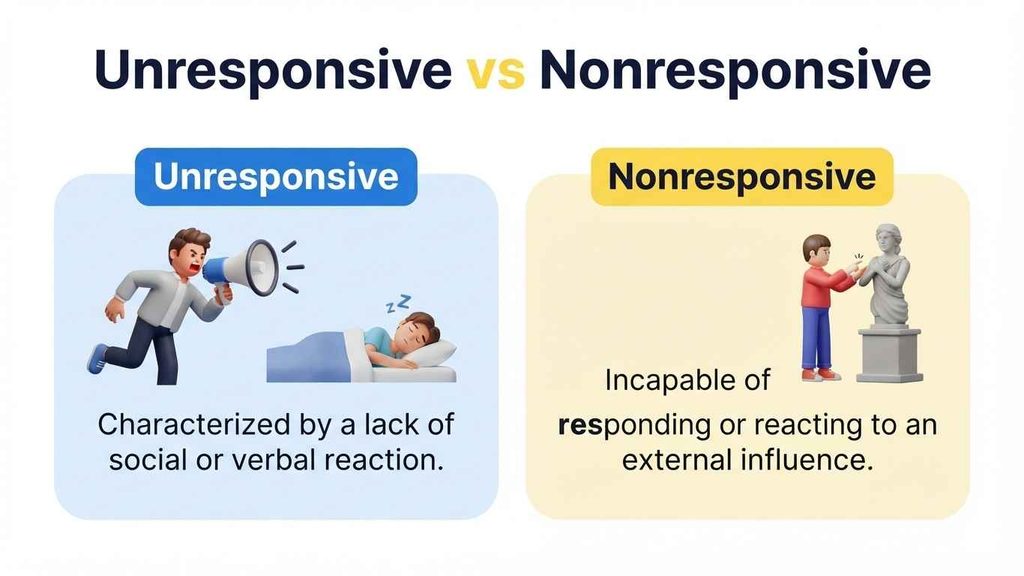
You type a message, you wait, and… nothing. No reply, no reaction, just silence on the other end. That quiet moment is exactly why so many people search for unresponsive vs nonresponsive because English gives us two almost-twin words for the same frustrating feeling, and picking the wrong one can quietly undercut your writing.
This guide breaks down the real meaning behind both words, shows you exactly when to use each one, and gives you natural examples from texting, medicine, and everyday work life. Whether you’re writing a report, a text, or a formal email, you’ll walk away knowing the difference between nonresponsive and unresponsive for good. Keep reading it’s simpler than it looks.
Quick Answer
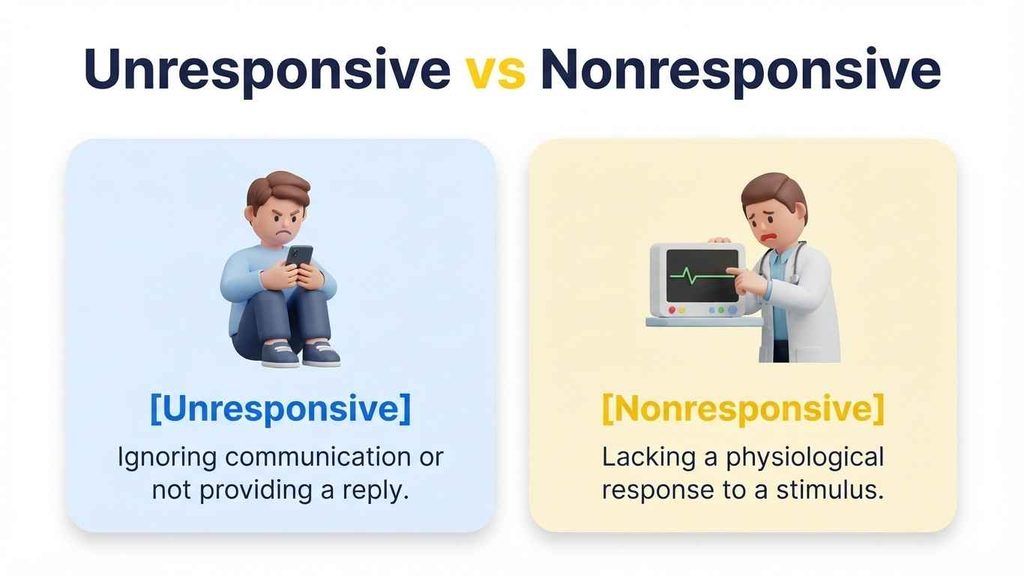
Unresponsive describes a person, patient, or system that fails to react or reply, and it’s the word people reach for most often. Nonresponsive means almost the same thing but leans more formal, technical, and clinical. In the unresponsive vs nonresponsive debate, context not correctness decides the winner.
| Feature | Unresponsive | Nonresponsive |
| Tone | Everyday, general | Formal, technical |
| Common field | Medicine, relationships, tech | Medicine, systems, legal/data forms |
| Frequency of use | Much more common | Less common, more niche |
| Prefix meaning | “un-” = not | “non-” = lacking |
| Best for | Conversation, general writing | Reports, clinical notes, official docs |
- Unresponsive is the safer default choice in casual and general writing.
- Nonresponsive fits better in medical charts, surveys, and technical reports.
- Both words are real, dictionary-recognized, and grammatically correct.
- Neither word is “wrong” the difference is register, not accuracy.
- Style guides in medicine and IT often prefer nonresponsive for precision.
Example in texting: Friend 1: He’s been unresponsive since yesterday, it’s freaking me out. Friend 2: Try calling instead of texting, maybe his phone died.
Nonresponsive vs Unresponsive: What’s the Difference?
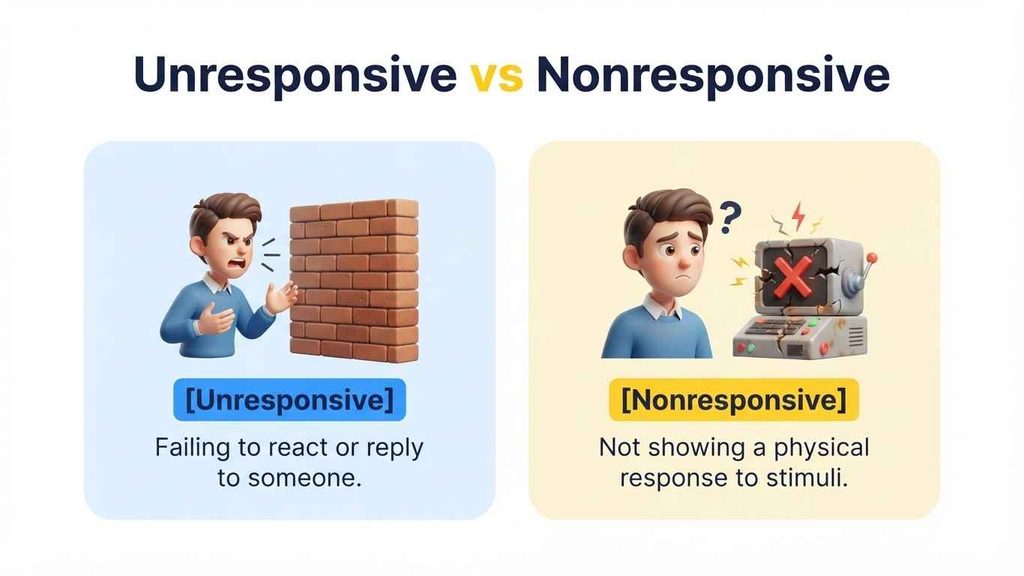
Here’s the honest truth: most native speakers use these two words without ever thinking twice, yet the nonresponsive vs unresponsive split actually matters once you’re writing for work, school, or health records. It comes down to formality and field.
Both words share the same root responsive, from the Latin responsivus, meaning capable of replying. The prefixes are where they split. Un- is the everyday negator, the one you already use in unhappy, unclear, and unfair. Non- feels more clinical, the one you see in non-toxic, non-refundable, and nondisclosure.
Why Does English Have Two Words for the Same Idea?
- English absorbed both “un-“ and “non-“ from different historical language sources.
- “Un-“ is Old English and feels natural in casual speech.
- “Non-“ is Latin-based and feels precise, technical, and formal.
- Many word pairs exist this way: nonfunctional vs unfunctional, nonstop vs unstopping.
- Writers pick one based on tone, audience, and industry expectations.
Example in chat: Friend 1: Is it “unresponsive” or “nonresponsive” for the report? Friend 2: Use nonresponsive, it sounds more official for a medical file.
Quick Answer
(Already covered above see “Quick Answer” for the fastest breakdown of unresponsive vs nonresponsive.)
What Does Nonresponsive Mean?
Nonresponsive means failing to give a reply, reaction, or response, and it usually shows up in formal or technical writing. It’s built from non- (lacking) plus responsive (able to react), making a word that literally means “not giving a response.”
You’ll see nonresponsive most in medical charts describing a patient’s condition, IT support tickets describing a frozen device, or legal and survey documents describing missing answers. It carries a slightly clinical, checklist feel precise rather than emotional.
What Does Nonresponsive Mean in a Medical Report?
- A nonresponsive patient shows no reaction to voice, touch, or pain stimuli.
- Doctors use it to document a specific, measurable lack of reaction.
- It can describe a treatment that isn’t producing results.
- Nurses may write “nonresponsive to stimuli” in clinical notes.
- The word signals urgency without sounding overly emotional.
- It’s often paired with vital signs for a full clinical picture.
Example in chat: Friend 1: The report said grandpa was briefly nonresponsive before the ambulance came. Friend 2: That must have been terrifying, is he stable now?
What Does Unresponsive Mean?
Unresponsive means not reacting, replying, or engaging and it’s the far more common of the two words in daily English. Built from un- (not) plus responsive, it covers everything from a silent friend to a frozen laptop to an unconscious patient.
Because un- is so flexible, unresponsive stretches across more situations than its cousin. You can call a coworker unresponsive to emails, a website unresponsive on mobile, or a toddler unresponsive during a nap-time meltdown. It’s the go-to word when you’re not writing something strictly formal.
How Is Unresponsive Used in Everyday Conversations?
- People call a friend unresponsive when texts go unanswered for hours.
- Tech support says a screen is unresponsive when taps don’t register.
- Teachers describe a student as unresponsive during a lesson.
- HR may flag an unresponsive candidate who stopped replying to emails.
- Paramedics use it as the first check in an emergency.
- It works equally well in speech, texts, and formal writing.
Example in texting: Friend 1: My phone’s been totally unresponsive since the update, ugh. Friend 2: Restart it, that update broke a lot of people’s phones.
Key Differences Between Nonresponsive and Unresponsive
Knowing the surface meaning is one thing spotting the real, practical differences is what actually improves your writing. The gap between unresponsive and nonresponsive shows up most clearly in tone, field, and frequency of use.
| Category | Unresponsive | Nonresponsive |
| Register | Casual to neutral | Formal, technical |
| Best context | Texts, articles, general speech | Medical charts, IT logs, legal docs |
| Emotional weight | Can sound personal or urgent | Sounds detached, clinical |
| Search popularity | Higher | Lower but steady |
| Typical subject | People, devices, relationships | Systems, patients, survey data |
Which Word Do Dictionaries List First?
- Major dictionaries list unresponsive as the more common headword.
- Nonresponsive is often cross-referenced as a synonym or variant.
- Both are grammatically standard, not slang or informal shortcuts.
- Style guides in journalism favor unresponsive for readability.
- Medical and legal style guides often favor nonresponsive for precision.
- Google search volume consistently favors “unresponsive” over “nonresponsive.”
Example in chat: Friend 1: Which one should I use in my nursing notes, nonresponsive or unresponsive? Friend 2: Check your hospital’s style guide most prefer nonresponsive for charting.
nonresponsive vs unresponsive
When people type “nonresponsive vs unresponsive” into Google, they’re usually double-checking spelling or trying to settle a quick argument. The short version: both spellings are correct, but they’re two separate words, not two spellings of one word.
- Neither word is a typo of the other they’re distinct terms.
- Unresponsive wins in casual writing and everyday conversation.
- Nonresponsive wins in clinical, legal, and technical documentation.
- Spell-check will accept both without flagging an error.
- When unsure, unresponsive is the statistically safer general choice.
Example in texting: Friend 1: Wait, is it “nonresponsive” or “un” something? Friend 2: Both exist! Just use unresponsive unless you’re writing something medical.
nonresponsive or unresponsive
If you’re staring at a blank document wondering nonresponsive or unresponsive, the fastest fix is to picture your audience. A doctor’s note, a data survey, or a compliance form leans nonresponsive. A text message, blog post, or casual email leans unresponsive.
- Ask yourself: is this document formal or conversational?
- Formal, clinical, or legal writing → lean toward nonresponsive.
- Everyday, personal, or general writing → lean toward unresponsive.
- When your audience is broad, unresponsive reads more naturally.
- Consistency matters more than perfection pick one and stay with it.
Example in chat: Friend 1: For my thesis on patient care, nonresponsive or unresponsive? Friend 2: Go with nonresponsive, it matches clinical language reviewers expect.
non responsive or unresponsive
Some people search “non responsive or unresponsive” with a space, unsure if “non responsive” is even a valid two-word phrase. It technically can appear as two words in older or looser writing, but the standard, dictionary-recognized spelling is the single hyphen-free word nonresponsive.
- “Non responsive” (two words) is nonstandard in modern style guides.
- The accepted single-word form is nonresponsive, no space or hyphen.
- Unresponsive never splits into two words it’s always one term.
- Autocorrect and grammar checkers usually flag the two-word version.
- Stick to the closed compound nonresponsive for professional writing.
Example in texting: Friend 1: Should I write “non responsive” as two words in this email? Friend 2: No, keep it one word: nonresponsive. Looks more polished that way.
non responsive vs unresponsive
The same logic carries into “non responsive vs unresponsive” searches people are really asking whether spacing changes meaning. It doesn’t change meaning, but it does change how professional your writing looks.
- Spacing errors like “non responsive” can read as careless in formal work.
- Unresponsive has no spacing variant to worry about at all.
- Use a grammar checker before submitting formal documents either way.
- Style consistency across a document boosts overall credibility.
- When editing, search-and-replace “non responsive” with nonresponsive first.
Example in chat: Friend 1: My professor circled “non responsive” in red on my paper. Friend 2: Yeah, it should be one word nonresponsive. Fix it before resubmitting.
When to Use “Nonresponsive”
Choosing nonresponsive signals precision, formality, and a technical or clinical setting. It’s the word professionals reach for when documentation, accuracy, and tone matter more than everyday warmth.
- Use it in medical charts describing a patient’s lack of reaction.
- Use it for IT tickets describing frozen software or hardware.
- Use it in legal or survey contexts describing missing responses.
- Use it when your house style guide specifically calls for it.
- Use it to sound more formal in professional reports.
- Avoid it in casual texts it can feel stiff or distant.
Example in texting: Friend 1: How do I phrase the incident report for the crashed server? Friend 2: Say the server was nonresponsive for twelve minutes before rebooting.
Examples of “Nonresponsive”
Real sentences make the word click faster than any definition. Here are natural, ready-to-use examples of nonresponsive across medical, tech, and formal writing situations.
- “The patient remained nonresponsive despite repeated attempts to wake her.”
- “Our server went nonresponsive during peak traffic last night.”
- “The survey listed several nonresponsive participants in the final data set.”
- “His rash proved nonresponsive to the prescribed cream.”
- “The vendor was flagged as nonresponsive after missing three deadlines.”
- “Technicians rebooted the nonresponsive router twice before it worked.”
- “The committee marked the application as nonresponsive to the requirements.”
Example in chat: Friend 1: The vendor missed another deadline, what do we call this in the file? Friend 2: Mark them nonresponsive that’s the standard term for procurement reports.
When to Use “Unresponsive”
Unresponsive is your default, everyday choice reach for it whenever you’re not writing something strictly clinical or technical. It fits texts, articles, general reports, and spoken conversation without ever sounding out of place.
- Use it for a friend or family member who stops replying.
- Use it for a device that freezes or stops reacting.
- Use it for medical emergencies described in plain language.
- Use it for a student or employee who disengages.
- Use it in news writing and general blog content.
- Use it whenever you’re unsure which word fits better.
Example in texting: Friend 1: She’s been unresponsive all day, should I be worried? Friend 2: Give it a few more hours, then call her mom just in case.
Examples of “Unresponsive”
Seeing unresponsive across different situations helps confirm just how flexible the word really is, from casual chats to emergency rooms.
- “He remained unresponsive after fainting on the subway platform.”
- “Customers grew frustrated with the unresponsive support team.”
- “The touchscreen was unresponsive until I restarted the tablet.”
- “Her unresponsive attitude made the meeting feel tense.”
- “Paramedics found the driver unresponsive but breathing.”
- “The landlord has been unresponsive to repair requests for weeks.”
- “The class stayed unresponsive during the pop quiz review.”
Example in chat: Friend 1: The landlord still hasn’t fixed the heater, it’s freezing. Friend 2: Honestly, he’s been totally unresponsive since we moved in.
Can Nonresponsive and Unresponsive Be Used Interchangeably?
In most everyday situations, yes swapping nonresponsive and unresponsive won’t confuse your reader or change the core meaning. Dictionaries generally list them as close synonyms, and casual writing rarely punishes the “wrong” pick.
| Situation | Interchangeable? | Better Choice |
| Texting a friend | Yes | Unresponsive |
| Medical chart notes | Technically, but… | Nonresponsive |
| Blog or news article | Yes | Unresponsive |
| Legal/compliance form | Technically, but… | Nonresponsive |
| Tech support ticket | Yes | Either works |
- Interchangeability works best in general, low-stakes writing.
- Formal fields still have a strong preference, even if not a rule.
- Swapping them rarely causes real miscommunication between readers.
- When in doubt, match the tone of the surrounding document.
- Editors may still flag one as “off” for stylistic consistency.
Example in texting: Friend 1: Can I just use unresponsive instead of nonresponsive in my essay? Friend 2: Totally fine, just stay consistent and don’t mix both in one paragraph.
Nonresponsive vs Unresponsive in Medical Terminology
Hospitals live and die by precise language, which is exactly why the unresponsive vs nonresponsive choice matters so much in patient charts. A single word can shape how urgently a case gets read.
- Unresponsive typically describes a patient’s overall consciousness level.
- Nonresponsive often describes a specific treatment or symptom outcome.
- EMTs favor unresponsive in first-contact, on-scene emergency reports.
- Specialists favor nonresponsive when documenting treatment resistance.
- Both terms appear side by side in the same patient file.
- Clarity here can directly affect triage and treatment decisions.
Example in chat: Friend 1: The chart says the tumor was nonresponsive to chemo, is that bad? Friend 2: It means that treatment didn’t work doctors will try another approach.
Nonresponsive vs Unresponsive in Technology and Computers
Tech support tickets throw both words around constantly, and knowing which one fits keeps your bug reports clear and professional. This is where nonresponsive and unresponsive genuinely overlap the most.
- An unresponsive app is the phrase most users naturally type.
- A nonresponsive server appears more often in engineering logs.
- “Not responding” pop-ups on Windows use plain, user-friendly language.
- IT tickets favor nonresponsive for a more technical, formal tone.
- Either word works fine in a casual bug report to a friend.
- Consistency across your team’s documentation matters more than the pick itself.
Example in texting: Friend 1: The app’s completely unresponsive, nothing loads. Friend 2: Same here, IT just logged it as a nonresponsive server issue.
Synonyms for Nonresponsive and Unresponsive
Expanding your vocabulary around unresponsive vs nonresponsive makes your writing sharper and helps you avoid repeating the same word over and over in one document.
| Word | Best Used For |
| Unreactive | Chemical, physical, or emotional lack of reaction |
| Silent | Human communication, ignored messages |
| Passive | Behavior, lack of initiative |
| Frozen | Devices, software, screens |
| Inert | Systems, substances, biological samples |
| Withdrawn | Emotional or social disengagement |
- Unreactive works well in scientific or emotional contexts.
- Silent feels natural for texts, calls, and messages.
- Frozen is the go-to casual word for tech problems.
- Inert suits chemistry, biology, and dormant systems.
- Withdrawn fits emotional or psychological descriptions best.
Example in chat: Friend 1: Is there another word for unresponsive I can use in my essay? Friend 2: Try “withdrawn” if you’re describing how someone acted emotionally.
Is Nonresponsive a Real Word?
Yes nonresponsive is a fully recognized, dictionary-listed English word, not slang or a typo of unresponsive. It’s simply less frequent, which sometimes makes it feel unfamiliar.
- Major dictionaries confirm nonresponsive as a standard adjective.
- It follows normal English prefix rules (non- + responsive).
- Spell-checkers and grammar tools accept it without flags.
- It’s common enough in medical and technical fields to be standard.
- Rarity doesn’t equal incorrectness plenty of valid words are less common.
Example in texting: Friend 1: Is “nonresponsive” even a real word or did I make it up? Friend 2: It’s real! Just less common than unresponsive in daily talk.
Which Word Sounds More Professional: Nonresponsive or Unresponsive?
Neither word is inherently “more correct,” but nonresponsive often reads as slightly more formal and buttoned-up, which is why it shows up in official reports.
- Nonresponsive suits contracts, medical files, and compliance reports.
- Unresponsive suits emails, articles, and general business writing.
- Overly formal word choices can feel stiff in casual messages.
- Match your word choice to your audience’s expectations, not habit.
- When representing a brand or company, lean toward the formal option.
Example in chat: Friend 1: Which sounds better in a client email, unresponsive or nonresponsive? Friend 2: Use unresponsive it’s warmer and still totally professional.
Does Google Prefer Nonresponsive or Unresponsive in Search?
Search data consistently shows unresponsive gets searched far more often than nonresponsive, which matters if you’re writing content meant to answer real reader questions.
- Unresponsive has noticeably higher monthly search volume.
- Nonresponsive still gets steady searches from medical and technical readers.
- Content covering both terms captures a wider audience naturally.
- Google’s AI Overviews reward pages that clearly define both words.
- Ranking well means answering the exact comparison readers are typing.
Example in texting: Friend 1: Why does everyone Google “unresponsive” more than “nonresponsive“? Friend 2: It’s just the word people naturally reach for in everyday speech.
Common Mistakes to Avoid
Even confident writers slip up with unresponsive vs nonresponsive, usually by mixing spacing, hyphens, or tone. These small errors are easy to fix once you know what to watch for.
| Mistake | Why It’s Wrong | Correct Version |
| “non responsive” | Incorrect spacing | nonresponsive |
| “un-responsive” | Unnecessary hyphen | unresponsive |
| Using nonresponsive in casual texts | Sounds overly stiff | unresponsive |
| Using unresponsive in strict clinical charts | Less precise register | nonresponsive |
| Mixing both terms in one paragraph | Inconsistent tone | pick one and stay consistent |
- Don’t add a hyphen to either word both are closed compounds.
- Don’t split “nonresponsive” into two separate words.
- Don’t switch between the two terms mid-document without reason.
- Don’t assume spell-check catches tone, only spelling.
- Don’t overuse either word vary with synonyms when writing longer pieces.
Example in chat: Friend 1: My grammar checker didn’t catch “non responsive,” is that fine? Friend 2: Nope, checkers miss spacing sometimes it should be one word, nonresponsive.
How to Remember Which Word to Fit
If the unresponsive vs nonresponsive choice still trips you up, a simple memory trick can settle it in seconds. Think of “un-” as the word you already use constantly unhappy, unsure, unfair while “non-” belongs to the checklist-and-clipboard world of forms, charts, and reports.
- Picture unresponsive as the word you’d say out loud to a friend.
- Picture nonresponsive as the word you’d see printed on a form.
- If you’re speaking casually, default to unresponsive every time.
- If you’re filling out paperwork, lean toward nonresponsive instead.
- When genuinely stuck, unresponsive is statistically the safer general pick.
- Re-read your sentence aloud if it sounds stiff, swap to unresponsive.
Writers who work across both worlds say, a nurse who also blogs, or a support agent who also writes internal reports often keep a mental switch: casual voice uses unresponsive, professional documentation uses nonresponsive. Once that switch becomes automatic, you’ll never have to pause mid-sentence again wondering which spelling looks more correct.
Example in texting: Friend 1: I still mix up nonresponsive and unresponsive every single time. Friend 2: Easy trick say it out loud. If it sounds normal, it’s unresponsive.
Frequently Asked Questions (FAQs)
Is nonresponsive the same as unresponsive?
They’re close synonyms, but nonresponsive leans formal and technical while unresponsive stays flexible and common in everyday use.
Which is more common, nonresponsive or unresponsive?
Unresponsive is far more common in everyday writing, speech, and search, while nonresponsive stays mostly in clinical or technical spaces.
Can I use nonresponsive in a text message?
Yes, but unresponsive fits casual texting better since nonresponsive can sound stiff or overly formal for friends.
Is “non responsive” with a space correct?
No the standard, dictionary-approved form is one word: nonresponsive, without a space or hyphen.
Why do doctors prefer nonresponsive?
Medical writing values precision, and nonresponsive sounds clinical and specific, which suits patient charts and treatment notes.
Does unresponsive only apply to people?
No, unresponsive describes people, devices, websites, and systems, making it more versatile than many assume.
Should I worry about which word I pick?
Not much in the unresponsive vs nonresponsive debate, both are correct, so focus on matching your document’s tone instead.
Conclusion
At the end of the day, the unresponsive vs nonresponsive debate isn’t really about right or wrong it’s about tone. Unresponsive is your everyday, flexible go-to for texts, articles, and general writing, while nonresponsive steps in when a medical chart, legal form, or technical report calls for something more formal.
Both words are correct, both are dictionary-recognized, and both describe the same core idea: a lack of reaction or reply. Once you match the word to your audience, the choice stops feeling confusing and starts feeling automatic. Next time you’re stuck between unresponsive and nonresponsive, just ask yourself who’s reading and let that answer guide your pen.

Amelia Brooks is a US-based author known for inspiring stories on meaning, growth, and hope, blending insight with simple, engaging storytelling.