

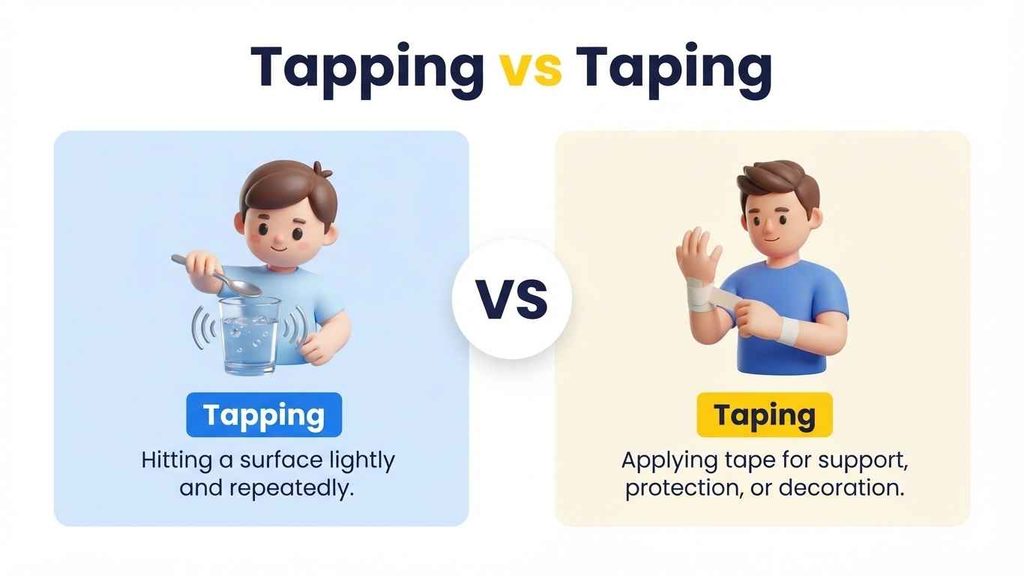
You typed it, then stopped. Was it tapping or taping? One tiny letter changes the whole meaning, and autocorrect never seems to know which one you actually want.
That small hesitation is exactly why this guide exists. Below, you’ll find the true meaning of tapping vs taping, clear examples, a few handy tables, and the confidence to use taping correctly every single time you write. Keep reading this one’s going to stick.
Taping or Tapping? Taping vs Tapping? Taped vs Tapped? Tapped vs Taped?
People search all four versions because the confusion runs deep, and honestly, that’s fair these words look nearly identical on a page. Tapping means repeated light contact; taping means using adhesive tape.
Why Does This Word Pair Trip So Many Writers Up?
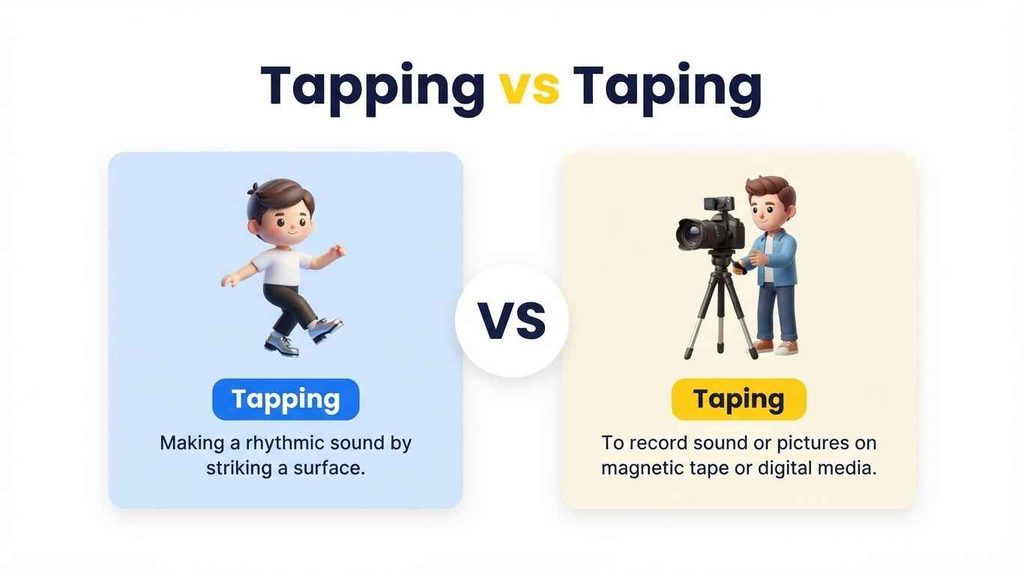
- One letter separates two completely different meanings.
- Autocorrect frequently swaps one word for the other.
- Tapped (past tense of tap) sounds close to taped (past tense of tape).
- Both words appear often in sports, therapy, and tech contexts.
- Non-native English speakers mix them up most often in writing.
Example in texting: Friend 1: are you tapping your foot again lol Friend 2: nah I’m taping this box for the move 📦
Tapping vs Taping
At the core, tapping is a rhythmic, repeated motion, while taping is a physical act of securing something with adhesive tape. Knowing this one distinction solves most of the confusion instantly.
What’s the Simplest Way to Remember the Difference?
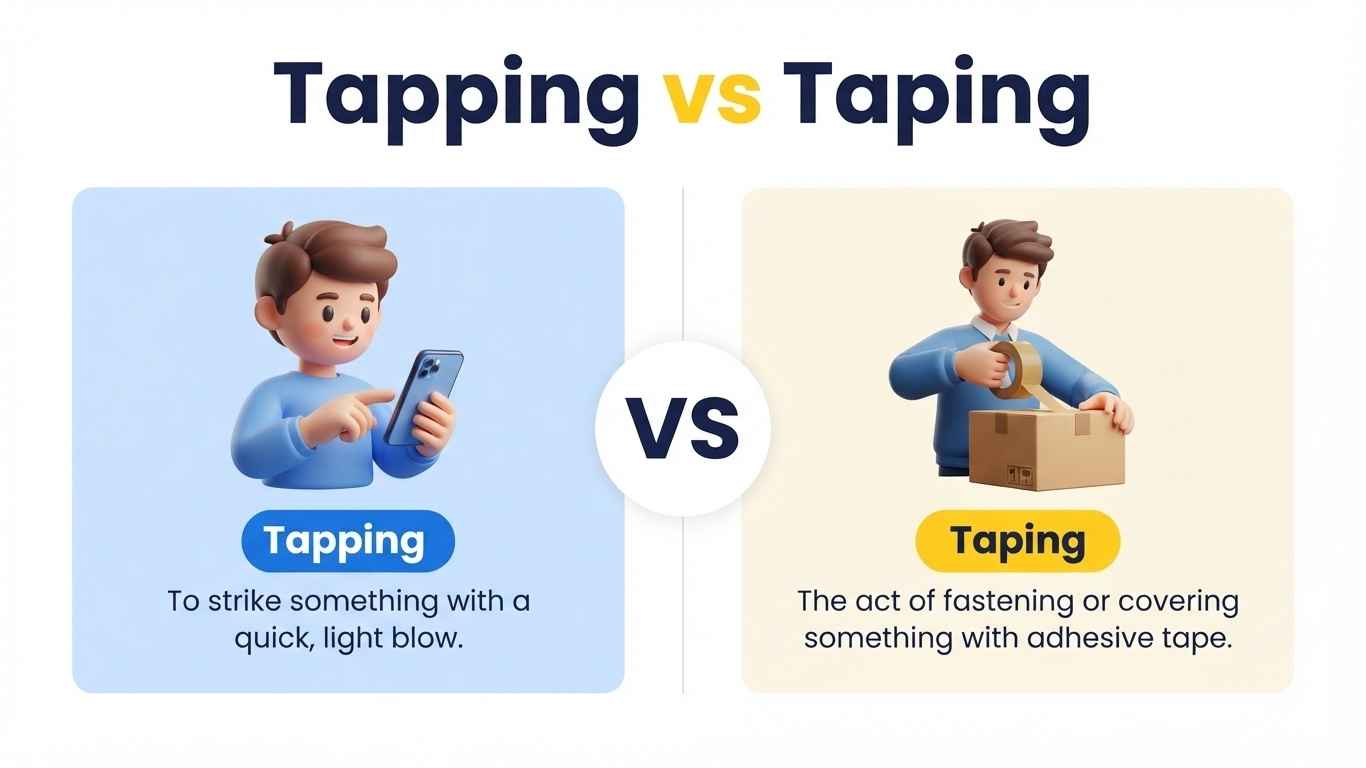
- Tapping = light, repeated strikes or touches.
- Taping = applying tape to hold, seal, or record something.
- Think “tap the table” vs “tape the box” as your anchor phrases.
- Tapping never involves an actual tape roll.
- Taping never means hitting something rhythmically.
- Both are verbs, but their root nouns are completely unrelated.
| Word | Root Word | Core Meaning |
| Tapping | Tap (hit) | Repeated light striking |
| Taping | Tape (adhesive) | Securing or recording with tape |
Example in chat: Friend 1: he was tapping his pen through the whole meeting Friend 2: meanwhile I was taping cables under my desk 😅
Meaning of Tapping
The meaning of tapping centers on light, repeated contact a finger on a desk, a foot to a beat, or even a therapist’s technique. It’s far more common in casual speech than taping.
What Does Tapping Really Mean in Everyday Language?
- Tapping describes quick, light hits, often rhythmic.
- Musicians and dancers use tapping to keep time.
- In therapy (EFT), tapping calms stress by touching specific body points.
- Tapping into a resource means accessing it, not hitting it.
- Phones use tapping to describe a touchscreen action.
- Martial artists tap out to signal submission.
- Tapping can also mean gently connecting two things, like glasses in a toast.
Example in texting: Friend 1: why do you keep tapping your phone screen Friend 2: I’m tapping through my messages, one sec
Meaning of Taping
Taping, on the other hand, means physically applying adhesive tape to secure, protect, or seal something or recording audio and video for later use. It’s a far more literal, hands-on action than tapping.
What Does Taping Actually Cover Beyond Adhesive Tape?
- Taping commonly means using kinesiology or athletic tape.
- It can mean recording a show, podcast, or interview.
- Taping a wound means bandaging it with medical tape.
- Painters use taping to protect edges before painting.
- Electricians rely on taping to insulate exposed wires.
- Taping a box means sealing it shut for shipping.
- The word always implies actual tape is involved somewhere.
| Type of Tape | Common Use |
| Athletic tape | Supporting joints and muscles |
| Kinesiology tape | Flexible muscle support |
| Duct or packing tape | Sealing boxes, repairs |
| Insulation tape | Protecting electrical wires |
Example in chat: Friend 1: are you free tonight Friend 2: taping the podcast episode, back in an hour
Key Differences
The clearest way to separate tapping vs taping is intent: one is motion-based, the other is material-based. Once you see that split, mixing them up becomes far less likely.
How Can You Tell Them Apart Instantly?
- Tapping = action of striking, no physical object required.
- Taping = action that always needs actual tape.
- Tapping relates to rhythm and repetition.
- Taping relates to security, protection, or recording.
- Ask yourself: “is tape involved?” If yes, it’s taping.
- Tapping is often heard in music and tech contexts.
- Taping is often heard in medical and DIY contexts.
| Feature | Tapping | Taping |
| Involves tape? | No | Yes |
| Type of action | Repeated light strike | Securing/recording |
| Common field | Music, therapy, tech | Sports medicine, DIY, media |
| Past tense | Tapped | Taped |
When to Use Tapping
Use tapping whenever you’re describing rhythm, light contact, or accessing something without any adhesive involved. It fits casual, physical, and even digital contexts naturally.
When Should You Use Tapping in a Sentence?
- Use it for fingers, feet, or pens hitting a surface.
- Use it for screen taps on phones or tablets.
- Use it when someone is tapping into savings or resources.
- Use it for EFT or acupressure-style stress techniques.
- Use it in music descriptions, like tapping a rhythm.
- Never use it if adhesive tape is part of the action.
Example in texting: Friend 1: she’s been tapping her foot all class Friend 2: probably nervous about the presentation
When to Use Taping
Choose taping whenever your sentence involves an actual tape, whether that’s securing an object, supporting a joint, or recording something for later.
When Should You Use Taping in a Sentence?
- Use it for sealing boxes, envelopes, or packages.
- Use it for athletic or kinesiology support on joints.
- Use it when recording audio or video content.
- Use it for painting prep, protecting clean edges.
- Use it for wire insulation or minor electrical fixes.
- Use it for bandaging injuries with medical tape.
Example in chat: Friend 1: how’s the ankle Friend 2: better, the trainer’s taping it before every game now
Why Do People Confuse Tapping and Taping So Often?
Because the words look nearly identical in print and sound close when spoken quickly, especially in casual texting where typos slip past unnoticed. Tapping and taping differ by just one vowel.
- Similar spelling makes visual scanning unreliable.
- Fast typing often drops the second “p” or the “e.”
- Autocorrect sometimes “fixes” the correct word into the wrong one.
- Both words are common in physical, hands-on contexts.
- Non-native speakers learn them together, increasing mix-ups.
Example in texting: Friend 1: wait did you mean tapping or taping the box Friend 2: taping lol autocorrect got me again
Examples
Seeing tapping and taping side by side in real sentences makes the distinction stick far better than definitions alone. Here are practical, everyday examples of both.
How Is Tapping vs Taping Used in Real Conversations?
- “She kept tapping her nails on the counter.”
- “He’s tapping into his creative side lately.”
- “The coach is taping the players’ wrists before the game.”
- “We’re taping the interview for the podcast tomorrow.”
- “The dancer’s tapping matched the drumbeat perfectly.”
- “I’m taping the corners so the paint stays clean.”
- “The doctor recommended taping the sprained ankle for support.”
| Sentence | Correct Word | Why |
| She was ___ her pen while thinking. | Tapping | Repeated light motion |
| He was ___ the wires together. | Taping | Uses adhesive tape |
| I’m ___ this call for records. | Taping | Recording action |
| The kid kept ___ the window. | Tapping | Light repeated hits |
Common Mistakes
Most tapping vs taping errors come from rushing or assuming the words are interchangeable, when they truly aren’t. A single wrong letter can confuse instructions, especially in medical or technical writing.
What Mistakes Should You Watch Out For?
- Writing “taping her fingers” when you mean light tapping.
- Writing “tapping the wound” instead of taping it.
- Assuming both words describe the same physical action.
- Forgetting that only taping involves an actual tape roll.
- Using tapped and taped interchangeably in past tense.
- Skipping proofreading, letting autocorrect choose the wrong word.
Example in chat: Friend 1: he’s taping his fingers again, so annoying in class Friend 2: I think you mean tapping 😂
Is It Correct to Say “Taping” a Video or “Tapping” a Video?
It’s always taping a video this comes from the older tradition of recording onto physical tape, a meaning that stuck even in the digital era.
- “Taping a video” means recording it for later viewing.
- “Tapping record” refers to the button press, not the recording itself.
- News and podcast teams still say they’re taping an episode.
- The phrase survives from VHS and cassette recording days.
- Never say “tapping a show” when you mean recording it.
Example in texting: Friend 1: are we live or taping this episode Friend 2: taping, we’ll edit it before it goes up
Tapping vs Taping in American English vs British English
Both American and British English use tapping and taping the same way, with meanings staying consistent across regions a rare point of agreement in English spelling.
- American English uses both words identically to British usage.
- No regional spelling variant exists for either word.
- Taping appears equally in UK sports medicine and US clinics.
- Tapping shows up in music terminology worldwide.
- Dictionaries from both regions confirm identical definitions.
Synonyms for Tapping and Taping
Knowing related words helps reinforce the meaning of each term and gives your writing more variety without losing precision.
Related Words for Tapping
- Drumming, knocking, rapping, patting, striking lightly
Related Words for Taping
- Sealing, binding, strapping, recording, fastening
Example in chat: Friend 1: strapping his knee before the match Friend 2: yeah basically taping it, same idea
Tapping vs Taping in Grammar and Parts of Speech
Grammatically, both tapping and taping are gerunds or present participles formed from the verbs “tap” and “tape.” Their spelling differences follow standard English rules.
- “Tap” doubles its final consonant: tap → tapping.
- “Tape” drops the silent “e” before adding -ing: tape → taping.
- This spelling rule explains the entire confusion at its root.
- Both words function as verbs, gerunds, or adjectives depending on sentence use.
- Remembering the base word instantly clarifies the correct spelling.
| Base Verb | -ing Form | Rule Applied |
| Tap | Tapping | Double final consonant |
| Tape | Taping | Drop silent “e” |
Tapping vs Taping: Quick Comparison Table
For a fast, scannable reference, here’s everything about tapping vs taping condensed into one simple table you can bookmark.
| Category | Tapping | Taping |
| Meaning | Light repeated striking | Securing/recording with tape |
| Past tense | Tapped | Taped |
| Common field | Music, tech, therapy | Sports, DIY, media |
| Needs physical tape | No | Yes |
| Example use | Tapping a rhythm | Taping an ankle |
FAQs
What is the difference between tapping and taping?
Tapping means lightly striking something repeatedly, while taping means securing or recording something using adhesive tape.
Can tapping and taping be used interchangeably?
No, tapping and taping describe different actions and should never be swapped in careful writing.
Is it tapped or taped for past tense?
Use “tapped” for the past tense of tapping, and “taped” for the past tense of taping.
When should I use tapping in a sentence?
Use tapping for rhythmic, light contact, like tapping a pen, foot, or phone screen.
When should I use taping in a sentence?
Use taping when adhesive tape or recording is involved, like taping a box or an interview.
Why do people confuse tapping and taping so much?
The words look and sound alike, and tapping vs taping mix-ups happen often during fast typing.
Does taping always mean using physical tape?
Mostly yes, though taping a video refers to recording, a meaning carried over from cassette tape history.
Conclusion
Tapping vs taping really comes down to one simple test: is actual tape involved? If yes, it’s taping; if it’s a light, repeated motion, it’s tapping. Once that distinction clicks, the confusion around tapping disappears for good.
Whether you’re taping a box, an ankle, or a podcast, or tapping a rhythm on your desk, you now have the tools to choose the right word every time. Next time your fingers hover over the keyboard, you won’t hesitate you’ll just know.

Amelia Brooks is a US-based author known for inspiring stories on meaning, growth, and hope, blending insight with simple, engaging storytelling.