

You typed “I need three copys of this file” into an email, hit send, and then that little doubt crept in wait, is that even a word? If you’ve ever paused mid-sentence wondering whether it’s copys or copies, you’re not alone, and honestly, it’s one of the most common mixed-up plurals in everyday English.
Here’s the good news: by the end of this guide, you’ll never second-guess it again. We’ll walk through the Plural of Copy rule in plain language, show you real sentence examples, and clear up the plural confusion once and for all so keep reading, because this one’s short, simple, and sticks for good.
Copys or Copies: Which is Correct? Grammar Guide
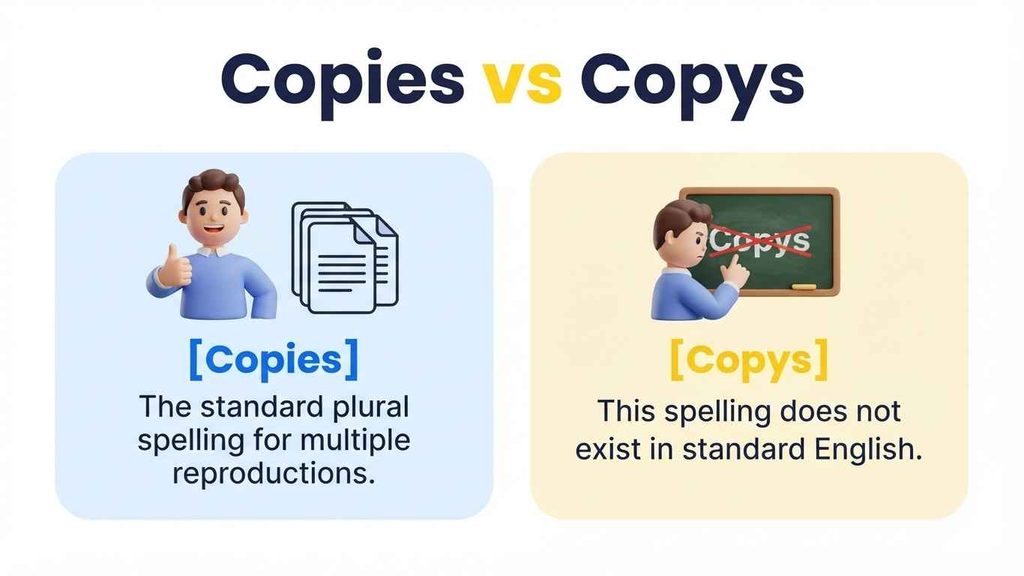
Copies is the only correct spelling copys is never accepted in standard English, whether you’re writing an email, a resume, or a legal document. The confusion around Plural of Copy usually comes from how English treats words ending in “y.”
Once you understand the pattern, you’ll spot it everywhere in office memos, textbooks, and even casual texts. The rule isn’t random; it follows a consistent structure that applies to dozens of everyday nouns.
- Copies is the only grammatically accepted plural of copy
- Copys shows up often in typos, texts, and rushed emails
- The mistake usually happens because of the “add an s” habit
- Spellcheckers usually catch it, but not always in casual chats
- Knowing this rule instantly makes your writing look more polished
Example in texting: Friend 1: can u send me 2 copys of the form Friend 2: it’s actually “copies” lol but yes sending now
Copys or Copies: Which is Correct?
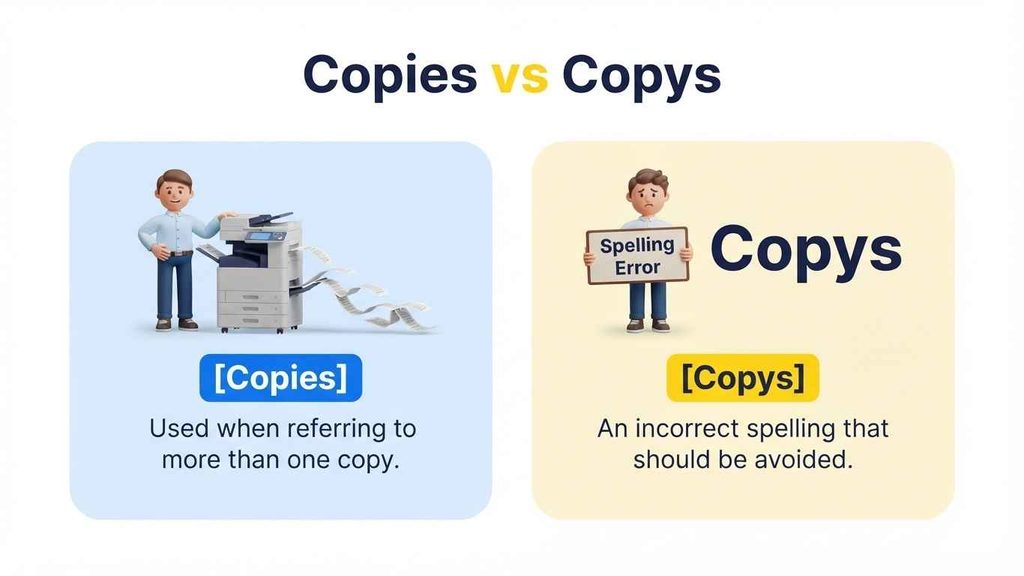
Most people default to just adding an “s” to any noun, which is exactly why copys feels natural even though it’s wrong the real Plural of Copy follows a different, older English pattern.
This isn’t a random exception either. It’s part of a whole family of nouns that behave the same way, so once you learn it here, you’ll recognize it instantly elsewhere.
- Consonant + y nouns change the “y” to “i” before adding “es”
- Copy becomes copies, following the same logic as “baby” to “babies”
- Vowel + y nouns are different “toy” simply becomes “toys”
- Native speakers often get this wrong in fast, casual writing
- Formal writing (resumes, contracts) should never use copys
| Word Type | Example Word | Correct Plural |
| Consonant + y | Copy | Copies |
| Consonant + y | Baby | Babies |
| Vowel + y | Toy | Toys |
| Vowel + y | Day | Days |
Example in chat: Friend 1: is it copys or copies for the report?? Friend 2: copies, always copy ends in consonant + y
What Does Plural of Copy Mean in English?
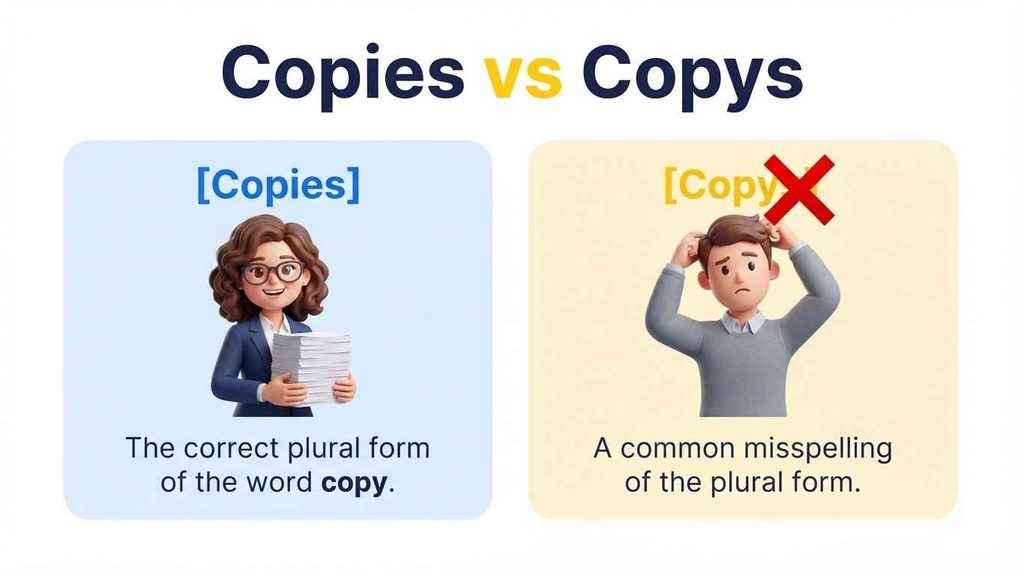
Plural of Copy simply asks: what’s the correct multiple form of the word “copy” in English? The answer, grammatically and consistently, is copies never copys, in any context or tone.
- The phrase mixes Hindi/Urdu (“ka”) with English grammar terms
- It’s commonly searched by ESL learners and bilingual writers
- The answer stays the same regardless of formal or casual tone
- Copies works for documents, books, photos, and files alike
- Understanding this helps bridge grammar gaps across two languages
copy ka bahuvachan
Copy ka bahuvachan is the Hindi-Urdu way of asking for the plural of copy, and the answer is identical to the English rule copies, formed by swapping “y” for “i” and adding “es.”
This kind of bilingual search is extremely common among students and professionals who think partly in Hindi or Urdu but write in English. Knowing both terms strengthens your grammar in either language.
- Bahuvachan simply means “plural form” in Hindi and Urdu
- Copy ka bahuvachan and Plural of Copy ask the exact same thing
- The correct answer in both cases is always copies
- This term is popular in Indian and Pakistani English-learning searches
- Mixing languages while learning grammar is completely normal and useful
Example in texting: Friend 1: copy ka bahuvachan kya hota hai? Friend 2: copies hota hai, copy nahi likhte plural mein
copy plural form
The copy plural form follows a well-known English spelling rule that applies to many nouns ending in a consonant followed by “y” and copy is a textbook example of exactly that pattern.
Once this clicks, you’ll never need to guess again. It becomes as automatic as knowing “cat” becomes “cats,” except this rule needs one small extra step.
- Copy plural form is officially and only copies
- The rule: consonant + y → drop the “y,” add “ies”
- This applies whether copy means a document or a duplicate
- Style guides like AP and Chicago both confirm copies as standard
- Dictionaries list no alternate accepted spelling for the plural
| Singular | Rule Applied | Plural |
| Copy | y → ies | Copies |
| City | y → ies | Cities |
| Story | y → ies | Stories |
| Party | y → ies | Parties |
Example in chat: Friend 1: what’s the copy plural form again Friend 2: copies! y turns into ies when it follows a consonant
Why Do People Confuse Copys With Copies?
Most confusion happens because English usually just adds “s” for plurals, so writers apply that default habit to copy without realizing consonant-plus-y nouns follow a different path entirely.
- Autocorrect sometimes fails to catch copys in fast typing
- Non-native speakers often generalize the simple “add s” rule
- Texting and chat culture normalizes small spelling shortcuts
- Similar words like “toy” and “boy” mislead people into “s” only
- Repetition of the wrong form in casual writing reinforces the error
copys or copies
When people search copys or copies, they’re really asking which spelling passes grammar checks, looks professional, and won’t get flagged in a resume, essay, or official letter and the answer is always copies.
There’s no context formal, informal, spoken, or written where copys becomes acceptable. It’s treated the same way as any other basic spelling mistake.
- Copies is correct in emails, essays, contracts, and casual chats
- Copys is not recognized by any major English dictionary
- Grammar checkers like Grammarly consistently flag copys as an error
- Teachers and editors treat it as a fundamental spelling mistake
- Once memorized, this rule rarely causes confusion again
Example in texting: Friend 1: sending copys of the slides now Friend 2: *copies 😄 but yes got them, thanks
When Should You Use Copies in a Sentence?
You should use copies any time you’re referring to more than one copy whether it’s physical documents, digital files, printed books, or even duplicate versions of a design or ad.
- Use copies when mentioning multiple printed documents
- Apply it to digital files like PDFs or scanned pages
- Use it for published items books, magazines, reports
- Reference copies when discussing backups or duplicate records
- Never swap in copys, regardless of formality or setting
Example in chat: Friend 1: how many copies do we need for the meeting Friend 2: print like 10 copies just to be safe
Why copies is the correct spelling?
English spelling rules aren’t arbitrary they follow patterns rooted in how the language evolved, and the Plural of Copy rule is a direct example of a rule that governs dozens of similar nouns.
Because copy ends in a consonant (“p”) followed by “y,” English grammar requires the “y” to change into “i” before adding “es.” This keeps pronunciation smooth and consistent with related words.
- The rule applies to any noun ending consonant + “y”
- Changing “y” to “i” keeps pronunciation natural and consistent
- Adding just “s” (copys) breaks this established spelling pattern
- The same logic governs words like “candy,” “family,” and “story”
- This rule has stayed stable in English for centuries
| Ending Pattern | Example | Correct Plural | Wrong Plural |
| Consonant + y | Copy | Copies | Copys |
| Consonant + y | Family | Families | Familys |
| Consonant + y | Candy | Candies | Candys |
Pluralization of Copy as a Noun
- Copies is required whenever copy refers to a document or item
- Business writing frequently uses this form “send the copies”
- Legal and academic writing follows the same strict rule
- Bring copies, not “copys,” to interviews or presentations
- This is the single most searched form of Plural of Copy
Pluralization of Copy as a Verb
- As a verb, copy doesn’t follow noun pluralization rules at all
- Third-person singular becomes copies “she copies the file”
- Plural subjects simply use copy “they copy the notes”
- This is different from the noun rule, so don’t mix them up
- Understanding this avoids confusing copys or copies in verb form
Example in texting: Friend 1: she copies her homework every single day lol Friend 2: honestly relatable, we all copy something sometimes
Copy Plural Rules for Nouns Ending in Y
Beyond copy, this same spelling logic applies to a huge range of common English nouns, which makes learning this one rule surprisingly valuable for your overall writing accuracy.
Recognizing the pattern once means you can apply it confidently to new words you encounter, without needing to look each one up individually.
- Consonant + y nouns always change to “ies” in plural form
- Vowel + y nouns simply add “s,” no spelling change needed
- Proper nouns ending in “y” are a common exception to this rule
- Compound words often follow the base word’s pluralization pattern
- Practicing with a short word list builds long-term confidence fast
| Category | Rule | Examples |
| Consonant + y | y → ies | Copy→Copies, Puppy→Puppies |
| Vowel + y | add s | Day→Days, Key→Keys |
| Proper nouns | add s | Mary→Marys, Kennedy→Kennedys |
Example in chat: Friend 1: does this rule work for other words too? Friend 2: yep, city, story, party same pattern as copies
Common Mistakes With Plural of Copy
Even confident writers slip up here occasionally, usually because of speed, autocorrect gaps, or simply never having learned the underlying spelling rule in the first place.
Spotting these mistakes in your own writing is the fastest way to stop making them for good.
- Typing copys out of habit from regular “add s” plurals
- Trusting autocorrect blindly instead of double-checking spelling
- Mixing up copy the verb with copy the noun mid-sentence
- Using copies correctly in speech but misspelling it in writing
- Forgetting the rule applies to similar words like “story” or “city”
Example in texting: Friend 1: i keep typing copys without noticing lol Friend 2: same, i set autocorrect to fix it for me now
Is It Correct to Say “Two Copys” or “Two Copies”?
“Two copies” is the only correct phrase “two copys” is a spelling error every time, regardless of whether you’re speaking, texting, or writing something formal.
- Two copies is grammatically correct in all contexts
- Two copys is never accepted, even informally
- This applies to any number three, five, or ten copies
- Saying it aloud sounds identical, so the mistake is purely written
- Fixing this one phrase improves your overall writing credibility
Examples of Using “Copies” in a Sentence
Seeing copies used naturally across different situations makes the rule easier to remember than simply memorizing it in isolation context always helps grammar stick.
Here are practical, everyday examples covering work, school, and daily life so you can see exactly how this word fits into real sentences.
- I printed three copies of the report before the meeting
- She kept extra copies of her resume in her bag
- The library stocks multiple copies of popular new releases
- We need signed copies of the contract from both parties
- He saved backup copies of the files on a drive
- Bring two copies of your ID to the appointment
- The teacher collected copies of every student’s assignment
- They ordered fresh copies of the flyer for the event
Example in chat: Friend 1: don’t forget copies of your ID for tomorrow Friend 2: got it, printing two copies right now
Copy vs Copies in Business and Legal Writing
Professional settings are exactly where the Plural of Copy mistake gets noticed most, since resumes, contracts, and official letters are judged partly on spelling accuracy and attention to detail.
Using copies correctly signals professionalism, while copys can quietly undermine an otherwise strong document.
- Contracts often require “signed copies” from every involved party
- Resumes should always say “copies of my portfolio,” never copys
- Legal filings use copies consistently across every jurisdiction
- HR emails referencing multiple documents should default to copies
- Proofreading tools flag copys instantly in business documents
| Setting | Correct Usage | Common Mistake |
| “Attached are three copies” | “Attached are three copys” | |
| Contract | “Both parties keep signed copies” | “Both parties keep signed copys” |
| Resume | “Copies available on request” | “Copys available on request” |
Example in texting: Friend 1: can you proofread my email before I send it Friend 2: yeah just fix “copys” to “copies” and it’s perfect
Frequently Asked Questions
Is it copy of documents or copies of documents?
Use “copies of documents” whenever you’re referring to more than one. The Plural of Copy is always copies in this context.
How should you refer to multiple ad copies?
Always say “ad copies” when discussing more than one version. This keeps the Plural of Copy correct in marketing and content writing.
What is the copy ka bahuvachan in simple terms?
Copy ka bahuvachan simply means the plural of copy, and the correct answer is always copies, never copys.
Why is copys considered incorrect in English?
Copys breaks the standard consonant-plus-y spelling rule. The accepted Plural of Copy has always been copies in every dictionary.
Does the plural rule change for copy as a verb?
No, the noun rule for Plural of Copy doesn’t apply to verbs. As a verb, it becomes “copies” only in third-person singular form.
Can copys ever be correct in casual texting?
No, even in texting, copys is a spelling mistake. The correct Plural of Copy, copies, works in every tone and setting.
What’s an easy way to remember Plural of Copy?
Remember: consonant + y becomes “ies.” That’s the entire trick behind the Plural of Copy, and it works for copies every time.
Conclusion
At the end of the day, the Plural of Copy debate has one simple answer: copies is correct, and copys never is. Whether you’re writing an email, a resume, or a quick text to a friend, remembering this one spelling rule instantly makes your writing sharper and more professional.
The plural pattern here consonant plus “y” becoming “ies” isn’t unique to copy either, so this single lesson quietly upgrades your grammar for dozens of other words too. Next time you catch yourself typing copys, pause for a second, fix it to copies, and keep writing with confidence.

Amelia Brooks is a US-based author known for inspiring stories on meaning, growth, and hope, blending insight with simple, engaging storytelling.


