
You’ve typed it a hundred times, then paused, backspaced, and stared at the screen wondering if you just made yourself look careless. That tiny extra “p” feels so small, yet it changes the entire meaning of your sentence and somehow nobody ever taught you the rule clearly.
This guide clears up the confusion for good. You’ll get the real meaning, the spelling logic, pronunciation tips, and simple examples that make tapping vs taping click instantly including when to use taping instead. By the end, you won’t second-guess yourself again. Let’s get into it.
Taping vs Tapping
Here’s a quick truth: taping and tapping aren’t interchangeable, even though they sound almost identical when spoken quickly. This section untangles the confusion before you read another word.
Is Taping the Same as Tapping?
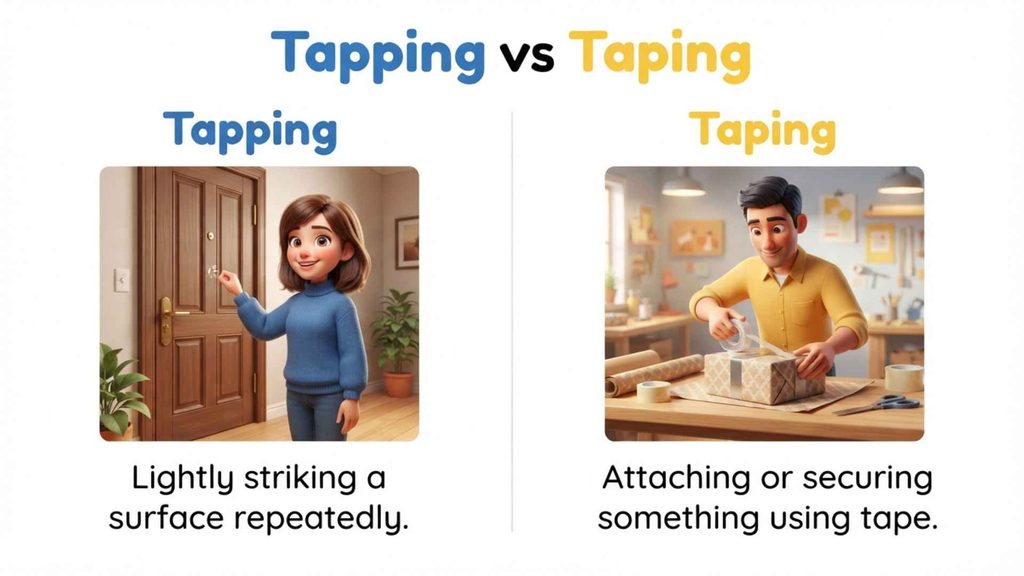
- Taping relates to the noun “tape” adhesive strips, video recording, or securing something.
- Tapping relates to the verb “tap” a light hit, knock, or quick touch.
- The single letter “p” is the only spelling difference, but the meaning shifts completely.
- Say each word slowly the vowel sound before the “p” gives away the correct spelling.
- Context almost always tells you which one a sentence needs.
Example in texting:
Friend 1: are you still taping the game tonight?
Friend 2: yeah, and I’m tapping my foot waiting for it to start lol
Spell Taping
Getting the spelling right for taping trips up even confident writers, mostly because the doubling rule feels backwards compared to tapping. Here’s the fix, explained simply.
Why Doesn’t Taping Double the P?
- Tape already ends in a silent “e,” so you drop the “e” and add “-ing.”
- That gives you taping one “p,” because there’s no need to protect a short vowel sound.
- Words like make → making and bake → baking follow the exact same pattern.
- Never double the consonant after a silent-e word it’s a common error.
- If you can spell “making,” you can already spell taping correctly.
| Base Word | Rule Applied | Correct Spelling |
| Tape | Drop silent “e,” add -ing | Taping |
| Make | Drop silent “e,” add -ing | Making |
| Bake | Drop silent “e,” add -ing | Baking |
Tapping vs Taping: What’s the Difference?
At its core, this comes down to two completely different root words that just happen to look like siblings. Understanding the roots makes the whole confusion disappear instantly.
What’s the Root Word Behind Each Spelling?
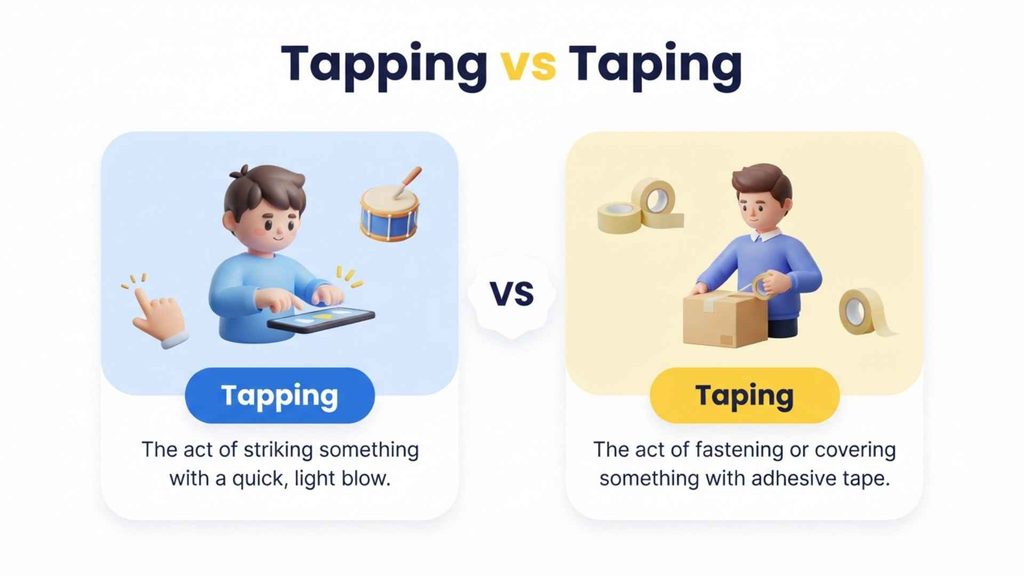
- Tap is a short, one-syllable verb meaning to strike lightly.
- Tape is a noun-turned-verb meaning to fasten or record with tape.
- Tapping describes repeated light contact, like fingers on a desk.
- Taping describes the act of using tape, physically or digitally.
- The extra “p” in tapping exists purely to protect the short vowel sound.
Example in chat:
Friend 1: my leg won’t stop tapping, I’m so nervous
Friend 2: same energy as me taping this box shut for the tenth time
What Are Tapping and Taping?
Before diving deeper, it helps to define both words plainly, without grammar jargon getting in the way of understanding what you’re actually saying.
What Does Each Word Literally Mean?
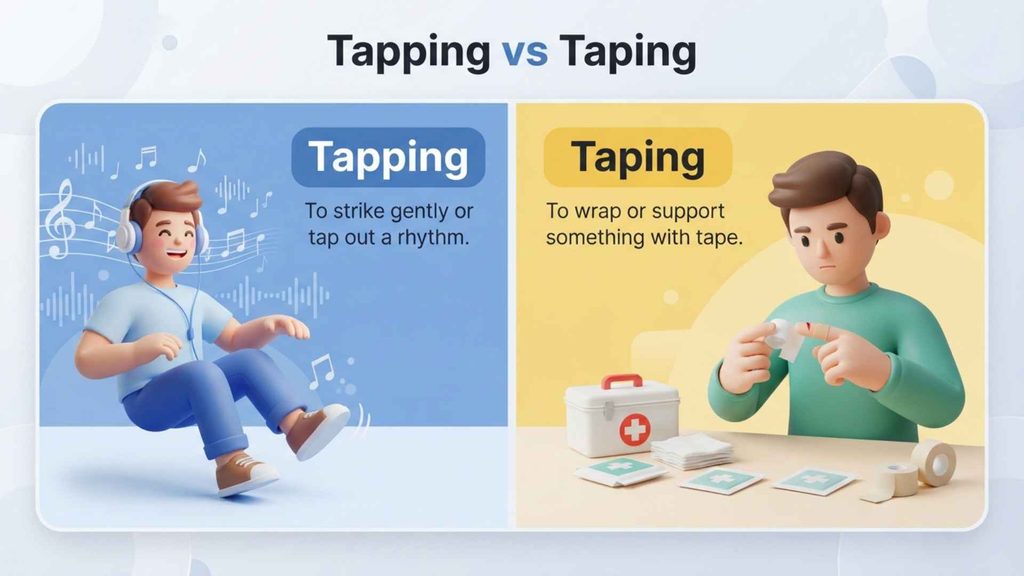
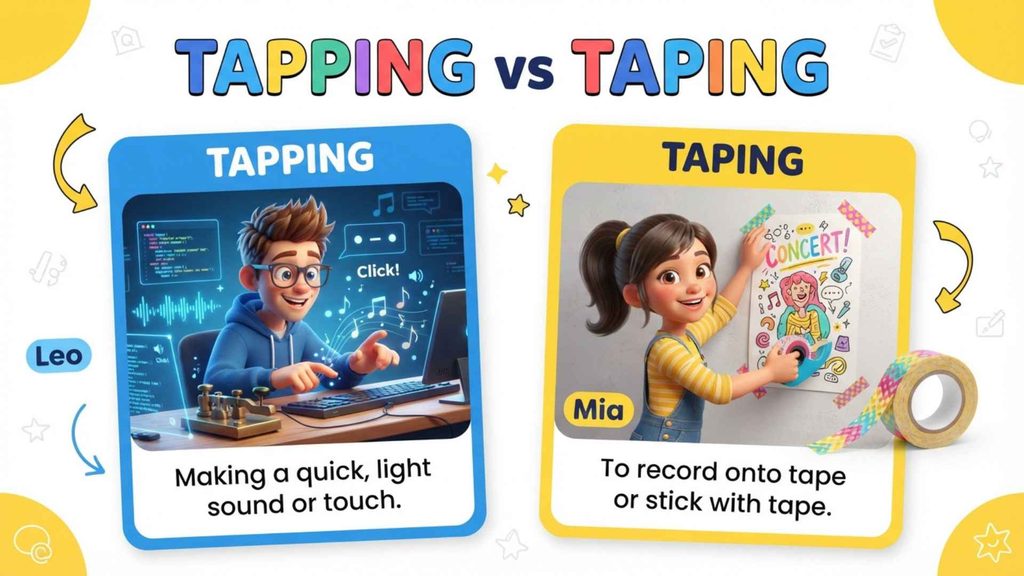
- Tapping means gently and repeatedly striking a surface, screen, or object.
- Taping means applying adhesive tape or recording audio and video.
- Doctors use tapping to describe checking reflexes or draining fluid.
- Athletes use taping to describe wrapping an ankle or wrist for support.
- Musicians “tap” a rhythm, while editors “tape” an interview for later use.
| Word | Meaning | Common Field |
| Tapping | Light, repeated striking | Everyday speech, tech, medicine |
| Taping | Using tape to fasten or record | Sports, video, packaging |
Why the Difference Matters
Mixing these two words up isn’t just a typo it can genuinely confuse the reader about what you’re describing, especially in professional or medical writing.
Can Mixing Them Up Change Your Meaning?
- Saying “I’m taping my fingers” instead of tapping implies wrapping, not touching.
- In resumes or reports, spelling errors quietly damage your credibility.
- Search engines and readers both notice inconsistent word usage on a page.
- Voice-to-text tools often mishear one for the other, so proofreading matters.
- Getting tapping vs taping right shows genuine attention to language.
Example in texting:
Friend 1: I sent the audio, I was taping the whole meeting
Friend 2: good thing, because I could hear you tapping your pen the whole time lol
The Core Rule for Tapping vs Taping
There’s one grammar rule that solves this entire debate, and once it clicks, you’ll never need to Google it again.
What Is the One-Syllable Doubling Rule?
- Short words ending in a single consonant after a single vowel double that consonant.
- Tap (vowel-consonant) becomes tapping, protecting the short “a” sound.
- Tape ends in a silent “e,” so the “e” is dropped, not doubled.
- This same rule applies to run → running and stop → stopping.
- Memorize this rule once, and dozens of word pairs become effortless.
| Rule | Example Word | Result |
| Short vowel + consonant → double | Tap | Tapping |
| Silent “e” → drop, don’t double | Tape | Taping |
| Short vowel + consonant → double | Run | Running |
Tapping vs Taping Pronunciation
Spoken aloud, these words sound frustratingly close, but native speakers actually shift the vowel sound slightly between the two here’s how to hear it.
How Are Tapping and Taping Pronounced Differently?
- Tapping uses a short “a” sound, like in “cat” or “hat.”
- Taping uses a long “a” sound, like in “cake” or “lake.”
- Say “tap” and “tape” out loud the difference is immediately obvious.
- The extra syllable weight sits on the first sound, not the ending.
- Recording yourself saying both words helps train your ear over time.
| Word | Phonetic Sound | Rhymes With |
| Tapping | /ˈtæp.ɪŋ/ | Mapping, Napping |
| Taping | /ˈteɪp.ɪŋ/ | Shaping, Draping |
Example in chat:
Friend 1: say tapping and taping out loud, they sound so different once you actually try
Friend 2: omg you’re right, I always mumbled through it
How to Use Tapping Correctly
Now let’s put tapping into real sentences so the correct usage sticks in everyday writing and texting alike.
When Should You Use Tapping in a Sentence?
- Use tapping for fingers, feet, or objects making repeated light contact.
- Use it for phone or screen actions, like “tapping” an app icon.
- Use it in medical contexts, like “tapping” a vein or knee reflex.
- Use it for wiretapping or phone surveillance, as in “phone tapping.”
- Avoid using it when tape or adhesive is actually involved.
Example in texting:
Friend 1: stop tapping the table, you’re making me anxious
Friend 2: sorry, I’m just tapping through my phone waiting for you
How to Use Taping Correctly
Here’s the flip side knowing exactly when taping is the right word to reach for.
When Should You Use Taping in a Sentence?
- Use taping when physically sealing a box, wall, or package.
- Use it when recording a video, podcast, or interview.
- Use it in sports contexts, like “taping” an injured ankle.
- Use it for securing wires, cords, or cables in place.
- Avoid it when describing a light knock or touch that’s tapping.
Example in chat:
Friend 1: are you done taping the boxes for the move?
Friend 2: almost, just taping the last one shut now
Correct Examples of Tapping and Taping
Seeing both words used correctly, side by side, makes the distinction far easier to remember than any rule alone.
What Do Correct Sentences Look Like?
- “She kept tapping her pencil during the exam.”
- “He’s taping the interview for the podcast episode.”
- “The nurse is tapping his knee to check reflexes.”
- “We’re taping the cardboard box before shipping it.”
- “My foot won’t stop tapping along to the beat.”
| Sentence | Word Used | Correct Meaning |
| She kept ___ her pencil. | Tapping | Light, repeated touch |
| He’s ___ the interview. | Taping | Recording |
| The nurse is ___ his knee. | Tapping | Medical check |
| We’re ___ the box. | Taping | Sealing with tape |
Incorrect vs Correct: Tapping and Taping
Mistakes usually follow the same pattern, so spotting them becomes easy once you know what to look for.
What Are the Most Common Spelling Mistakes?
- Incorrect: “I’m tapeing the box.” Correct: “I’m taping the box.”
- Incorrect: “He’s taping his fingers on the desk.” Correct: “tapping.”
- Incorrect: “She’s tappeing the ankle.” Correct: “taping the ankle.”
- Incorrect: “The app is tapeing slow.” Correct: “tapping is slow.”
- Watch for the extra “e” it never belongs in taping.
| Incorrect | Correct | Why |
| Tapeing | Taping | Silent “e” is dropped, not kept |
| Taping the desk | Tapping the desk | No adhesive involved |
| Tappeing | Taping | Extra letters never belong |
Why People Confuse Tapping and Taping
Understanding why this mix-up happens so often makes it much easier to catch yourself before hitting send or submit.
Why Do These Words Trip People Up So Often?
- They look almost identical, separated by a single letter.
- Autocorrect frequently swaps one for the other without warning.
- Both words relate loosely to hands, touch, or physical contact.
- English spelling rules aren’t taught consistently in schools.
- Fast typing and texting habits skip careful proofreading.
Example in texting:
Friend 1: I keep typing tapeing by accident, autocorrect never catches it
Friend 2: same, I always have to double check tapping vs taping now
Common Mistakes Checklist
Run through this quick checklist before you hit publish, post, or send on anything involving these two words.
How Can You Catch These Mistakes Before Publishing?
- Check for a stray “e” before “-ing” that’s a red flag.
- Confirm whether tape or adhesive is genuinely part of the sentence.
- Read the sentence aloud to hear the vowel sound clearly.
- Search the document for both spellings using find-and-replace.
- Ask if the action involves touching or fastening before finalizing.
| Checklist Item | Yes/No | Action Needed |
| Stray “e” present? | Remove if using tapping | |
| Adhesive involved? | Use taping | |
| Light touch involved? | Use tapping |
Tapping vs Taping in Real English
Real-world writing texts, emails, captions shows these words in action far better than textbook definitions ever could.
How Do Native Speakers Actually Use These Words?
- Podcasters say they’re “taping an episode” instead of recording.
- Gamers describe “tapping” buttons rapidly during intense gameplay.
- Physical therapists mention “taping” a sprained wrist for support.
- Anxious habits get described as “tapping” a foot or pen.
- Social captions often read “taping this for later,” meaning saving footage.
Example in chat:
Friend 1: this podcast host says they’re taping three episodes today
Friend 2: no wonder she kept tapping her mic to check the sound
Tapping vs Taping Comparison Table
Sometimes a single glance beats a paragraph of explanation here’s everything side by side.
Which Table Makes Tapping vs Taping Instantly Clear?
- Compare spelling, pronunciation, and meaning in one glance.
- Bookmark this table for quick future reference.
- Notice how context, not sound, decides the right word.
- Use this as a cheat sheet when proofreading fast.
- Share it with anyone who mixes the two up often.
| Feature | Tapping | Taping |
| Root Word | Tap | Tape |
| Vowel Sound | Short “a” | Long “a” |
| Meaning | Light, repeated touch | Using adhesive tape or recording |
| Example | Tapping a pen | Taping a box |
| Common Field | Texting, tech, medicine | Sports, video, shipping |
The Easiest Memory Trick
If rules never stick for you, a simple visual trick works far better than grammar theory.
Is There a Trick to Remember the Spelling Forever?
- Picture a roll of tape one “p,” just like the word taping.
- Picture two fingers tap-tap-tapping double letters for double taps.
- Link “taping” with “shaping,” since both drop the silent “e.”
- Link “tapping” with “mapping,” since both double the consonant.
- Repeat the trick out loud a few times until it feels automatic.
Example in texting:
Friend 1: how do you remember tapping vs taping spelling
Friend 2: tape has one p, so does taping that’s literally it
Real-Life Situations
Here’s how this word pair shows up across different everyday scenarios you’ll actually run into.
Where Do You See These Words Used Daily?
- Sports: trainers are taping an athlete’s ankle before the game.
- Tech: users are tapping icons to open apps on their phone.
- Medicine: doctors are tapping a joint to relieve fluid pressure.
- Media: crews are taping a segment for tomorrow’s broadcast.
- Home: someone is taping boxes shut while moving apartments.
| Situation | Correct Word | Reason |
| Sealing a package | Taping | Adhesive tape used |
| Nervous finger habit | Tapping | Light, repeated touch |
| Recording a show | Taping | Video/audio capture |
| Checking a phone screen | Tapping | Physical screen contact |
Expert Tips for Remembering Tapping vs Taping
A few practical habits from editors and writers keep this mistake from ever slipping into your work again.
What Do Professional Editors Recommend?
- Proofread out loud, since your ear catches vowel differences fast.
- Highlight every “-ing” word during a final editing pass.
- Ask yourself if tape is physically or digitally involved.
- Practice writing both words five times until they feel natural.
- Keep this guide bookmarked for quick, confident double-checks.
Example in chat:
Friend 1: any tips for never messing up tapping vs taping again
Friend 2: just ask “is there actual tape involved” solves it every time
Tapping vs Taping: American vs British English
Regional habits barely change the spelling rule here, but usage context can shift slightly depending on where you’re writing from.
Does British English Spell These Words Differently?
- Both American and British English use tapping with a doubled “p.”
- Both dialects spell taping with a single “p,” no regional variation.
- British speakers may say “sellotaping” informally instead of taping.
- American sports commentary uses “taping” up more casually than UK broadcasts.
- The core spelling rule stays identical across English dialects worldwide.
Tapping vs Taping: Synonyms and Related Words
Expanding your vocabulary around this word pair makes your writing sound more natural and varied overall.
What Words Are Related to Tapping and Taping?
- Synonyms for tapping: knocking, patting, drumming, clicking.
- Synonyms for taping: recording, filming, sealing, wrapping.
- Related term: wiretapping, meaning secretly recording phone calls.
- Related term: duct tape, a common adhesive used for taping.
- Related term: tap dance, a rhythmic style built on repeated tapping.
What Does Tapping Mean in Texting or Chat?
In casual messages, tapping almost always refers to a small physical or digital action rather than anything formal or technical.
Why Do People Say “Tapping” in Everyday Texts?
- It describes tapping a screen to like, react, or open something.
- It describes a nervous habit, like tapping a foot while waiting.
- Group chats use it loosely, like “just tapping in to say hi.”
- It never involves adhesive tape in casual conversation.
- Context in the sentence always confirms the intended meaning.
Example in texting:
Friend 1: I’m just tapping in to check if you’re free later
Friend 2: yes! stop tapping your phone anxiously, I saw you typing lol
Why Do People Mix Up Tapping and Taping?
This question deserves its own spotlight because the confusion isn’t about intelligence it’s about how similar the words appear on a page.
Is Autocorrect Really to Blame for This Mistake?
- Autocorrect often swaps the words without flagging an error.
- Fast typers skip re-reading before sending a message.
- The words share nine identical letters out of ten total.
- Non-native speakers sometimes learn the sound before the spelling.
- Slowing down for three seconds before sending fixes most mistakes.
When Should You Use Taping Instead of Tapping?
A clear decision point helps you choose the right word instantly, without overthinking the sentence.
What’s the Quick Test Before You Type Either Word?
- Ask: is adhesive tape physically or digitally involved here?
- If yes, always choose taping, no exceptions to this rule.
- If it’s a light touch or knock, choose tapping instead.
- If you’re recording audio or video, default to taping.
- When unsure, reread the sentence and picture the actual action.
Frequently Asked Questions About Tapping vs Taping
Is it tapping or taping when texting someone?
Neither directly relates to sending a text message itself. Tapping describes the physical action of pressing your screen, while typing the message is separate.
What is the correct spelling of taping a box?
Taping is correct, with a single “p,” because “tape” drops its silent “e” before adding “-ing” in standard spelling rules.
Why does tapping have two p’s but taping only has one?
Tapping doubles the consonant to protect the short vowel sound in “tap,” while taping simply drops the silent “e” from “tape.”
Can tapping and taping ever mean the same thing?
No, tapping vs taping always describes two different actions one is a light touch, the other involves adhesive tape or recording.
Is “tapeing” ever a correct spelling?
No, “tapeing” is always incorrect. The proper spelling is taping, following the standard silent-e dropping rule in English.
How do you remember tapping vs taping for good?
Picture a literal roll of tape one “p” to remember taping, and picture two fingers tapping twice for the double “p” in tapping.
Does phone tapping use the word tapping or taping?
Phone surveillance always uses tapping, as in “wiretapping,” since it describes secretly listening in rather than using adhesive tape.
Conclusion
At the end of the day, tapping vs taping comes down to one small but meaningful rule: doubled consonants for short vowels, dropped silent “e” for the rest. Once that clicks, you’ll spell both words correctly without pausing to second-guess yourself.
Whether you’re taping a box, recording a podcast, or just tapping your fingers while you wait, the right word is always just one context clue away. Keep this guide handy, reread the examples when in doubt, and let tapping vs taping finally stop tripping you up for good. Small fixes like this quietly make your writing sound sharper, more confident, and more trustworthy overall.
Want me to save this as a downloadable file (Markdown or Word doc) so it’s ready to publish?

Amelia Brooks is a US-based author known for inspiring stories on meaning, growth, and hope, blending insight with simple, engaging storytelling.