
You typed it, stared at it, and suddenly it looked wrong. Sane or sain which one is even a real word anymore? That tiny flicker of doubt over a five-letter word is more common than people admit, especially when autocorrect stays silent and just lets you post it.
Here’s the good news: this guide clears up the confusion for good. You’ll get the exact meaning of both words, where each one comes from, how to pronounce them, and simple tricks that make the difference stick in your head forever. By the end, sane vs sain won’t trip you up again so let’s get into it.
The Quick Answer: Sane Is the Word You Want
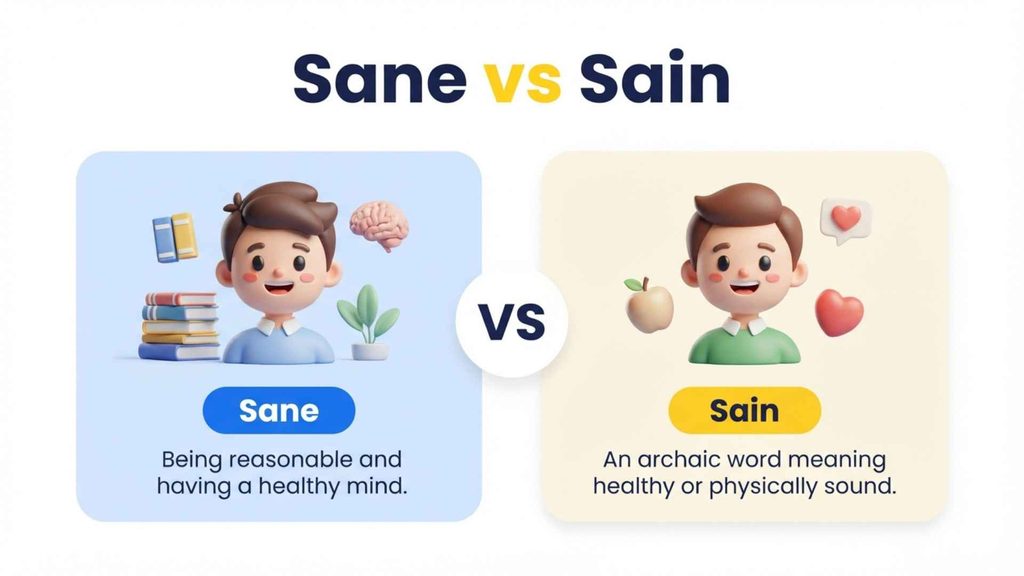
If you’re writing about mental soundness, rational thinking, or someone being “in their right mind,” sane is the correct spelling 99.9% of the time. Sain is a real but archaic word with a completely different meaning.
Is “Sain” Even a Real Word?
Yes, sain is a genuine English word it’s just centuries old and almost never used in modern writing outside Scottish dialect or historical fiction.
- Sane describes a healthy, rational mind; it’s the word 99% of writers actually need.
- Sain means to bless or protect someone from evil, historically by making the sign of the cross.
- Spellcheck rarely flags sain because it’s a real dictionary entry, not a typo.
- Both words are homophones they sound identical: /seɪn/.
- If you’re texting, emailing, or writing an essay, sane is almost always the right choice.
| Word | Meaning | Common Today? |
| Sane | Mentally sound, rational | Yes everyday word |
| Sain | To bless or protect from evil | No archaic/dialect |
Example in texting: Friend 1: this week has been insane, i need a vacation to stay sane Friend 2: same lol, my brain is fried
What Does “Sane” Actually Mean?
Picture the relief of a clear head after total chaos that calm, grounded feeling is basically what sane describes. It’s one of the most useful words in the English language for talking about rational, balanced thinking.
Sane is an adjective meaning mentally healthy, rational, and capable of sound judgment. It’s used in everyday conversation, medicine, psychology, and law.
How Is “Sane” Used in Everyday Conversation?
- Sane most often describes a person’s mental state or level-headed behavior.
- People say “stay sane” to mean keeping calm under pressure or stress.
- A “sane decision” is one that’s sensible, reasonable, and well thought out.
- In legal settings, being declared sane means understanding right from wrong.
- The opposite of sane is insane, meaning irrational or mentally unwell.
- Sanity is the noun form, referring to the state of being sane.
- Comparative and superlative forms are saner and sanest.
Example in chat: Friend 1: honestly keeping a routine is the only sane thing i can do rn Friend 2: real, same energy over here
What Does “Sain” Actually Mean?
Now imagine a completely different scene: an old Scottish cottage, a mother tracing a protective sign over her sleeping child. That ritual is exactly what sain, not sane, was created to describe.
Sain is an archaic verb meaning “to bless” or “to protect from evil influence,” historically by making the sign of the cross over a person or object.
What Does “Sain” Mean in Old or Scottish English?
- Sain comes from Old English segnian, meaning to mark with a cross.
- It was traditionally used to protect babies, homes, and livestock from harm.
- In Scots dialect, people still say “sain the bairn” when a child sneezes.
- The verb forms are sains, saining, and sained.
- Modern English rarely uses sain outside poetry, folklore, or historical texts.
- It survives today mainly in Scottish and northern English dialect.
| Form | Example |
| Base | to sain |
| Past tense | sained |
| Present participle | saining |
Example in chat: Friend 1: reading this old scottish poem and it keeps saying “sain us” Friend 2: whoa that’s old english for bless us, not sane like the mental health word
Sane vs Sain: The Core Difference
Two nearly identical words, two entirely different worlds one lives in your group chat, the other lives in a history book. Understanding that gap is the fastest way to stop second-guessing your spelling.
The core difference is simple: sane describes a rational mind, while sain describes an act of blessing or protection. One is modern and common; the other is archaic and rare.
Why Do People Confuse Sane and Sain?
- Sane and sain are spelled almost identically, just one letter apart.
- Both words are pronounced exactly the same, which fuels the mix-up.
- Sain rarely appears in modern writing, so people assume it’s a typo for sane.
- Autocorrect tools sometimes suggest sain by accident when typing quickly.
- Reading old literature or Scottish folklore is the most common place people encounter sain.
| Feature | Sane | Sain |
| Meaning | Rational, mentally sound | To bless, protect from evil |
| Part of speech | Adjective | Verb |
| Usage today | Very common | Extremely rare |
| Origin | Latin sanus | Old English segnian |
Example in texting: Friend 1: wait is it “stay sane” or “stay sain” Friend 2: sane! sain is a totally different old word lol
Grammar Breakdown: Part of Speech and Forms
Grammar rules make the difference between these two words even clearer once you see them laid out side by side. It’s a small detail that instantly boosts your writing confidence.
Sane functions as an adjective with comparative and superlative forms, while sain functions as a verb with standard past tense and participle forms.
What Part of Speech Is Sane vs Sain?
- Sane is always an adjective, describing a noun like “mind” or “person.”
- Sain is always a verb, describing an action performed on someone or something.
- Sane has the comparative form saner and superlative form sanest.
- Sain conjugates as sain, sains, sained, saining.
- The adverb form of sane is sanely; the noun form is sanity.
| Grammar Element | Sane | Sain |
| Type | Adjective | Verb |
| Comparative/Past | saner | sained |
| Related noun | sanity | saining |
Example in chat: Friend 1: is sanely even a real word Friend 2: yep, “she calmly and sanely explained the plan”
Where Does “Sane” Come From?
Every word has a backstory, and sane‘s is refreshingly simple. It traces straight back to a Latin root that still echoes in modern medical language today.
Sane comes from the Latin word sanus, meaning “healthy” or “sound,” entering English in the 1600s to describe a healthy state of mind.
- Sane derives directly from the Latin adjective sanus, meaning healthy.
- The word entered English usage around the 1620s, per historical records.
- It shares its root with words like sanitary and sanitize.
- Sanity, the noun form, followed a similar path from Latin.
- The concept of a “sound mind” is baked into the word’s origin.
Example in texting: Friend 1: fun fact, sane comes from the same latin root as sanitize Friend 2: never made that connection but it makes total sense
Where Does “Sain” Come From?
Unlike sane‘s tidy Latin roots, sain has a much older, more mystical history rooted in ritual and protection from harm.
Sain traces back to Old English segnian and Latin signare, meaning “to mark with a sign,” referring to the ritual act of blessing something with the sign of the cross.
- Sain comes from Old English segnian, itself from Latin signare.
- It’s related to the word sign, sharing the same ancient root.
- The word was widespread in Middle English religious and folk practice.
- Scottish and Germanic languages kept versions of this word alive longest.
- Today, sain survives mostly in dialect dictionaries and old texts.
Example in chat: Friend 1: sain literally shares a root with the word “sign” Friend 2: that actually makes it way easier to remember
Pronunciation
Here’s the twist that catches almost everyone off guard: these two words don’t just look alike they sound completely identical when spoken out loud.
Both sane and sain are pronounced /seɪn/, rhyming with “rain,” “main,” and “gain,” making them true homophones in spoken English.
Do Sane and Sain Sound the Same?
- Sane and sain are both pronounced /seɪn/, exactly alike.
- They’re also homophones of Seine, the French river’s name.
- Stress falls on the single syllable in both words.
- Context, not sound, is the only way listeners tell them apart.
- This is exactly why the spelling matters so much in writing.
| Word | IPA | Rhymes With |
| Sane | /seɪn/ | rain, main, gain |
| Sain | /seɪn/ | rain, main, gain |
Example in texting: Friend 1: how do you even say “sain” out loud Friend 2: exactly like sane, they’re pronounced the same word
How to Use “Sane” Correctly
Once you know the meaning, using sane correctly in a sentence becomes second nature almost instantly. It’s one of those words that fits naturally into casual and formal writing alike.
Use sane whenever you’re describing rational thinking, mental soundness, or a reasonable decision in conversation, writing, medical contexts, or legal discussions.
When Should You Use the Word Sane?
- Use sane to describe someone with a clear, rational mind.
- Use it for a sensible choice, like “the sane option was to wait.”
- Legal writing uses sane to determine criminal responsibility.
- Casual speech uses “stay sane” to mean staying calm under stress.
- Medical and psychological contexts use sane to describe mental stability.
- Avoid using sane casually to describe someone with a real mental illness.
Example in chat: Friend 1: working from home keeps me somewhat sane tbh Friend 2: honestly relatable, remote work has its perks
How to Use “Sain” Correctly (If You Ever Need To)
You’ll almost never need this word in daily life, but knowing how to use it correctly is handy for reading old literature, folklore, or Scottish dialect writing.
Use sain only in historical, poetic, or dialect contexts to mean “bless” or “protect from evil,” typically followed by a person or object as the object of the verb.
- Use sain in historical fiction or period-accurate dialogue.
- Use it when quoting or referencing Scottish folklore and traditions.
- Pair sain with a direct object, like “sain the child.”
- Avoid using sain in modern, everyday writing it reads as archaic.
- Recognize sain when reading old poems, ballads, or dialect texts.
Example in texting: Friend 1: this old ballad keeps repeating “god sain thee” Friend 2: that’s basically old-timey for “god protect and bless you”
Sane vs Insane vs Sain: Don’t Confuse These Three
Throw a third word into the mix and things can get messy fast but the distinction here is actually one of the easiest to lock in once you see it laid out.
Sane means mentally sound, insane is its direct opposite meaning irrational, and sain is an unrelated archaic word meaning to bless or protect.
Are Sane and Insane Opposites?
- Sane and insane are true antonyms describing mental states.
- Sain has no relationship to either word’s meaning at all.
- Insanity is a legal and clinical term, not a casual insult.
- Sane is far more common in everyday speech than insane.
- Mixing up sain here usually happens from fast typing, not confusion.
| Word | Category | Meaning |
| Sane | Mental state | Rational, sound mind |
| Insane | Mental state | Irrational, unsound mind |
| Sain | Unrelated verb | To bless or protect |
Example in chat: Friend 1: this traffic is actually insane today Friend 2: yeah, staying sane through this commute is a real challenge
Common Mistakes to Avoid
Small mix-ups like this one rarely feel like a big deal until a typo shows up in a resume, an email, or a published article. A little awareness goes a long way.
The most common mistake is typing sain when you mean sane, usually from fast typing, autocorrect suggestions, or simple unfamiliarity with the archaic word.
- Don’t type sain when you mean a rational, healthy mind.
- Don’t assume spellcheck will always catch this mistake sain is a real word.
- Don’t confuse sain with sain-sounding names like Seine or saint.
- Double-check professional writing where sane appears near deadlines or stress.
- Remember: if it’s about mental soundness, the answer is always sane.
| Mistake | Correction |
| “I need to stay sain.” | I need to stay sane. |
| “That’s a sain decision.” | That’s a sane decision. |
Example in texting: Friend 1: just caught myself typing sain instead of sane lol Friend 2: happens to everyone, spellcheck won’t even flag it
Related Words Worth Knowing
Understanding the wider word family around sane and sain makes both terms easier to remember and gives your vocabulary a nice little boost along the way.
Related words include sanity, insane, insanity, sanely, and saner, all connected to the concept of mental soundness rather than the archaic idea behind sain.
- Sanity is the noun form describing the state of being sane.
- Insanity describes the opposite a state of irrational thinking.
- Sanely is the adverb form, describing an action done rationally.
- Saner and sanest are comparative and superlative forms of sane.
- Sanitary and sanitize share the same Latin root as sane, not sain.
Example in chat: Friend 1: is sanity related to sane Friend 2: yep, sanity is just the noun version of being sane
Homophones That Trip Up Writers and Editors
Beyond sane and sain, English is full of sound-alike traps that quietly slip past even careful writers. Knowing the pattern helps you catch them faster next time.
Homophones like sane, sain, and Seine all share the identical /seɪn/ sound, which is exactly why context and spelling awareness matter more than pronunciation.
- Seine refers to the river in France, unrelated to either word.
- Sane, sain, and Seine are all pronounced identically.
- Editors catch these errors by reading slowly, not by listening.
- Grammar tools often miss sain because it’s a valid dictionary word.
- Building a mental list of homophones improves overall writing accuracy.
| Homophone | Meaning |
| Sane | Rational, mentally sound |
| Sain | To bless or protect |
| Seine | A river in France |
Example in texting: Friend 1: english has way too many words that sound the same Friend 2: sane, sain, and seine are literally all pronounced the same lol
Sane in Everyday Speech vs Formal and Legal Writing
Context changes everything about how a word lands and sane shifts tone dramatically depending on whether you’re texting a friend or writing a legal brief.
In casual speech, sane often means “calm” or “grounded,” while in legal and medical writing it carries a precise, formal meaning tied to accountability and mental competence.
- Casual use: “staying sane” simply means managing stress well.
- Legal use: sane determines whether someone understood their actions.
- Medical use: sane describes a patient’s overall mental stability.
- Formal writing avoids slang phrasing like “keeping it sane.”
- Always match the tone of sane to your writing’s context.
Example in chat: Friend 1: lawyers use sane so differently than we do in texts Friend 2: true, for us it just means “not stressed out today”
A Simple Way to Remember the Difference
Memory tricks work far better than memorizing rules, especially for two words this visually close. Here’s a simple mental shortcut that sticks.
Remember: sane rhymes with “brain,” which is exactly what the word describes a healthy, rational brain. Sain rhymes with “saint,” a word tied to blessing and protection.
- Link sane to brain both relate to the mind.
- Link sain to saint both relate to blessing.
- If you mean mental soundness, always default to sane.
- If unsure, ask yourself: “am I talking about a rational mind?”
- When in doubt, sane is correct 99% of the time in modern writing.
Example in texting: Friend 1: sane = brain, sain = saint, got it now Friend 2: that actually makes it impossible to forget
Quick Reference Table: Sane vs Sain at a Glance
Sometimes a single table says more than five paragraphs ever could. Here’s the full comparison in one clean, scannable snapshot for quick future reference.
This quick-reference table summarizes everything about sane and sain meaning, usage, pronunciation, and origin so you can double-check either word in seconds.
- Bookmark this table for fast future spelling checks.
- Use it as a cheat sheet before publishing or sending writing.
- Share it with anyone who mixes up these two words often.
- Notice how sane dominates modern, everyday usage.
- Notice how sain stays confined to historical or dialect writing.
| Category | Sane | Sain |
| Meaning | Mentally sound, rational | To bless or protect from evil |
| Part of speech | Adjective | Verb |
| Pronunciation | /seɪn/ | /seɪn/ |
| Origin | Latin sanus | Old English segnian |
| Modern usage | Extremely common | Rare, archaic/dialect |
| Related words | sanity, insane, sanely | saining, sained |
Example in chat: Friend 1: saving this table so i never mix these up again Friend 2: smart move honestly, way easier than remembering a rule
Can “Sain” Ever Be Correct in Modern English?
Yes but only in very narrow situations, so it’s worth knowing exactly when this old word is genuinely the right choice.
Sain is correct in modern English only when writing historical fiction, quoting Scottish dialect, or referencing folklore traditions involving blessing or protection.
- Use sain when writing period-accurate historical dialogue.
- Use it when directly quoting Scots or Old English sources.
- Use it in academic discussions of language history or etymology.
- Never use sain in a resume, email, or casual modern message.
- When in doubt about context, sane is always the safer choice.
Example in texting: Friend 1: so is sain ever actually correct to use Friend 2: only in old poems or scottish dialect, otherwise it’s sane
Frequently Asked Questions
Is it “sane” or “sain”?
Sane is the correct modern spelling for describing a rational, healthy mind. Sain is a real but archaic word with a different meaning entirely.
What does “sain” mean in English?
Sain is an old word meaning to bless or protect someone from evil, historically through the sign of the cross. It’s mostly found in Scottish dialect and folklore.
Are “sane” and “sain” pronounced the same?
Yes, both words are pronounced identically as /seɪn/. This shared sound is exactly why so many people accidentally confuse the two spellings.
Why does spellcheck not catch “sain” as an error?
Spellcheck tools recognize sain as a valid dictionary word, so they won’t flag it, even though sane is almost always what you actually meant to write.
Is “sain” still used anywhere today?
Yes, sain survives in Scottish dialect, folklore, and historical or poetic writing, though it’s essentially absent from everyday modern English outside those contexts.
What is the opposite of “sane”?
The direct opposite of sane is insane, describing an irrational or mentally unsound state, unrelated in meaning to the archaic word sain.
How can I remember when to use “sane” vs “sain”?
Link sane to “brain” for mental soundness, and sain to “saint” for blessing. This simple trick makes choosing the correct word almost automatic.
Conclusion
At the end of the day, the choice between sane and sain really isn’t that complicated once you know what each word actually means. Sane describes a rational, healthy mind and belongs in nearly everything you write, from texts to essays to legal documents. Sain, on the other hand, is a fascinating relic of Old English and Scottish tradition, reserved almost entirely for blessing or protection in historical and dialect writing.
So the next time your fingers hesitate over the keyboard, trust this simple rule: if you’re talking about mental soundness, reach for sane. If you’re quoting an old ballad or writing period fiction, sain might just be exactly the word you need. Either way, you’ll never second-guess this mix-up again.

Amelia Brooks is a US-based author known for inspiring stories on meaning, growth, and hope, blending insight with simple, engaging storytelling.