Ever stopped mid-sentence, stared at the screen, and wondered if your fingers just played a trick on you? That tiny flash of doubt around Prefer or Perfer is far more common than you think, and it happens to careful writers every day.
This guide on Prefer or Perfer gives you the clear answer, easy memory tricks, and real examples so you never second-guess yourself again. You will also see why Perfer keeps sneaking into emails, essays, and chats. Getting it right protects your credibility in school, work, and everyday messages. Stay with me, and that doubt will fade.
What’s the Difference?
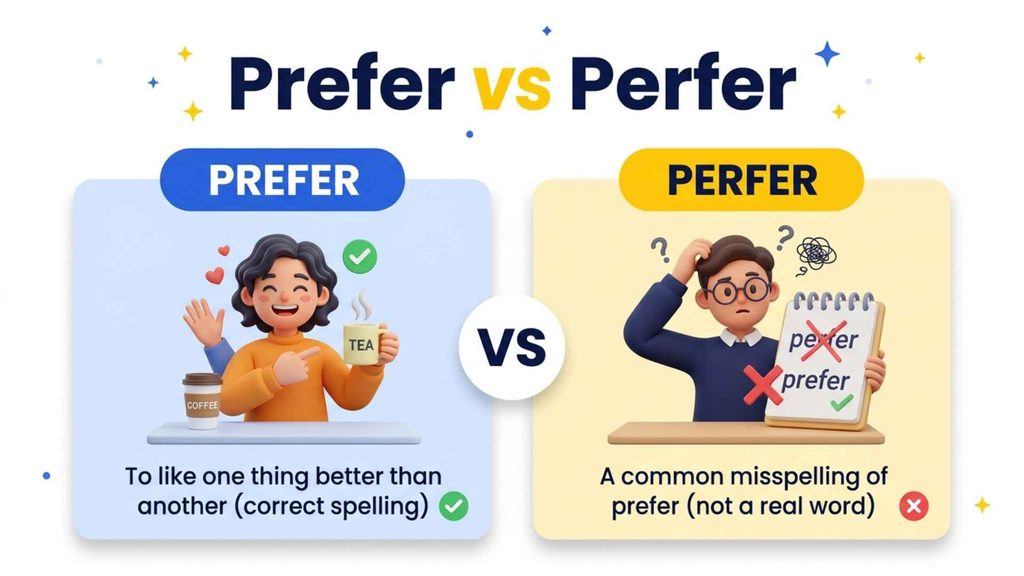
The difference looks tiny on screen but feels huge in writing, so here is the plain truth about Prefer or Perfer: one is a word, and Perfer is a slip.
What Is the Real Difference Between Prefer or Perfer?
Think of it like a real door and a painted door. Prefer opens and works in every sentence, while perfer only looks like a door. All major dictionaries, including Oxford, Cambridge, and Merriam-Webster, list one correct spelling, and it is the one with the r right after the p.
- Prefer is a verb meaning to like one option more than another.
- Perfer is a misspelling and carries no meaning in English.
- Every major dictionary lists only prefer as the accepted form.
- Spelling errors like this can weaken professional writing quickly.
- The fix is easy once you link the word to its prefix.
| Feature | Prefer | Perfer |
| Part of speech | Verb | Not a word |
| Meaning | To like one thing better | None |
| Correct? | Yes | No |
| Typical use | All writing | Typing slip only |
Example in texting:
Friend 1: Wait, do I perfer tea or prefer tea? My brain froze.
Friend 2: Prefer, with the r right after the p. Tea sounds good though.
Is “Prefer” a Grammar, Vocabulary, or Usage Issue?
Honestly, it is a bit of all three, which is why Prefer or Perfer trips people up, and why the wrong spelling Perfer survives so long in everyday online writing.
Is Prefer a Transitive Verb or Just a Formal Word?
The spelling slip is mainly a vocabulary issue, but grammar and usage step in once the word is spelled right. Prefer is a transitive verb, so it wants an object. It also sounds slightly formal, which matters in casual texts and chats.
- Grammar: prefer needs an object such as a noun, gerund, or infinitive.
- Vocabulary: only one spelling exists, so memorize the correct one.
- Usage: prefer sounds polite and formal compared with would rather.
- Comparison: use to or over, not than, after prefer.
- Register: swap in like better when chatting with close friends.
| Issue type | What it covers | Quick example |
| Vocabulary | Choosing the right word and spelling | prefer, never perfer |
| Grammar | Object and comparison rules | I prefer tea to coffee |
| Usage | Tone and formality | I like tea better (casual) |
Example in texting:
Friend 1: I prefer pizza to burgers, but I’m easy.
Friend 2: Fancy wording! I just like pizza better.
A Detailed Guide to Using “Prefer”
Ready for the full picture? This section walks through meaning, sound, patterns, and examples so Prefer or Perfer never feels confusing, and Perfer never lands in your final drafts again.
How Do You Use Prefer Correctly Step by Step?
Using prefer well takes four small skills: knowing the meaning, hearing the pronunciation, picking a grammar pattern, and checking the spelling. Each skill gets its own section below. Together they give you the confidence to write without hesitating again.
- Start with the meaning so every sentence has a clear purpose.
- Practice the pronunciation so the pre- sound sticks in memory.
- Choose a grammar pattern that fits noun, gerund, or infinitive.
- Review real-world examples to see natural sentence structure.
- Finish by checking the spelling before you hit send.
| Skill | Goal | Quick check |
| Meaning | Know what the word says | Does it show a choice? |
| Pronunciation | Hear pri-FUR | Can I say it aloud? |
| Grammar | Pick a pattern | Is there an object? |
| Spelling | Type it right | Does pre come first? |
Example in chat:
Friend 1: Can you check my email? I wrote “I prefer to meet Monday.”
Friend 2: Looks great. Spelling, grammar, and tone are all clean.
Meaning
Words carry feelings, and this one carries choice, so let us quickly look at what prefer really says in the Prefer or Perfer debate, since Perfer says nothing at all.
What Does Prefer Mean in Simple Words?
In plain words, prefer means to like one option more than another, or to choose something over other choices because it suits you better. It shows personal choice, not a rule. Perfer shows nothing, since it is only a typing mistake.
- Prefer shows a stronger liking for one thing among several.
- It signals personal choice, taste, or a favored option.
- It works for people, places, plans, and objects alike.
- The noun form is preference, meaning a favored choice.
- The adjective preferable means more desirable than something else.
| Word form | Example |
| Verb | I prefer tea. |
| Noun | My preference is tea. |
| Adjective | Tea is preferable. |
| Adverb | I would preferably leave early. |
Example in texting:
Friend 1: Pizza or tacos tonight?
Friend 2: I prefer tacos, but pizza works too.
Pronunciation
Say it out loud and the spelling starts to make sense, because the sound behind Prefer or Perfer explains why Perfer feels so believable to your ears at first listen.
How Do You Pronounce Prefer Correctly?
The word has two syllables, with stress on the second one: pri-FUR. The first syllable sounds like pri, not per. Many people hear a quick r sound near the start and write the letters in the wrong order, which creates perfer.
- Stress the second syllable: pri-FUR, not PRE-fur.
- The first syllable sounds like the start of prevent.
- The IPA symbols read /prɪˈfɜːr/ in most dictionaries.
- Fast speech can blur the r sound and cause errors.
- Say it slowly while typing to protect your spelling.
| Region | Common sound |
| US English | pri-FUR, with the final r pronounced |
| UK English | pri-FUR, with the final r softened |
Example in chat:
Friend 1: Is it PRE-fer or pri-FUR?
Friend 2: Pri-FUR. Stress the second part, and the spelling follows.
Common Grammar Patterns
Patterns make grammar easy, and three simple ones cover almost every sentence you will write with prefer, which settles the Prefer or Perfer question while keeping Perfer far, far away.
Which Grammar Patterns Work With Prefer?
Three patterns cover almost everything. You can prefer a noun to another noun, a gerund to another gerund, or an infinitive. Keep both sides of a comparison in the same form, and your sentences stay balanced and clean.
- Noun pattern: prefer coffee to tea, with matching nouns.
- Gerund pattern: prefer walking to driving, with matching -ing forms.
- Infinitive pattern: prefer to travel by train, with a base verb.
- Add rather than with infinitives: prefer to walk rather than drive.
- Use over as a modern, friendly alternative to to.
| Pattern | Structure | Example |
| Prefer + noun | prefer A to B | I prefer apples to oranges. |
| Prefer + gerund | prefer -ing to -ing | She prefers reading to watching TV. |
| Prefer + infinitive | prefer to + verb | They prefer to leave early. |
| Would prefer | would prefer to + verb | We would prefer to wait. |
Example in texting:
Friend 1: Walk or drive?
Friend 2: I prefer walking to driving when it’s sunny.
Real-World Examples for “Prefer”
Rules feel dull until you see them working, so here are real sentences from work, school, and home that show Prefer or Perfer in action, with Perfer nowhere in sight.
What Are Some Real Sentences Using Prefer?
Examples teach faster than rules. Here are everyday lines from the office, classroom, and living room. Notice how prefer stays polite and clear, whether you write a business email, an academic paper, or a quick note to a roommate.
- Workplace: I prefer to hold meetings in the morning.
- Business email: We would prefer to move forward with option one.
- Academic writing: Researchers often prefer qualitative methods for deeper insight.
- Technology: Most users prefer a simple interface over a cluttered one.
- Daily life: I prefer pizza to burgers, but choose anything.
| Setting | Tone | Sample sentence |
| Formal | We prefer a Friday deadline. | |
| School | Academic | Students prefer clear rubrics. |
| Chat | Casual | I prefer movies at home. |
Example in chat:
Friend 1: Where should we meet?
Friend 2: I prefer the café near campus. It’s quieter there.
Why “Perfer” Is Always Incorrect
Here is the honest reason behind the slip: Perfer looks right for a second, yet Prefer or Perfer has only one answer, and spelling logic backs it up every time.
Why Do People Think Perfer Looks Right?
The mistake feels natural for three reasons: phonetic spelling, fast fingers, and look-alike words. None of them make perfer legitimate. They only explain the slip. Once you see the pattern, catching it becomes automatic.
- Phonetic spelling tempts writers to type letters in sound order.
- Typing speed can swap the r and e keys.
- Look-alike words such as refer and perform nudge the brain.
- The pre- prefix means before, so pre comes first.
- No dictionary has ever listed perfer as a valid word.
| Cause | What happens | Fix |
| Sound confusion | The r shifts early | Say pri-FUR |
| Fast typing | Letters swap | Proofread once |
| Similar words | Refer distracts you | Remember pre- means before |
Example in texting:
Friend 1: I perfer mornings, honestly.
Friend 2: Small fix: prefer. Pre comes first, like preview.
When Not to Use “Prefer”
Even the correct word has limits, and knowing them keeps your writing smooth, so let us see where prefer fits awkwardly beyond the Prefer or Perfer spelling trap of Perfer.
When Should You Avoid Using Prefer in a Sentence?
Even the correct word can go wrong. The biggest trap is using than after it. Another is mixing a gerund with an infinitive. And in relaxed chats, prefer may sound stiff, so friendlier phrases often fit better.
- Avoid than after prefer: say coffee to tea instead.
- Do not mix a gerund and an infinitive across a comparison.
- Skip prefer in casual chat when like better sounds warmer.
- Avoid stacking prefer with more, since it already means more liked.
- Do not write perfer in any message, formal or relaxed.
| Wrong | Right |
| I prefer coffee than tea. | I prefer coffee to tea. |
| I prefer walking to swim. | I prefer walking to swimming. |
| I perfer quiet. | I prefer quiet. |
Example in texting:
Friend 1: I prefer cats than dogs.
Friend 2: Cats to dogs, you mean! Totally agree though.
Common Mistakes: A Quick Comparison Table
Seeing right and wrong side by side makes the lesson stick, so this quick table shows the most frequent slips around Prefer or Perfer, including every single sneaky Perfer variation.
What Are the Most Common Prefer Mistakes to Avoid?
Side by side, mistakes lose their power. The table below shows spelling slips, wrong prepositions, and verb-form errors in one glance. Scan it once before sending any important message, and you will catch most problems fast.
- Spelling slip: perfer instead of prefer, the most frequent error.
- Third person: prefers keeps its s, never perfers.
- Wrong preposition: than replaces to, which breaks the grammar rule.
- Past tense: preferred needs a double r, not prefered.
- Pronunciation echo: typing what you hear causes the swap.
| Correct sentence | Incorrect sentence | Why it is wrong |
| I prefer apples to oranges. | I perfer apples to oranges. | Misspelling |
| She prefers reading to TV. | She perfers reading to TV. | Misspelling in third person |
| We prefer working from home. | We perfer working from home. | Misspelling |
| I prefer this option to the last. | I prefer this option than the last. | Wrong preposition |
Example in chat:
Friend 1: She perfers tea, right?
Friend 2: Prefers, with an r after the p. And yes, she loves tea.
The Origin of “Prefer”
Every word has a story, and this one starts in ancient Latin, which quietly explains the Prefer or Perfer puzzle and why Perfer has no history behind it at all.
Where Does the Word Prefer Come From?
The word traces back to Latin praeferre, built from prae, meaning before, and ferre, meaning to carry. It literally meant to carry before, or set in front. It reached English through Old French, keeping that pre- start.
- Prae means before, the same root found in preview and prefix.
- Ferre means to carry, as seen in transfer and refer.
- The Latin meaning was to set one thing ahead of another.
- English borrowed the word through Old French centuries ago.
- Knowing the etymology makes the spelling logical, not random.
| Part | Meaning | Related words |
| prae- | before | preview, prefix, prevent |
| ferre | to carry | transfer, refer, confer |
Example in texting:
Friend 1: Why does prefer start with pre?
Friend 2: Latin prae means before. You set one thing before another.
Prefer vs Rather: Which Sounds More Natural?
Many learners ask which phrase feels more natural, and the answer shapes how you use prefer after settling Prefer or Perfer, since Perfer never even enters the comparison at all.
Is Would Prefer or Would Rather More Natural?
Both phrases express a choice, but they feel different. Would prefer sounds polite and slightly formal, while would rather sounds relaxed and spoken. Grammar differs too, because would rather takes a bare verb, while prefer takes an infinitive.
- Would prefer to fits emails, interviews, and customer service replies.
- Would rather fits friendly chats and quick spoken answers.
- After would rather, use the base verb without to.
- After prefer, use to plus the base verb.
- Both can show a polite refusal when handled with a warm tone.
| Phrase | Pattern | Example |
| would prefer | + to + verb | I would prefer to wait. |
| would rather | + base verb | I would rather wait. |
| prefer | + noun | I prefer tea to coffee. |
Example in texting:
Friend 1: Movie or game night?
Friend 2: I’d rather stay in and play games.
Prefer to or Prefer Than: Which Preposition Is Correct?
Small words cause big headaches, and the preposition after prefer is a perfect example, even once Prefer or Perfer is solved and Perfer is long since forgotten from your writing.
Should You Say Prefer To, Prefer Over, or Prefer Than?
The safe choice is to. It is the traditional preposition after prefer, as in tea to coffee. Over is also accepted in modern English, especially in business and tech writing. Than is the one to avoid, because it belongs to comparatives like better or more.
- To is the classic partner: I prefer tea to coffee.
- Over is modern and clear: I prefer remote work over commuting.
- Than breaks the rule, so rewrite with to or rather than.
- Use rather than with infinitives: prefer to rest rather than rush.
- Keep both sides parallel so the comparison reads smoothly.
| Option | Verdict | Example |
| to | Correct | I prefer cats to dogs. |
| over | Correct | I prefer cats over dogs. |
| than | Avoid | I prefer cats than dogs. |
| rather than | Correct with infinitives | I prefer to nap rather than scroll. |
Example in chat:
Friend 1: I prefer mornings than evenings.
Friend 2: Mornings to evenings! Same here, honestly.
Expert Insight
Language teachers who work with learners every week repeat one simple lesson about Prefer or Perfer: logic beats memorization, and Perfer loses against plain logic every single time, no exceptions.
What Do Language Experts Say About Prefer and Perfer?
Teachers and editors describe this as a classic phonetic error. The brain hears sounds, then maps them to letters, and English makes that map messy. The cure is connection: link the spelling to the Latin root and the pre- meaning, and the error loses its grip.
- Phonetic errors happen when ears guide fingers instead of memory.
- Word roots give spelling a logical anchor that sticks.
- Proofreading aloud catches slips that silent reading misses.
- Editors treat perfer as a pure typo, never a variant.
- Consistent habits beat last-minute spell checks every time.
Example in texting:
Friend 1: My editor flagged perfer in my draft again.
Friend 2: Read it aloud once. You’ll hear pri-FUR and fix it.
Why Do People Type Perfer Instead of Prefer?
Curious minds always ask why, and the honest answer behind Prefer or Perfer mixes speed, sound, and habit, which explains why Perfer keeps showing up uninvited in emails and chats.
What Makes Perfer So Easy to Type by Mistake?
Speed, sound, and habit work together. When you type fast, the r drifts earlier, and the word looks fine at a glance. Autopilot typing, small keyboards, and quick texting make the slip even more likely, especially on phones.
- Fast typing shifts the r one slot too early.
- Mobile keyboards make neighboring keys easy to hit by mistake.
- Spoken sound hides the first vowel in quick speech.
- Visual familiarity with per words like perfect misleads the eye.
- Skipped proofreading lets small errors reach the send button.
| Trigger | Typical result |
| Rushed typing | perfer |
| Small phone screen | swapped or skipped letters |
| Similar words (perform, perfect) | a per- start guess |
Example in texting:
Friend 1: Ugh, I typed perfer again on my phone.
Friend 2: Happens to everyone. Slow down and watch the pre.
How to Never Misspell “Prefer”
Nobody wants to feel that flash of doubt again, so these simple habits lock in Prefer or Perfer for good and push Perfer out of your fingers and your memory.
How Can You Remember the Spelling of Prefer Forever?
Memory tricks work best when they are simple. Anchor the word to its prefix, say it slowly, and attach a tiny mnemonic. Three habits, practiced for a week, are enough to make the correct spelling feel automatic.
- Think pre- means before, as in preview and prevent.
- Sound it out slowly: PRE then FER, with r after p.
- Use a mnemonic: pre comes first in prefer, like pre-game.
- Proofread twice, once for meaning and once for spelling.
- Turn on spell check, then still read your final draft.
| Trick | How it helps |
| Prefix link | Ties spelling to meaning |
| Slow sounding | Slows down letter swaps |
| Mnemonic | Gives a quick mental cue |
| Final proofread | Catches missed typos |
Example in chat:
Friend 1: How do you never mess up prefer?
Friend 2: Pre comes first, like preview. Works every single time.
Prefer Synonyms and Alternatives for Everyday Writing
Sometimes a fresher word sounds better, and knowing the options helps you move past Prefer or Perfer worries while keeping Perfer out of every sentence you write, formal or casual.
What Are Good Synonyms for Prefer in Everyday Writing?
Variety keeps writing fresh. Depending on tone, you can swap prefer for favor, choose, or opt for. Each alternative carries a slightly different feel, so match the word to your audience. Formal papers lean one way, friendly texts another.
- Favor feels formal and works well in reports and essays.
- Choose is neutral and works in almost every setting.
- Opt for sounds decisive and suits business or shopping choices.
- Like better feels friendly and fits casual conversations.
- Lean toward shows a gentle, not final, preference.
| Synonym | Tone | Example |
| favor | Formal | Many readers favor short paragraphs. |
| opt for | Confident | I will opt for the window seat. |
| like better | Casual | I like tea better. |
| go for | Informal | Let’s go for tacos. |
Example in texting:
Friend 1: Window or aisle?
Friend 2: I’d go for the window. Better view.
Is Perfer a Real Word in Any Dictionary?
Dictionaries settle arguments quietly, and checking them answers the Prefer or Perfer question for good, because Perfer appears in none of the major English references, whether American, British, or Australian.
Do Oxford, Cambridge, or Merriam-Webster List Perfer?
No major reference lists it. Spelling guides, style manuals, and learner dictionaries all point to prefer as the only accepted form. If you spot perfer in published text, treat it as a typo, not a regional variant or a clever stylistic choice.
- Oxford lists prefer, with its forms preferred, preferring, and prefers.
- Cambridge teaches prefer as a verb of choice and liking.
- Merriam-Webster gives the same spelling and similar definitions.
- Regional variants like American and British English agree here.
- Style guides never present perfer as an acceptable alternative.
| Source | Lists perfer as a word? |
| Oxford | No |
| Cambridge | No |
| Merriam-Webster | No |
| Style guides | No |
Example in chat:
Friend 1: Maybe perfer is a British spelling?
Friend 2: Nope. Both British and American English use prefer.
Related Grammar Confusions
Spelling traps travel in packs, and once Prefer or Perfer is solved, a few cousins deserve attention, since Perfer is not the only sneaky slip waiting out there for you.
Which Other Spelling Mix-Ups Should You Watch For?
Many writers who slip on prefer also stumble on a handful of commonly confused words. Learning them together saves time. The list below covers spelling errors, homophones, and look-alike pairs that appear in school essays, work emails, and social posts.
- Receive vs recieve: follow i before e except after c.
- Separate vs seperate: remember there is a rat in separate.
- Affect vs effect: affect is usually a verb, effect usually a noun.
- Then vs than: then marks time, than marks comparison.
- Its vs it’s: it’s always means it is or it has.
| Pair | Quick fix |
| Accept / Except | Accept receives, except excludes |
| Your / You’re | You’re means you are |
| Definitely / Defiantly | Definitely means for sure |
| There / Their / They’re | Place, ownership, and they are |
Example in texting:
Friend 1: Is it effect or affect in this sentence?
Friend 2: Affect is the verb here. I prefer simple rules like that.
Preferred, Preferring, and Preference: Spelling Each Form
One more layer remains, because prefer changes shape in different tenses, and each form follows the same logic that settles Prefer or Perfer and firmly rejects Perfer every single time.
Does Prefer Double the R in Preferred and Preferring?
Yes for two forms, no for others. When the stress stays on the last syllable, English doubles the final consonant, giving preferred and preferring. When the stress moves forward, as in preference and preferable, the r stays single.
- Preferred doubles the r because stress stays on the last syllable.
- Preferring also doubles the r for the same reason.
- Preference keeps one r, since stress shifts to the first syllable.
- Preferable also keeps one r with stress on the first syllable.
- Prefers simply adds an s for third person singular.
| Form | Spelling | Example |
| Past tense | preferred | She preferred tea. |
| -ing form | preferring | Preferring tea, she declined coffee. |
| Noun | preference | My preference is clear. |
| Adjective | preferable | Tea is preferable. |
Example in chat:
Friend 1: Is it prefered or preferred?
Friend 2: Preferred, with two r’s. I preferred the first draft too.
Does Autocorrect Always Fix Perfer?
Technology feels like a safety net, yet it has gaps, so let us test whether autocorrect really solves Prefer or Perfer and catches Perfer on every phone, laptop, and device.
Can You Trust Spell Check to Catch Perfer?
Most tools catch it, but not all, and not always. Autocorrect can fail in messy sentences, in apps without checking, or when you type in a hurry. Treat software as backup, not as your only proofreading plan.
- Word processors usually underline perfer with a red line.
- Phone keyboards often fix it, but sometimes suggest odd words.
- Social apps may skip checking for short posts and captions.
- Grammar tools help but can miss context-based mistakes.
- Manual proofreading remains the most reliable final defense.
| Tool | Catches perfer? | Note |
| Word processor | Usually | Check the red lines |
| Phone keyboard | Often | Suggestions vary |
| Social apps | Sometimes | Many skip checks |
| Human proofreader | Almost always | Best final check |
Example in texting:
Friend 1: Autocorrect left perfer in my caption.
Friend 2: Always reread. Tools help, but eyes win.
FAQs
1. Is “Perfer” ever correct?
For Prefer or Perfer, only prefer is correct. Perfer is always a misspelling.
2. Why do people misspell “prefer” as “perfer”?
Prefer or Perfer confusion comes from fast typing and sound. The letters simply swap.
3. What is the correct spelling: “prefer” or “perfer”?
In Prefer or Perfer, prefer wins. Dictionaries list no other spelling.
4. Can I use “perfer” in my writing?
In Prefer or Perfer, never choose perfer. It looks careless in school and work.
5. Is “prefer” a real word?
Yes. In Prefer or Perfer, prefer is a real verb meaning to like better.
6. What preposition should I use with “prefer”?
Use to or over, never than. Good grammar matters as much as Prefer or Perfer spelling.
7. How can I remember prefer instead of perfer?
For Prefer or Perfer, remember pre- means before, so pre comes first.
Conclusion
So, where does that leave Prefer or Perfer? The answer is calm and simple: prefer is the only correct spelling, and it means choosing one option over another. Every time doubt creeps in, remember the Latin root, the pre- prefix, and the slow pri-FUR sound.
Mistakes happen to everyone, and a quick proofread fixes them. If you ever catch Perfer in a draft, smile, correct it, and move on. Solving Prefer or Perfer is a small win, yet it builds the kind of trust that careful, confident writing earns in school, at work, and online.
Here is your takeaway: before you hit send, glance at that tiny word and say, pre comes first. Keep that cue handy, and Prefer or Perfer stops being a question for good.
Meta Description
Prefer or Perfer? Only prefer is correct. Learn the meaning, simple memory tricks, and real examples to spell it right every time.
LSI, NLP Keywords and Entities (extracted from the competitor article, bolded in the draft)
- Core terms: prefer, perfer, misspelling, correct spelling, common spelling mistake, English learners
- Semantic and related phrases: personal choice, like better, choose over, would rather, would prefer, preference, preferable, preferred, preferring
- Grammar terms: transitive verb, gerund, infinitive, preposition, prefer to, prefer over, prefer than, rather than, sentence structure, third person singular
- Pronunciation terms: syllables, stress, pri-FUR, IPA, r sound, phonetic spelling
- Etymology entities: Latin, praeferre, prae, ferre, Old French, pre- prefix, etymology
- Entities: Oxford, Cambridge, Merriam-Webster, dictionaries, style guides
- Writing context: professional writing, academic writing, business email, workplace, proofreading, spell check, autocorrect
- Related confusions: receive vs recieve, separate vs seperate, affect vs effect, then vs than, its vs it’s, your vs you’re, accept vs except, definitely vs defiantly

Amelia Brooks is a US-based author known for inspiring stories on meaning, growth, and hope, blending insight with simple, engaging storytelling.