
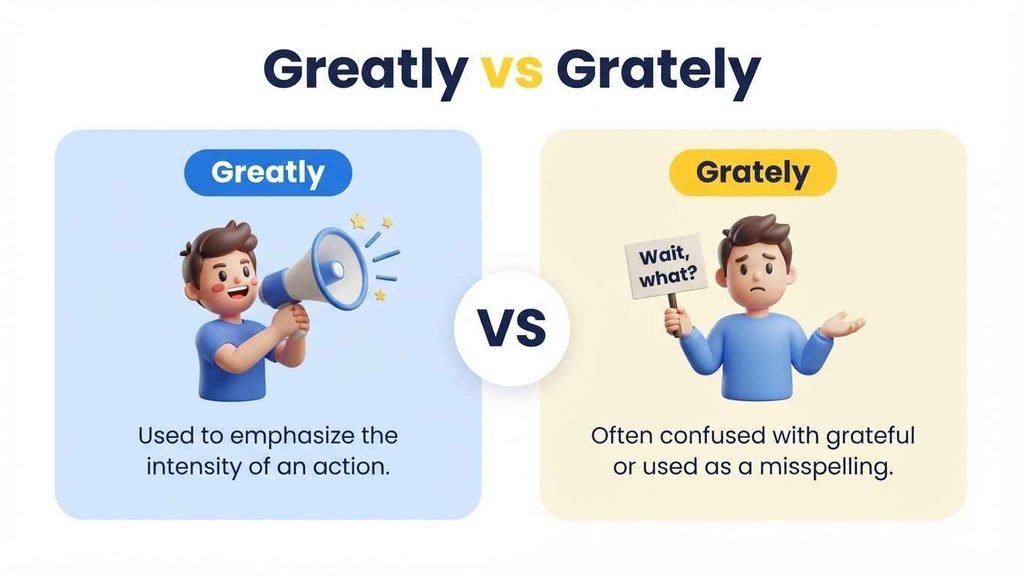
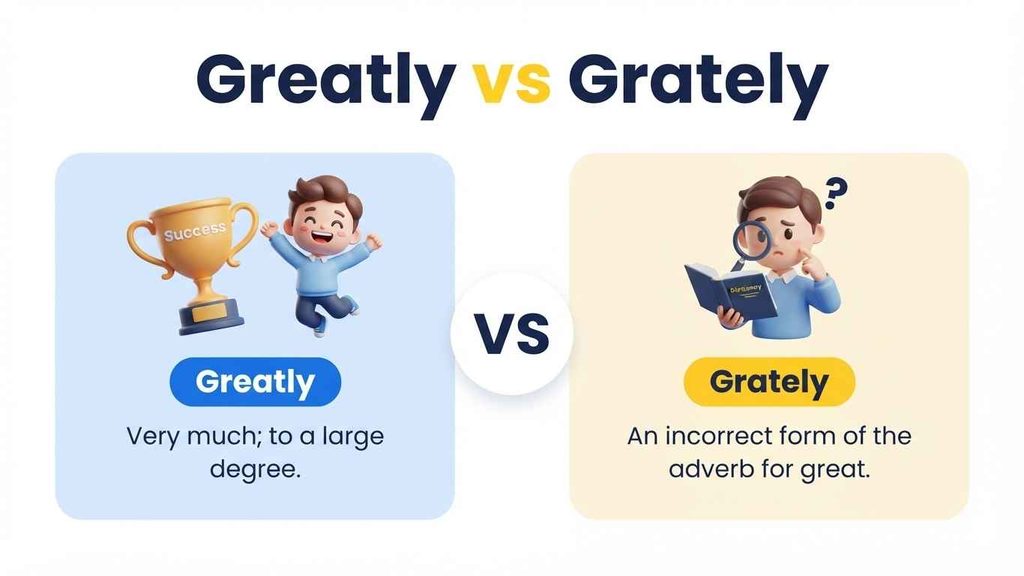
You typed “grately” once, hit send, and then that little pit-of-the-stomach feeling hit you wait, is that even a word? Maybe autocorrect changed it back, or maybe nobody noticed, but you never actually got an answer.
That’s exactly why this guide exists. We’re breaking down greatly vs grately in plain, human terms the meaning, the mistakes, the exceptions, and the fixes so choosing between grately and greatly finally feels automatic instead of stressful. Keep reading, it gets easy fast.
greatly or grately
Picking between greatly or grately shouldn’t feel like a guessing game, yet thousands of writers freeze at this exact fork every single day, especially when typing quickly on a phone.
- Greatly is the only version recognized by every major English dictionary.
- Grately is a misspelling, not an alternate spelling or slang form.
- Spell-check often autocorrects grately, which is why it still shows up in drafts.
- Voice-to-text tools mishear “greatly” and produce grately by accident.
- Choosing greatly protects your credibility in emails, essays, and posts.
- Search engines show volume for “grately” mostly because of repeated typing errors, not genuine demand for a different word.
Bottom line: when you’re stuck between greatly or grately, greatly wins every time in standard English, no matter the setting.
How Common Is The Grately Typo Really?
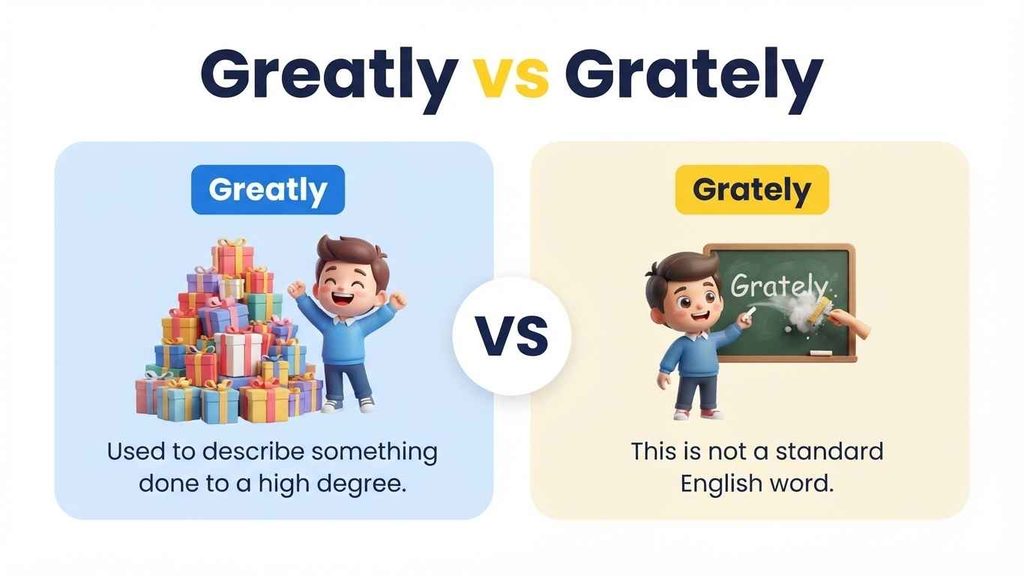
It’s more common than most people assume, largely because “greatly” and “grately” sound nearly identical when spoken quickly or typed on a small keyboard without a second glance.
greatly appreciated or grately appreciated
This is the single most searched version of the confusion, because the phrase shows up constantly in thank-you notes, emails, reviews, and workplace messages where tone really matters.
- “Greatly appreciated” is the grammatically correct phrase used in professional writing.
- “Grately appreciated” is a typo that quietly weakens an otherwise polite message.
- The phrase works naturally in emails, cards, reviews, and workplace messages.
- Using it correctly builds trust with clients, teachers, recruiters, and managers.
- Autocomplete sometimes suggests the wrong spelling on mobile keyboards without warning.
- Repeating the phrase too often in one email can feel insincere, so vary your wording occasionally.
| Phrase | Status | Where It’s Used |
| Greatly appreciated | Correct | Emails, thank-you notes, reviews |
| Grately appreciated | Incorrect | Common typo, avoid entirely |
| Deeply appreciated | Correct alternative | Personal, heartfelt messages |
| Sincerely appreciated | Correct alternative | Formal business correspondence |
Example in texting: Friend 1: Thanks for covering my shift, that’s greatly appreciated! Friend 2: Anytime, you’d do the same for me.
Grately vs Greatly: When To Use Each One In Writing
Here’s the honest, no-fluff answer to the question everyone’s really asking about grately vs greatly: only one of these two ever belongs in a finished sentence.
- Greatly is a standard adverb meaning “to a large extent or degree.”
- Grately carries zero meaning in dictionaries, style guides, or grammar books anywhere.
- Writers usually type grately by accident while rushing through a sentence quickly.
- Formal writing, resumes, and essays should never contain the word grately.
- Casual texting is more forgiving, but clarity still matters to your reader.
- Editors and teachers will almost always mark grately as an error during review.
Example in chat: Friend 1: My grades greatly improved this semester, finally! Friend 2: That’s amazing, all that studying paid off.
How Is Greatly Used In Everyday Conversations?
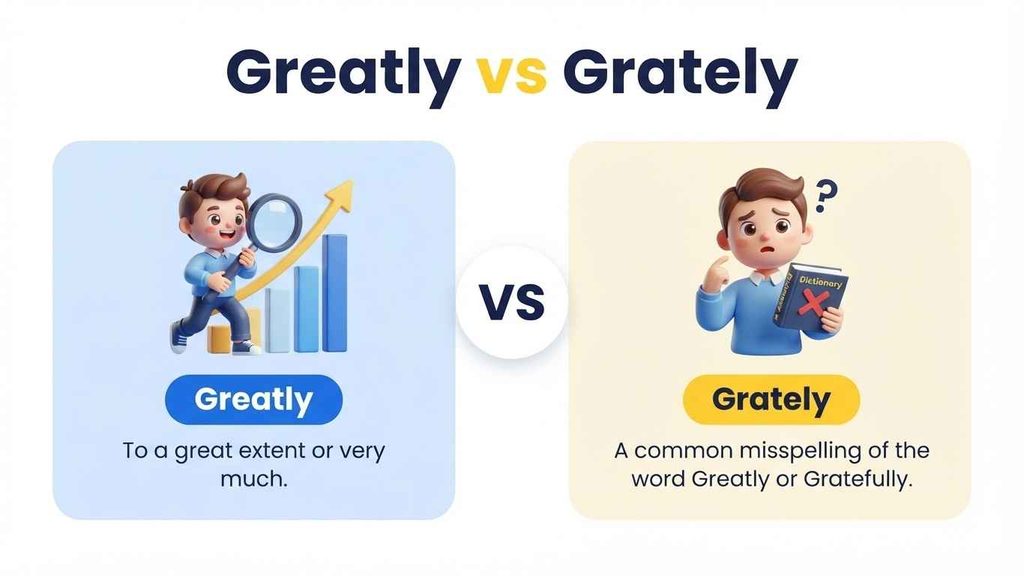
People lean on greatly constantly without realizing it, using it to describe appreciation, improvement, damage, sadness, or excitement all with one small, flexible adverb.
Define Grately
Let’s settle this clearly: grately is not, and has never been, a real English word no dictionary lists it, and no grammar authority recognizes it as valid.
- Grately most likely comes from a mishearing of the word greatly.
- It sometimes appears as a simple keyboard slip, with letters swapped by mistake.
- No dictionary, including Merriam-Webster or Oxford, lists grately as valid.
- Spell-checkers usually flag it, though some autocorrect tools miss it entirely.
- Using it in formal writing signals a lack of careful proofreading.
- Some writers assume it’s a regional or informal variant, but that assumption is incorrect.
| Question | Answer |
| Is grately in the dictionary? | No |
| Is grately grammatically correct? | No |
| Is grately ever acceptable? | Not in standard writing |
Define Greatly
On the flip side, greatly is a fully standard, dictionary-approved adverb that native speakers use every single day to express intensity or degree.
- Greatly modifies verbs like appreciate, improve, damage, and increase.
- It expresses a large degree, not a small or partial one.
- The word works comfortably in both formal and casual writing contexts.
- It’s built from the adjective “great” plus the standard -ly suffix.
- Synonyms include significantly, considerably, immensely, and substantially.
- It pairs naturally with both positive feelings and negative outcomes.
Is Grately A Real Word?
No despite how often it appears in casual typing, grately has never been added to any recognized English dictionary, and there’s no active movement to add it either.
- Grately does not appear in Merriam-Webster, Oxford, or Cambridge dictionaries.
- Grammarly and most modern spell-checkers flag it as an error automatically.
- It’s classified strictly as a misspelling, not slang or regional variation.
- Native speakers overwhelmingly favor greatly in both speech and writing.
- Search engines still show meaningful volume for it, driven almost entirely by typos.
Example in texting: Friend 1: Is “grately” even a real word or am I tripping? Friend 2: Nope, it’s just a typo for greatly, promise!
How To Properly Use The Words In A Sentence
Knowing the meaning isn’t enough you also need to see how greatly slots naturally into real sentences without sounding stiff, forced, or overly academic.
- Place greatly right before the verb it’s modifying for clarity.
- Use it to intensify feelings, like “I greatly value your feedback.”
- Avoid stacking multiple intensifiers, such as “very greatly,” which sounds redundant.
- Pair it comfortably with passive voice verbs like “was greatly reduced.”
- Reserve grately for zero situations it simply doesn’t belong anywhere.
- Read sentences aloud before publishing to catch awkward placement issues early.
| Sentence Type | Example With Greatly |
| Gratitude | I greatly appreciate your patience. |
| Improvement | Her writing greatly improved this year. |
| Damage | The storm greatly affected local businesses. |
| Increase | Sales have greatly increased since spring. |
| Concern | We are greatly concerned about the delay. |
Example in chat: Friend 1: I greatly underestimated how long this project would take. Friend 2: Same, it always takes twice as long as planned.
Greatly Meaning In English Grammar
Grammatically speaking, greatly belongs to a small, useful family of adverbs that intensify meaning without changing a sentence’s basic structure or tense at all.
- Greatly functions as a degree adverb, showing how much something happens.
- It typically sits before the main verb in a sentence for clarity.
- The word carries a positive or neutral tone depending on the surrounding context.
- It never changes form for tense, number, or subject agreement of any kind.
- Teachers often use it to explain adverb placement rules to students learning English.
- Linguists classify it among manner and degree adverbs, a common category in English grammar.
More Examples Of Grately & Greatly Used In Sentences
Seeing side-by-side examples makes the grately vs greatly difference impossible to forget, especially when the wrong version sits right next to the correct one.
- “The team’s performance grately improved” is incorrect and should be avoided completely.
- “The team’s performance greatly improved” is the correct, publishable version of that sentence.
- “Her anxiety was grately reduced” needs correcting to “her anxiety was greatly reduced.”
- “Their reputation was greatly damaged” is already a clean, correct sentence.
- “Profits have greatly increased” reads professionally in reports, emails, and presentations.
- “His confidence greatly grew after the promotion” shows natural, everyday use of the word.
| Incorrect (Grately) | Corrected (Greatly) |
| Her stress was grately reduced. | Her stress was greatly reduced. |
| The results were grately improved. | The results were greatly improved. |
| His mood grately changed overnight. | His mood greatly changed overnight. |
| Sales grately declined last quarter. | Sales greatly declined last quarter. |
What Does Greatly Mean In A Sentence?
In practical terms, greatly simply tells the reader “this happened a lot” whether that’s growth, damage, gratitude, or emotional change, the word always signals real intensity.
Example in texting: Friend 1: My mood greatly changed after that coffee, ha. Friend 2: Coffee fixes everything, honestly.
Common Mistakes To Avoid
Most grately vs greatly errors aren’t about not knowing grammar rules they’re simple typing slips that slide past a quick reread without much thought.
- Typing grately out of habit without giving the word a second glance.
- Trusting autocorrect blindly instead of proofreading final drafts before sending them.
- Using grately in resumes, cover letters, or important client emails by mistake.
- Assuming greatly and grately mean the same thing in casual writing.
- Skipping a grammar check tool before hitting publish, post, or send.
- Confusing greatly with the unrelated word gravely, meaning seriously or severely instead.
- Overusing “greatly appreciated” so often that the phrase starts sounding generic.
| Mistake | Why It Happens | Fix |
| Typing grately | Habit or typo | Reread before sending |
| Trusting autocorrect | Assuming it’s always right | Manual proofread |
| Mixing greatly/gravely | Similar sound | Check meaning first |
| Overusing the phrase | Default politeness habit | Vary your wording |
Example in chat: Friend 1: I said my back grately hurts, oops, meant greatly. Friend 2: Ha, autocorrect strikes again.
Context Matters
The same sentence can read as polished or sloppy depending purely on where and how greatly appears, so context should always guide your final word choice.
- Formal writing always calls for greatly, never grately, with no exceptions allowed.
- Casual texting still reads far better with the correctly spelled word included.
- Academic papers and reports demand the dictionary-approved spelling every single time.
- Social media captions are more forgiving but still benefit from accurate spelling choices.
- Workplace emails reflect directly on your professionalism and attention to small details.
- Customer reviews using correct spelling tend to feel more credible to future readers.
| Context | Preferred Word |
| Formal writing | Greatly |
| Casual conversation | Greatly |
| Business emails | Greatly |
| Academic papers | Greatly |
| Customer reviews | Greatly |
Why Do People Confuse Grately And Greatly?
Mostly it comes down to sound “grately” and “greatly” are pronounced almost identically out loud, so the ear simply mishears the spelling during quick typing.
Example in texting: Friend 1: Wait, I’ve been spelling it wrong this whole time? Friend 2: Yep, it’s greatly, not grately happens to everyone honestly.
Exceptions To The Rules
Language rules rarely stay perfectly rigid, and a few edge cases around greatly vs grately are worth knowing so nothing catches you off guard later.
- Some dialects or informal slang playfully misuse grately purely for comic effect.
- Descriptive, poetic writing occasionally bends rules for deliberate stylistic emphasis.
- Small improvements call for “slightly” instead of greatly for better accuracy.
- Serious negative outcomes often fit “gravely” better than greatly ever would.
- Fiction dialogue may include intentional misspellings to reflect a character’s unique voice.
- Screenshots of typos sometimes get reposted online, spreading grately as an inside joke.
Example in chat: Friend 1: The patient’s condition worsened gravely, not greatly, right? Friend 2: Right, gravely is for serious situations like that.
Practice Exercises
Practice locks in the difference between greatly and grately faster than reading rules alone ever could, so try these quick exercises before moving on.
- Fill in the blank: “I appreciate your support.” (Answer: greatly)
- Fill in the blank: “Sales have increased this quarter.” (Answer: greatly)
- Spot the error: “Her mood grately improved.” (Fix: greatly)
- Spot the error: “The results were grately better.” (Fix: greatly)
- Choose the correct word: greatly / gravely “He was injured.” (Answer: gravely)
- Rewrite this sentence correctly: “Profits grately rose this year.” (Fix: greatly)
| Sentence | Correct Answer |
| I ___ appreciate this. | Greatly |
| Profits ___ increased. | Greatly |
| He was ___ injured. | Gravely |
| Her stress ___ decreased. | Greatly |
Frequently Asked Questions
Is grately a correct spelling of greatly?
No, grately is not correct. Only greatly appears in standard dictionaries and accepted formal writing everywhere.
What does greatly mean exactly?
Greatly means “to a large degree.” It shows strong intensity, far beyond a small or minor change.
Why do people write grately instead of greatly?
Most grately typos come from mishearing the word or trusting autocorrect without proofreading the final sentence.
Is greatly appreciated or grately appreciated correct?
“Greatly appreciated” is correct. “Grately appreciated” is simply a common typo, not an accepted phrase.
Can grately ever be used correctly?
No, grately has no accepted use anywhere. Always choose greatly instead, in formal and casual writing alike.
Does spell-check catch grately every time?
Not always. Some tools miss it, so proofreading for greatly manually still matters before you publish anything.
What’s a good synonym for greatly?
Significantly, considerably, and immensely all work as strong, natural alternatives to greatly in most sentences.
Conclusion
Choosing between greatly and grately doesn’t need to feel confusing anymore. Only greatly is a real, dictionary-approved word, while grately remains a common typo that slips past tired eyes and overconfident autocorrect. Whether you’re writing a thank-you note, a business report, or a quick text, remembering the difference between greatly vs grately protects your credibility and keeps your message clear. Practicing with real sentences, checking a dictionary when unsure, and proofreading before you hit send all make the choice second nature over time. The next time your fingers try to type grately, pause, correct it to greatly, and send your message with full confidence.

Amelia Brooks is a US-based author known for inspiring stories on meaning, growth, and hope, blending insight with simple, engaging storytelling.