

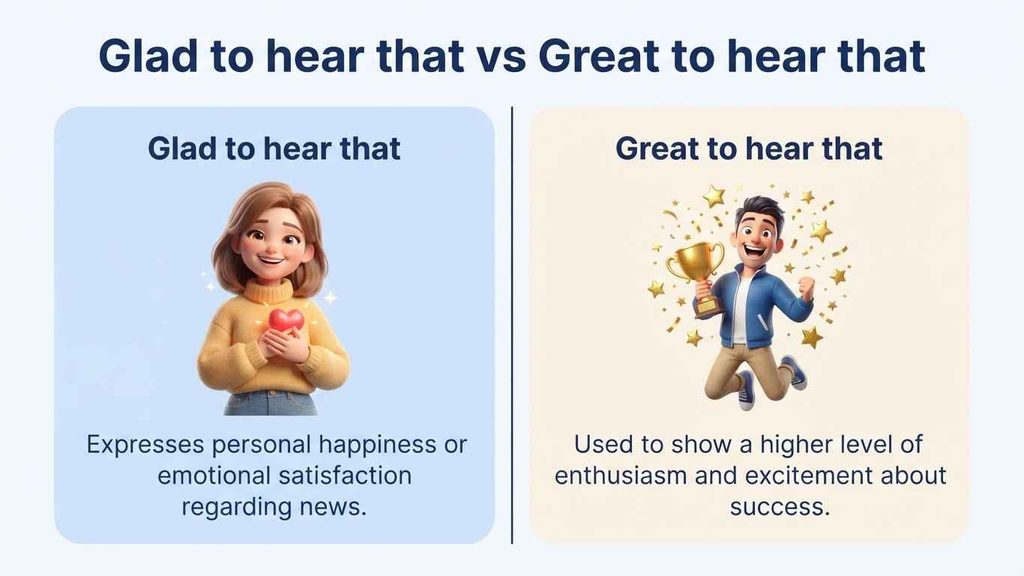
Someone just told you good news, and the only words that came out were “glad to hear that” again. It feels a little empty, doesn’t it, like you’re reading from a script instead of actually reacting to a person you care about.
That flat feeling is exactly what this guide fixes. You’ll walk away understanding the true glad to hear that meaning, why it matters so much in daily conversation, and dozens of that genuine alternative you can use in texts, emails, and real talk starting today. Keep reading, because your next reply is about to sound a lot more like you.
Glad To Hear That Meaning In Everyday Conversations

At its core, the glad to hear that meaning is simple: you’re telling someone their news made you feel happy, relieved, or reassured on their behalf. It’s a small phrase carrying real emotional acknowledgment.
People use it as a bridge phrase, something that says “I heard you, and I’m reacting to it” without needing a long speech. It shows up in texts, emails, phone calls, and face-to-face chats equally.
What Situations Call For This Phrase?
- Health updates a friend recovers or gets a clear test result
- Career wins a coworker lands a promotion or new job
- Relationship news someone gets engaged or reconciles
- Everyday relief a delayed flight lands safely, a lost item turns up
- Small good news nice weather, a fixed car, a finished project
Example in texting: Friend 1: My surgery went great, no complications at all! Friend 2: Glad to hear that, I’ve been thinking about you all week.
What Does “Glad To Hear That” Really Mean?

People search this question constantly because the phrase feels automatic, and they want to know if there’s more depth behind it than a polite reflex response. There usually is more meaning packed inside than most realize.
At its base, “glad” signals a mild-to-moderate positive emotion, while “to hear that” points back to whatever the other person just shared. Together, the glad to hear that meaning communicates shared happiness without overselling it.
It’s less intense than “thrilled” or “overjoyed,” which is exactly why it fits so many situations. The phrase works as a flexible middle-ground reaction, strong enough to sound sincere but calm enough for casual and professional settings alike.
Why You Need Different Ways To Respond
Positive responses make people feel good when they share updates with you. Saying glad to hear that works fine, but using it constantly makes your words lose their punch over time.
Changing your responses shows you’re really listening instead of running on autopilot. A friend getting engaged deserves more excitement than a routine work update, and your words should reflect that difference.
Why Does Repetition Weaken A Phrase?
- Overuse dulls the emotional impact of any phrase
- Predictability makes replies feel automatic instead of genuine
- Mismatched tone signals you’re not really paying attention
- Variety shows effort and active listening
- Context should always shape your word choice
Example in chat: Friend 1: We finally got approved for the house! Friend 2: That’s incredible, I’m so happy for you two!
That’s Good To Hear
This short phrase carries a calm, steady warmth, making that’s good to hear feel less dramatic than “glad to hear that” while still landing as sincere and kind in casual talk.
It works well for lighter updates, weather clearing up, a minor fix, or news that’s pleasant but not life-changing. It keeps the mood relaxed without underselling the moment.
When Should You Use “That’s Good To Hear”?
| Situation | Why It Fits |
| Neighbor mentions their car got fixed | Casual, low-stakes update |
| Coworker says a meeting got shorter | Mild relief, no big emotion needed |
| Friend says traffic wasn’t bad | Small talk that needs a light response |
| Someone confirms plans are still on | Reassurance without overreacting |
| Parent shares kids had a good day | Warm but everyday tone |
- Neighborly tone that fits fence-side chats
- Low-pressure phrase for minor updates
- Versatile across texts and spoken conversation
- Genuine without sounding overly excited
- Easy to say naturally, no forced enthusiasm
Example in texting: Friend 1: The plumber finally showed up and fixed the sink. Friend 2: That’s good to hear, one less thing to worry about.
Good To Hear
Dropping the “that’s” makes good to hear feel even more relaxed, almost like a quick nod in conversation. It’s perfect for fast replies where you still want to sound present.
This shortened version fits texting culture especially well, where brevity matters but warmth still counts. It says “I noticed, and I’m glad” in the fewest words possible.
Is “Good To Hear” Too Casual For Work?
- Slack messages handle this phrase comfortably
- Quick emails between familiar coworkers work fine too
- Formal reports should avoid this shortened version
- First-time clients deserve a slightly more polished phrase
- Team chats with regular collaborators suit it perfectly
Example in chat: Friend 1: The delivery finally arrived, everything’s in one piece. Friend 2: Good to hear, was getting worried about that package.
I Am Happy To Hear That
Saying I am happy to hear that personalizes the reaction by centering your own emotional response rather than describing the news itself, which makes it feel more intimate and direct.
This phrasing works beautifully in both spoken and written form. It tells the other person exactly how their update affected you, which builds a stronger emotional connection than a generic acknowledgment.
How Does Adding “I Am” Change The Tone?
- Personal ownership of the emotion, not just an observation
- Warmer delivery than a detached one-liner
- Works well in voice messages and phone calls
- Suits close relationships more than distant acquaintances
- Pairs naturally with a follow-up question
Example in texting: Friend 1: I finally got the internship I wanted! Friend 2: I am happy to hear that, tell me everything about it.
I Am Glad To Hear That
This version keeps the personal “I am” structure while softening the emotional intensity slightly compared to “happy.” I am glad to hear that sits in a comfortable middle zone.
It’s flexible enough for professional emails and personal messages alike, making it one of the safest full-sentence options when you’re unsure how much enthusiasm the moment calls for.
Where Does This Phrase Fit Best?
- Formal emails replying to good project updates
- Text conversations with acquaintances or new friends
- Phone calls where tone needs to stay measured
- Written cards or notes for milestone events
- Client replies where warmth still needs polish
Example in chat: Friend 1: The doctor said the treatment is working well. Friend 2: I am glad to hear that, thank you for updating me.
Professional Ways To Say “Glad To Hear That”
Work situations need you to sound polished while staying warm. These professional phrases help you respond to colleagues, bosses, and clients without sounding stiff, cold, or repetitive.
Your coworkers notice when you communicate thoughtfully. The right words build trust and show you actually process what people tell you, not just nod along.
Which Professional Phrase Fits Formal Emails Best?
- “That’s excellent news” for major wins and promotions
- “Delighted to hear that” for significant achievements
- “Thank you for the update” for ongoing project reports
- “Thank you for telling me” for confidential or sensitive news
- “That’s a pleasure to hear” for resolved problems
| Phrase | Best Used For |
| That’s excellent news | Promotions, approvals, big wins |
| Delighted to hear that | Major announcements, achievements |
| Thank you for the update | Ongoing project check-ins |
| Thank you for telling me | Personal or confidential disclosures |
| That’s a pleasure to hear | Resolved issues, good health news |
Example in chat: Friend 1: The client signed the contract this morning. Friend 2: That’s excellent news, great work getting that closed.
Casual Ways To Say “Glad To Hear That”
Talking with friends and family calls for a relaxed style. These casual phrases sound natural without any stiffness, letting your real personality come through.
Close friends appreciate responses that sound like you, not a business memo. These options keep things authentic while still showing genuine support.
Which Casual Phrase Fits Texting Best?
- “I’m happy to hear it” for everyday personal wins
- “That’s good to hear” for low-key, pleasant updates
- “Fantastic news” for big, exciting announcements
- “That’s good news” for updates that matter emotionally
- “I’m thankful for that” when the news benefits you directly
| Phrase | Everyday Use Case |
| I’m happy to hear it | Passing a test, small personal wins |
| That’s good to hear | Weather, minor fixes, routine updates |
| Fantastic news | Engagements, competitions, big goals |
| That’s good news | Moving closer to family, life changes |
| I’m thankful for that | Someone doing you a favor |
Example in texting: Friend 1: You’re engaged?! When did this happen? Friend 2: Last night! Fantastic news, right?
Synonyms For Glad To Hear That You Can Use Today
Beyond full phrases, single-word synonyms and short expressions can freshen up your replies instantly. These related phrases work as quick substitutes in almost any message.
Mixing single words with fuller sentences keeps your communication style varied so no single response starts to feel like a copy-paste reply.
What Are Quick One-Word Alternatives?
| Word/Phrase | Tone |
| Wonderful | Warm, enthusiastic |
| Relieved | Focused on worry lifting |
| Encouraging | Supportive, forward-looking |
| Reassuring | Calm, steady |
| Heartening | Emotional, sincere |
- Wonderful works for almost any positive update
- Relieved fits news that ends a worry
- Encouraging suits progress reports and small steps
- Reassuring matches health or safety news
- Heartening adds emotional depth to formal writing
Example in chat: Friend 1: The test results finally came back normal. Friend 2: Relieved to hear that, I know you were stressed.
Why Do People Say “Glad To Hear That” So Often?
This phrase became a default response because it’s short, safe, and universally understood, letting people react quickly without overthinking their wording in fast-moving conversations.
It also carries low risk. Unlike stronger reactions, glad to hear that rarely feels like an overreaction or an underreaction, which is exactly why it’s become a habitual, almost automatic reply.
Is Automatic Usage A Bad Habit?
- Convenience makes it a default, not necessarily wrong
- Safety in tone avoids awkward mismatched reactions
- Familiarity means the listener instantly understands it
- Repetition only becomes an issue when it’s the only phrase used
- Awareness of alternatives fixes the repetitive habit fast
Example in texting: Friend 1: I finally cleaned out my whole garage today. Friend 2: Glad to hear that, bet it feels so much lighter in there.
Text Message Examples Using Glad To Hear That
Seeing real conversations helps more than definitions alone. These texting examples show how the phrase and its alternatives play out across different relationships and moods.
Notice how tone shifts slightly depending on who’s texting whom, even though the core sentiment, happiness for the other person, stays consistent throughout every example below.
How Do Texts Differ Between Friends And Coworkers?
| Context | Sample Reply |
| Best friend | “OMG glad to hear that, calling you tonight!” |
| Coworker | “Glad to hear that, thanks for the quick update.” |
| Family group chat | “So glad to hear that, love you all.” |
| New acquaintance | “Glad to hear that, hope things keep going well.” |
| Long-distance friend | “Glad to hear that, miss catching up like this.” |
- Punctuation and emojis loosen up friend texts
- Shorter replies suit fast-paced coworker chats
- Group tone should match the group’s usual energy
- New relationships call for slightly more restraint
- Long gaps between messages deserve a warmer opener
Example in texting: Friend 1: Guess who just got the apartment we wanted! Friend 2: Glad to hear that!! When do you move in?
How To Pick the Right Response
Think about who you’re talking to first. Work contacts need formal phrasing like “that’s excellent news,” while close friends appreciate casual options like “happy to hear it.”
Consider where you are, too. A work email needs different language than a text to family, even if you’re saying essentially the same thing.
What Three Questions Decide Your Response?
| Question | Why It Matters |
| Who is this person to me? | Determines formality level |
| Where is this conversation happening? | Sets the channel’s tone |
| How big is this news to them? | Matches your energy correctly |
- Relationship closeness decides how casual you can go
- Platform (email versus text) shapes word choice
- News size determines how much enthusiasm fits
- Cultural context may call for extra formality
- Past patterns with that person guide consistency
Example in chat: Friend 1: Just wanted to let you know the flight landed safe. Friend 2: So glad to hear that, thanks for texting me right away.
Is It Rude To Reply With Just “Okay” Instead Of Glad To Hear That?
Replying with a bare “okay” to genuinely good news often reads as dismissive, even if that’s not the intent, because it skips any emotional acknowledgment of what was shared.
Context matters, though. A quick “okay” to a minor logistical update isn’t rude, but skipping any reaction to meaningful news, like a health result, can feel cold or careless.
When Is A Short Reply Actually Fine?
- Routine logistics rarely need a warm response
- Meaningful news always deserves acknowledgment
- Tone history with that person sets expectations
- Follow-up questions can soften a short initial reply
- Timing matters, a delayed “okay” reads worse than an instant one
Example in texting: Friend 1: Landed safe, on my way home now. Friend 2: Okay, glad to hear that, drive safe!
Common Mistakes When Saying Glad To Hear That
Even a friendly phrase can misfire if the delivery is off. These common mistakes quietly undercut the warmth you’re trying to express, even with good intentions behind them.
Watching for these slip-ups helps your responses land the way you actually mean them, instead of accidentally sounding flat, sarcastic, or disconnected from the conversation.
What Should You Avoid Saying?
| Mistake | Why It Backfires |
| Using it for every single update | Feels robotic and insincere |
| Pairing it with a flat tone of voice | Reads as unconvincing |
| Replying too late to timely news | Weakens the emotional impact |
| Using it for bad news by mistake | Feels awkward and confusing |
| Overloading a text with the same phrase | Looks copy-pasted |
- Timing your reply quickly matters more than people think
- Tone of voice should match the words you’re choosing
- Variety prevents the phrase from feeling scripted
- Context-checking avoids using it for the wrong kind of news
- Follow-up questions make the reply feel complete
Example in chat: Friend 1: Actually, the surgery got postponed again. Friend 2: Oh no, that’s rough, sending you patience for the wait.
Making These Phrases Natural
Start using one new phrase each day until it feels normal. Keep this guide nearby at first, then you’ll naturally reach for the right response without thinking twice.
Watch how other people respond to good news. Notice which phrases make conversations flow better and which ones fall flat in real, lived exchanges.
How Long Does It Take To Sound Natural?
| Practice Stage | What Happens |
| Week 1 | Consciously choosing new phrases |
| Week 2–3 | Phrases start feeling less forced |
| Week 4+ | Responses become automatic and genuine |
- Repetition in low-stakes chats builds comfort fast
- Self-awareness catches old habits as they happen
- Small experiments with new phrasing lower the pressure
- Feedback from friends shows what sounds authentic
- Patience with yourself speeds up the adjustment
Example in texting: Friend 1: You sound different lately, more chill somehow. Friend 2: Yeah, I’m glad to hear that actually, been working on it.
Quick Summary
Professional phrases like “that’s excellent news” and “delighted to hear that” work great at work. They sound polished while still showing real enthusiasm for good news.
Casual phrases like “I’m happy to hear it” and “that’s good to hear” fit everyday talk with friends. They sound relaxed, warm, and completely genuine.
| Category | Examples |
| Professional | That’s excellent news, delighted to hear that |
| Casual | I’m happy to hear it, that’s good to hear |
| Personal | I am glad to hear that, I’m thankful for that |
| Quick | Good to hear, wonderful, relieved |
Match your excitement to how big the news actually is, since small updates need simple responses while big achievements deserve celebratory ones.
Frequently Asked Questions (FAQs)
What is the glad to hear that meaning in a text message?
In texting, the glad to hear that meaning is a quick, sincere signal that someone’s update made you feel happy for them.
Is “glad to hear that” too formal for friends?
No, it works fine with friends too. It only feels stiff if it’s the only phrase you ever use with them.
Can I use “glad to hear that” for sad news?
No, it’s meant for positive updates only. Using it for bad news confuses the emotional tone completely.
Does “glad to hear that” work well in emails?
Yes, it fits professional emails perfectly. It stays warm without crossing into overly casual territory.
What’s a stronger version of glad to hear that?
“Delighted to hear that” or “fantastic news” both carry more emotional weight than the standard phrase.
How do I reply to “glad to hear that”?
A simple “thanks, means a lot” works well, keeping the exchange warm without over-explaining.
Why do people overuse glad to hear that?
It’s short, safe, and universally understood, which makes it an easy default even when variety would sound better.
Conclusion
Understanding the true glad to hear that meaning changes how you respond to the people around you. Whether you’re writing a formal email or texting a close friend, having that kind of variety in your back pocket makes every reply feel intentional instead of automatic.
Try picking one new phrase from this guide and using it today. Notice how the person on the other end responds when your words actually match the moment. Small shifts like this, choosing glad to hear that or a warmer alternative on purpose, build stronger, more genuine connections one conversation at a time.

Amelia Brooks is a US-based author known for inspiring stories on meaning, growth, and hope, blending insight with simple, engaging storytelling.