
You typed the word, stared at it for a second too long, and thought wait, is it encorporate or incorporate? You’re not alone. That tiny flicker of doubt hits writers, students, and even seasoned professionals more often than anyone likes to admit, especially when a deadline is staring back at you.
This guide clears up the confusion for good. You’ll get the real meaning, the correct spelling, simple examples, and a few memory tricks that make incorporate stick in your brain forever. By the time you finish reading, the debate over incorporate vs encorporate will feel like a non-issue so let’s get into it.
Encorporate vs Incorporate: Which Spelling Is Correct?
Here’s the short, honest answer before anything else: only one of these words actually exists in English, and mixing them up can quietly undermine how careful your writing looks.
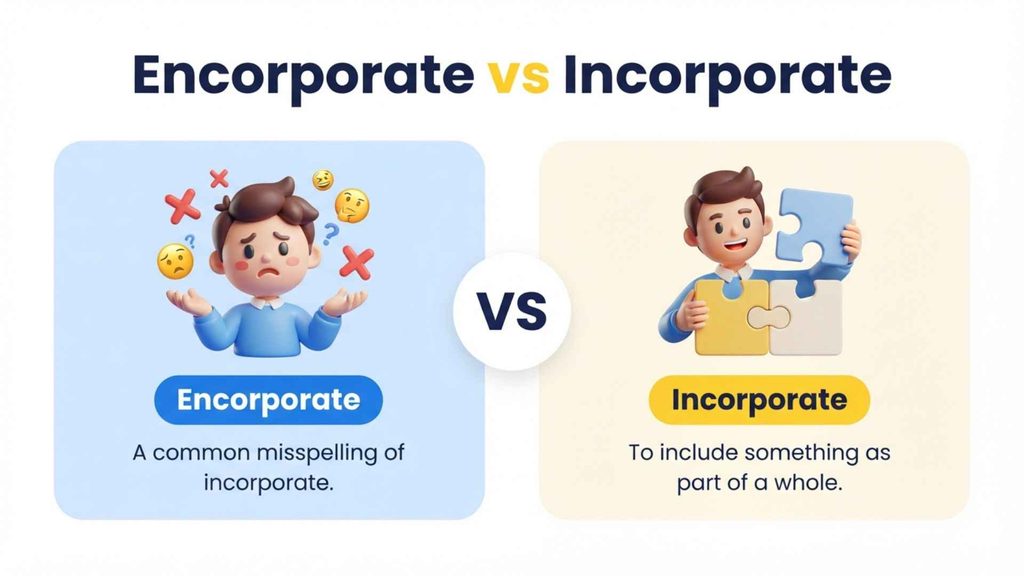
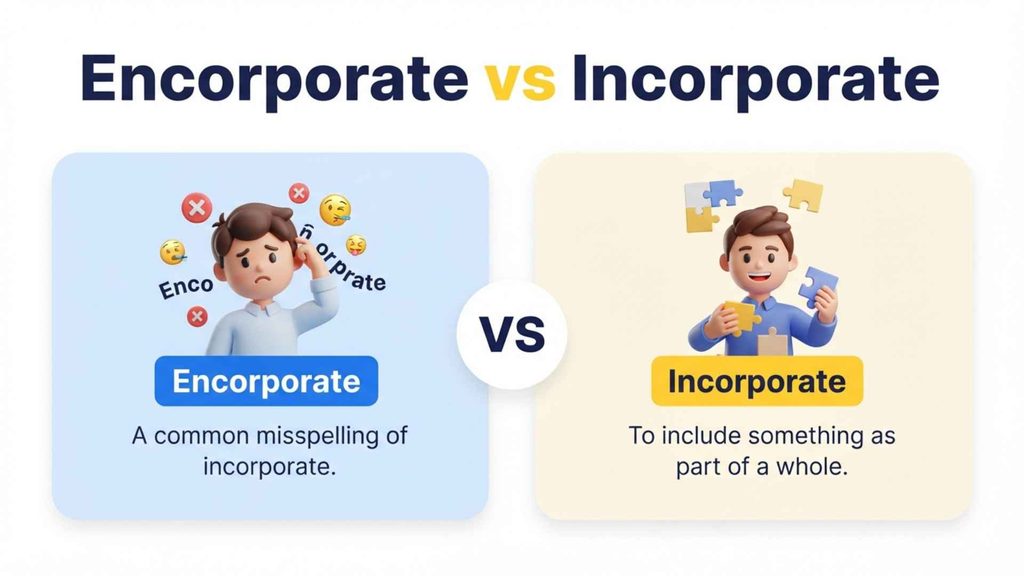
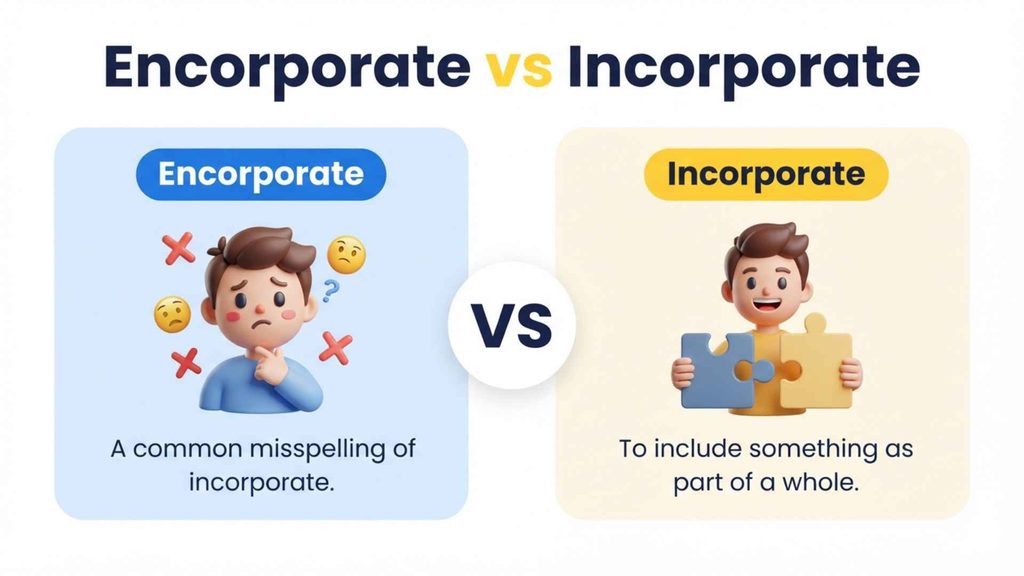
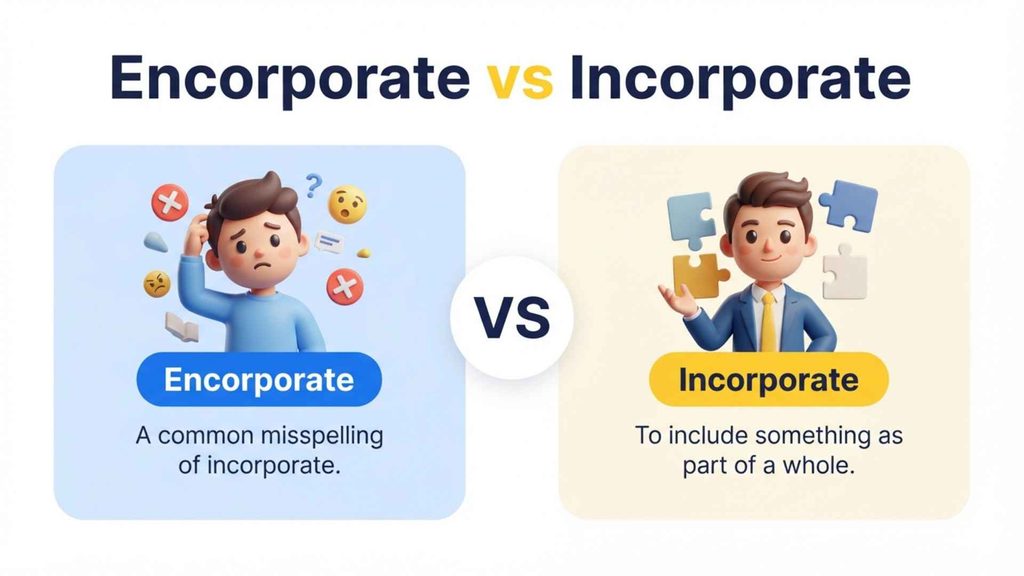
Incorporate is the correct and only recognized spelling. Encorporate is a common misspelling that has never been accepted by any major dictionary, style guide, or grammar authority.
Is “Encorporate” Ever Listed in Any Dictionary?
- Incorporate appears in every major dictionary, including Merriam-Webster and Oxford.
- Encorporate appears in zero recognized English dictionaries.
- The confusion usually comes from mixing up the prefixes en- and in-.
- Spellcheckers automatically flag encorporate as an error.
- Native speakers rarely make this mistake once they learn the root word corporate.
Example in texting: Friend 1: We need to incorporate your notes before the meeting. Friend 2: Got it, sending them now!
What Is the Difference Between Encorporate and Incorporate?
There isn’t really a “difference” in the way people assume, and that’s exactly what trips readers up. Incorporate is real; encorporate is simply an incorrect variation with no separate meaning of its own.
- Incorporate means to include something as part of a whole.
- Encorporate is not a recognized alternate spelling.
- The mix-up happens because en- and in- both sound similar.
- No dictionary treats incorporate vs encorporate as two valid options.
- Only incorporate should ever appear in formal or casual writing.
Why Do So Many People Search “Incorporate vs Encorporate”?
People search this comparison because spellcheck sometimes lags, autocorrect can misfire, and the words simply sound alike when spoken quickly in conversation.
Why the Correct Spelling Matters
A single misspelled word can shift how credible your writing feels, especially in resumes, business emails, and legal documents where precision matters most.
- Accuracy builds trust with readers and employers instantly.
- Misspellings can trigger automatic rejection in applicant tracking systems.
- Legal and business writing demands exact spelling for corporate terms.
- Search engines and readers both favor correctly spelled content.
- Getting incorporate right shows attention to detail in any field.
Example in chat: Friend 1: Did you fix that typo in the report? Friend 2: Yep, changed “encorporate” to incorporate already.
The Core Rule
Every confusing spelling has a rule hiding underneath it, and this one is refreshingly simple once you see the pattern clearly laid out.
- The prefix in- means “into” in Latin-based English words.
- Corporate comes from the Latin word corpus, meaning “body.”
- In- + corporate literally means “to bring into the body.”
- There is no valid en- version of this particular root word.
- Memorizing the in- prefix instantly fixes the spelling for good.
What Grammar Rule Explains the “In-” Spelling?
English prefixes like in-, im-, and ir- typically attach to Latin roots, and corporate is a Latin-based word, which is exactly why incorporate is correct.
| Prefix | Meaning | Example Word |
| in- | into | incorporate |
| en- | to cause to be | enable |
| im- | not / into | impossible |
| ir- | not | irregular |
What Does Incorporate Mean?
At its heart, incorporate is about bringing separate pieces together into one unified whole, whether that’s an idea, an ingredient, or an entire company.
- To combine something so it becomes part of a larger whole.
- To include an idea, detail, or feature within something bigger.
- To form a company into a legal corporation.
- To blend ingredients together until they’re fully mixed.
- To embody or represent a set of values or ideas.
Example in texting: Friend 1: Can you incorporate my edits into the doc? Friend 2: Already done, check it now.
Incorporate Meaning in Simple Words
If the dictionary definition feels a little stiff, here’s the plain-English version anyone can understand instantly, no grammar degree required.
- Incorporate simply means “add this in so it becomes part of the whole.”
- Think of it as merging something smaller into something larger.
- In business, it means officially registering a company as a corporation.
- In cooking, it means folding ingredients together evenly.
- In writing, it means weaving new information into existing content.
How Would You Explain Incorporate to a Beginner?
Picture a puzzle piece clicking into place that’s essentially what happens every time you incorporate something new into an existing system or idea.
Is Encorporate a Real Word?
No and this deserves a direct, no-nonsense answer because the internet is full of half-truths about obscure “alternate spellings” that simply don’t exist.
- Encorporate does not appear in Merriam-Webster, Oxford, or Cambridge.
- It is not a regional or British variant of the word.
- Style guides like AP and Chicago never list it as acceptable.
- Autocorrect tools consistently flag it as a misspelling.
- There is no historical or etymological basis for encorporate.
Example in chat: Friend 1: I always misspell it as “encorporate,” lol. Friend 2: Just remember it’s incorporate like “in the corporation.”
Why Does Incorporate Begin With “In”?
The prefix isn’t random; it’s rooted in centuries-old Latin word-building patterns that still shape modern English spelling today.
- In- comes from Latin, meaning “into” or “within.”
- Corpus is Latin for “body,” forming the root of corporate.
- Together, incorporate literally means “to form into one body.”
- This same pattern shows up in words like include and inject.
- Recognizing Latin roots helps you spell dozens of similar words correctly.
Are There Other English Words With This Same “In-” Pattern?
Yes words like inject, include, inhale, and infuse all follow the same Latin in- pattern, which makes incorporate far less of an outlier than it feels.
How to Pronounce Incorporate Correctly
Pronunciation confusion can also feed spelling mistakes, so getting the sound right often helps the spelling click into place naturally.
- As a verb, it’s pronounced in-KOR-puh-rayt.
- As an adjective, it’s pronounced in-KOR-puh-rit.
- The stress always falls on the second syllable.
- There is no soft “en” sound anywhere in the correct pronunciation.
- Saying it slowly out loud reinforces the correct incorporate spelling.
How to Use Incorporate Correctly
Once the spelling is locked in, using incorporate naturally in a sentence is straightforward, especially once you see it in a few real contexts.
- Use it when adding new information into an existing document.
- Use it when registering a business as an official corporation.
- Use it when blending ingredients in a recipe or mixture.
- Use it when merging feedback, ideas, or data into a plan.
- Avoid pairing it with the incorrect spelling encorporate anywhere.
Example in texting: Friend 1: We should incorporate customer feedback into the redesign. Friend 2: Agreed, I’ll add it to the next sprint.
Correct Examples of Incorporate
Seeing the word in full, natural sentences makes the correct usage stick far better than any rule on its own.
- “The company plans to incorporate in Delaware next month.”
- “She will incorporate the new data into her thesis.”
- “Chefs incorporate herbs slowly to balance the flavor.”
- “The team decided to incorporate remote work policies.”
- “He wants to incorporate more exercise into his routine.”
| Sentence Type | Example |
| Business | The startup will incorporate as an LLC. |
| Cooking | Gently incorporate the eggs into the batter. |
| Writing | Please incorporate these edits by Friday. |
| Lifestyle | Try to incorporate stretching into your morning. |
Incorrect vs. Correct Examples
Side-by-side comparisons make the mistake almost impossible to repeat once you’ve actually seen it corrected in context.
- ❌ “We need to encorporate this data.” → ✅ “We need to incorporate this data.”
- ❌ “The firm will encorporate next year.” → ✅ “The firm will incorporate next year.”
- ❌ “Please encorporate feedback.” → ✅ “Please incorporate feedback.”
- ❌ “Encorporated businesses” → ✅ “Incorporated businesses”
- ❌ “Encorporation papers” → ✅ “Incorporation papers”
Example in chat: Friend 1: Boss said “encorporate” in the email again. Friend 2: Yeah, it’s actually spelled incorporate happens a lot.
Common Mistakes Checklist
Before you hit send on that email or essay, run through this quick checklist to catch the mistake before anyone else does.
- Check for the prefix it should always be “in-,” not “en-.”
- Search the document for “encorporate” using find-and-replace.
- Read the sentence aloud to catch awkward phonetic spelling.
- Compare with the root word corporate to confirm accuracy.
- Trust spellcheck, but verify it manually for important documents.
- Bookmark a reliable dictionary for quick spelling checks.
What Does Incorporate Mean in Business Writing?
In professional and legal contexts, incorporate carries extra weight because it often refers to a formal, legally binding business action.
- It means officially forming a company as a separate legal entity.
- Incorporated businesses gain limited liability protection for owners.
- The term appears in articles of incorporation and legal filings.
- Business writing always uses the in- spelling, never encorporate.
- Investors and lawyers expect precise use of incorporate in contracts.
Incorporate in Real English
Outside of formal writing, incorporate shows up constantly in everyday conversation, news articles, and casual emails without anyone even noticing it.
- News articles incorporate quotes from multiple sources.
- Teachers incorporate games into lesson plans for engagement.
- Fitness coaches tell clients to incorporate rest days.
- Marketers incorporate keywords naturally into content.
- Friends casually say they’ll incorporate feedback into weekend plans.
Example in texting: Friend 1: I’m trying to incorporate more veggies into my meals. Friend 2: Same, it’s harder than it sounds.
Formal vs. Informal Usage
The word flexes easily between boardrooms and casual chats, which is part of why it’s so widely used across nearly every type of writing.
- Formal: “The board voted to incorporate the subsidiary.”
- Informal: “Let’s incorporate that idea into the plan.”
- Legal writing leans on incorporate for precision and clarity.
- Casual speech uses it loosely to mean “add” or “include.”
- Both contexts always use the same correct spelling: incorporate.
Encorporated vs Incorporated
The past-tense and adjective form follows the exact same spelling rule, so there’s no separate exception to memorize here at all.
- Incorporated is the only correct past-tense and adjective form.
- Encorporated is a misspelling with zero dictionary support.
- Company names often include “Incorporated,” abbreviated as “Inc.”
- Legal documents always use incorporated, never the incorrect variant.
- Autocorrect will flag encorporated the same way it flags encorporate.
| Form | Correct | Incorrect |
| Base verb | incorporate | encorporate |
| Past tense | incorporated | encorporated |
| Adjective | incorporated | encorporated |
| Noun | incorporation | encorporation |
Encorporation
Just like its verb form, this noun version is also consistently misspelled by the same small group of writers, so the fix here is identical.
- Incorporation is the correct noun form, meaning the act of forming a corporation.
- Encorporation does not exist in any recognized dictionary.
- Legal paperwork often references “articles of incorporation.”
- The noun follows the same in- prefix rule as the verb.
- Businesses file for incorporation with state or government agencies.
Example in chat: Friend 1: Working on the incorporation paperwork today. Friend 2: Let me know if you need help reviewing it.
Encorporate vs Incorporate Comparison Table
Sometimes a clean visual comparison settles the debate faster than paragraphs of explanation ever could.
| Feature | Incorporate | Encorporate |
| Dictionary status | Valid, recognized word | Not a real word |
| Prefix | in- (into) | en- (incorrect here) |
| Usage in business | Standard, legal term | Never used correctly |
| Spellcheck result | Accepted | Flagged as error |
| Recommended use | Always | Never |
Incorporate vs Include, Integrate, and Combine
These words often get grouped together, but each carries its own subtle shade of meaning worth understanding clearly.
- Include simply means to contain something as one part.
- Integrate implies blending two systems so they work as one.
- Combine means joining two or more things together generally.
- Incorporate leans toward absorbing something fully into a whole.
- All four words avoid the incorrect spelling pattern seen in encorporate.
How Is Incorporate Different From Integrate in Daily Use?
Integrate often describes systems or people blending smoothly together, while incorporate more often describes adding a specific element into something already established.
Synonyms for Incorporate You Can Use
Variety keeps writing fresh, and these alternatives work well whenever you want to avoid repeating the same word too many times.
- Include a simple, everyday alternative.
- Integrate best for systems or processes blending together.
- Merge ideal for combining two separate entities.
- Blend perfect for mixtures, flavors, or ingredients.
- Absorb useful when something is fully taken in.
- Embed great for technical or structural contexts.
How Do You Know If You’re Using Incorporate Correctly?
A quick self-check can save you from an embarrassing typo in an email, resume, or published article before it’s too late.
- Reread the sentence and check the prefix spelling.
- Replace it mentally with “include” if it fits, you’re likely correct.
- Search the word in a trusted dictionary before publishing.
- Ask a colleague or use grammar software for a second check.
- Practice writing the word until it becomes automatic muscle memory.
Memory Trick
A simple mental hook can lock this spelling into long-term memory faster than repeating the rule over and over again.
- Remember: “INcorporate” starts the same as “INside.”
- Think of bringing something INto the corporate body.
- Corp in the middle should remind you of “corporation.”
- There’s no “en” in “corporation,” so there’s no “en” in incorporate.
- Say it slowly: in-CORP-orate, emphasizing the middle syllable.
Example in texting: Friend 1: How do you remember the spelling? Friend 2: “IN” like “inside” incorporate, easy.
Real-Life Situations
Seeing the word show up across different scenarios helps cement just how often incorporate appears in daily and professional life.
- Filing paperwork to incorporate a small business.
- A teacher asking students to incorporate sources into an essay.
- A chef learning to incorporate butter into a sauce slowly.
- A manager asking a team to incorporate client feedback.
- A student trying to incorporate new vocabulary into writing.
| Scenario | Correct Usage |
| Legal | File to incorporate the company. |
| Academic | Incorporate citations properly. |
| Culinary | Incorporate the flour gradually. |
| Workplace | Incorporate the new policy. |
Incorporate in Academic and Professional Writing
Universities and workplaces both expect precise spelling, and incorporate is one of those words that quietly signals a polished, careful writer.
- Research papers incorporate evidence to support arguments.
- Cover letters incorporate relevant skills and experience.
- Reports incorporate data visualizations for clarity.
- Presentations incorporate feedback from earlier drafts.
- Professional emails incorporate action items from meetings.
Can Encorporate Ever Be Used Correctly?
Short answer: no, not in standard English, though it’s worth understanding exactly why this remains true across every context.
- Encorporate is never correct in formal writing.
- It is never correct in casual writing either.
- No regional dialect or historical spelling supports it.
- It is not a valid creative or stylistic choice.
- Every instance of encorporate should be replaced with incorporate.
Expert Tips
A few extra habits from experienced editors and writers can help this spelling and others like it stay locked in permanently.
- Read widely to absorb correct spelling patterns naturally.
- Use grammar tools as a backup, not a replacement for learning.
- Write the word by hand a few times to build memory.
- Teach it to someone else to reinforce your own understanding.
- Review important documents twice before sending or publishing.
Key Takeaways at a Glance
Before wrapping up, here’s a fast recap of everything that actually matters from this entire guide.
- Only incorporate is a real, dictionary-recognized word.
- Encorporate is a common but incorrect misspelling.
- The prefix in- means “into,” matching the Latin root corpus.
- Incorporate works in business, cooking, writing, and everyday speech.
- Simple memory tricks make the correct spelling permanent.
Frequently Asked Questions
Is it spelled incorporate or encorporate?
It is always spelled incorporate. Encorporate is a misspelling with no dictionary support anywhere.
What does incorporate mean in simple terms?
Incorporate means to include or blend something into a larger whole or system.
Why do people misspell incorporate as encorporate?
The prefixes en- and in- sound similar, which causes many writers to incorporate the wrong spelling by mistake.
Is encorporate a British spelling of incorporate?
No, encorporate is not a British, American, or regional variant of incorporate anywhere.
What is the noun form of incorporate?
The correct noun form is incorporation, describing the act of forming or including something formally.
Does spellcheck catch encorporate as an error?
Yes, most spellcheck tools automatically flag encorporate and suggest incorporate as the correction.
How can I remember to spell incorporate correctly?
Think “into the corporation” this trick makes the correct spelling of incorporate stick fast.
Conclusion
So, encorporate or incorporate? The answer was never really a toss-up incorporate is the only correct spelling, rooted firmly in the Latin prefix in- and the word corpus. Whether you’re filing legal paperwork, writing an essay, or texting a friend about weekend plans, incorporate is the word you want every single time.
Understanding the small but important difference in incorporate vs encorporate doesn’t just fix a spelling error it sharpens how careful and credible your writing feels to anyone reading it. Keep the memory trick close, reread your work once more, and let incorporate become second nature in everything you write from here on out.

Amelia Brooks is a US-based author known for inspiring stories on meaning, growth, and hope, blending insight with simple, engaging storytelling.