
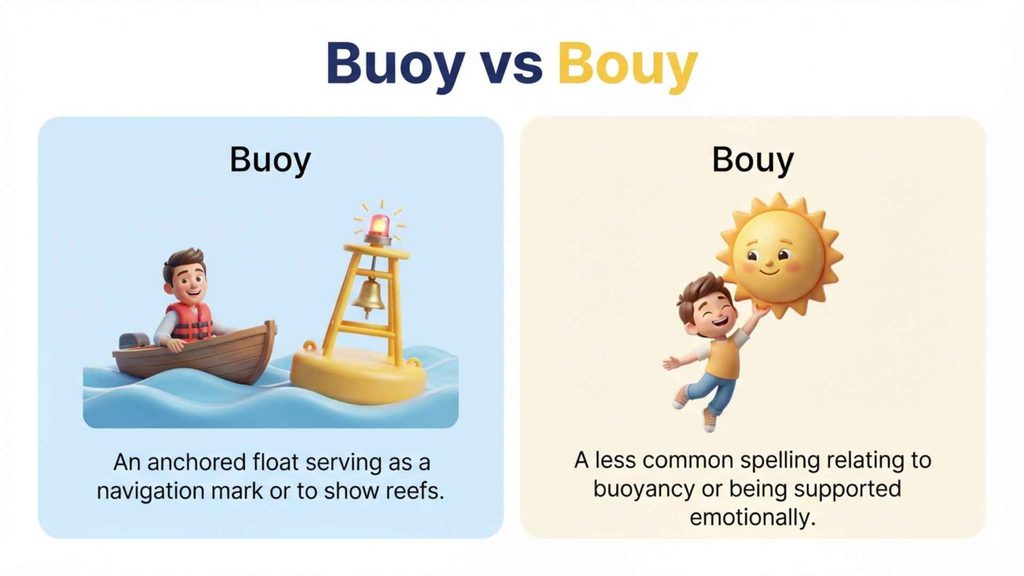
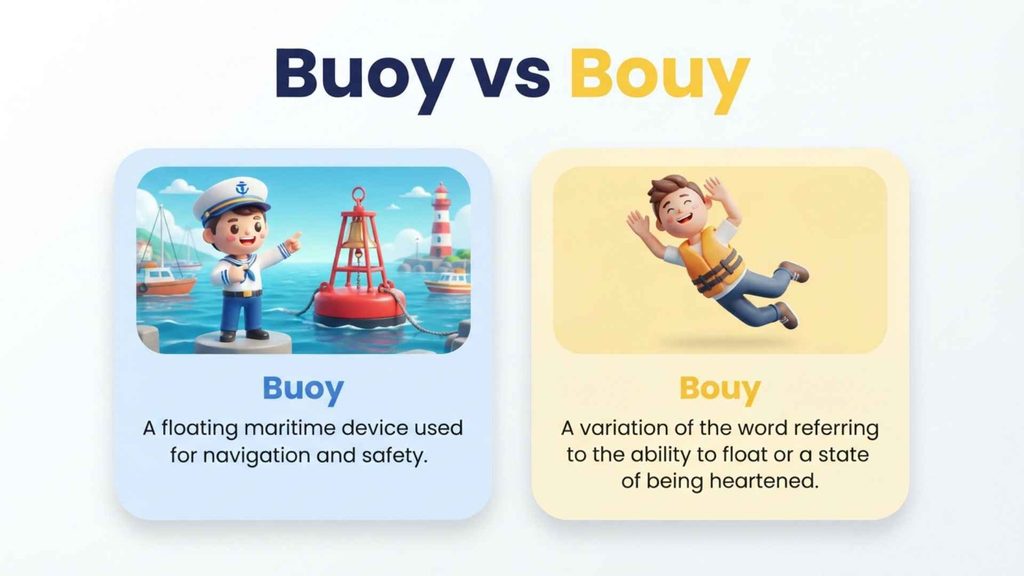
You typed it, stared at it, and something felt off. That’s the moment almost everyone hits with buoy or bouy the cursor blinking, the red squiggly line refusing to budge, and a nagging feeling that English just doesn’t want to make sense today.
Here’s the good news: this article settles the confusion for good. You’ll get the real meaning behind buoy or bouy, the history of why the spelling looks so strange, and simple tricks to lock in the correct form forever. No jargon, no guesswork just a clear answer you can trust. Keep reading, and you’ll never hesitate over this word again.
Buoy
Buoy is the only correct spelling. It names a floating marker anchored in water, and it also works as a verb meaning to keep something afloat literally or emotionally. You’ll spot it in maritime charts, news headlines about markets, and everyday pep talks about staying hopeful.
- Noun use: a floating navigational or safety device
- Verb use: to buoy someone’s mood or keep an object afloat
- Pronunciation: varies between American and British English
- Root: traced to Middle Dutch and Old French influence
- Never misspelled in any recognized dictionary entry
Example in chat: Friend 1: did you see the orange buoy near the dock? Friend 2: yeah, marks the swimming zone
Bouy
Bouy is not a word it’s simply a common misspelling of buoy. No dictionary, style guide, or regional variant recognizes it. It shows up because the pronunciation of the real word doesn’t visually match its letters, so people guess and land on the wrong order.
- Not listed in Merriam-Webster, Oxford, or Cambridge
- No etymology it has no independent linguistic history
- Spell-check flag most editors will underline it instantly
- Common in casual typing, rare in edited publications
- Always correctable to buoy with zero exceptions
Example in texting: Friend 1: is it spelled bouy or buoy lol Friend 2: buoy! bouy isn’t even real
Buoy or Bouy – Quick Answer
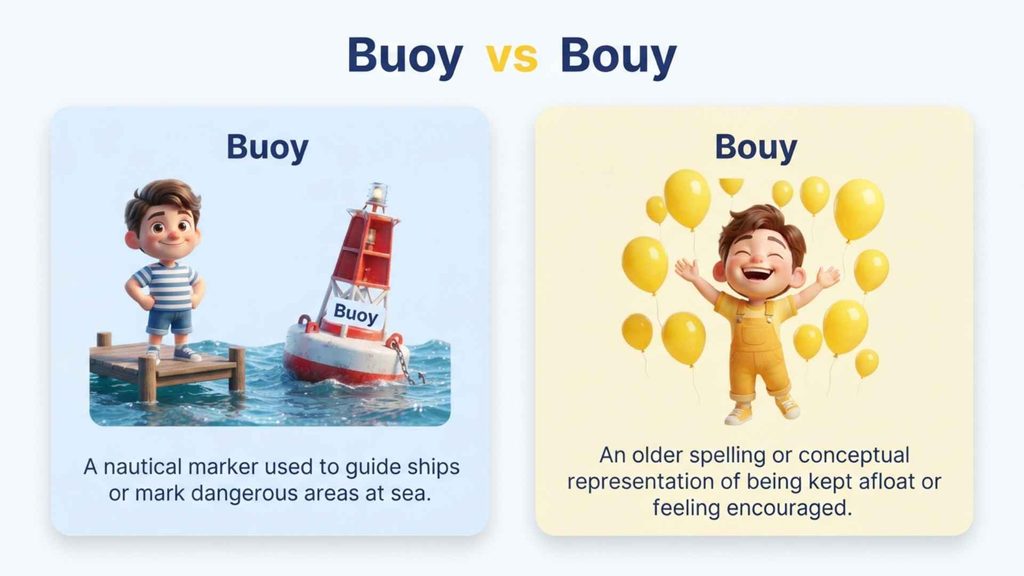
Short on time? Here’s the one-line answer: always write buoy, never bouy. There’s no gray area, no accepted alternate spelling, and no situation formal or casual where the second version passes as correct English.
Is “Buoy” or “Bouy” Ever Interchangeable?
- Correct spelling: buoy, in every English-speaking region
- Incorrect spelling: bouy, with zero legitimate exceptions
- Dictionaries agree across American, British, and international editions
- Search engines auto-correct “bouy” queries toward “buoy” results
- Professional writing treats “bouy” as a clear error
Simple Examples
- ✅ The rescue crew anchored a buoy near the reef.
- ✅ Good news can buoy a tired team’s spirits.
- ❌ The sailors spotted a “bouy” in the fog wrong.
- ✅ Bright buoys marked the safe swimming area.
- ❌ Investors were “bouyed” by the report should be buoyed.
Quick Comparison
| Word | Correct? | Meaning |
| Buoy | ✅ Yes | Floating marker; to keep afloat or lift spirits |
| Bouy | ❌ No | Misspelling with no dictionary standing |
What Does “Buoy” Mean?
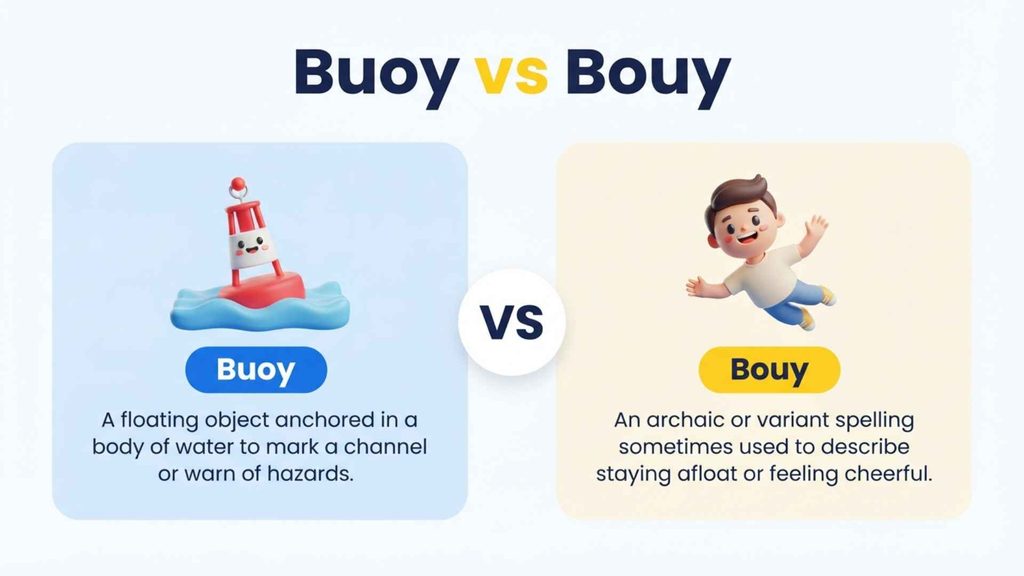
Curious what this five-letter word actually covers? It carries more range than most people expect, working as both a physical object and a feeling. Buoy and its close relative bouy (the wrong version) both point back to one true meaning.
- Noun: a floating device anchored to the seabed or shore
- Marks hazards, channels, moorings, and safe zones
- Verb: to buoy up a mood, market, or morale
- Figurative use: encouragement that lifts someone emotionally
- Related word: buoyancy, the ability of an object to float
- Common collocations: “buoyed by,” “life buoy,” “marker buoy”
How Is “Buoy” Used in Everyday Conversations?
People reach for buoy far beyond the harbor. A headline might say sales figures were “buoyed” by holiday demand, or a friend might say a compliment “buoyed” their whole week.
| Context | Example Sentence |
| Nautical | The channel buoy guided the ferry safely to port. |
| Financial | Strong earnings buoyed the stock price. |
| Emotional | Her kind words buoyed him after a rough day. |
Example in texting: Friend 1: that promo email really buoyed our sign-ups this week Friend 2: love that, way better than last month
Is “Bouy” a Real Word?
No and this deserves a firm answer because so many writers assume it might be a lesser-known variant. It isn’t. Bouy has never appeared as a standard entry, and treating it as a stylistic choice will only confuse readers or damage your credibility.
- Zero dictionary listings, historical or current
- No accepted regional dialect uses this spelling
- Autocorrect and spell-checkers flag it automatically
- Search results for “bouy” redirect toward buoy definitions
- Professional editors always correct it without exception
Example in chat: Friend 1: my teacher marked “bouy” wrong on my essay Friend 2: yeah that’s not a real word, it’s buoy
The Origin of Buoy
Ever wonder why this word looks so unusual? Its roots explain everything. Buoy traces back through Middle Dutch and Old French, carrying centuries of maritime history into modern English while bouy never existed at any point along that timeline.
- Middle Dutch root: boeie or boye, meaning “shackle” or “fetter”
- Entered Middle English around the 14th century
- Latin influence: boia, meaning chain, reinforcing the tethered concept
- Original meaning: a marker tied down yet floating on the surface
- Figurative expansion: by the 17th century, “buoy someone’s spirits” appeared in literature
Where Did the Word Buoy Come From Originally?
The nautical sense came first, describing a floating anchor point for guiding ships. Writers later borrowed the image something tethered but rising to describe hope, confidence, and resilience.
Why Do People Misspell Buoy as Bouy?
If you’ve typed “bouy” without thinking twice, you’re in good company. This mix-up happens constantly, and it comes down to one simple mismatch: the way buoy sounds doesn’t match the way it’s spelled, so the brain fills in the gap with bouy instead.
- Sound-first spelling: writers spell what they hear, not what’s written
- Two pronunciations: American BOO-ee versus British BOY add confusion
- Analogy with “boy” tricks British speakers especially
- Autocomplete slips happen when typing quickly on mobile
- Low exposure: most people rarely write this word, so it never sticks
Why Does Buoy Get Misspelled So Often?
Because the u-before-o letter order feels backward compared to how the word sounds out loud, even fluent writers second-guess themselves every time they reach for it.
Example in texting: Friend 1: i always second guess if it’s buoy or bouy Friend 2: same, i just think “buoyant” and copy the spelling
British English vs American English Spelling (Buoy vs Bouy)
Thought regional English might change the spelling here? It doesn’t. Buoy stays identical in both British and American writing the only real difference between them is how the word sounds out loud, not how it’s spelled on the page.
- Spelling stays fixed: buoy, everywhere English is written
- American pronunciation: BOO-ee, two distinct syllables
- British pronunciation: BOY, a single syllable
- No dialect legitimizes the bouy spelling
- Formal style guides in both regions require buoy
Is There Any Difference?
No meaningful spelling difference exists between British and American English for this word pronunciation is the only variable that changes across the Atlantic.
Comparison Table
| Feature | British English | American English |
| Spelling | buoy | buoy |
| Pronunciation | BOY | BOO-ee |
| “Bouy” accepted? | Never | Never |
| Figurative use | Yes | Yes |
Which Spelling Should You Use?
There’s really only one safe choice on the page, no matter your audience or region. Choosing correctly protects your credibility, whether you’re writing a text message, a business email, or a technical maritime report.
Use “Buoy” When:
- Describing a floating water marker or safety device
- Writing the verb form: to buoy up, to buoy someone’s spirits
- Composing professional, academic, or casual content of any kind
- Referring to anything that stays afloat, physically or figuratively
- Following dictionary and style-guide standards without deviation
Never Use “Bouy”
- No context makes this spelling acceptable
- Spell-check tools will flag it immediately
- Editors and teachers will always correct it
- Search engines treat it as a typo, not a variant
- Double-checking nautical vocabulary before publishing prevents slip-ups
Buoy as a Noun and Verb
One word, two jobs. Understanding both roles of buoy makes it far easier to use naturally in writing, whether you’re describing a harbor scene or a rebound in confidence.
Buoy (Noun)
A buoy, as a noun, is a physical floating object typically brightly colored and anchored used to guide, warn, or support boaters and swimmers on the water.
- Marks channels and safe navigation routes
- Signals hazards like rocks or shallow water
- Serves as a mooring point for docking boats
- Comes in specific colors with standardized meanings
- Used in safety equipment, like life buoys on ships
| Buoy Type | Purpose |
| Life buoy | Emergency flotation for rescue |
| Mooring buoy | Ties up a vessel |
| Fairway buoy | Marks the center of a channel |
| Danger buoy | Warns of underwater hazards |
Example in chat: Friend 1: the red buoy means stay to the right, right? Friend 2: yep, red right returning
Buoy (Verb)
As a verb, to buoy or buoy up means to keep something afloat physically, or to lift someone’s mood, confidence, or energy in a figurative sense.
- Financial contexts: strong data can buoy investor confidence
- Emotional contexts: kind words buoy someone through a hard week
- Physical contexts: a life jacket buoys a swimmer in open water
- Past tense: buoyed, never “bouyed”
- Common pairing: “buoyed by,” describing the cause of the lift
Example in texting: Friend 1: the team’s win really buoyed morale this week Friend 2: honestly needed that after such a rough month
Common Expressions Using Buoy
| Expression | Meaning |
| Buoy up | To raise spirits; to lift emotionally |
| Buoyed by | Encouraged or supported by something |
| Life buoy | A ring-shaped flotation device for emergencies |
| Marker buoy | Identifies a specific location in water |
| Mooring buoy | Used to tie up a vessel |
Pronunciation of Buoy: Why It Confuses People
This is genuinely one of the strangest five-letter words to say out loud. Buoy and its incorrect twin bouy both trip people up because the spoken form barely resembles the written one.
- American English: BOO-ee, with the “u” leading both in sound and spelling
- British English: BOY, collapsing to a single syllable
- No universal phonetic clue links the letters to either pronunciation
- Regional confusion leads British speakers to associate it with “boy”
- Best strategy: memorize the spelling separately from how you say it
How Do You Actually Pronounce Buoy Correctly?
Say BOO-ee in American contexts and BOY in British ones both are accepted, and neither pronunciation should ever change how the word is spelled.
Example in chat: Friend 1: wait it’s pronounced boy in the uk?? Friend 2: yep, one syllable, weirdly
Common Mistakes with Buoy or Bouy
Even confident writers slip on this word. Knowing the exact traps ahead of time makes it far easier to avoid them the next time buoy shows up in your writing.
- Spelling by ear instead of checking the dictionary
- Assuming regional variation exists when it doesn’t
- Mixing up past-tense forms, like “bouyed” instead of buoyed
- Confusing buoy with boy based on British pronunciation
- Skipping spell-check on nautical or financial writing
Mistake 1: Spelling by Sound
Writers hear BOO-ee or BOY and guess at the letters, often landing on “bouy” or “bouey.” Trusting the dictionary form over your ear avoids this entirely.
Mistake 2: Assuming “Bouy” Is an Alternative Spelling
Some assume that because pronunciation shifts by region, spelling must too. It doesn’t both British and American English rely on the same fixed form, buoy.
Mistake 3: Using Incorrect Past Tense Forms
The past tense is buoyed, not “bouyed” or “buoyd.” This applies to both the literal and figurative senses of the verb.
- ✅ The news buoyed his confidence.
- ❌ The news “bouyed” his confidence.
Mistake 4: Mixing Up Buoy with Boy
British pronunciation makes buoy sound just like boy, but they’re unrelated words. A boy is a male child; a buoy is a floating marker or a verb about lifting spirits. Context, not sound, should guide your spelling.
Buoy or Bouy in Everyday Examples
Seeing the word in real-world settings helps the correct spelling stick. Across emails, headlines, and casual posts, buoy shows up constantly while bouy never should.
Emails
“Please confirm the location of the warning buoy before tomorrow’s inspection.”
News
“Markets were buoyed by stronger-than-expected employment figures released Friday.”
Social Media
“Nothing like spotting a yellow buoy on your morning paddle calm water, clear skies.”
Formal Writing
“The navigational buoy installed at the harbor entrance was replaced after storm damage.”
Maritime Communication
“All vessels: red channel buoy at the north marker is temporarily out of service.”
Example in DM style: Friend 1: check the email, ops team flagged a buoy issue near the dock Friend 2: on it, pulling up the report now
Buoy in Common Phrases and Maritime Terms
Sailors and everyday writers both lean on a small set of go-to phrases built around buoy. Learning these makes the word feel far less intimidating and much easier to use correctly.
- Buoy tender a vessel that services and maintains navigational buoys
- Buoyed up emotionally lifted; feeling more confident or hopeful
- Fairway buoy marks the center of a navigable channel
- Danger buoy warns mariners of underwater hazards
- Sound buoy equipped with a bell or horn for foggy conditions
- Buoyancy the related noun describing an object’s ability to float
Buoy or Bouy – Google Trends & Usage Data
Search behavior tells its own story here. Searches for buoy consistently outnumber searches for bouy, and most people typing the second version are actually trying to confirm the correct spelling.
- Correction-driven searches: most “bouy” queries seek the right spelling
- Published usage: near-zero appearances of “bouy” across two centuries of text
- Consistent presence: “buoy” appears steadily in literature, journalism, and technical writing
- Search engines auto-suggest “buoy” when “bouy” is typed
- Trend stability: interest in the correct spelling has held steady for years
Comparison Table: Buoy vs Bouy
| Feature | Buoy | Bouy |
| Correct spelling | ✅ Yes | ❌ No |
| Found in dictionary | ✅ Yes | ❌ No |
| Used as noun | ✅ Yes | ❌ No |
| Used as verb | ✅ Yes | ❌ No |
| British English | ✅ Accepted | ❌ Never |
| American English | ✅ Accepted | ❌ Never |
| Published usage | ✅ Extensive | ❌ None |
How to Remember the Correct Spelling
A few memory tricks can permanently fix buoy in your mind, so you stop second-guessing yourself every time you write it.
- Letter order: B-U-O-Y the “u” always comes before the “o”
- Mnemonic: “Boats Use Orange Yellow” buoys first letters spell BUOY
- Root connection: buoyant and buoyancy share the same B-U-O-Y sequence
- Spell-check habit: run a check on anything with nautical vocabulary
- Visual repetition: write the word a few times until the pattern sticks
What’s the Easiest Way to Never Misspell Buoy Again?
Anchor the word to “buoyant” if you can spell that confidently, you already know the exact letter sequence buoy relies on.
Buoy vs Similar Confusing Words
Buoy isn’t the only word that trips people up. Comparing it against its closest look-alikes and sound-alikes makes the distinctions far easier to remember for good.
Buoy vs Boy
These words sound identical in British English but mean completely different things. Boy (B-O-Y) refers to a male child. Buoy (B-U-O-Y) is the nautical marker or the verb meaning to uplift. The extra “u” is the entire difference.
Buoyant vs Buoy
Buoyant is the adjective form built from buoy. It describes something able to float, or a person who’s cheerful and resilient. Both words share the same root: a person feeling buoyant has effectively been buoyed up.
Buoy vs Beacon
Both are navigational aids, but they work differently. A buoy floats on water and is anchored in place. A beacon is a fixed signal light or transmitter, often on land. Figuratively, a beacon suggests guidance; a buoy suggests support and staying afloat.
Is a Buoy the Same as a Float?
Not quite and this distinction trips up plenty of writers searching for the right term. A buoy is a fixed, anchored marker, while a float is often a loose, unanchored object.
- Buoy: anchored to the seabed, stays in one location
- Float: may drift freely, not always tethered
- Shared purpose: both help objects or people stay above water
- Different contexts: buoys are official markers; floats are often recreational
- Overlap: some swim floats are informally called buoys
Can “Buoy” Be Used as a Business or Finance Term?
Absolutely, and this usage shows up constantly in headlines. Financial writers rely on buoy to describe anything that lifts performance, confidence, or momentum without turning to dry, technical language.
- Stock markets: good earnings can buoy share prices
- Consumer confidence: positive news can buoy spending habits
- Employment reports: strong hiring numbers buoy economic optimism
- Currency values: rate changes can buoy or weaken a currency
- Investor sentiment: reassurance from leadership can buoy market trust
How Do Native Speakers Actually Use Buoy in Speech?
Native speakers rarely overthink it the word slips naturally into casual and professional talk alike, almost always tied to floating, support, or encouragement.
- Casual chats: “that news really buoyed me up today”
- Workplace talk: “let’s buoy team morale before the deadline”
- Sports commentary: “the win buoyed the whole squad’s confidence”
- Weather and travel: “watch for the channel buoy near the marina”
- Everyday encouragement: “your support really buoyed me through it”
Frequently Asked Questions
Is “bouy” ever correct?
No. “Bouy” is never correct in any dialect or style guide. It’s simply a misspelling of buoy and should always be corrected.
How do you pronounce buoy?
American English says BOO-ee, two syllables. British English says BOY, one syllable. Either way, the spelling of buoy stays the same.
What is the plural of buoy?
The plural is buoys just add an “s.” Example: “The harbor uses several colorful buoys to guide boats.”
Can buoy be used as a verb?
Yes. To buoy or buoy up means to keep afloat or lift someone’s mood, as in “the win buoyed everyone’s spirits.”
What is the past tense of buoy?
The past tense is buoyed, never “bouyed.” Example: “Falling rates buoyed the housing market this quarter.”
What is the difference between a buoy and a beacon?
A buoy floats on water to mark hazards or channels. A beacon is typically a fixed light or signal, often on land, guiding navigation from a stationary point.
Why does buoy look like it should be spelled differently?
Because English spelling and pronunciation often diverge. Buoy entered English through Dutch and Old French, and it kept its original letter order instead of adapting to how it sounds.
Conclusion
The debate over buoy or bouy really has one simple resolution: buoy is correct, always, everywhere. Bouy has no dictionary entry, no regional exception, and no place in careful writing, whether you’re describing a floating marker or a boost in confidence. Understanding the meaning, origin, and pronunciation of buoy removes the guesswork for good, and knowing why bouy keeps sneaking into first drafts helps you catch it before it ever gets published.
Next time you’re unsure, picture the letters B-U-O-Y in order, lean on the buoyant connection, and let your spell-checker back you up. Get this one word right, and you’ll never hesitate over buoy or bouy again just confident, correct writing every time.

Amelia Brooks is a US-based author known for inspiring stories on meaning, growth, and hope, blending insight with simple, engaging storytelling.