
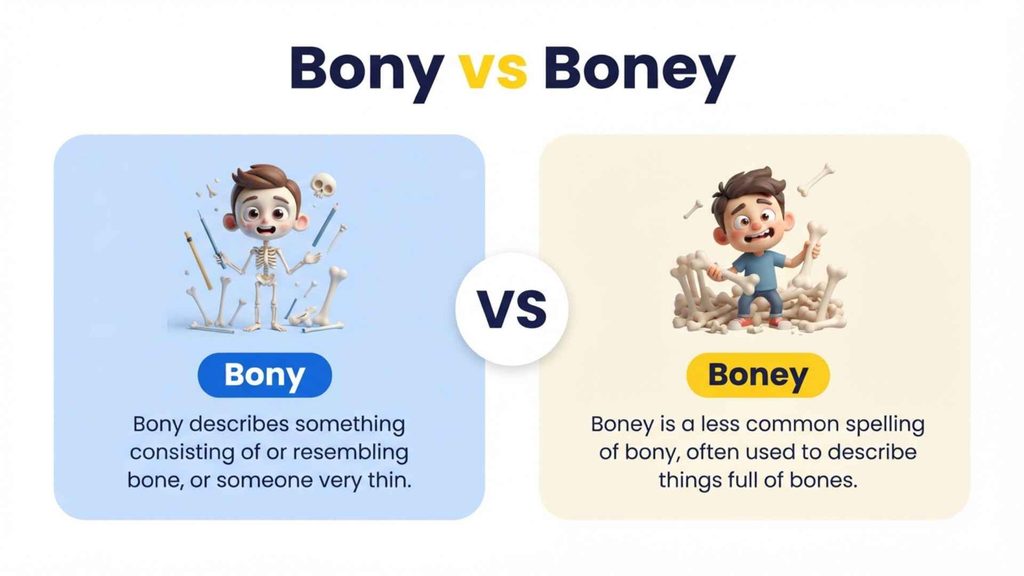
You’re mid-sentence and freeze: is it bony or boney? That tiny spelling doubt can make anyone second-guess a word they’ve used for years. It matters because spelling signals care in emails, essays, and posts.
This guide covers the meaning, pronunciation, and correct use of both spellings, with real examples, tables, and memory tricks. Whether you searched bony or boney or just want to understand boney better, you’ll leave confident. Keep reading and settle it for good.
Boney meaning
Ever seen boney in a text and wondered if it’s a typo? It isn’t quite, and this section explains why bony or boney causes so much confusion.
What Is the Meaning of Boney in Simple Words?
- Alternative spelling of bony, meaning having prominent bones.
- Dictionaries label it an alternative spelling of bony. babelfree
- Describes thin people, animals, or things that look bone-like.
- Carries the same meaning as bony in every sense.
- Appears mostly in casual writing, fiction, and names.
Example in texting:
Friend 1: Your cat looks so boney lately.
Friend 2: Vet says she’s fine, just a lean build.
Bony meaning
Think of a child’s scraped knee or a fish dinner gone wrong. Both involve bony things, and knowing the meaning helps you choose between bony or boney with confidence.
What Does Bony Mean in English?
- Made of bone, such as a bony skull or bony plate.
- Full of bones, like a bony piece of fish.
- Having prominent bones, as in a bony face or shoulders.
- Resembling bone in hardness or texture.
- Suggests thinness when describing a person or animal.
Example in chat:
Friend 1: This trout is super bony.
Friend 2: Ugh, pass me the fish knife.
What does boney mean
Searching “what does boney mean” usually means you spotted it somewhere and wanted a quick answer. Here it is, so the bony or boney question stops nagging you.
What Does the Word Boney Actually Mean?
- Same sense as bony: having visible or prominent bones.
- Can describe a very thin person or animal.
- Can mean full of bones, like a fish.
- Works as an adjective, never a noun or verb.
- Treated as a variant, not a different word.
Example in texting:
Friend 1: What does boney mean in that caption?
Friend 2: Same as bony, just spelled differently.
Quick Definition
Short on time? Here’s the fastest summary of bony or boney: one meaning, two spellings, and boney as the less common variant most editors correct.
What Is the Quick Definition of Bony or Boney?
- Adjective: having, resembling, or made of bone.
- Bony is the standard, preferred spelling.
- Boney is a less common variant spelling.
- Both share one pronunciation and one meaning.
- Choose bony unless a name requires otherwise.
Example in chat:
Friend 1: Quick definition of bony?
Friend 2: Thin, or full of bones. Boney works too, but bony is safer.
Quick Answer
Want the verdict right now? Use bony. It’s the form dictionaries list first, while boney shows up as a variant in bony or boney debates.
Which Spelling Should You Use Right Now?
- Default to bony in school, work, and publishing.
- Merriam-Webster lists boney as the less common variant. merriam-webster
- Accept boney only in names or quoted material.
- Avoid switching spellings within one document.
- Check your style guide if it specifies otherwise.
Example in texting:
Friend 1: Bony or boney for my essay?
Friend 2: Bony. Done.
Comparison Table
Tables make a spelling choice stick. Here’s a clean side-by-side of bony or boney, so you can see how little separates boney from its standard twin.
How Do Bony and Boney Compare Side by Side?
| Feature | Bony | Boney |
| Status | Standard spelling | Variant spelling |
| Meaning | Having prominent bones | Same meaning |
| Part of speech | Adjective | Adjective |
| Pronunciation | /ˈboʊni/ | /ˈboʊni/ |
| Formal writing | Recommended | Avoid |
| Names | Rare | Common (Boney M, Boney James) |
- Spelling is the only real difference.
- Meaning stays identical in both forms.
- Frequency favors bony overwhelmingly.
- Tone doesn’t change with spelling.
- Safety lies with bony in formal text.
Example in chat:
Friend 1: Is there any difference besides spelling?
Friend 2: Nope. Just pick bony.
Meaning Of Both Words
Two spellings, one idea. The meaning of bony or boney centers on bones, whether made of them, full of them, or sticking out like them.
What Is the Shared Meaning of Bony and Boney?
- Composed of bone, as in bony tissue.
- Resembling bone in feel or look.
- Packed with bones, like some fish.
- Showing bones through skin, suggesting thinness.
- Used literally or figuratively, depending on context.
Example in texting:
Friend 1: Why did the doc say “bony growth”?
Friend 2: It means a growth made of bone.
What Does Bony Mean
Let’s zoom in on the standard form. Understanding what bony means makes the boney variant easy to spot, and the bony or boney choice becomes automatic.
What Does Bony Mean in Everyday Use?
- Thin and angular, like bony elbows.
- Rigid, like a bony ridge on a skull.
- Awkward to eat, like a bony fish.
- Medical, referring to bony structures in the body.
- Descriptive, rarely a compliment when aimed at people.
Example in chat:
Friend 1: He has such bony hands.
Friend 2: Pianist hands, honestly.
What Does Boney Mean
If you’ve seen boney online, it means exactly what its standard twin does. The bony or boney question is about spelling, never about a hidden second sense.
Does Boney Mean Something Different From Bony?
- No difference in dictionary meaning exists.
- Thin or bone-filled are the main senses.
- Common in informal posts and fiction.
- Appears in nicknames and band names.
- Won’t confuse readers, but may look careless.
Example in texting:
Friend 1: Boney knees, boney elbows, same thing?
Friend 2: Same thing. Just spell it bony.
Key Differences
The gap between bony or boney is tiny but real. Think of boney as the casual cousin and bony as the one who wears a suit.
What Are the Key Differences Between Bony and Boney?
| Aspect | Bony | Boney |
| Dictionary headword | Yes | Variant listing |
| Formal acceptance | High | Low |
| Meaning | Identical | Identical |
| Typical use | Everywhere | Casual, names |
- Preference goes to bony in publishing.
- Editors often change boney automatically.
- Pronunciation never differs.
- Search results show bony far more often.
- Names like Boney M keep the variant alive.
Example in chat:
Friend 1: Spot the difference?
Friend 2: Only the e. Pick bony.
Which One Is Correct
Both are understood, but only one is preferred. In the bony or boney contest, bony wins for correctness, and boney earns “acceptable variant” at best.
Is Bony or Boney the Correct Spelling?
| Context | Best Choice |
| School essay | Bony |
| Business email | Bony |
| Fiction (stylized) | Either |
| Proper names | As written |
- Bony is correct in standard English.
- Vocabulary.com lists boney as a synonym of bony. vocabulary
- Boney is correct only as a variant.
- Consistency matters more than the variant choice.
- Names keep their original spelling.
Example in texting:
Friend 1: Final answer, bony or boney?
Friend 2: Bony. Always bony.
Pronunciation Guide
Good news: no tricky sounds here. Whether you write bony or boney, you say it the same way, with boney sounding identical.
How Do You Pronounce Bony and Boney?
- Say “BOH-nee,” with stress on the first syllable.
- Rhymes with “phony” and “pony.”
- Spelling never changes the sound.
- Practice by saying it aloud twice.
- Record yourself to check clarity.
Example in chat:
Friend 1: Is it “bah-nee”?
Friend 2: No, BOH-nee, like phony.
IPA Pronunciation
Phonetics fans, this one’s for you. The IPA transcription proves that bony or boney are spoken identically, so boney is purely a spelling matter.
What Is the IPA for Bony and Boney?
| Accent | IPA |
| US English | /ˈboʊni/ |
| UK English | /ˈbəʊni/ |
- Pronunciation references give the US form as /ˈboʊni/. pronounce
- UK speakers use a slightly rounder “oh” sound.
- Stress falls on the first syllable.
- Both spellings share identical IPA.
- Dictionaries list one entry for both.
Example in texting:
Friend 1: Why does the UK IPA look different?
Friend 2: Just a different “oh” vowel.
Syllable Breakdown
Counting syllables helps with spelling and poetry. For bony or boney, the count stays the same, and boney splits just like its standard sibling.
How Many Syllables Are in Bony and Boney?
- Two syllables: bo-ny or bo-ney.
- First syllable carries the stress.
- Long O sound opens the word.
- Final syllable is a light “ee.”
- Poets treat it as a trochee (strong-weak).
Example in chat:
Friend 1: Syllables in boney?
Friend 2: Two. BO-ney.
Common Pronunciation Mistakes
Even simple words trip people up. A few slips happen with bony or boney, and none depend on whether you spell it with boney or not.
What Are Common Mistakes When Saying Bony?
- Short O (“bonny”) changes it into another word.
- Stressing the second syllable sounds unnatural.
- Rhyming with “honey” is a frequent error.
- Dropping the final vowel makes it “bone.”
- Mixing up with “Bonnie,” the name.
Example in texting:
Friend 1: I said “bonny” and everyone laughed.
Friend 2: It’s BOH-nee, like pony.
How To Remember The Correct Spelling
Memory tricks beat memorizing rules. For bony or boney, one simple link to the word “bone” keeps you on track and boney out of formal writing.
What Is the Easiest Trick to Remember Bony?
- Drop the e from bone, then add y.
- Picture bone losing its tail letter.
- Chant “bone minus e plus y.”
- Compare with stony, not “stoney.”
- Write it ten times to lock it in.
Example in chat:
Friend 1: How do I never forget it?
Friend 2: Bone loses the e. Bony.
Examples In Sentences
Seeing words in action beats definitions. These examples show bony or boney doing real work, with boney appearing as the spelling variant.
How Do You Use Bony and Boney in Sentences?
- Place the adjective before a noun: “bony fingers.”
- Use it after “is”: “The fish is bony.”
- Pair with body parts for clarity.
- Add degree words: “very bony,” “slightly bony.”
- Keep the same spelling within a text.
Example in texting:
Friend 1: Her hands were bony and cold.
Friend 2: Gloves needed, clearly.
Examples Using Bony
Here’s the standard spelling in context. Each use of bony below also shows why bony or boney rarely needs a long debate, and why boney stays secondary.
What Are Good Example Sentences Using Bony?
- “His bony shoulders” poked through the thin shirt.
- “The bony fish” had to be carefully filleted.
- “A bony ridge” ran above the skull’s eyes.
- “The bony old horse” limped across the field.
- “Her bony knees” showed beneath the torn jeans.
Example in chat:
Friend 1: Describe the stray dog.
Friend 2: Bony, scruffy, and incredibly sweet.
Examples Using Boney
Now the variant. These sentences show boney appearing in casual writing, though the bony or boney rule still says choose the standard form for formal work.
What Are Example Sentences Using Boney?
- “Boney fingers” drummed on the table.
- “A boney fish” ruined the otherwise good meal.
- “Boney, scrapey sounds” came from the dark room.
- “A boney frame” hung inside his oversized coat.
- “Boney elbows” dug into my side on the bus.
Example in texting:
Friend 1: Wrote “boney elbows” in my story.
Friend 2: Fine for fiction, but bony is cleaner.
Common Mistakes
Small errors can hide in plain sight. When writing bony or boney, a handful of habits cause most slips, especially around the boney variant.
What Are the Most Common Bony or Boney Mistakes?
- Treating boney as a separate word.
- Using boney in formal essays.
- Mixing both spellings in one article.
- Writing “bone” when you mean “bony.”
- Ignoring the dictionary’s preferred form.
Example in chat:
Friend 1: He is bone, right?
Friend 2: Bony. “Bone” is the noun.
Assuming Both Spellings Are Equally Common
They aren’t. In the bony or boney comparison, bony dominates print and dictionaries, while boney appears far less often.
Are Bony and Boney Equally Common in English?
- Bony wins in books, news, and academic writing.
- Boney lives in casual posts and names.
- Dictionaries lead with bony.
- Search volume reflects confusion more than use.
- Writers should treat boney as rare.
Example in texting:
Friend 1: Everyone uses boney online though.
Friend 2: Not really. Bony still leads.
Using The Variant In Formal Writing
Formal writing rewards precision. Choosing boney over bony in a report might make readers wonder about your editing, so settle bony or boney early.
Is Boney Acceptable in Formal Writing?
- Avoid it in essays, reports, and journals.
- Use bony to match dictionary standards.
- Keep boney only inside direct quotes.
- Proofread for accidental variants.
- Follow your publisher’s style guide.
Example in chat:
Friend 1: My professor circled “boney.”
Friend 2: Swap to bony and move on.
Confusing Proper Names With Standard English
Names break spelling rules. Boney shows up in famous names, which blurs the bony or boney line for many readers who then assume boney is standard.
Why Do Names Like Boney M Confuse Spelling?
- Boney M is a well-known band name.
- Boney James is a saxophonist’s stage name.
- “Boney” was a British nickname for Napoleon.
- Names keep their original spelling.
- Common nouns follow dictionary spelling.
Example in texting:
Friend 1: Boney M uses an e, so it’s fine, right?
Friend 2: For the band, yes. Not for the adjective.
Thinking The Words Have Different Meanings
A second spelling tempts us to invent a second meaning. With bony or boney, no such split exists, and boney simply echoes the same idea.
Do Bony and Boney Have Different Meanings?
- Meanings are identical across dictionaries.
- Spelling is the only variation.
- No formal versus informal sense exists.
- Tone comes from context, not spelling.
- Don’t invent distinctions that aren’t there.
Example in chat:
Friend 1: Is boney more insulting than bony?
Friend 2: No, same word, different spelling.
Ignoring Context
Context decides whether a word lands kindly or harshly. Bony can mean “full of bones” or “thin,” so the bony or boney choice never replaces careful reading.
How Does Context Change the Meaning of Bony?
- Fish dinner: it means full of bones.
- Skull or anatomy: it means made of bone.
- Describing people: it suggests thinness.
- Tone can turn it harsh or neutral.
- Reread your sentence before publishing.
Example in texting:
Friend 1: I called her bony. She’s upset.
Friend 2: Yikes. Try “slender” next time.
Etymology And Word Origin
Words carry history. The roots behind bony or boney trace straight to “bone,” which explains why boney looks so tempting to spell.
Where Does the Word Bony Come From?
- Built from “bone” plus the suffix -y.
- Bone comes from Old English bān.
- Suffix -y means “having the quality of.”
- The first known use of bony dates to the 14th century. merriam-webster
- Boney reflects keeping the silent “e.”
Example in chat:
Friend 1: Why would anyone keep the e?
Friend 2: They’re mirroring bone. Sweet logic, wrong spelling.
Bony vs Boney Regional Usage
Does geography change the spelling? Not much. Across regions, bony or boney follows the same pattern, with bony standard and boney a variant.
Does Bony or Boney Vary by English Region?
| Region | Preferred Spelling |
| United States | Bony |
| United Kingdom | Bony |
| Australia | Bony |
| Canada | Bony |
- No regional spelling split exists.
- Pronunciation differs slightly by accent.
- Boney appears anywhere as a variant.
- Style guides agree on bony.
- Meaning is the same worldwide.
Example in texting:
Friend 1: Do Brits spell it differently?
Friend 2: Nope. Bony everywhere.
American English
In the US, dictionaries lead with bony. When Americans debate bony or boney, the winner is almost always the shorter, standard form, while boney gets treated as a variant.
Is Bony the Preferred Spelling in American English?
- Merriam-Webster treats bony as the headword.
- Textbooks and news outlets use bony.
- American speakers say /ˈboʊni/.
- Boney appears in names and informal text.
- Editors typically correct boney.
Example in chat:
Friend 1: US spelling, bony or boney?
Friend 2: Bony.
British English
British writers follow the same rule. For bony or boney, UK usage prefers bony, even though the accent changes the vowel slightly, and boney still reads as a variant.
How Is Bony Spelled and Said in British English?
- Spelled bony in standard British writing.
- Pronounced /ˈbəʊni/ in the UK.
- Boney was once Napoleon’s British nickname.
- Dictionaries list boney as a variant.
- Formal British text uses bony.
Example in texting:
Friend 1: British “boney” for the old general?
Friend 2: Historical nickname only. Adjective is bony.
Australian English
Australian writing follows British spelling conventions in many words, yet bony or boney isn’t one of them, since both varieties settle on bony with boney as a variant.
Which Spelling Do Australians Use for Bony?
- Bony is standard in Australian publications.
- Pronunciation leans toward the UK sound.
- Boney appears informally.
- Dictionaries follow the international standard.
- Fish descriptions use “bony” regularly.
Example in chat:
Friend 1: Aussie fish menu says “bony.”
Friend 2: Yep, standard spelling.
Canadian English
Canada blends American and British habits, but not here. For bony or boney, Canadians follow the standard bony, and boney stays an occasional variant.
Is Bony Also Standard in Canadian English?
- Canadian dictionaries list bony first.
- No special Canadian spelling exists.
- Pronunciation matches the American sound.
- Boney is accepted only informally.
- Style guides back bony.
Example in texting:
Friend 1: Canadian spelling for bony?
Friend 2: Same as everyone else.
Grammar Rules
Grammar keeps spelling debates simple. For bony or boney, the same rules apply to either form, and boney behaves exactly like its standard twin.
What Grammar Rules Apply to Bony and Boney?
- Adjective only; it modifies nouns.
- Position: before a noun or after “be.”
- Adverb form is “bonily,” rarely used.
- Noun form is “boniness.”
- No plural, since adjectives don’t pluralize.
Example in chat:
Friend 1: Can I say “the bonies”?
Friend 2: No, bony stays singular as an adjective.
Part Of Speech
Every word has a job. In the bony or boney pair, both spellings are adjectives, so boney follows the same grammar as bony.
Is Bony a Noun, Verb, or Adjective?
- Adjective: describes bones or thinness.
- Not a noun; “bone” is the noun.
- Not a verb; “to bone” is a different word.
- Modifies people, animals, food, or structures.
- Related forms include boniness and bonily.
Example in texting:
Friend 1: Is bony a verb?
Friend 2: Nope, pure adjective.
Comparative And Superlative Forms
Need to compare two things? Bony changes form easily. For bony or boney, spelling the comparative correctly matters, since boney would sound odd as “boneyer.”
What Are the Comparative and Superlative of Bony?
| Form | Spelling |
| Base | bony |
| Comparative | bonier |
| Superlative | boniest |
- Merriam-Webster lists bonier and boniest as the forms. merriam-webster
- Change y to i before -er or -est.
- Avoid “boneyer” and “boneyest.”
- Use “more bony” only sparingly.
- Compare with “stonier,” not “stoneyer.”
Example in chat:
Friend 1: Whose hands are boniest?
Friend 2: Grandpa’s. Bonier than mine, definitely.
Common Word Combinations
Collocations make writing sound natural. The pairings below work with bony or boney, though most professionals pick bony in each case and treat boney as optional.
What Words Commonly Go With Bony?
| Phrase | Typical Use |
| bony fingers | describing hands |
| bony fish | food or biology |
| bony frame | body shape |
| bony ridge | anatomy |
| bony knees | describing legs |
- Bony shoulders often signal thinness.
- Bony structure appears in medical writing.
- Thin and bony is a common pair.
- Bony piece describes food with bones.
- Bony old man appears in fiction.
Example in texting:
Friend 1: Which words pair with bony?
Friend 2: Fingers, knees, fish, frame. Easy.
Real Life Usage Examples
Real writing shows real habits. Here’s how bony or boney appears out in the wild, with bony dominating and boney surfacing in casual spots.
How Is Bony Used in Real Life?
- Menus warn about bony fish.
- Doctors describe bony growths and spurs.
- Novelists paint bony hands and faces.
- Parents mention bony knees on kids.
- Texts use boney casually.
Example in chat:
Friend 1: Menu says “bony fish.”
Friend 2: Order something else, then.
Daily Conversation
Everyday talk is relaxed. People say bony without thinking, and the bony or boney question only appears once someone types it out, often as boney.
How Do People Use Bony in Daily Conversation?
- Describing a thin pet or relative.
- Complaining about a bony cut of meat.
- Joking about “bony elbows” on a crowded bus.
- Commenting gently on a friend’s weight.
- Avoiding it when it might offend.
Example in texting:
Friend 1: This chicken is so bony.
Friend 2: Cheap cuts do that.
Academic Writing
Scholarly work demands precision. In academic texts, bony is the only safe form in the bony or boney choice, and boney would likely be flagged.
Which Spelling Fits Academic Writing?
- Bony appears in biology and medical texts.
- Anatomical terms rely on “bony structure.”
- Boney is generally flagged by editors.
- Citations should reproduce spelling exactly.
- Consistency across the paper matters.
Example in chat:
Friend 1: Using boney in my lab report.
Friend 2: Switch to bony. Graders notice.
Professional Communication
Emails, reports, and presentations all benefit from polish. For bony or boney, professionals choose bony, which avoids any appearance of carelessness and keeps boney out of client-facing text.
Is Bony or Boney Better in Business Emails?
- Bony looks correct and polished.
- Boney may trigger spell-check underlines.
- Describe products with neutral words.
- Avoid it when describing people at work.
- Proofread before hitting send.
Example in texting:
Friend 1: Used “boney” in a client email.
Friend 2: Quick edit to bony, then resend.
Literature And Media
Authors love vivid body words. In fiction, bony or boney can become a stylistic choice, though most published works use bony, and boney appears when voice demands it.
How Do Writers Use Bony in Literature and Media?
- Authors paint characters with bony hands.
- Horror stories use bony, skeletal imagery.
- Poets use it for harsh landscapes.
- Screenwriters note it in character descriptions.
- Stylized writing may use boney deliberately.
Example in chat:
Friend 1: Her bony fingers gripped the rail.
Friend 2: Creepy, in a good way.
Bony Meaning In Business
Business borrows body language. Bony isn’t a formal business term, but it works metaphorically, and the bony or boney choice still favors the standard spelling.
Does Bony Have a Meaning in Business Contexts?
- Not an established business term.
- Metaphorically, it can describe a lean budget.
- Retail may describe bony cuts of meat.
- Avoid it in formal reports.
- Use “lean” or “minimal” instead.
Example in texting:
Friend 1: Our budget is looking bony this quarter.
Friend 2: Lean works better in the memo.
Bony Fish
Fish tales are full of bones. In biology, bony has a precise meaning, and the bony or boney question rarely appears in textbooks, where bony reigns.
What Are Bony Fish?
- Bony fish have skeletons made mostly of bone.
- Examples include salmon, tuna, and cod.
- Sharks are cartilaginous, not bony.
- Scientific name is Osteichthyes.
- Cooks use “bony” to warn about pin bones.
Example in chat:
Friend 1: Is salmon a bony fish?
Friend 2: Yes. Sharks aren’t.
Related Words And Confused Terms
Neighbors in the dictionary often trade places. For bony or boney, these related words help you choose better terms, and each reinforces why bony is the standard.
What Words Are Related to Bony?
- Bone is the noun root.
- Boned means having bones removed or specified.
- Boneless is the opposite for food.
- Skeletal and osseous are technical synonyms.
- Scrawny and gaunt describe extreme thinness.
Example in texting:
Friend 1: Is boned the same as bony?
Friend 2: No. Boned means with bones removed or present.
Bony Synonyms and Antonyms
Variety keeps writing fresh. Alongside bony or boney, knowing alternatives lets you describe thinness or bone structure without repeating boney or bony endlessly.
What Are Synonyms and Antonyms of Bony?
| Synonyms | Antonyms |
| skinny, scrawny, gaunt | plump, stocky |
| osseous, skeletal | boneless |
| lean, lanky | well-padded |
- Thesaurus data lists boney, osseous, and scrawny among synonyms. rhymebook
- Gaunt suggests illness or hardship.
- Lanky means tall and thin, not unhealthy.
- Boneless is the most direct opposite.
- Choose gentle words around people.
Example in chat:
Friend 1: Synonym for bony that isn’t rude?
Friend 2: Slender or lean.
Bony Meaning in Medical Terms
Medical writing uses bony constantly. In clinical contexts, bony or boney has no real debate, because bony is the standard, and boney would look like a typo.
What Does Bony Mean in Medicine and Anatomy?
- Bony structure refers to bone as a tissue.
- Bony prominence means a bump of bone.
- Bony spur describes extra bone growth.
- Bony pelvis names the pelvic skeleton.
- Clinicians avoid the boney spelling entirely.
Example in texting:
Friend 1: Scan shows a bony spur.
Friend 2: Ask the doctor what it means.
Boney Meaning in Slang and Names
Outside dictionaries, boney takes on a life of its own. Names, nicknames, and slang explain why bony or boney keeps popping up in searches.
Why Does Boney Appear as a Name or Nickname?
- Boney M is a famous disco group.
- Boney James is a jazz saxophonist.
- “Boney” nicknamed Napoleon in British songs and stories.
- Users sometimes pick it as a handle.
- Names don’t follow dictionary spelling rules.
Example in chat:
Friend 1: Is Boney M spelled wrong?
Friend 2: No, it’s a proper name.
Bony Rhymes and Word Family
Wordplay helps memory. Bony or boney, the sound stays constant, so rhymes and relatives can lock in the spelling and shrink the boney confusion.
What Words Rhyme With Bony?
- Phony is a perfect rhyme.
- Pony and stony share the sound.
- Baloney rhymes loosely.
- Boniness is the noun form.
- Bonily is the adverb form.
Example in texting:
Friend 1: Rhyme for bony?
Friend 2: Pony, phony, stony.
Is Boney a Real Word in English?
It’s the question behind every bony or boney search. Yes, boney is recognized, but only as a variant, not the preferred spelling.
Can You Use Boney as a Real Word?
- Recognized by dictionaries as a variant.
- Merriam-Webster calls it the less common form. merriam-webster
- Understood by readers in any context.
- Discouraged in formal text.
- Fine for names and quotes.
Example in chat:
Friend 1: Is boney real?
Friend 2: Real, but bony is better.
What Is the Opposite of Bony?
Opposites sharpen meaning. When deciding bony or boney, knowing the antonym helps you pick the right tone, and boney shares the same opposites.
What Word Means the Opposite of Bony?
- Thesaurus data gives boneless as the opposite. rhymebook
- Plump and stocky also work for bodies.
- Boneless fits chicken or fish.
- Well-padded is a gentler option.
- Choose by context, not just meaning.
Example in texting:
Friend 1: Opposite of bony chicken?
Friend 2: Boneless chicken.
Why Do People Spell Bony as Boney?
It makes sense logically. Bony or boney confusion usually starts with the noun “bone,” so adding boney feels natural even though the rule drops the e.
Why Is Boney Such a Common Misspelling?
- Visual link to “bone” keeps the e.
- Autocorrect sometimes accepts the variant.
- Names like Boney M reinforce it.
- English spelling is full of silent-e exceptions.
- Habit from writing “stoney” or “homey.”
Example in chat:
Friend 1: Why do I always type boney?
Friend 2: Because “bone” has an e. Drop it.
Expert Language Insight
Language experts treat spelling variants as a matter of convention, not logic. For bony or boney, convention picks bony, and boney survives mainly through habit and names.
What Do Language Experts Say About Bony or Boney?
- Dictionaries list bony as the standard.
- Editors normalize boney to bony.
- Variants exist without being wrong.
- Consistency matters more than personal preference.
- Context decides whether boney is acceptable.
Example in texting:
Friend 1: Who decides which spelling is right?
Friend 2: Dictionaries and style guides, mostly.
Frequently Asked Questions About Bony vs Boney
Is it bony or boney?
Use bony as the standard answer. When asking bony or boney, the first form wins.
Are bony and boney the same word?
Yes, they share one meaning. In bony or boney, only spelling differs.
Is boney incorrect?
Not strictly, but it’s a variant. In bony or boney, formal writers choose bony.
How do you pronounce bony or boney?
Both say “BOH-nee.” The bony or boney spelling doesn’t change the sound.
Which spelling is more common?
Bony is far more common. In bony or boney, boney trails behind.
Can boney be used in names?
Yes, names like Boney M keep it. For bony or boney, names follow their own spelling.
What is the opposite of bony?
Boneless is the standard opposite. In bony or boney, the antonym stays the same.
Conclusion
So, bony or boney? The answer is simple: use bony. Both spellings mean the same thing, sound the same, and describe someone or something with prominent bones, yet only one is the standard dictionary form. Boney has its place in names, nicknames, and casual writing, but it’s a variant, not a different word.
Remember the quick trick: bone loses its e before the y arrives. Next time you’re stuck on bony or boney, pause, apply that trick, and write with confidence. Pay attention to context too, because bony can describe a fish dinner or a person’s frame, and your tone matters either way. Pick the standard spelling, stay consistent, and move on.
Meta Description
Bony or boney: which spelling is right? Get the quick meaning, pronunciation, and examples to write with confidence.

Amelia Brooks is a US-based author known for inspiring stories on meaning, growth, and hope, blending insight with simple, engaging storytelling.