
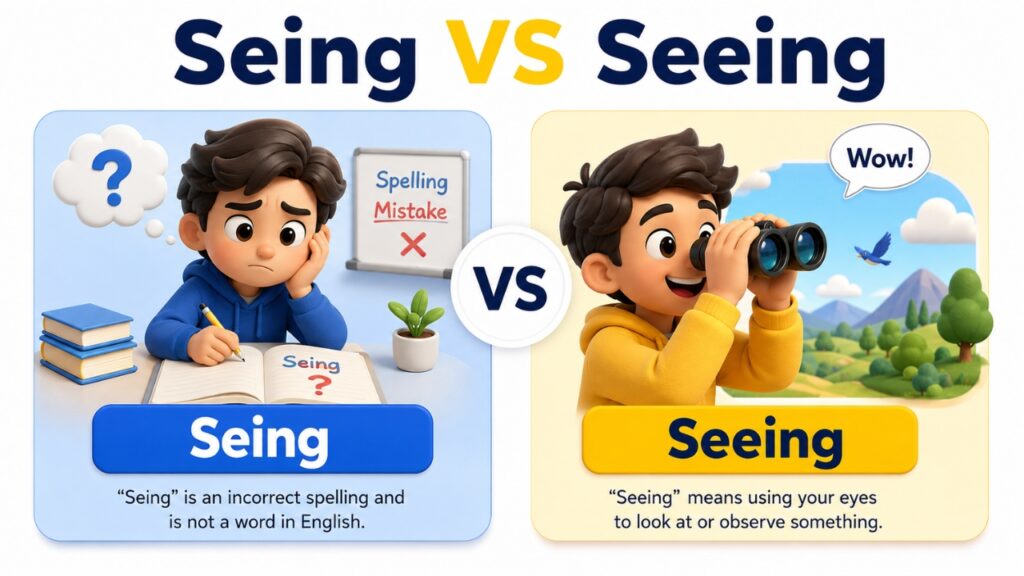
You’ve typed it fast, paused, and stared at the screen wondering if something looked off. That flicker of doubt over seing or seeing happens to almost everyone who writes in English regularly, and it’s more common than most people admit. It’s not a sign of poor grammar. It’s just one of those small words that trips up the eye because the double “e” gets lost when you’re typing quickly.
This guide walks you through the real seeing or seing meaning, where each word came from, how to use them correctly, and phrases like “seeing red” that trip people up even more. By the end, you’ll never second-guess this spelling again, and you’ll actually understand why the confusion happens in the first place. Let’s clear it up together.
Seing Vs Seeing: Can Someone See What They Hear Or Think?
Before jumping into grammar rules, it helps to understand why this mix-up between seing or seeing happens at all, and the answer lies partly in how our brains process language.
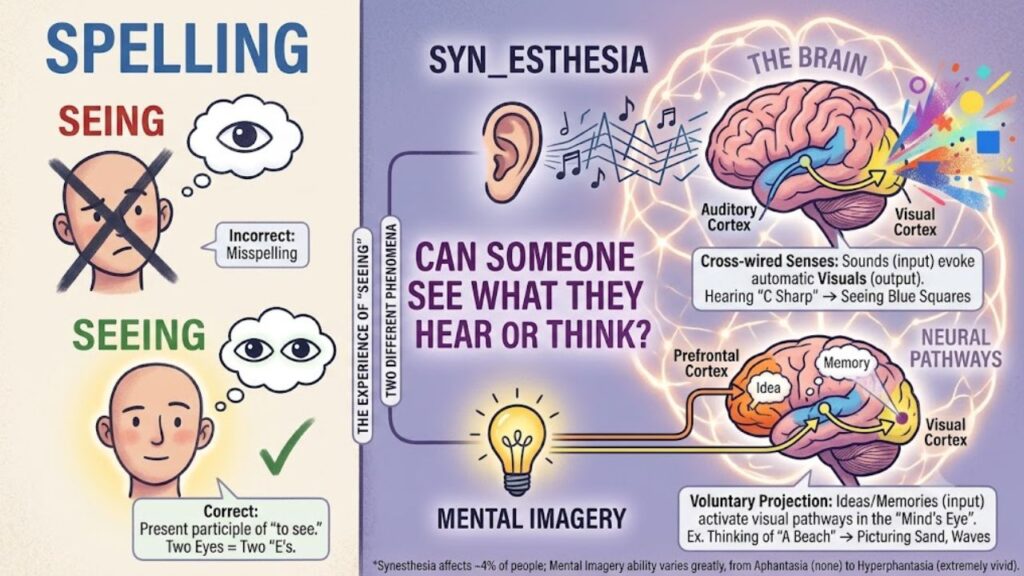
Some people have a rare condition called tickertaping, where they mentally “see” the written form of words as they hear or speak them, almost like internal subtitles. This ability falls under synesthesia, a broader neurological phenomenon where one sense triggers a response in another. Common crossovers include:
- Hearing a sound and picturing a color
- Reading a word and tasting something
- Watching a shape while hearing a tone
- Speaking a sentence and seeing it typed out
- Thinking a word and visualizing its spelling instantly
For the rest of us, spelling has to be learned the hard way, through repetition and visual memory. Teachers often suggest reading words aloud and picturing their shape, which is exactly why the double “e” in seeing deserves extra attention. Picture two open eyes side by side, that’s your memory trick for seeing, not seing.
Example in writing: “I keep seing the same typo in my draft” should always read “I keep seeing the same typo in my draft.”
Origin Of The Words “Seign” And “Seeing”
Understanding where these two words came from makes the seing or seeing debate much easier to settle, since one has ancient roots and the other has simply faded from use.
| Word | Origin | Meaning | Modern Status |
| Seign / Seing | Old French, from Latin signum | A signature, seal, or mark | Archaic, rarely used |
| Seeing | Old English seon | The act of observing or perceiving | Standard modern English |
The Origin of “Seign” (or “Seing”)
The word seign, sometimes written as seing, comes from Old French, where it referred to a signature, seal, or personal mark. Old French itself borrowed this from Latin signum, meaning a sign or symbol. You can spot that same Latin root hiding inside modern words like sign, signal, and signature.
In medieval documents, a person’s seign functioned much like a handwritten signature does today. As the word signature took over everyday English, seign quietly disappeared from common speech. Most dictionaries now label it archaic, meaning it’s historically real but no longer part of standard modern writing.
The Origin of “Seeing”
Seeing has a completely different and far more active history. It traces back to the Old English verb seon, meaning to see, look, or behold, a verb that’s been in continuous use since at least the 12th century.
Grammatically, seeing is the present participle of the verb “to see.” When you add “-ing” to a base verb ending in a double vowel, both letters stay in place, which is exactly why it’s seeing and never seing. This is a consistent spelling rule across English, not a random exception.
Using “Seeing” Correctly
The flexibility of seeing is part of why the word shows up everywhere, since it works as a present participle, a gerund, and even a conjunction.
- As a present participle: “I am seeing real progress this month.”
- As a gerund: “Seeing the mountains at sunrise was unforgettable.”
- As a conjunction: “Seeing that everyone arrived, let’s start.”
- In relationships: “He’s been seeing someone new lately.”
- In observation: “We kept seeing the same pattern repeat.”
Example in writing: Friend one texts, “Been seeing a lot of rain lately, huh?” Friend two replies, “Yeah, seeing that forecast made me cancel our hike.”
Using “Seign” in a Sentence (Historical Context Only)
Because seign is archaic, you’d only find it referenced in historical writing or academic discussions about medieval documentation practices, never in modern conversation or professional writing.
- Historical: “The document bore the nobleman’s seign as proof of approval.”
- Academic: “Scholars studied the seign found on the ancient charter.”
- Never modern: Avoid using seign in emails, essays, or texts today.
Quick Correction Guide
| Incorrect | Correct |
| I am seing the sunrise. | I am seeing the sunrise. |
| She enjoys seing art. | She enjoys seeing art. |
| Seing as it’s cold outside. | Seeing as it’s cold outside. |
What Is the Real Difference Between Seing and Seeing?
This question sits at the heart of the seing or seeing confusion, and the honest answer is that only one of these spellings belongs in modern writing at all.
- Seeing is the correct, active, everyday spelling used constantly.
- Seing is a typo or an archaic variant, not a modern word.
- Double “e” must always stay when adding -ing to “see.”
- Spellcheck will usually catch seing, but not always in fast typing.
- Context matters little here, since seeing is universally correct.
Why Do People Keep Misspelling Seeing as Seing?
Typing speed and pronunciation are usually the real culprits, since the double “e” in seeing often gets swallowed when the word is spoken or typed quickly.
- Fast typing drops a letter without the writer noticing.
- Pronunciation blends the two e’s into one soft sound.
- Autocorrect gaps on some devices may miss the error.
- Visual similarity to seign confuses occasional readers.
- Muscle memory from typing “see” alone shortens the habit.
Example in writing: “Can you send the pics from seing the concert?” is a common slip for “seeing the concert.”
When Should You Use “Seeing” as a Conjunction?
Many writers don’t realize seeing can replace “because” or “since” in a sentence, which adds useful variety without changing the meaning.
- Formal writing: “Seeing that the report is late, we’ll adjust the deadline.”
- Casual speech: “Seeing as you’re already here, let’s talk.”
- Cause and effect: Use it when explaining a reason clearly.
- Sentence starters: Works well to open a clause naturally.
- Avoid overuse: Reserve it for moments needing a soft explanation.
Synonyms For The Words “Seign” And “Seeing”
Synonyms for “Seign” (Signature / Mark)
Since seign historically pointed to a signature or personal mark, these modern alternatives carry a similar meaning today.
- Initials — first letters of a name used as an identifying mark
- Endorsement — a signature of approval on legal or financial paperwork
- Mark — a written symbol identifying someone or something
- Seal — an emblem or stamp used to authenticate a document
- Emblem — a symbol representing a person, group, or idea
Synonyms for “Seeing” (Observing / Perceiving)
If you want variety instead of repeating seeing throughout a piece, these words work as strong substitutes.
- Spotting — noticing something quickly, often something small
- Noticing — becoming aware of something through attention
- Observing — watching carefully and systematically over time
- Perceiving — becoming aware through the senses or intuition
- Distinguishing — recognizing something as separate or different
- Witnessing — seeing something happen firsthand in real time
- Beholding — seeing something remarkable, often in literary tone
What Does Seeing Red Mean?
“Seeing red” ranks among the most vivid idioms tied to the word seeing, and it describes a feeling almost everyone has experienced at some point in daily life.
When someone says they’re seeing red, it means they’ve become extremely angry, so furious that their judgment feels clouded, almost as though their vision has turned red with rage.
The Origin of “Seeing Red”
The phrase is most often linked to bullfighting, where a matador waves a red cape, called a muleta, to provoke a charging bull. That cultural link between red and aggression became so strong that “seeing red” entered everyday English to describe human fury.
Interestingly, bulls are actually colorblind to red, it’s the cape’s movement, not its color, that triggers the charge. Despite that fact, the connection stuck, and the phrase has been common since the early 20th century. A second theory ties it to real physiology, since anger raises blood pressure and can visibly redden the face and eyes.
How to Use “Seeing Red” in Sentences
- Frustration: “He was seeing red after his car got scratched.”
- Workplace anger: “That comment made her see red instantly.”
- Building tension: “The delay had the whole team seeing red.”
- Personal reaction: “I saw red the moment I read that email.”
- Calm response: “She refused to let the insult make her see red.”
Example in writing: Friend one says, “He totally saw red when they cancelled the trip.” Friend two replies, “Honestly, I’d be seeing red too.”
Related Idioms That Use “Seeing”
| Idiom | Meaning |
| Seeing red | Being extremely angry |
| Seeing eye to eye | Agreeing with someone |
| Seeing is believing | You must witness something to believe it |
| Seeing someone | Dating or meeting a person romantically |
| Seeing as / seeing that | Because or since |
How Can You Remember the Correct Spelling of Seeing Forever?
A simple visual trick solves the seing or seeing problem permanently, and it works because it ties the spelling to something memorable rather than abstract rules.
- Picture two eyes side by side for the double “e.”
- Say it slowly out loud to hear both vowels clearly.
- Write it by hand a few times to build muscle memory.
- Use spellcheck as backup, not a replacement for learning.
- Read it in context within full sentences, not isolated.
FAQs
Is “seing” ever correct in English?
No. In modern English, seing is always incorrect. Seeing with a double “e” is the accepted spelling everywhere.
What is the seing meaning in historical contexts?
Historically, seign referred to a signature, seal, or identifying mark, borrowed from Old French and Latin signum.
Why do people write “seing” instead of “seeing”?
The mix-up between seing or seeing often happens because the double “e” gets lost when typing or speaking quickly.
Can “seeing” be used as a conjunction?
Yes. Seeing as or seeing that can replace “because” or “since,” such as “Seeing that it’s raining, let’s stay in.”
What does “seeing red” mean?
“Seeing red” is an idiom meaning someone has become extremely angry, likely linked to the red cape used in bullfighting.
What are some synonyms for “seeing”?
Strong alternatives to seeing include spotting, noticing, observing, perceiving, witnessing, and distinguishing.
Is “seeing” used differently in British and American English?
No. The spelling seeing is identical and correct in both British and American English without exception.
Conclusion
To wrap things up, the debate between seing or seeing has a clear answer: seeing is correct, and seing is simply a spelling slip. Understanding the full seeing or seing meaning helps you write with more confidence, whether you’re texting a friend or drafting a formal report. Remember that the verb “see” always keeps both “e” letters when adding “-ing,” which is the simple rule behind the entire mix-up.
Next time your fingers move fast and that double “e” almost slips away, pause for a second and picture those two open eyes. That small habit is enough to make sure you never confuse seing or seeing again, and it carries over into cleaner, more confident writing overall.

Amelia Brooks is a US-based author known for inspiring stories on meaning, growth, and hope, blending insight with simple, engaging storytelling.