
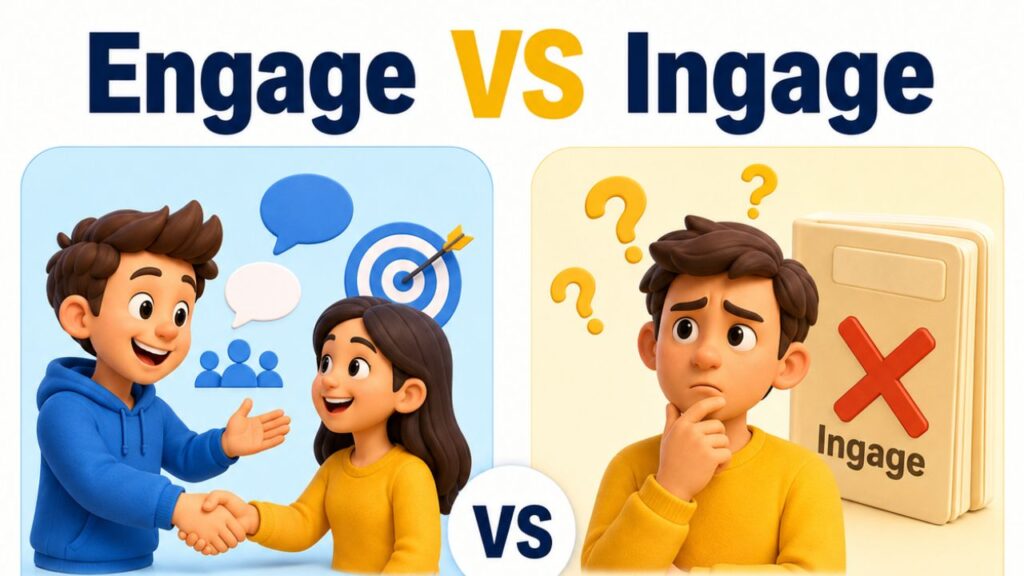
You’ve typed it before without thinking twice. “I want to ingage with my audience more this year.” It reads fine in your head, sounds fine out loud, and then autocorrect quietly underlines it in red. That tiny squiggly line has probably made you pause and wonder if you’ve been spelling this word wrong your whole life.
Here’s the good news. This guide clears up the ingage vs engage confusion once and for all, with real examples, pronunciation notes, and simple rules you’ll actually remember. By the time you finish reading, the difference between engage vs ingage will feel obvious instead of confusing. Let’s get into it.
Ingage vs Engage
The short answer is simple. Engage is the correct, dictionary-approved spelling in modern English. Ingage is essentially an outdated or mistaken variant that rarely appears in anything written today. When people search for ingage vs engage, they’re usually double-checking a word they just typed or read somewhere unfamiliar.
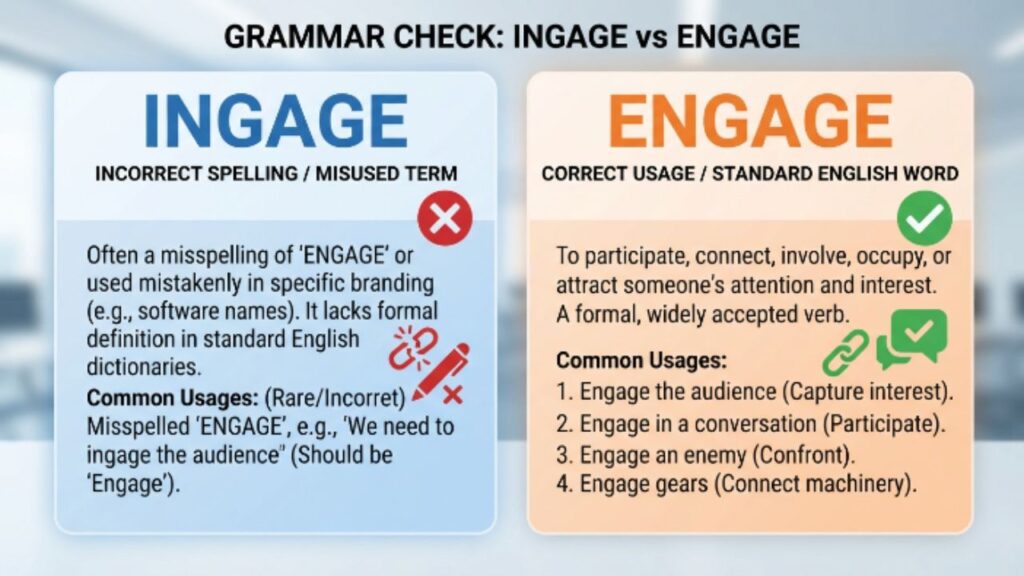
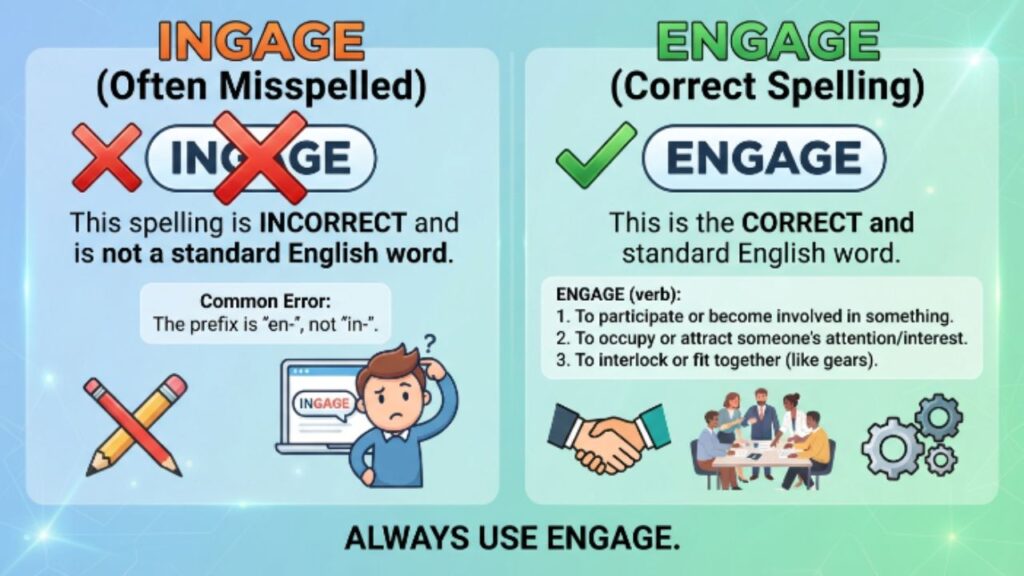
Engage means to involve someone, attract their attention, connect with them, or participate in an activity. You can engage a customer, engage in conversation, or engage a machine’s gears. Ingage carries the exact same intended meaning whenever someone uses it, but it’s simply not accepted by style guides, teachers, or editors. Consequently, if you’re choosing between the two for anything you plan to publish, engage wins every single time.
Pronunciation
Both words sound almost identical when spoken aloud, which is exactly why the spelling mix-up happens so often in the first place.
| Word | US Pronunciation | UK Pronunciation |
| Engage | /ɪnˈɡeɪdʒ/ | /ɪnˈɡeɪdʒ/ |
| Ingage | /ɪnˈɡeɪdʒ/ | /ɪnˈɡeɪdʒ/ |
Since the pronunciation offers zero clues about spelling, your ear simply can’t help you here. You have to memorize the written form instead, and that’s precisely why so many people end up Googling engage vs ingage in the first place.
How Do Native Speakers Avoid This Mistake?
Most native speakers avoid the error through repeated exposure rather than any grammar rule they consciously remember. Here’s what tends to help:
- Reading widely builds automatic pattern recognition for correct spelling
- Writing by hand slows you down enough to catch typos
- Spell-check tools flag ingage instantly in most software
- Word association with “engagement” reinforces the correct root
- Repetition in school essays locks the spelling into memory
Difference Between Ingage vs Engage
The core difference comes down to acceptance, not meaning. Engage is a fully recognized English verb found in every major dictionary. Ingage is treated as a spelling error, occasionally traced back to archaic or regional English from centuries ago.
- Engage appears in Merriam-Webster, Oxford, and Cambridge dictionaries
- Ingage is absent from nearly all standard dictionaries today
- Engage is taught in schools worldwide as the correct form
- Ingage shows up mostly in typos, old manuscripts, or non-native writing
- Engage carries full grammatical support across tenses like engaged, engaging, engages
Example in chat: Friend 1: did you ingage with the new post yet lol Friend 2: it’s engage, not ingage 😂 but yes I liked it
Nature and Behaviour of Engage vs Ingage
Understanding how each word behaves in a sentence makes the choice between ingage vs engage even clearer, especially once you see them side by side in context.
Engage
Engage functions as a standard transitive and intransitive verb, meaning it can take a direct object or stand alone in a sentence.
- Works as a transitive verb: “She engaged the audience.”
- Works as an intransitive verb: “He didn’t engage at all.”
- Forms regular past tense: engaged
- Forms regular present participle: engaging
- Pairs naturally with prepositions like “with” and “in”
Ingage
Ingage doesn’t have any independent grammatical identity of its own. It simply mirrors engage’s behavior because it’s a misspelling rather than a distinct word.
- Has no dictionary entry of its own in modern English
- Carries no separate meaning from engage
- Shows up mostly in casual typing errors
- Occasionally found in archaic texts from earlier centuries
- Never appears in style guides as an accepted alternative
Why People Get Confused About Ingage vs Engage
The confusion isn’t random. It stems from a few overlapping habits in how people type, speak, and read English every day.
- Similar sounds make the prefixes “en” and “in” easy to swap
- Fast typing on phones increases small spelling slips
- Autocorrect gaps on certain apps don’t always catch it
- Old texts occasionally used the ingage spelling, adding to the myth
- Non-native speakers sometimes transfer spelling patterns from other languages
Is Ingage Ever Considered Correct in Any Context?
No modern context treats ingage as correct, though historical linguists sometimes reference it. If you’re studying old English texts or tracing word evolution, you might encounter ingage in its archaic form. Outside of that narrow academic interest, always default to engage.
Comparison Table
| Feature | Engage | Ingage |
| Correct spelling | Yes | No |
| Found in dictionaries | Yes | Rarely |
| Taught in schools | Yes | No |
| Accepted in business writing | Yes | No |
| Grammatically standard | Yes | No |
| Historical usage | Present | Present |
| Pronunciation | /ɪnˈɡeɪdʒ/ | /ɪnˈɡeɪdʒ/ |
The Origin of Engage
The word engage traces back to Old French engagier, which itself came from combining “en” (to put into) with “gage” (a pledge). It entered Middle English carrying the sense of pledging or binding oneself to something.
Over several centuries, the meaning broadened well beyond its original legal and financial roots. It grew to describe:
- Involvement in activities or discussions
- Attraction of someone’s attention or interest
- Participation in shared tasks or events
- Connection between people, ideas, or mechanisms
The variant ingage did surface occasionally in older English manuscripts, but standardization efforts eventually cemented engage as the accepted spelling across dictionaries and style guides.
British vs American English
Both major English dialects agree completely here, which is somewhat rare for spelling debates.
| Type | British English | American English |
| Correct word | Engage | Engage |
| Ingage accepted? | No | No |
| Common usage | Formal and casual | Formal and casual |
Unlike words such as “colour” versus “color,” there’s no regional split to navigate. Whether you’re writing for a British publication or an American one, engage remains your only correct option.
Which One Should You Use?
Always choose engage for anything you write, whether it’s professional, academic, or casual. There’s genuinely no scenario in modern communication where ingage serves you better.
- Emails to colleagues, clients, or customers
- School assignments including essays and reports
- Social media captions and comments
- Business writing like proposals and marketing copy
- Blog posts and articles across any niche
- News articles and press releases
Which Spelling Do Professional Editors Actually Prefer?
Professional editors, publishers, and style guides unanimously prefer engage without exception. If a manuscript or article ever contains “ingage,” editors flag it immediately as a typo requiring correction before publication.
Common Mistakes
| Wrong | Correct |
| Ingage customers | Engage customers |
| Ingage in class | Engage in class |
| Ingage readers | Engage readers |
| Ingage users online | Engage users online |
| Ingage with feedback | Engage with feedback |
Example in texting: Friend 1: gonna ingage more on insta this week Friend 2: *engage 😅 but good goal honestly
Everyday Usage Examples
Seeing engage across different everyday contexts helps the correct spelling stick permanently in your memory.
Emails
- “Please engage with the client before Friday’s call.”
- “We need to engage new customers this quarter.”
Social Media
- “Great content always engages followers instantly.”
- “Short videos engage viewers faster than long ones.”
News
- “The campaign engaged young voters across the country.”
- “Local sports events engage fans of every age.”
Formal Writing
- “Teachers should engage students through active discussion.”
- “Leaders engage communities by listening first.”
Usage Trends
Engage has grown significantly in popularity thanks to marketing and social media culture, where “engagement” has become a measurable metric. You’ll spot it constantly across:
- Marketing dashboards tracking likes, shares, and comments
- Education platforms measuring student participation
- Politics campaigns targeting voter involvement
- Technology products designed around user engagement
- Social media algorithms that reward engaged audiences
Ingage, meanwhile, remains almost entirely confined to accidental typos or outdated historical texts, with essentially no organic modern usage.
Why Does Autocorrect Still Miss Ingage vs Engage Mistakes?
Autocorrect sometimes misses this error because “ingage” resembles other valid words starting with “in,” so the system hesitates to auto-correct it confidently. That’s why proofreading manually still matters, even with modern spell-check tools running in the background.
Metaphors and Similes
Writers frequently lean on engage to build vivid, emotional imagery, especially in storytelling and persuasive writing.
Metaphors
- “Her speech engaged the crowd like a magnet pulling in metal.”
- “The novel engaged his mind long after he closed it.”
Similes
- “The game engaged kids like a blockbuster movie.”
- “Her story engaged listeners like a favorite song on repeat.”
Connotative Meaning
| Word | Feeling | Example |
| Engage | Positive | “Engage with your team openly.” |
| Engage | Neutral | “Engage the machine’s clutch.” |
| Ingage | Negative | Perceived as a careless spelling error |
Because ingage signals a mistake rather than intent, it often creates an unintended negative impression, even when the writer meant nothing by it.
Idioms and Proverbs
A few common idioms lean directly on the word engage, reinforcing just how embedded it is in everyday English.
“Engage your brain”
Meaning: think carefully before speaking or acting.
Sentence: “Engage your brain before you hit send on that email.”
“Be fully engaged”
Meaning: completely involved or committed to something.
Sentence: “She was fully engaged in the project from day one.”
Literature and Movies
Literature
Engage appears constantly across English fiction and nonfiction, spanning genres from classic novels to modern educational texts written between the 1800s and today.
Movies
Film dialogue has helped cement the word in pop culture. Science fiction especially leans on it, most famously through the command “Engage!” used aboard fictional starships in adventure and action films.
What Are the Best Alternatives to Engage in Formal Writing?
If you want variety beyond repeating engage constantly, consider synonyms like involve, captivate, connect, participate, or attract. These alternatives keep formal writing fresh while avoiding any temptation to misspell the original word.
Why This Difference Matters
Correct spelling shapes how readers perceive you, whether they realize it consciously or not.
- Communication stays clear when spelling is accurate
- School grades often depend on spelling precision
- Professional image improves with polished writing
- Online credibility grows when content reads error-free
Using engage correctly signals strong English skills, while ingage risks making otherwise solid writing look careless.
Usefulness in Daily Life
Getting ingage vs engage right pays off across nearly every writing situation you’ll encounter.
- Writing emails that reflect professionalism
- Posting online without embarrassing typos
- Creating content that reads smoothly and confidently
- Speaking professionally during interviews or meetings
- Passing exams that grade written accuracy
Good spelling quietly builds trust, even when nobody explicitly comments on it.
Situational Preference
In every modern situation, engage remains the smarter, safer choice. Use it in schools, offices, websites, social platforms, and formal reports without hesitation. Teachers, editors, and companies all expect this standard spelling, and deviating from it rarely goes unnoticed. The spelling ingage may occasionally surface in very old books or historical documents, but modern readers almost universally interpret it as an error. If clear communication matters to you, and it should, always choose engage over ingage. This applies equally to students, bloggers, professional writers, and business owners crafting customer-facing content.
What Should You Do If You Already Wrote Ingage by Mistake?
Simply correct it wherever you find it, whether that’s an old email, a social post, or a published article. There’s no lasting damage from a one-time typo. Just update it to engage going forward and treat it as a small, easily fixed habit.
FAQs
Is ingage a real word?
No, ingage isn’t a recognized word in modern standard English dictionaries.
Which spelling is correct, engage or ingage?
Engage is correct. It’s the only version accepted by dictionaries and style guides.
Why do people write ingage instead of engage?
People write ingage because it sounds nearly identical to engage when spoken aloud.
Is ingage used anywhere in older English?
Yes, some historical texts used ingage, though modern English standardized it as engage.
Should I ever use ingage in essays or exams?
No, always use engage in essays, since ingage will be marked incorrect.
Do British English speakers ever use ingage instead of engage?
No, British English treats engage as the only correct spelling, matching American usage.
Can engage mean something beyond just participation?
Yes, engage can also mean to attract attention, connect, or activate something mechanically.
Why This Difference Matters
Choosing correctly between ingage vs engage ultimately comes down to trusting the dictionary over instinct. Engage stands as the accepted, professional, and grammatically sound choice across every English-speaking region. Ingage survives mostly as a spelling slip or a relic from centuries-old writing, carrying no real place in contemporary communication.
Remember this simple rule going forward: engage connects, involves, and attracts attention, while ingage simply signals a typo waiting to be fixed. Whether you’re emailing a client, posting on social media, or finishing a school essay, sticking with engage keeps your writing polished and credible. Next time you catch yourself typing “ingage,” pause, correct it, and move on with confidence.

Amelia Brooks is a US-based author known for inspiring stories on meaning, growth, and hope, blending insight with simple, engaging storytelling.