
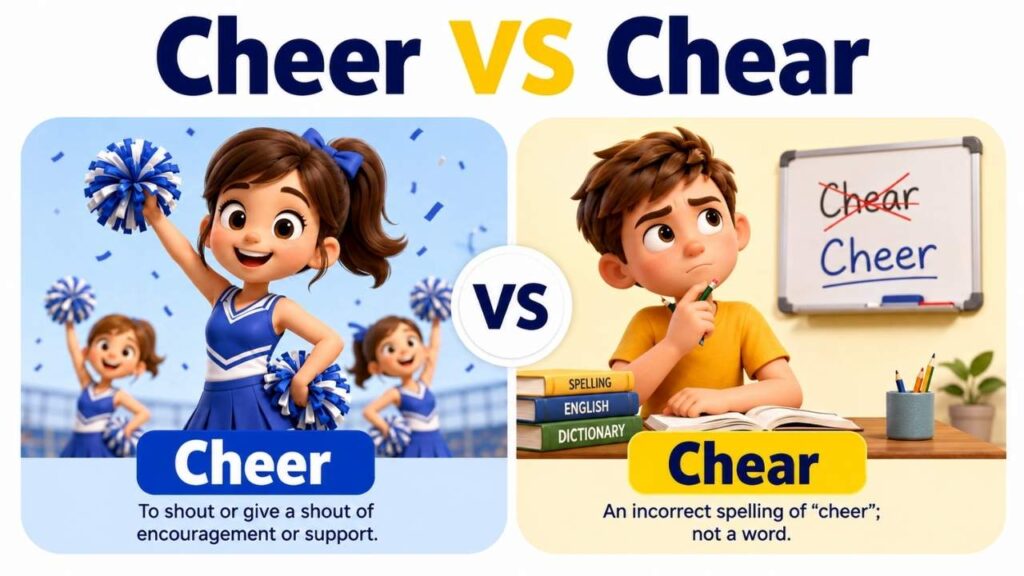
Ever typed a word, stared at it for a second too long, and thought “wait, is that even spelled right”? That’s exactly what happens when people run into chear meaning questions online. It looks like cheer. It sounds like cheer. But something about it feels off, and that little doubt is enough to send you straight to Google.
Here’s the good news. By the end of this guide, you’ll never second-guess cheer vs chear again. You’ll know exactly which word belongs in your emails, essays, and everyday writing, plus a few surprising facts about where chear actually came from. Let’s clear this up once and for all.
Cheer Vs Chear
Confusion around cheer vs chear is more common than you’d think, especially among writers who learned English through speech before spelling. Both words sound identical when spoken aloud, which naturally creates doubt when it’s time to type them out.

The short answer: cheer is the only correct spelling in modern English. It works as a verb and a noun, covering everything from encouragement to celebration. Chear, on the other hand, is a fossil. It belonged to old English writing centuries ago and has no place in a text message, resume, or blog post today.
Here’s a quick side-by-side to make the distinction crystal clear:
| Feature | Cheer | Chear |
| Status in modern English | Correct, standard spelling | Obsolete, incorrect |
| Part of speech | Verb and noun | Historically used as both |
| Where you’ll see it | Emails, books, conversations | Old manuscripts, archaic texts |
| Spell-check result | Passes | Flagged as an error |
| Everyday usage | Extremely common | Practically nonexistent |
- Standard spelling: Cheer is the version every dictionary recognizes.
- Obsolete form: Chear survives only in historical documents.
- Sound-alike trap: Homophones like these trip up even confident writers.
- Spell-check reliance: Most tools catch chear automatically.
- Professional writing: Always defaults to cheer, never chear.
Chear Meaning
If you’re searching for the chear meaning specifically, you’re not chasing a hidden definition. You’re looking at an old, retired spelling of the word cheer, nothing more mysterious than that. Once you understand this, the confusion tends to disappear pretty quickly.
The chear meaning traces back to early modern English, a period when spelling wasn’t standardized the way it is now. Writers had far more freedom, and words often appeared in several spellings across different texts. Chear was simply one variant among many, used interchangeably with what we now call cheer.
- No separate definition: Chear carries the exact meaning as cheer.
- Historical spelling: It reflects an older stage of English writing.
- Not a synonym: It’s a variant spelling, not a distinct word.
- Fell out of use: Standardization pushed chear into obscurity.
- Modern relevance: Zero, outside of historical or academic interest.
Understanding cheer vs chear this way removes the mystery. There’s no secret nuance separating them, just centuries of language evolution that left one spelling behind.
Definitions Of Cheer And Chear
Getting the full picture means looking closely at both words side by side, because that’s really where cheer vs chear starts making complete sense. Once the definitions click, the rest of this guide falls into place easily.
The cheer definition describes a word that functions as both verb and noun, carrying meanings tied to joy, encouragement, and comfort. The chear definition, meanwhile, simply points back to cheer as its obsolete ancestor. There isn’t a competing meaning to memorize here.
- Dual function: Cheer works as both an action word and a naming word.
- Emotional core: Both definitions center on positivity and support.
- One true form: Chear inherits cheer’s meaning without adding anything new.
- Dictionary status: Cheer appears in every current dictionary; chear rarely does.
- Writing impact: Choosing correctly affects how professional your work looks.
What Is The Definition Of Cheer?
The cheer definition shows a word packed with encouragement, positivity, and celebration. As a verb, cheer means to shout with joy, support someone loudly, or lift a person’s spirits when they’re feeling low. As a noun, it describes that same burst of happiness or a general feeling of cheerfulness.
Think about a stadium crowd. Fans don’t just watch quietly, they cheer their team on with everything they’ve got. That’s the verb form in action, full of energy and public support. Meanwhile, someone spreading holiday cheer during December is using the noun form, referring to a warm, shared sense of joy.
- Verb usage: To shout, support, or encourage someone loudly.
- Comfort meaning: To cheer someone up during a hard moment.
- Noun usage: A loud shout of approval or happiness.
- Atmosphere sense: Cheer can describe a room’s mood or feeling.
- Common phrase: “Cheers” as a friendly greeting or toast.
Example in chat: Friend 1: My presentation totally bombed today, I feel awful. Friend 2: Aw, let’s grab pizza tonight to cheer you up!
More Meanings Of Cheer
Beyond joy and support, cheer carries a few lesser-known meanings worth knowing, especially for anyone studying English spelling and vocabulary depth. These extra layers show just how flexible this small word really is.
Older English usage connected cheer to food and festive gatherings, describing the meals and drinks shared during celebrations. You’ll still spot traces of this in phrases like “good cheer” at holiday tables. It’s less about shouting and more about warmth, abundance, and togetherness.
- Festive meals: Older texts used cheer to describe holiday spreads.
- Good cheer: A phrase meaning optimism and a hopeful spirit.
- Inner state: Cheer can describe someone’s overall mood or outlook.
- Lasting positivity: The word often implies enduring, not fleeting, joy.
- Social warmth: Cheer ties closely to hospitality and shared happiness.
What Is The Definition Of Chear?
The chear definition is refreshingly simple once you strip away the confusion: it’s just an old, retired spelling of cheer. Writers centuries ago used it in poems, letters, and early printed books before English spelling became standardized.
As grammar rules tightened over time, language experts phased out variant spellings like chear in favor of one consistent form. Today, if you see chear in a text, it’s either a typo, a deliberate stylistic choice in historical fiction, or a genuine spelling mistake.
- Archaic origin: Found mostly in centuries-old manuscripts.
- Same root meaning: Identical to cheer, just an older spelling.
- Spell-check flag: Nearly every tool marks it as wrong.
- No modern usage: Absent from contemporary writing entirely.
- Historical curiosity: Interesting for language lovers, not everyday writers.
Cheer Meaning In Different Contexts
Context changes everything, and that’s exactly why cheer meaning shifts depending on where and how you use the word. A sports arena, a holiday dinner, and a comforting text message all call for slightly different flavors of the same core idea.
In sports, cheer means loud vocal support for a team or player. In social settings, it often refers to a festive mood or hospitality. In personal conversations, cheering someone up means offering emotional comfort. Recognizing these contexts helps you use the word naturally.
- Sporting events: Fans cheer loudly to show team support.
- Holiday settings: Cheer reflects festive food, drinks, and joy.
- Personal comfort: Cheering someone up means emotional encouragement.
- Professional emails: “Cheers” often closes a friendly message.
- General mood: Cheer can simply describe a person’s happy outlook.
What Does Chear Mean In Old English?
People often wonder what chear specifically meant centuries ago, since old texts didn’t always follow today’s spelling conventions. Understanding this history makes the modern cheer vs chear debate much easier to accept.
In early English writing, spelling wasn’t fixed by dictionaries the way it is now. Authors wrote words the way they sounded to them, which meant cheer appeared as chear, cheare, and several other forms across different manuscripts. None of these carried a different meaning, they were simply regional or personal spelling choices.
- Unstandardized spelling: Old English allowed multiple forms per word.
- Sound-based writing: Authors often spelled words phonetically.
- Same core meaning: Chear always meant what cheer means now.
- Printing press influence: Standardization increased once printing became common.
- Modern dictionaries: None list chear as an accepted current spelling.
How To Properly Use Cheer And Chear In A Sentence
Knowing the definitions is one thing, but applying correct cheer usage in real sentences is where most writers actually need help. Fortunately, the rule here couldn’t be simpler once you commit it to memory.
Always use cheer, never chear, in any sentence you write today. Whether you’re crafting a formal email, a casual text, or a heartfelt card, cheer is the only acceptable spelling. Chear belongs strictly to historical texts and has no place in current writing of any kind.
| Sentence Type | Correct Version | Incorrect Version |
| Sports support | The fans cheer for their team. | The fans chear for their team. |
| Comfort | She tried to cheer him up. | She tried to chear him up. |
| Holiday greeting | We wish you holiday cheer. | We wish you holiday chear. |
| Email sign-off | Cheers, see you soon! | Chears, see you soon! |
| General mood | His cheer lifted the whole room. | His chear lifted the whole room. |
- Verb form: Use cheer to describe shouting or comforting.
- Noun form: Use cheer for a feeling of joy or approval.
- Sign-offs: “Cheers” works fine in casual emails.
- Never chear: Avoid it in every writing context without exception.
- Spell-check trust: Let your tools flag chear automatically.
Common Mistakes With Cheer And Chear
Even confident writers slip up occasionally, and knowing the common traps helps you sidestep them before they become embarrassing typos in a final draft. Most mistakes come down to speed, autocorrect quirks, or simple unfamiliarity with spelling history.
Typing quickly on a phone often causes accidental letter swaps, turning cheer into chear without anyone noticing until it’s too late. Reading your work aloud, or using a reliable spell-checker, catches most of these errors before they reach your reader.
- Rushed typing: Fast typing on phones invites accidental swaps.
- Autocorrect gaps: Not every keyboard flags chear as wrong.
- Assuming variety: Some writers wrongly think both spellings are valid.
- Skipping proofreads: Small errors slip through without a final read.
- Confusing homophones: Cheer’s identical sound makes typos easy to miss.
Is Chear A Real Word Today?
This is one of the most searched questions tied to this topic, and the honest answer is refreshingly direct. No, chear is not considered a real, accepted word in modern English writing or speech.
Dictionaries classify chear as archaic or obsolete, meaning it existed historically but has since been replaced entirely by cheer. You won’t find it in style guides, grammar checkers, or professional writing standards anywhere. If it appears, treat it as an error every time.
- Dictionary status: Labeled obsolete or missing entirely.
- Grammar tools: Universally flag chear as incorrect.
- Publishing standards: No modern publication accepts chear.
- Educational materials: Textbooks teach only the cheer spelling.
- Practical takeaway: Replace chear with cheer every single time.
Cheer Vs Chear: Fun Facts About These Words
Language history hides some genuinely fun surprises, and the story behind cheer vs chear is no exception. These details make the topic memorable long after you’ve learned the basic spelling rule.
Interestingly, the earliest meaning of cheer had nothing to do with shouting at all. It originally described a person’s face or facial expression, reflecting their mood rather than loud celebration. Over centuries, that meaning shifted toward the joyful, energetic sense we recognize today.
| Fun Fact | Detail |
| Original meaning | Referred to facial expression or mood |
| Modern shift | Evolved into joy, celebration, and encouragement |
| Toast tradition | “Cheers” became popular at gatherings and parties |
| Email sign-off | Common casual closing in British English |
| Chear’s fate | Phased out once spelling became standardized |
- Facial origin: Cheer once described someone’s expression or countenance.
- Toast custom: Raising glasses with “cheers” spread across cultures.
- British influence: “Cheers” often means thank you informally there.
- Word evolution: Meaning shifted from face to feeling over time.
- Chear’s decline: Standardized spelling rules erased it from use.
Why Do People Confuse Cheer With Chear?
Confusion between these two almost always comes down to sound, not meaning, since spoken English gives zero clues about spelling differences. This is a classic case of a homophone trap catching writers off guard.
Add in autocorrect inconsistencies, unfamiliarity with archaic English, and the sheer speed of digital typing, and it’s easy to see why chear keeps popping up in casual writing. The confusion isn’t really about grammar knowledge, it’s about spelling awareness.
- Identical pronunciation: Both words sound exactly the same aloud.
- Limited exposure: Few people encounter chear in modern reading.
- Digital typing speed: Quick typing increases the chance of errors.
- Historical unfamiliarity: Many writers don’t know chear’s archaic status.
- Spelling assumptions: Some guess incorrectly based on sound alone.
Synonyms And Related Words For Cheer
Expanding your vocabulary around cheer meaning makes your writing richer and helps you avoid repeating the same word too often. These related terms capture similar shades of joy, support, and encouragement.
Words like encouragement, comfort, and applause overlap closely with cheer’s various senses. Meanwhile, terms like optimism and cheerfulness capture its emotional, mood-based meaning. Mixing these into your writing keeps things fresh and expressive.
- Encouragement: Support offered to lift someone’s spirits.
- Applause: Public approval, often through clapping or shouting.
- Cheerfulness: A general state of happiness or positivity.
- Comfort: Emotional reassurance during a difficult moment.
- Optimism: A hopeful, forward-looking attitude toward life.
List Of Examples Of Cheer And Chear In Your Sentences
Seeing correct usage in action cements everything you’ve learned so far about cheer vs chear. Since chear has no legitimate modern use, every example below relies entirely on the correct, standard spelling.
- The crowd let out a huge cheer when the buzzer sounded.
- She sent a card to cheer her grandmother up after surgery.
- Their kindness brought unexpected cheer during a tough week.
- Volunteers lined the route to cheer the marathon runners on.
- The office decorated early to spread some holiday cheer.
- His jokes always manage to cheer up a quiet room.
- Supporters continued to cheer even after the team lost.
- A simple “cheers” ended her email on a warm note.
- The good news filled the family with genuine cheer.
- Teachers cheered the students on during exam week.
FAQs
What is the difference between cheer and chear?
Cheer is the correct, modern spelling used today, while chear is an obsolete form no longer accepted in standard cheer meaning contexts.
Is chear ever correct to use?
No, chear isn’t correct in any modern writing. Always choose cheer, since chear reflects outdated spelling with no current acceptance.
Where did the chear spelling come from?
Chear came from early English, when spelling wasn’t standardized. It shared the same cheer meaning as today’s accepted version.
Does cheer have more than one meaning?
Yes, cheer means joy, encouragement, comfort, and even festive food historically, showing how flexible this simple word truly is.
Why does spell-check flag chear as wrong?
Modern dictionaries and grammar tools recognize only cheer, so chear gets flagged since it no longer fits accepted cheer meaning standards.
Can chear appear in historical fiction writing?
Occasionally, yes. Writers sometimes use chear intentionally for old-world tone, though it still isn’t standard in everyday cheer meaning usage.
What’s the easiest way to remember the correct spelling?
Just remember cheer is always correct, while chear belongs only to history books, never to modern emails, essays, or messages.
Conclusion
At the end of the day, understanding chear meaning comes down to one simple truth: cheer is correct, and chear is history. The full cheer vs chear comparison shows that chear once existed as an old English spelling, but standardized grammar rules retired it long ago. Cheer, meanwhile, remains alive and well, carrying meanings tied to joy, encouragement, comfort, and celebration in daily life.
Next time you’re tempted to type chear, pause for a second and swap it for cheer instead. That small habit protects your credibility in emails, essays, and everyday writing. Language keeps evolving, but this particular rule stays refreshingly simple, so lock it in and write with confidence going forward.

Amelia Brooks is a US-based author known for inspiring stories on meaning, growth, and hope, blending insight with simple, engaging storytelling.


