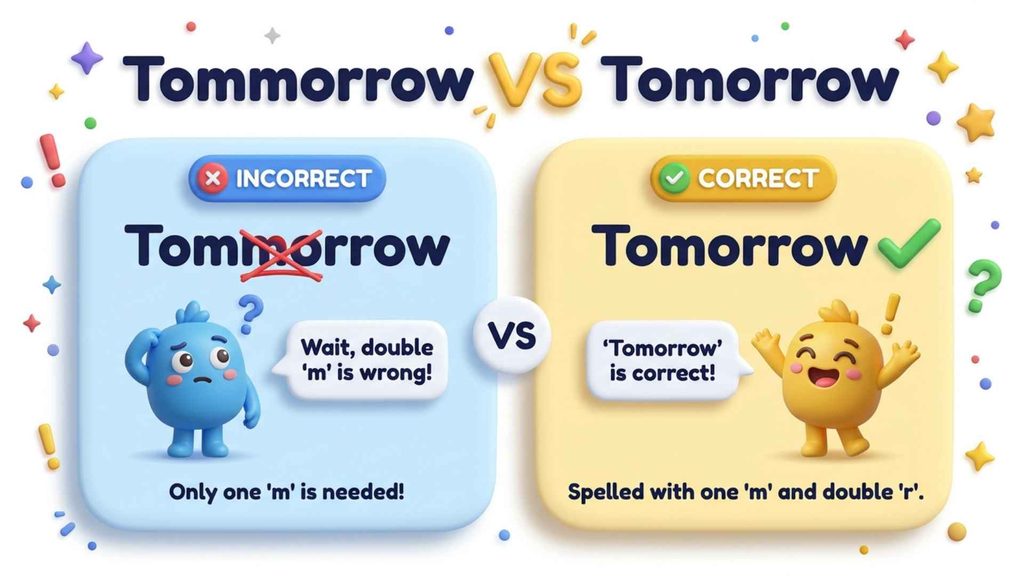
You type a quick message, glance at it, and something looks off. That extra letter in tommorrow sneaks past even careful writers, and the little jolt of embarrassment is real. If you have ever stared at a word until it stopped looking like a word, you are in good company.
This guide covers why tommorrow feels so natural to type, the real tomorrow meaning, its Old English roots, and memory tricks that actually stick. Spelling it right protects your credibility in emails, essays, and texts. Keep reading and you will never second-guess it again.
The Correct Spelling: “Tomorrow”
Typing tommorrow feels harmless until someone points it out, and then it nags at you. Here is the clean answer, with the spelling laid out clearly, so doubt fully disappears.
How Do You Spell Tomorrow Correctly?
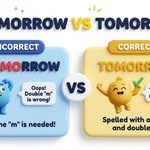
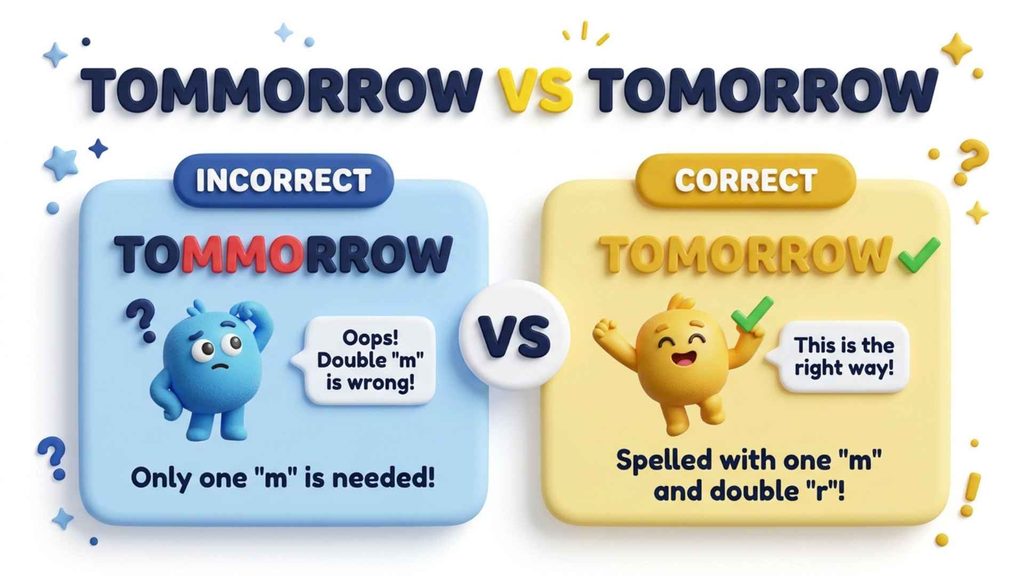
The only correct form is tomorrow: one m and two rs, in the order T-O-M-O-R-R-O-W. The spelling is identical in American English and British English, so no regional rule rescues tommorrow.
- One “m” sits in the middle, right after the first “o”.
- Two “r”s sit together near the end of the word.
- It works as a noun, as in “Tomorrow is Friday.”
- It also works as an adverb, as in “See you tomorrow.”
- Every major dictionary lists only one accepted spelling.
- Tommorrow never appears as a valid variant anywhere.
| Form | Correct? | What Went Wrong |
| tomorrow | Yes | Nothing, this is the standard form |
| tommorrow | No | Extra “m” in the middle |
| tommorow | No | Extra “m” and a missing “r” |
| tomorow | No | One “r” is missing |
| tomarrow | No | Wrong vowel after the “m” |
Example in texting: Friend 1: “Are we still meeting tommorrow?” Friend 2: “Yes, tomorrow at six. Your spelling needs coffee, though.”
Why “Tommorrow” Is Incorrect
Why does tommorrow look so right while being so wrong? The answer lives in how our ears trick our fingers, and understanding it makes the habit really easy to break.
Why Do People Double the M in Tomorrow?
The heavy “MOR” sound pulls attention to the middle of the word. Writers then borrow the double letters pattern from words like committee and summer, and the extra m slips in without permission.
- Phonetic confusion makes the strong middle syllable feel doubled.
- Pattern interference from words like “common” nudges fingers toward “mm”.
- Typing speed causes repeated keystrokes before the brain catches up.
- Overcorrection happens when writers know about the double “r”.
- Skipped proofreading lets the error survive into the final draft.
- Visual familiarity makes the wrong version look almost right.
Example in chat: Friend 1: “Why does tommorrow look so right to me?” Friend 2: “Because your brain wants symmetry. The m just isn’t doubled.”
Origin and Etymology of “Tomorrow”
Words carry history, and tommorrow ignores every bit of it. Once you see exactly where tomorrow actually came from, the single m starts to feel truly obvious rather than random.
Where Does the Word Tomorrow Come From?
The word grew out of the Old English phrase to morgenne, meaning “on the morrow.” Over centuries the two pieces fused into one, and the etymology explains the modern spelling perfectly.
- Old English gave us to morgenne, meaning “on the morning.”
- Middle English blended the parts into forms like to morwe.
- Modern English fused them into one standardized word, tomorrow.
- The prefix “to” adds nothing extra beyond its own two letters.
- The old noun “morrow” brings one m and two r’s.
- The spelling reflects word structure, so tommorrow breaks it.
Example in texting: Friend 1: “Why does tomorrow have just one m?” Friend 2: “It’s ‘to’ plus ‘morrow’, and morrow only has one m.”
Tomorrow Meaning and Definition
People searching tommorrow often want more than a quick spelling fix, they want the tomorrow meaning itself. Here is what the word actually says, in very plain and friendly language.
What Does Tomorrow Mean in English?
Tomorrow points to the day after today. It can also stand for the near future in a broader sense, which is why writers love it for hope, plans, and fresh starts.
- Literal meaning: the day that follows the current day.
- Figurative meaning: the future, often hopeful or uncertain.
- Noun use: “Tomorrow is a new chance.”
- Adverb use: “We leave tomorrow.”
- Possessive form: “tomorrow’s weather” shows relation to that day.
- Idioms: “Tomorrow is another day” offers comfort after a rough one.
Example in texting: Friend 1: “What does tomorrow’s plan look like?” Friend 2: “Same as today, just with more coffee.”
Common Mistakes and Confusions
Almost everyone has typed tommorrow at some point, so honestly there is no shame in it. Let us calmly look at the usual spelling slip-ups and why they keep happening.
What Are the Most Common Tomorrow Misspellings?
Misspellings cluster around the middle and the ending. Non-native English speakers face extra trouble because the sound of the word does not match its letters neatly.
- Tommorow doubles the m and drops an r.
- Tomorow keeps one m but loses an r.
- Tomarrow swaps the second vowel for an a.
- Tomoro drops several letters during fast typing.
- Mixed-up doubling happens when writers guess which letters repeat.
- Native speakers make these errors too, so it is not carelessness.
| Misspelling | Error Type | Simple Fix |
| tommorrow | Extra “m” | Use one “m” |
| tommorow | Extra “m”, missing “r” | Remove an “m”, add an “r” |
| tomorow | Missing “r” | Add the second “r” |
| tomarrow | Wrong vowel | Use “o” after the “m” |
| tomoro | Letters missing | Write all eight letters |
Example in texting: Friend 1: “I wrote tomarrow in my essay.” Friend 2: “Swap the a for an o and you’re safe.”
Commonly Misspelled Words Like Tomorrow
Tommorrow has plenty of company on the list of commonly tricky words. Seeing the pattern across similar words helps your brain really relax and trust the correct spelling next time.
Which Other Words Are Commonly Misspelled?
Doubled letters cause most of the trouble. Words like accommodate, occurrence, and embarrass trip writers for the same reason tommorrow does: the brain guesses where the pairs belong.
- Accommodate needs two c’s and two m’s.
- Occurrence needs two c’s and two r’s.
- Embarrass needs two r’s and two s’s.
- Tomorrow needs just one m and two r’s.
- Rhyming words like borrow and sorrow share its ending.
- Memorizing patterns beats memorizing every word one by one.
| Word | Doubled Letters | Common Slip |
| accommodate | cc, mm | Using a single c |
| occurrence | cc, rr | Using one r |
| embarrass | rr, ss | Using one r |
| tomorrow | rr | Doubling the m |
Example in chat: Friend 1: “Is it embarass or embarrass?” Friend 2: “Two r’s, two s’s. Just like tomorrow’s two r’s.”
Memory Aids and Tricks for Correct Spelling
Good memory tricks turn a nagging little doubt into a quick, automatic reflex. Here are four simple ones that finally stop tommorrow from creeping sneakily back into your daily writing.
What Are the Best Mnemonics for Spelling Tomorrow?
A mnemonic works because it hooks new information onto something you already know. The four tricks below each use a different style, so you can pick the one that clicks for you.
- Structural split breaks the word into “to” and “morrow”.
- Rhyme trick links it to borrow and sorrow.
- Capitalization trick highlights letters like toMoRRow.
- Phrase anchor wraps the facts into one short sentence.
- Repetition turns any trick into automatic muscle memory.
- Visual cues on sticky notes keep the pattern in sight.
Example in texting: Friend 1: “Any trick for spelling tomorrow?” Friend 2: “Think borrow, sorrow, tomorrow. Same ending.”
Side-by-Side Comparison: Tomorrow vs Tommorrow
Sometimes a clear comparison settles the argument faster than any rule. Here is tomorrow versus tommorrow, laid out plainly feature by feature, so the winner is obvious at a glance.
Is It Tomorrow or Tommorrow?
It is tomorrow, every time. One version is a real English word with roots stretching back many centuries, while the other is simply a spelling mistake with no standing in any dictionary.
- Tomorrow appears in every dictionary and style guide.
- Tommorrow appears in none of them.
- Formal writing accepts only the first form.
- Search engines match readers’ queries to the correct spelling.
- Both versions have two r’s, so the m is the difference.
- One letter separates polished writing from a visible error.
| Feature | Tomorrow | Tommorrow |
| Correct spelling | Yes | No |
| Number of “m”s | 1 | 2 |
| Number of “r”s | 2 | 2 |
| In dictionaries | Yes | No |
| Used in formal writing | Yes | Never |
| Origin | Old English to morgenne | Spelling error |
| Parts of speech | Noun and adverb | None, incorrect form |
Example in texting: Friend 1: “Tomorrow or tommorrow?” Friend 2: “Tomorrow. One m, two r’s. Done.”
Real-World Usage Examples
Seeing tomorrow inside real sentences makes the spelling stick far better than rules alone. Here are everyday examples, and a reminder of how tommorrow looks when it goes badly wrong.
How Do You Use Tomorrow in a Sentence?
Context is the best teacher. Notice how tomorrow fits work, school, and casual chats without ever changing its spelling, even when it takes an apostrophe.
- Professional: “The client presentation is scheduled for tomorrow at ten.”
- Academic: “Tomorrow’s lecture covers the second chapter.”
- Casual: “Let us meet tomorrow after class.”
- Email: “Please send your feedback by tomorrow afternoon.”
- Wrong usage: “I will call you tommorrow” contains an extra m.
- Correct fix: “I will call you tomorrow” looks clean.
Example in texting: Friend 1: “Call me tommorrow?” Friend 2: “Sure, tomorrow works. Sorry, couldn’t resist.”
Impacts of Incorrect Spelling
One extra letter can really speak louder than you expect. Let us honestly see what tommorrow can quietly cost you in your work, your school life, and your online presence.
Does Spelling Tomorrow Wrong Really Matter?
Small errors shape first impressions. A reader who spots tommorrow may quietly question your attention to detail, even when your ideas are strong and well argued.
- Professional impact: typos in cover letters signal carelessness to hiring managers.
- Academic impact: repeated errors can lower grades in essays and exams.
- SEO impact: misspelled keywords may fail to match what users search.
- Credibility impact: small errors add up to a careless overall impression.
- Trust impact: readers focus on mistakes instead of your message.
- Fixable impact: a quick proofreading pass removes nearly all of it.
Example in chat: Friend 1: “Did you see my email?” Friend 2: “Yes, tommorrow was misspelled twice. Maybe proofread next time.”
Is Tommorrow a Real Word?
Short answer first: absolutely no. But the full, fascinating story about tommorrow, and why it feels real, is genuinely worth knowing before your very next message.
Is Tommorrow in the Dictionary?
No major dictionary lists tommorrow. It is a misspelling of tomorrow, and spell-checkers treat it as an error for exactly that reason.
- Dictionaries list only tomorrow, with one m.
- Style guides never accept tommorrow as an alternative.
- Spell-checkers flag it with a red underline.
- Lookalike words make it feel real, but it is not.
- Regional variants do not exist for this word.
- Search tools often autocorrect the query silently.
Example in texting: Friend 1: “Is tommorrow a real word?” Friend 2: “Nope. Tomorrow is the real one.”
Auto-Correct and Spell-Check Limitations
Technology helps a lot, but it is still not a perfect safety net. Here is exactly where spell-check catches tommorrow and where it sometimes quietly lets the mistake slide through.
Why Does Spell-Check Miss Some Errors?
Spell-check compares words with a dictionary, so it works well for obvious errors. Basic editors, phone keyboards, and tiny fonts are where tommorrow can slip past unnoticed.
- Microsoft Word flags the error and suggests the right form.
- Grammarly offers a one-click correction.
- Google Docs underlines the mistake in red.
- Basic editors may carry limited dictionaries and miss it.
- Auto-correct on phones sometimes swaps in a different wrong word.
- Small fonts hide the extra m even during proofreading.
| Tool | Catches It? | Note |
| Microsoft Word | Usually | Red underline and suggestion |
| Grammarly | Usually | One-click fix |
| Google Docs | Usually | Red underline |
| Basic text editors | Sometimes | Limited dictionaries |
| Phone keyboards | Sometimes | May swap in the wrong word |
Example in texting: Friend 1: “My phone didn’t flag tommorrow.” Friend 2: “Auto-correct isn’t a proofreader. Read it once yourself.”
Why Do I Keep Spelling Tomorrow Wrong?
If tommorrow keeps sneaking into your writing, you are not alone, and you are certainly not careless. Habit and sound are the real culprits, and both can be gently retrained.
How Can I Stop Misspelling Tomorrow for Good?
Your brain stores spelling as a visual and motor pattern. Once the wrong pattern is stored, muscle memory repeats it until you deliberately overwrite it with the correct one.
- Slow down for three seconds whenever you type the word.
- Replace the old pattern by typing tomorrow ten times.
- Read aloud in parts: to, mor, row.
- Set a text shortcut that expands “tmrw” into tomorrow.
- Search your draft for tommorrow before sending anything important.
- Stay patient, because new habits need a few weeks.
Example in chat: Friend 1: “I always type tommorrow!” Friend 2: “Type tomorrow ten times. Your fingers will learn.”
Correct Usage in Context
Grammar feels so much easier when you see it working in real sentences. Here is how tomorrow behaves as a noun and an adverb, with no room left for tommorrow.
Is Tomorrow a Noun or an Adverb?
It is both. As a noun it names a day or the future, and as an adverb it tells you when something happens, with the same spelling either way.
- Noun subject: “Tomorrow is the first day of the quarter.”
- Noun object: “I am not worried about tomorrow.”
- Adverb: “She will arrive tomorrow evening.”
- Adverb: “We plan to finish the project tomorrow.”
- Possessive: “Tomorrow’s meeting moved to two o’clock.”
- Possessive: “Check tomorrow’s weather before leaving.”
Example in texting: Friend 1: “Is tomorrow’s meeting still on?” Friend 2: “Yes, tomorrow at two. Don’t be late.”
Practical Tips for Avoiding Mistakes
Habits beat willpower every single time, and that is good news. These practical steps make the correct spelling automatic, so tommorrow never gets another chance to appear in your writing.
What Are the Best Habits to Avoid Spelling Errors?
Pick two or three habits and use them daily. Consistency matters far more than variety when you are retraining muscle memory for a word you type often.
- Split the word into to, mor, row before writing.
- Rhyme it with borrow to recall the ending.
- Use a visual cue like toMoRRow on a sticky note.
- Proofread specifically for this word before sending.
- Run spell-check as a second pass, never the only one.
- Practice the word inside full sentences several times.
| Habit | Time Needed | Best For |
| Split the word | 5 seconds | Quick typing |
| Rhyme with borrow | 3 seconds | Sound-based learners |
| Sticky note cue | 1 minute to set up | Visual learners |
| Sentence practice | 2 minutes | Building muscle memory |
| Final proofread | 30 seconds | Important emails |
Example in texting: Friend 1: “How do you never mess up tomorrow?” Friend 2: “I split it: to, morrow. Takes three seconds.”
The Structural Split Method
Breaking a word into smaller parts is honestly the oldest and most reliable spelling trick for good reason. With tommorrow, one clean split makes the whole puzzle fall into place.
How Does the Structural Split Method Work?
Split the word into TO + MORROW. The first piece is tiny and simple, and the second piece carries both the single m and the double r.
- Step one: write “to” and pause for a moment.
- Step two: add “morrow”, which starts with one m.
- Check the ending: “morrow” finishes with two r’s and “ow”.
- Say it aloud: “TO, MORROW” with a clear little pause.
- Remember: the m belongs to morrow, so it is never doubled.
- Apply it to other compound words you find tricky.
Example in texting: Friend 1: “How do I remember it?” Friend 2: “To plus morrow. Morrow has one m.”
The Rhyme Trick
Rhymes stick in the brain like favorite songs, and they stay there for years. Pair tomorrow with two friendly words, and tommorrow loses its hold on your fingers almost immediately.
Which Words Rhyme With Tomorrow?
Three words share the -orrow ending: borrow, sorrow, and tomorrow. If you can spell the first two, you already own the pattern.
- Borrow ends in -orrow with two r’s.
- Sorrow follows the same pattern exactly.
- Morrow itself is the old word hiding inside tomorrow.
- Chant it: “borrow, sorrow, tomorrow” three times.
- Pair them in a sentence: “Tomorrow I borrow.”
- Notice none of the three double any other letter.
Example in chat: Friend 1: “Tomorrow ends like borrow, right?” Friend 2: “Exactly, and sorrow too. Two r’s.”
The Capitalization Trick
Sometimes a little visual drama does the trick for people who think in pictures. A few strategic capital letters can lock the tomorrow pattern in place and push tommorrow out.
How Does the toMoRRow Capitalization Trick Work?
Write the word as toMoRRow on a sticky note. The capitals highlight exactly the letters people get wrong, so your eyes learn the count without any effort.
- Capital M reminds you there is only one.
- Capital RR shows the pair that really is doubled.
- Sticky notes place the cue where you actually write.
- Handwriting it twice strengthens the visual memory.
- Phone wallpaper or a pinned note works for digital writers.
- Fade it out after a few weeks, once the pattern is automatic.
Example in texting: Friend 1: “Why is it written toMoRRow?” Friend 2: “One M, two R’s. Capitals make it obvious.”
The Phrase Anchor
A short sentence can carry all the facts you need in a few words. This anchor keeps tomorrow straight in your head and stops tommorrow from ever sounding believable again.
What Is the Best Phrase to Remember Tomorrow?
Try this anchor: “One M, then two Rs: toMoRRow.” It sounds like a tiny chant, and the chant is the point. Say it twice and it lives in your head.
- Say it aloud twice before writing the word.
- Rhythm makes the phrase easier to remember than rules.
- Personalize it with your own silly version if you prefer.
- Pair it with the borrow-sorrow-tomorrow rhyme for double support.
- Teach it to a friend, because teaching locks memory in.
- Revisit it the next day to confirm it stuck.
Example in chat: Friend 1: “Quick, spell tomorrow!” Friend 2: “One M, then two Rs. Easy.”
How Do You Spell Tomorrow Correctly in a Text?
Texting moves fast, and tommorrow loves fast typing most of all. Here is how to keep your messages quick, casual, friendly, and still spelled properly without slowing your thumbs down.
Is It Okay to Use Tmrw or 2morrow in Texts?
Informal abbreviations are fine between friends, but they are not a substitute for knowing the real spelling. In professional messages, always write tomorrow in full.
- Tmrw is accepted casually between friends and in quick chats.
- 2morrow looks playful but reads as unprofessional elsewhere.
- Full spelling is safest in work messages and emails.
- Keyboard shortcuts can expand tmrw into tomorrow automatically.
- Voice typing usually spells the word correctly for you.
- Rereading your message once takes two seconds.
Example in texting: Friend 1: “see u tmrw!” Friend 2: “See you tomorrow! Bring snacks.”
Tomorrow Spelling in British vs American English
Some spelling pairs, like color and colour, change across the Atlantic, so wondering about tommorrow is natural. The good news is that this word stays the same everywhere in English.
Does Tomorrow Have a Different Spelling in the UK?
No, it does not. American English and British English both use tomorrow, so there is no regional rule that makes tommorrow acceptable in either place.
- American English writes tomorrow with one m and two r’s.
- British English writes it the exact same way.
- Canadian and Australian English also follow the same spelling.
- Pronunciation differs slightly, but spelling never changes.
- Color and colour differ, but tomorrow does not.
- Global writers can use one spelling with complete confidence.
| Variety | Spelling | Accepted Variant |
| American English | tomorrow | None |
| British English | tomorrow | None |
| Canadian English | tomorrow | None |
| Australian English | tomorrow | None |
Example in chat: Friend 1: “Do Brits spell tomorrow differently?” Friend 2: “Nope. Same spelling, different accent.”
FAQs
Is it tomorrow or tommorrow?
It is tomorrow, with one m and two r’s. Tommorrow is always a spelling mistake in every context.
How many m’s are in tomorrow?
Tomorrow has exactly one m and two r’s. Tommorrow adds a second m that does not belong.
Why do people misspell tomorrow as tommorrow?
The strong middle sound makes people double letters. That habit produces tommorrow even in careful writing.
What is the origin of the word tomorrow?
It comes from the Old English phrase to morgenne, meaning “on the morning.” That history shows why tommorrow is wrong.
Is tommorrow correct in any English dialect?
No dialect accepts it. Tommorrow is wrong in American, British, Canadian, and Australian English alike.
What is the easiest trick to remember the spelling?
Remember that it rhymes with borrow and sorrow. That rhyme keeps tommorrow from creeping into your writing.
Can spell-check fix tommorrow automatically?
Most tools flag it, but some phone keyboards miss it. Never rely only on software to catch tommorrow.
Conclusion
The answer is simple and final: tomorrow is correct, and tommorrow is always wrong, even when tommorrow feels right under fast fingers. Once you see the word as to plus morrow, the single m and the double r start to make sense, and the old habit loses its grip.
You are not careless for making this mistake. Sound, speed, and pattern memory all push in that direction, which is why even confident writers type tommorrow now and then. The fix is small and kind: pick one trick, practice it for a week, and proofread this one word before you hit send.
Your next step is easy. Write the word correctly three times right now, whisper “borrow, sorrow, tomorrow,” and let tommorrow become something you used to type.
SEO working notes (not part of the published article)
LSI / NLP keywords and entities from the competitor article: tomorrow vs tommorrow, correct spelling, spelling mistake, misspelling, double m, double r, one m and two r’s, tommorow, tomorow, tomarrow, tomoro, noun, adverb, Old English, to morgenne, Middle English, etymology, morrow, borrow, sorrow, mnemonic, memory aids, muscle memory, phonetic confusion, double letters, non-native English speakers, American English, British English, dictionary, style guide, spell-check, auto-correct, Grammarly, Microsoft Word, Google Docs, proofreading, credibility, first impressions, cover letter, job applications, essays, SEO keywords, formal writing, commonly misspelled words.

Amelia Brooks is a US-based author known for inspiring stories on meaning, growth, and hope, blending insight with simple, engaging storytelling.