
Ever typed a word so fast that autocorrect quietly changed it and you didn’t notice until someone pointed it out? That’s exactly what happens with vinal vs vinyl. One letter swap, and suddenly your sentence looks off, even if you know exactly what you meant.
Here’s the good news: by the end of this guide, you’ll never second-guess yourself again. We’ll break down the real meaning of vinyl, explain where “vinal” actually comes from, and give you a foolproof way to remember which one belongs in your writing. Let’s clear this up for good.
Vinal
Vinal is a real but rarely used word, and it’s easy to confuse with vinyl because they sound nearly identical when spoken quickly. This section untangles what vinal actually means.
- Vinal is an official fiber name defined by the U.S. Federal Trade Commission for a specific synthetic textile fiber.
- It is not the everyday word people mean when talking about records, flooring, or plastic.
- The term shows up mostly in textile industry documents and fabric-content labels.
- Outside that narrow context, “vinal” is almost always a misspelling.
- Dictionaries list it, but general readers rarely encounter it in normal conversation.
Is “Vinal” Even a Real Word?
Yes technically. Vinal exists as a defined term for a manufactured fiber made from vinyl alcohol compounds, used mainly in industrial and textile contexts. But if you’re texting a friend about a vinyl record or vinyl flooring, “vinal” is simply the wrong word, not a stylistic choice.
| Aspect | Vinal |
| Word class | Noun (fiber type) |
| Common usage | Very rare, technical |
| Everyday meaning | None not used casually |
| Correct in most writing? | Usually no |
Example in texting: Friend 1: “Is this jacket vinal or vinyl?” Friend 2: “Definitely vinyl vinal’s basically never what people mean 😅”
What Do Vinal and Vinyl Mean?
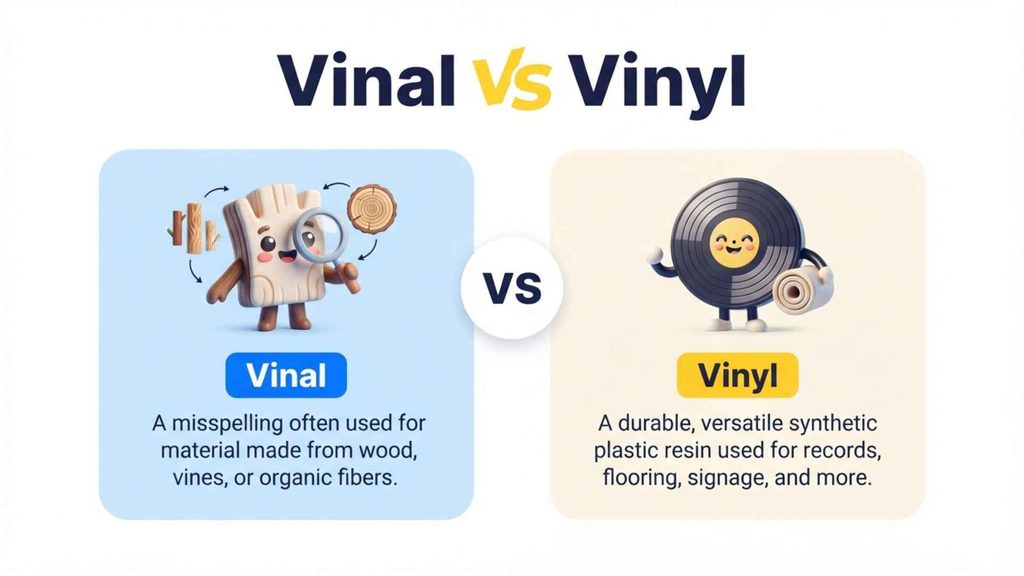
Understanding vinal and vinyl starts with knowing they aren’t interchangeable at all they’re two completely different words that just happen to look and sound alike on the page.
- Vinyl refers to a common plastic (polyvinyl chloride) used in floors, records, and siding.
- Vinal refers to a specific synthetic textile fiber, defined narrowly by regulators.
- Vinyl is the word you’ll see in product descriptions, ads, and everyday speech.
- Vinal appears almost exclusively in technical or legal fabric labeling.
- The two words are not synonyms and shouldn’t be swapped for style.
Example in chat: Friend 1: “My new record player came with a vinyl mat.” Friend 2: “Nice! Vinyl is so satisfying to unbox.”
Vinal vs Vinyl: Which Spelling Is Correct?
When people search vinal vs vinyl, they’re almost always trying to confirm one thing: which spelling to actually use in their sentence. The answer is simpler than it feels.
- Vinyl is correct in the vast majority of everyday, product, and casual contexts.
- Vinal is correct only when referring specifically to the FTC-regulated fiber.
- Spell-check tools often flag “vinal” precisely because it’s so rarely intended.
- If you’re unsure, default to vinyl it covers records, flooring, siding, and more.
- Reserve “vinal” strictly for technical textile writing.
What Does Vinyl Mean in Everyday Use?
In daily conversation, vinyl almost always means one of three things: a type of durable plastic, a music record format, or a home-improvement material like flooring and siding. None of these everyday meanings involve the word “vinal” at all.
Why the Difference Matters
Getting vinal vs vinyl wrong isn’t just a typo issue it can quietly undercut how professional or credible your writing looks, especially in product listings, resumes, or client-facing content.
- Misspellings reduce trust in product descriptions and business communication.
- Search engines and readers both associate correct spelling with credibility.
- Using the wrong word can cause genuine confusion in technical or legal writing.
- Consistent spelling supports better SEO performance for websites and blogs.
- Small errors compound; readers notice patterns, not just single mistakes.
The Core Rule
Here’s the single rule that solves this entire debate: unless you’re specifically writing about the regulated textile fiber, the word you want is always vinyl, never vinal.
- Vinyl = the default, everyday spelling for plastic, records, and flooring.
- Vinal = a narrow, technical exception used almost nowhere else.
- When in doubt, choose vinyl it’s statistically almost always correct.
- Treat “vinal” as a specialist term, not an alternate spelling.
- This rule applies across casual writing, business writing, and marketing copy.
How to Use Vinyl Correctly
Using vinyl correctly is mostly about context pairing it with the right noun so your meaning is instantly clear to any reader, whether you’re describing flooring or a record collection.
- Pair vinyl with a noun: vinyl flooring, vinyl siding, vinyl records.
- Use it as an uncountable material noun (“made of vinyl,” not “a vinyl”).
- Capitalize only at the start of a sentence it’s not a proper noun.
- Use “vinyl” for both the material and the music format.
- Avoid pairing it with “vinal” spelling in product titles or headings.
Correct Examples of Vinyl
Seeing vinyl used correctly in real sentences makes the rule stick far better than any explanation alone.
- “The kitchen has durable vinyl flooring that resists water damage.”
- “She collects vinyl records from the 1970s.”
- “Our house uses vinyl siding for low-maintenance exterior walls.”
- “This tablecloth is made of easy-to-clean vinyl.”
- “He prefers the warm sound of vinyl over digital streaming.”
Incorrect vs Correct Examples
Placing the wrong version next to the right one is one of the fastest ways to spot the pattern permanently.
| Incorrect | Correct |
| “I bought a vinal record.” | “I bought a vinyl record.” |
| “The floor is vinal.” | “The floor is vinyl.” |
| “Vinal siding on the house.” | “Vinyl siding on the house.” |
| “A vinal tablecloth.” | “A vinyl tablecloth.” |
| “Vinal chloride plastic.” | “Vinyl chloride plastic.” |
Why Do People Confuse Vinal and Vinyl?
The confusion between vinal and vinyl isn’t random it comes down to how similar the words sound out loud and how rarely most people actually see “vinal” written down anywhere.
- Both words share nearly identical pronunciation when spoken casually.
- Autocorrect and predictive typing sometimes introduce the swap unintentionally.
- “Vinal” is technically a real word, so spell-check doesn’t always flag it.
- Most people have never encountered vinal’s actual meaning, so it feels interchangeable.
- Fast typing and texting make letter-order slips more common.
Common Mistakes Checklist
Before you hit publish or send, run through this quick list to catch the error before anyone else does.
- Did you mean the plastic material or the record format? Use vinyl.
- Are you writing about a regulated textile fiber? Only then use vinal.
- Did autocorrect silently change your spelling? Double-check before posting.
- Is this for a product listing or marketing copy? Vinyl is almost certainly right.
- Would a reader understand instantly? If not, you may have the wrong word.
Vinal vs Vinyl in Real English
Looking at how native speakers actually write and talk confirms just how one-sided this really is vinyl dominates everyday English by a wide margin.
- News articles, product pages, and blogs overwhelmingly use vinyl.
- “Vinal” appears almost exclusively in fiber-content tags and technical standards.
- Search data shows people typing “vinal” usually mean vinyl.
- Style guides and dictionaries list vinyl as the common-use term.
- Native speakers rarely use “vinal” outside of specialized industries.
Why Do Spelling Mix-Ups Like This Happen So Often?
Words that sound alike but rarely appear side by side create the perfect conditions for confusion. Since most readers only ever encounter vinyl, the rarer spelling starts to feel like a plausible variant even though it isn’t one.
Formal vs Informal Usage
Whether you’re writing a casual text or a formal report, the spelling rule doesn’t actually change only the tone around it does.
- Informal writing: “Grabbed some cool vinyl at the record shop today.”
- Formal writing: “The flooring specification calls for commercial-grade vinyl tiles.”
- Technical/legal writing is the only place “vinal” is appropriate.
- Marketing copy should always default to vinyl for clarity and reach.
- Academic writing about textiles should define vinal if it’s used at all.
Example in DM: Friend 1: “Formal report or quick text, does spelling change?” Friend 2: “Nope, still vinyl either way just keep the tone casual or formal.”
Vinal vs Vinyl Comparison Table
A side-by-side view makes the entire vinal vs vinyl debate easy to settle in seconds.
| Feature | Vinal | Vinyl |
| Common usage | Rare, technical | Extremely common |
| Meaning | Regulated textile fiber | Plastic material / music format |
| Everyday writing | Almost never correct | Almost always correct |
| Industry | Textiles | Flooring, music, construction |
| Search intent | Usually a typo | Intended meaning |
The Easiest Memory Trick
If you only remember one thing from this article, make it this simple trick it works every single time you’re unsure.
- Think “vinYL records” the “Y” matches the plastic and music meaning.
- Remember: vinal rhymes loosely with “final” and stays confined to fabric labels.
- If your sentence involves flooring, records, or plastic, always pick vinyl.
- If your sentence involves regulated fiber content, only then consider vinal.
- When still unsure, say it out loud “vinyl” almost always fits.
Real-Life Situations
Seeing how this plays out in daily life shopping, texting, and working helps the rule feel practical instead of abstract.
- Shopping for flooring: always describe it as vinyl flooring.
- Buying a record: it’s a vinyl record, not vinal.
- Writing a product listing: use vinyl to match what customers search.
- Filling out a fabric-content tag: use vinal only if it’s the true fiber.
- Texting a friend about your collection: vinyl, every time.
Expert Tips
A few extra habits from experienced editors and copywriters can help you avoid this mistake permanently.
- Run a quick find-and-replace check for “vinal” before publishing content.
- Add vinyl to your custom dictionary so autocorrect stops flagging it.
- When editing others’ work, treat “vinal” as a red flag worth double-checking.
- Keep a style guide note reminding writers vinyl is the default spelling.
- Read your sentence aloud your ear often catches what your eye misses.
Vinyl Flooring vs Vinyl Records: Two Popular Meanings
Most searches for this topic actually trace back to one of two products, and both use the exact same spelling.
- Vinyl flooring is prized for being water-resistant and low-maintenance.
- Vinyl records are analog music discs enjoying a strong modern revival.
- Both terms use identical spelling the only difference is context.
- Vinyl siding is a third common use, popular for home exteriors.
- None of these products are ever correctly spelled with an “a.”
FAQ
Is “vinal” a misspelling of “vinyl”?
In almost every everyday context, yes vinal is what people type when they actually mean vinyl, the common plastic or record material.
What does vinal actually mean?
Vinal is a specific, FTC-regulated textile fiber name, unrelated to the plastic or music meanings most people associate with vinyl.
Which spelling should I use for flooring?
Always use vinyl for flooring “vinal flooring” is incorrect and not a recognized industry term.
Why does autocorrect sometimes accept “vinal”?
Because vinal is a genuine dictionary word, spell-checkers won’t flag it, even though vinyl is almost always what you meant.
Are vinal and vinyl pronounced the same?
They sound extremely similar when spoken quickly, which is a major reason the vinal vs vinyl confusion keeps happening.
Is vinyl a plastic or a fabric?
Vinyl is a type of plastic (polyvinyl chloride), commonly used for flooring, siding, and music records not a fabric.
How can I remember the correct spelling?
Link vinyl to “vinYL records” in your mind, and reserve “vinal” only for rare, technical fiber-labeling situations.
Conclusion
At the end of the day, vinal vs vinyl comes down to one simple habit: default to vinyl unless you’re writing about a specific, regulated textile fiber. Vinyl covers flooring, records, siding, and nearly every everyday use you’ll ever write about, while vinal stays confined to a narrow technical corner most people never need. Once you connect vinyl to its “Y,” the mix-up stops for good. Keep that memory trick handy, double-check before you publish, and you’ll spell it right every time no more second-guessing, just confident, clear writing.

Amelia Brooks is a US-based author known for inspiring stories on meaning, growth, and hope, blending insight with simple, engaging storytelling.