
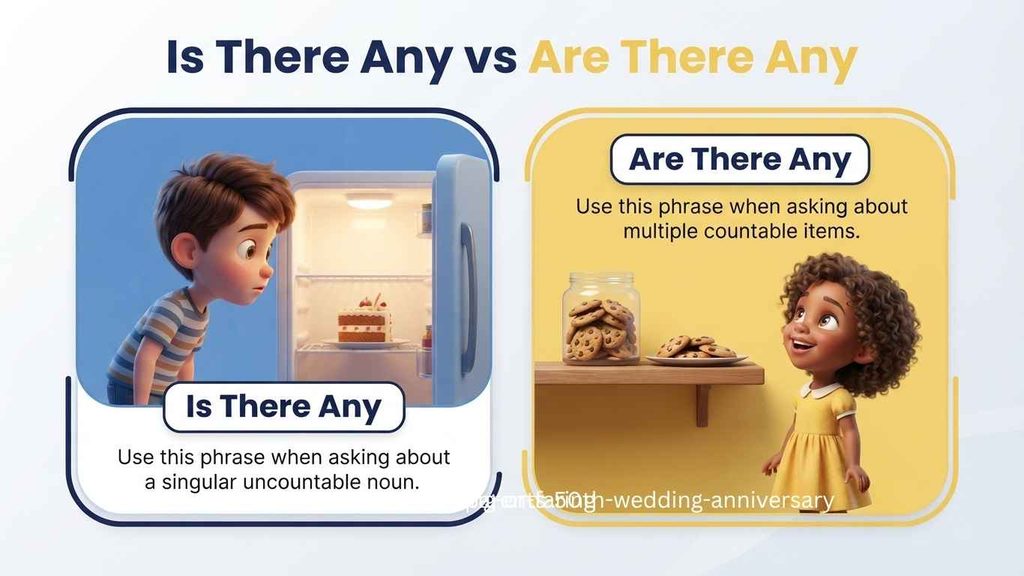
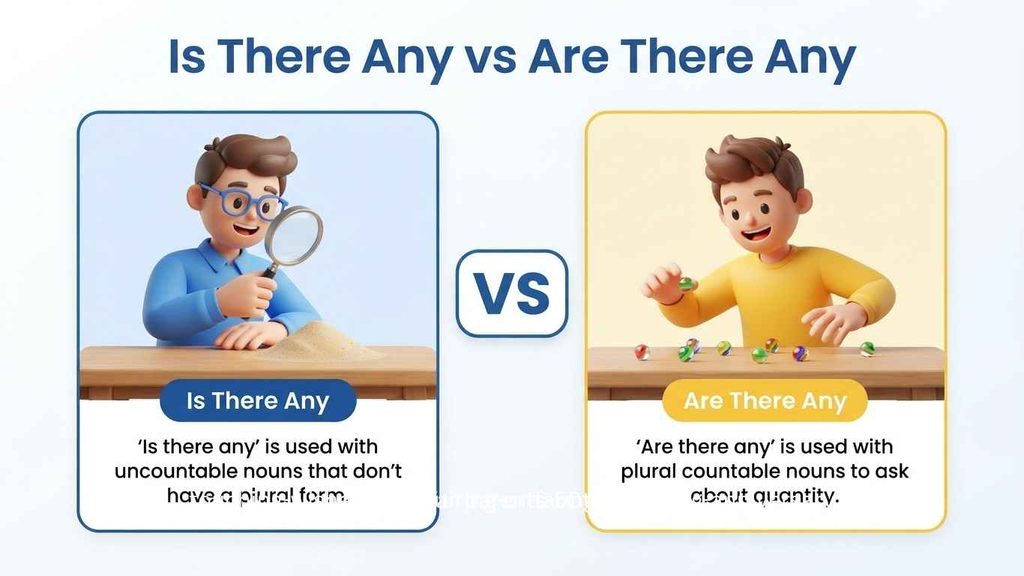
Ever paused mid-sentence, unsure whether to say “is there any” or “are there any,” and just hoped it sounded right? You’re not alone this tiny grammar choice trips up even confident English speakers, because the rule feels invisible until someone points it out.
The good news is that the answer comes down to one simple question about the noun you’re using. In this guide, you’ll get clear rules, real examples, a handy comparison table, and answers to the questions people search most, so is there any confusion left after this disappears for good. Keep reading, and you’ll never second-guess this phrase again.
“Is There Any” vs “Are There Any”: Differences and usage
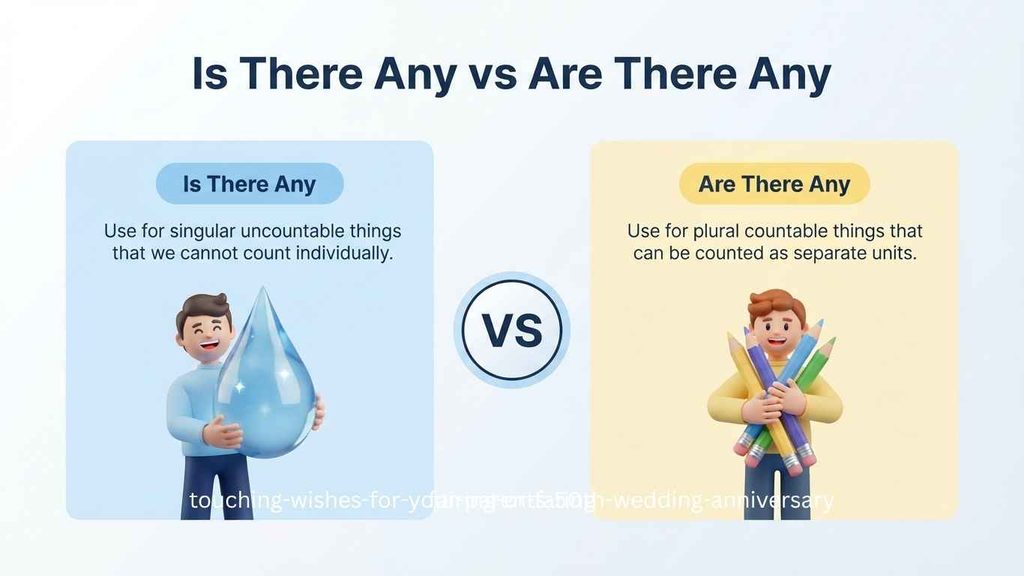
The choice between is there any and are there any depends entirely on whether the noun that follows is countable or uncountable. Is there any pairs with uncountable nouns things like water, milk, sugar, advice, or information that you can’t count one by one. Are there any pairs with plural countable nouns things like books, apples, tickets, or ideas that you can count individually.
Think of it as a two-second mental checklist. Ask yourself: can I put a number in front of this noun? If you can say “three apples” but not “three waters” (in the everyday sense), you already know which phrase to use. This is called subject-verb agreement, and it’s one of the most common ESL grammar mistakes learners make.
| Uncountable Noun (Is There Any) | Countable Noun (Are There Any) |
| Is there any bread in the pantry? | Are there any slices of bread left? |
| Is there any chance of rain? | Are there any storms forecasted this week? |
| Is there any information on this topic? | Are there any articles on this subject? |
| Is there any coffee left? | Are there any mugs in the cupboard? |
Is there any: Explained
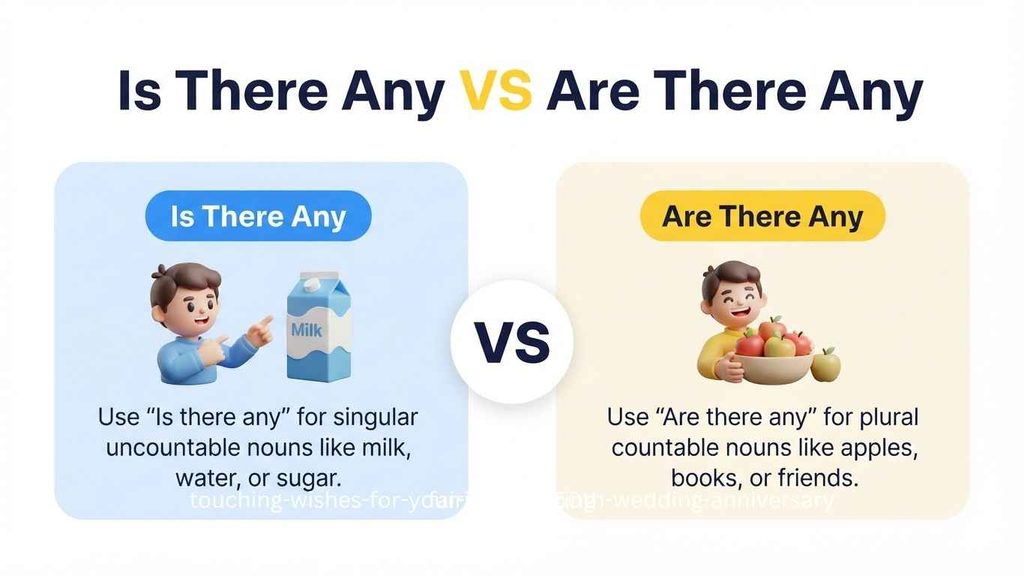
Is there any is used when you’re asking whether something exists, especially with uncountable nouns or abstract ideas. You’re asking about a substance, a concept, or a general quantity rather than a specific number of items.
Usage with Uncountable Nouns
- “Is there any water in the bottle?” water is uncountable
- “Is there any advice for me?” advice can’t be counted
- “Is there any sugar left?” the verb stays singular
- “Is there any love or happiness in that story?” abstract, uncountable concepts
Quick Tip: Reach for is there any whenever you’re asking about a substance, an emotion, or a general amount. It’s the natural, polite choice in everyday conversational English.
Are there any: Explained
Are there any is used when you’re asking about multiple, countable items and you don’t know the exact number. It signals that you expect a plural noun to follow.
Here’s the quick breakdown:
- Start with “are” the plural form of the verb “to be”
- Add “there” this introduces existence
- Follow with “any” this shows an unspecified amount
- Use a plural noun books, tickets, students, ideas
- Form the full question “Are there any tickets left?”
Examples in action:
- Are there any cookies left in the jar?
- Are there any students in the classroom right now?
- Are there any tickets available for tonight’s concert?
What Is the Difference Between “Some” and “Any” in Questions?
This is one of the most searched follow-up questions, and it matters because some and any are both quantifiers, but they don’t behave the same way. In statements, English speakers usually say “there is some water” but in questions and negatives, any takes over: “is there any water?” or “there isn’t any water.”
- Use some in positive statements and polite offers (“Would you like some tea?”)
- Use any in questions and negative sentences (“Is there any tea left?”)
- Both work with countable and uncountable nouns, so the noun type still decides “is/are”
- This swap is a core rule in English grammar that native speakers use instinctively
Understanding this some vs any distinction makes your questions sound far more natural, especially if English isn’t your first language.
“Is there any” vs “Is there a”
Is there any works with uncountable nouns or general amounts think water, sugar, or time. Is there a, on the other hand, works with singular countable nouns, when you’re asking about one specific item a chair, a book, a meeting.
- Is there any → uncountable nouns or general ideas
- Is there a → singular, countable nouns
- Mixing the two up is one of the fastest ways to sound unnatural in English
Using “Is There Any” with Uncountable Nouns
When you’re asking about a substance or a concept that resists counting, is there any is the correct, polite form. “Is there any advice you can give me?” and “is there any information available?” both sound natural because advice and information are mass nouns.
Using “Is There A” with Singular Nouns
When you want to know about one specific object, switch to is there a. “Is there a pen on the table?” or “is there a meeting today?” both point to a single, identifiable item rather than a general quantity.
Examples of using ‘is there any’ in a sentence:
- Is there any milk left in the fridge?
- Is there any sugar in the jar?
- Is there any information about the meeting?
- Is there any chance of rain today?
- Is there any evidence to support this claim?
- Is there any time to finish this task?
- Is there any truth to that rumor?
- Is there any point in arguing further?
Examples of using ‘Are there any’ in a sentence:
- Are there any cookies left in the jar?
- Are there any students in the classroom right now?
- Are there any tickets available for the concert tonight?
- Are there any new messages in my inbox?
- Are there any discounts for students at this store?
- Are there any meetings scheduled for today?
- Are there any seats left on the train?
- Are there any questions before we begin?
Common Mistakes to Avoid When Using “Is There Any” and “Are There Any”
Even confident writers slip up here, usually because they focus on the word “any” instead of the noun attached to it. The most frequent error is treating a countable noun as if it were uncountable, or the reverse.
| Mistake | Correction |
| Is there any apples left? | Are there any apples left? |
| Are there any information available? | Is there any information available? |
| Is there any chairs in the room? | Are there any chairs in the room? |
| Are there any money in the account? | Is there any money in the account? |
Notice that “money” and “information” feel like they should be plural but are actually uncountable nouns in standard English. This is exactly why memorizing a short list of tricky mass nouns money, information, advice, news, furniture saves you from repeated mistakes.
Which Phrase Should You Use in Formal Writing vs Casual Speech?
In formal writing emails, reports, academic papers both is there any and are there any remain correct, but writers tend to favor complete, precise phrasing like “Is there any documentation available?” rather than shortened or dropped forms. In casual speech, the same rule applies grammatically, though contractions and quicker pacing are common (“Any coffee left?”).
- Formal contexts still require correct subject-verb agreement
- Casual speech may drop “is there” entirely but the underlying rule doesn’t change
- Business and academic writing benefit from full, grammatically precise questions
- Regardless of tone, the countable-vs-uncountable rule always applies
Quick Grammar Rule: How to Choose the Right Phrase Every Time
If you only remember one rule from this entire guide, make it this one: check the noun first, then pick the verb. This tiny habit eliminates almost every mistake related to is there any, are there any, and is there a.
- Ask: “Can I count this noun?” If no → is there any
- Ask: “Is there more than one of these?” If yes → are there any
- Ask: “Am I asking about one specific thing?” If yes → is there a
- When in doubt, mentally swap in “some” if “some water” sounds right, use is there any
Conclusion
Choosing correctly between is there any and is there a really comes down to one habit: check the noun before you speak. Use is there any with uncountable nouns like water, sugar, or information, and switch to is there a when you mean one specific, countable item like a book or a chair.
Are there any takes over once you’re asking about multiple countable things, from tickets to students to messages. Once this small rule clicks, is there any hesitation you used to feel disappears, and your questions start sounding confident and natural without extra thought. Practice with real sentences from your own day, and the habit will stick faster than any list of rules ever could.
Frequently Asked Questions
What is the difference between “is there any” and “is there a”?
Is there any is used for uncountable nouns or general amounts, while is there a is used for singular, countable nouns when asking about one specific item.
When should I use “are there any”?
Use are there any with plural, countable nouns when asking about multiple items, such as books, tickets, or students, especially when the exact number is unknown.
Can “is there any” be used with plural nouns?
No. Is there any is reserved for uncountable nouns or general quantities; for plural, countable nouns, are there any is the correct choice instead.
Is “is there a” polite to use in questions?
Yes, is there a sounds polite and natural when asking about one specific item, and it keeps your question clear, direct, and respectful.
How do I choose between “is there any” and “are there any”?
Check whether the noun is countable first. If it’s uncountable, use is there any; if it’s plural and countable, use are there any instead.
Why does “is there any information” sound correct but “is there any apples” doesn’t?
Because “information” is an uncountable noun while “apples” is countable and plural, so is there any only fits the first, and are there any fits the second.
Does British English use “is there any” differently than American English?
No, the core rule of is there any stays the same in both varieties; the difference lies mainly in vocabulary choices, not in this grammar rule itself.

Amelia Brooks is a US-based author known for inspiring stories on meaning, growth, and hope, blending insight with simple, engaging storytelling.