Ever caught yourself pausing mid-sentence, unsure whether you meant “indulgent” or “sober,” and wondering if anyone would even notice the slip? Most of us have been there reaching for a word that feels right but second-guessing whether it actually fits the moment.
That’s exactly what this guide is here to fix. We’ll walk through the true meaning of indulgent vs. sober, show you real examples, and help you use sober with total confidence in any conversation. By the time you finish reading, picking the right word won’t feel like guesswork anymore it’ll just feel natural.
Indulgent
Curious why one word can sound like a treat and the other like a warning label? That curiosity is exactly why indulgent vs. sober trips people up so often.
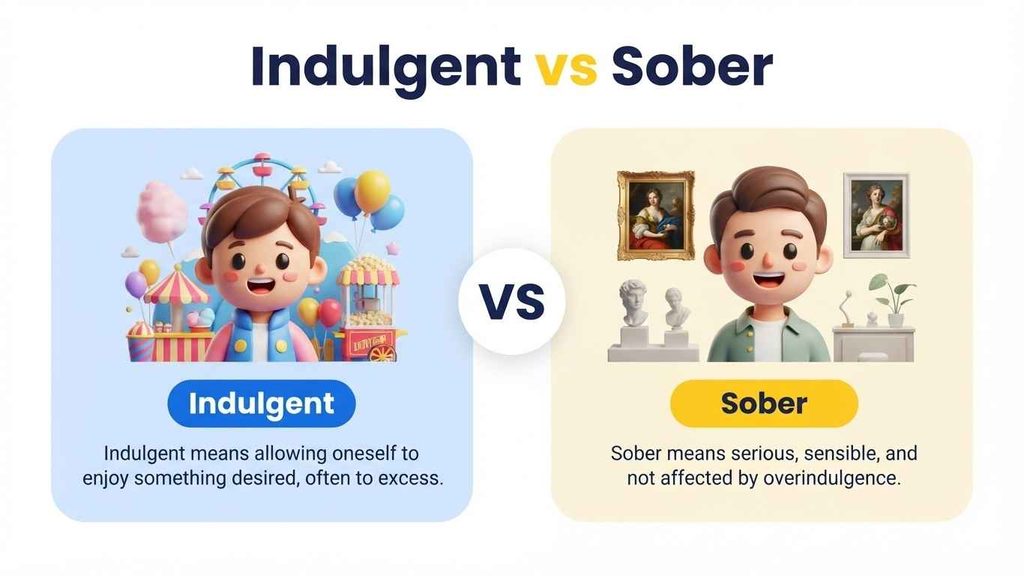
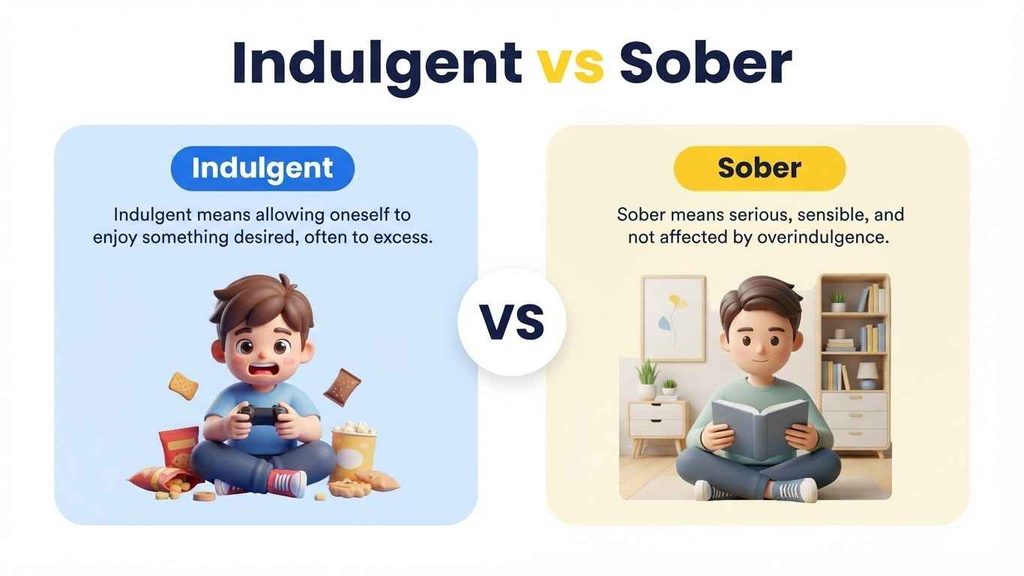
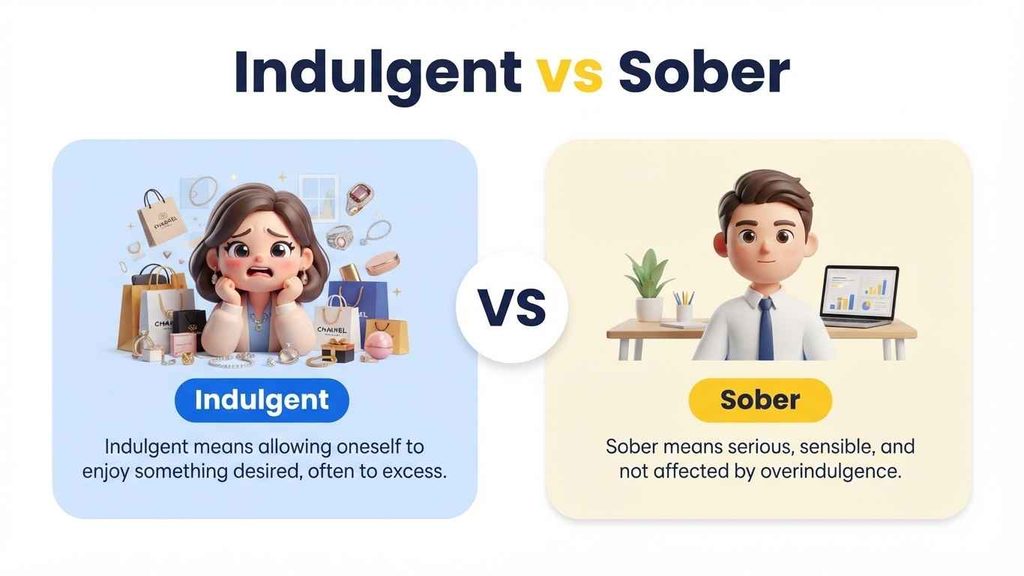
Indulgent describes a person, action, or moment that gives in to pleasure, comfort, or excess without much worry about the consequences. It’s the word you reach for when something feels generous, self-gratifying, or a little too good to resist.
What Does “Indulgent” Actually Mean In Everyday Language?
- Pampering yourself or someone else with extra comfort or care
- Giving in to a craving instead of resisting it
- Being lenient with rules, especially around treats or rewards
- Choosing luxury over restraint in food, spending, or rest
- Showing generosity that borders on excess
| Aspect | What “Indulgent” Signals |
| Tone | Warm, generous, playful |
| Common use | Food, spa days, parenting, spending |
| Risk | Can suggest lack of self-control |
| Best setting | Casual, personal, emotional writing |
Example in texting: Friend 1: “I ate the whole dessert menu tonight lol.” Friend 2: “So indulgent 😂 you deserved it though.”
Sober
Ever wonder why “sober” carries so much weight in a single word? It’s because sober stands for something people trust clarity, control, and honesty.
Sober means being free from the influence of alcohol or drugs, but it also describes a mindset: careful, serious, and clear-headed. When someone is being sober, they’re thinking straight and acting with intention rather than impulse.
What Does “Sober” Mean Beyond Just Not Drinking?
- Staying clear-headed during stressful moments
- Making rational decisions instead of emotional ones
- Speaking with a serious and grounded tone
- Practicing restraint even when tempted
- Showing discipline in daily choices
| Aspect | What “Sober” Signals |
| Tone | Calm, serious, controlled |
| Common use | Recovery, professional settings, reflection |
| Risk | Can sound overly formal if misused |
| Best setting | Professional, medical, reflective writing |
Example in chat: Friend 1: “How was the office party for you?” Friend 2: “Stayed sober the whole night, just wanted a clear head for Monday.”
What Does Indulgent vs. Sober Really Mean?
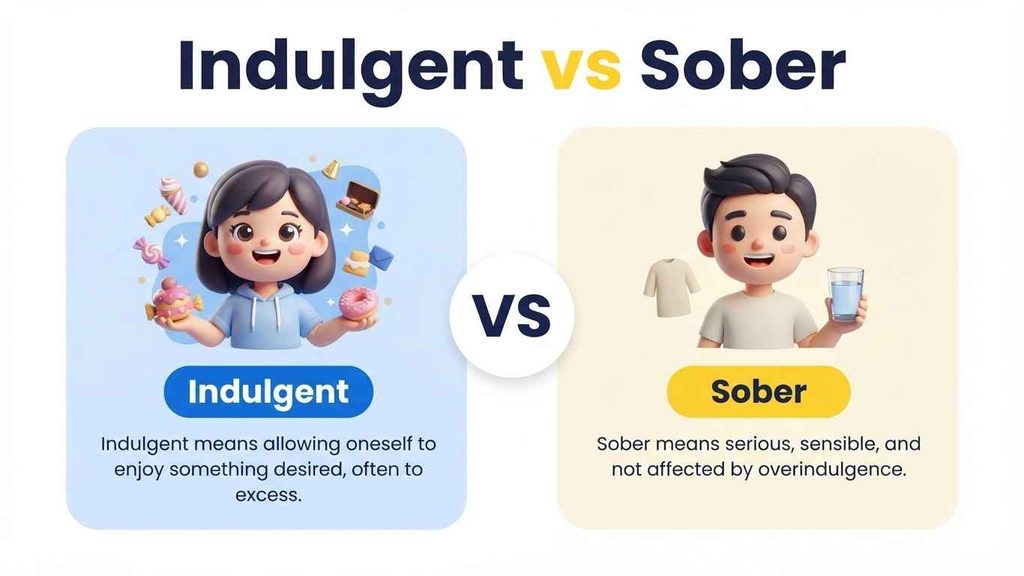
People type this exact question into Google because these two words sit on opposite ends of the same emotional spectrum pleasure versus control.
In simple terms, indulgent is about giving yourself permission to enjoy something fully, while sober is about holding back and staying grounded. Neither word is “better” they just describe different moods, situations, and intentions. Choosing between indulgent and sober really comes down to what story you want your sentence to tell.
- Indulgent = pleasure-first, low restraint, generous mindset
- Sober = control-first, high restraint, disciplined mindset
- Both words can describe behavior, not just people
- Context, not grammar, decides which word fits
- Misusing either can flip the entire meaning of your sentence
Example in texting: Friend 1: “Was the retreat relaxing?” Friend 2: “Super indulgent massages, wine, zero schedule.”
How To Properly Use The Words In A Sentence
Struggling to picture these words in action? A few side-by-side examples usually clear up the confusion faster than any definition can.
Using indulgent and sober correctly is less about grammar rules and more about matching the word to the mood of your sentence. Get the mood right, and the word almost picks itself.
How Is Indulgent Used In Everyday Conversations?
- My indulgent grandmother always sneaks me extra dessert
- He was indulgent with his kids, giving them anything they wanted
- She booked an indulgent spa weekend after a rough month
- The menu was full of indulgent, chocolate-heavy desserts
- He felt indulgent buying that designer jacket on a whim
- He stayed sober through the whole wedding reception
- She gave a sober update on the company’s finances
- The sober driver made sure everyone got home safe
- After the scare, he had a sober moment of reflection
- Her sober tone made the meeting feel more serious
Example in chat: Friend 1: “How do I describe my aunt who spoils everyone?” Friend 2: “Just say she’s incredibly indulgent, that word does it all.”
More Examples Of Indulgent & Sober Used In Sentences
Want more proof these words aren’t interchangeable? Seeing them stacked side by side makes the contrast almost impossible to miss.
Reading real examples is one of the fastest ways to lock in the difference between indulgent and sober for good, especially if you’re a visual learner.
Which Real-Life Examples Show The Difference Best?
- She indulged in a shopping spree after her big win
- He was indulgent with his time, always helping neighbors
- The hotel’s indulgent spa package included massages and facials
- He indulged his sweet tooth with a giant slice of cake
- The vacation felt indulgent, with a private pool and gourmet food
- She has been sober for five years now
- The teacher gave a sober talk about study habits
- He was sobered by the news of the accident
- The manager’s sober assessment surprised the whole team
- She stayed sober-minded during the entire crisis
Example in texting: Friend 1: “Describe your weekend in one word.” Friend 2: “Indulgent. Zero regrets.”
Indulgent vs. Sober: Key Differences At A Glance
Sometimes a definition just isn’t enough you need to see both words laid out to really feel the contrast between them.
This quick comparison strips away the extra explanation so you can see exactly where indulgent and sober part ways, and why swapping them changes your whole message.
What’s The Fastest Way To Tell These Words Apart?
- Indulgent leans toward pleasure; sober leans toward control
- Indulgent suits casual talk; sober suits formal talk
- Indulgent can imply excess; sober implies restraint
- Indulgent feels warm and playful; sober feels serious and calm
- Indulgent often describes treats; sober often describes mindset
| Feature | Indulgent | Sober |
| Core meaning | Enjoying pleasure freely | Staying clear-headed and controlled |
| Typical tone | Playful, generous | Serious, disciplined |
| Common contexts | Food, spending, parenting | Recovery, work, reflection |
| Opposite feeling | Restraint | Excess |
| Reader’s takeaway | Warmth, indulgence | Trust, clarity |
Example in chat: Friend 1: “Is ‘sober’ only about drinking?” Friend 2: “Nope, it also just means clear-headed and serious.”
Why Do People Confuse Indulgent And Sober?
This question comes up constantly because both words describe a state of mind, not just an action and states of mind can feel blurry.
People mix up indulgent and sober mostly because they’re thinking about tone rather than meaning. Once you separate the feeling a sentence gives off from the literal definition, the confusion usually disappears.
- Both words can describe a person’s overall personality
- Both can modify behavior in almost any setting
- Writers sometimes chase a tone instead of the true meaning
- Autocorrect and translation tools occasionally swap similar-sounding words
- Non-native speakers may confuse them due to opposite connotations
Example in texting: Friend 1: “I always mix these two up honestly.” Friend 2: “Just remember: indulgent = treat yourself, sober = hold back.”
Common Mistakes To Avoid
Nobody wants to send a message that accidentally means the opposite of what they intended but with these two words, it happens more than you’d think.
Since indulgent and sober sit on opposite ends of the same scale, one wrong swap can completely flip your sentence’s meaning.
What Are The Most Common Slip-Ups With These Words?
- Writing indulgent when you actually mean sober, and vice versa
- Pairing both words in one sentence without clarity
- Using indulgent in a serious, professional context by mistake
- Using sober to describe a fun, celebratory moment
- Ignoring your audience when choosing which word fits
| Mistake | Wrong Example | Correct Fix |
| Word swap | “I had an indulgent night at the office meeting.” | “I had a sober night at the office meeting.” |
| Reverse swap | “I had a sober dessert after dinner.” | “I had an indulgent dessert after dinner.” |
| Mixing both | “It was an indulgent and sober vacation.” | “It was an indulgent vacation.” |
| Ignoring tone | Using indulgent in a formal report | Use sober for formal reports |
Example in chat: Friend 1: “I just texted my boss ‘had an indulgent weekend of paperwork’ lol.” Friend 2: “That should’ve been sober weekend, honestly 😂”
Tips To Avoid These Mistakes
Worried you’ll still mix these words up after reading this far? A few quick habits can make the right choice almost automatic.
Getting indulgent and sober right consistently just takes a bit of practice and a habit of pausing before you hit send.
How Can You Remember Which Word Fits Best?
- Check the meaning before typing either word
- Consider your audience and the setting you’re writing for
- Read the sentence aloud to test how it feels
- Compare it against a correct example sentence
- Avoid stacking both words together unless contrast is the goal
- Practice using each word separately until it feels automatic
Example in texting: Friend 1: “How do I stop mixing these words up?” Friend 2: “Say the sentence out loud first, you’ll hear which one fits.”
Synonyms And Related Words For Indulgent And Sober
Looking for other ways to say the same thing without repeating yourself? A strong list of related words can instantly sharpen your writing.
Expanding your vocabulary around indulgent and sober makes your writing feel richer and helps you avoid repeating the same word over and over.
What Are Some Close Synonyms For Each Word?
- Indulgent synonyms include lenient, pampering, generous, and permissive
- Sober synonyms include clear-headed, disciplined, serious, and restrained
- Overindulgent describes taking indulgence to an extreme
- Temperate is a formal synonym close to sober
- Self-gratifying captures the emotional core of indulgent behavior
| Word | Related Synonyms |
| Indulgent | Lenient, pampering, generous, permissive, self-gratifying |
| Sober | Clear-headed, disciplined, restrained, serious, temperate |
| Opposite of Indulgent | Sober, strict, restrained |
| Opposite of Sober | Indulgent, reckless, excessive |
Example in chat: Friend 1: “Need a fancier word for sober in my essay.” Friend 2: “Try ‘temperate,’ it sounds more formal but means the same thing.”
Context Matters
Ever said the “right” word but still got a weird reaction? That usually means the word was correct but the context was wrong.
Choosing between indulgent and sober depends heavily on where you’re speaking, who’s listening, and what tone the moment calls for.
How Does Setting Change Which Word You Should Use?
- Professional settings usually call for sober language
- Social settings often welcome indulgent language comfortably
- Marketing copy may lean indulgent to create excitement
- Formal writing almost always favors sober phrasing
- Cultural norms can shift which word feels more natural
- In business reports, sober language signals responsibility and clarity
- Among friends, indulgent language signals fun and comfort
- In advertising, indulgent language sells excitement and desire
- In recovery communities, sober carries deep personal meaning
- In creative writing, either word can set the entire tone
Example in texting: Friend 1: “Should my work email sound indulgent or sober?” Friend 2: “Definitely sober, save indulgent for our group chat.”
When Should You Use Indulgent Instead Of Sober?
This is one of the most-searched questions about these two words, and the answer is simpler than most people expect.
Reach for indulgent when your sentence is about pleasure, comfort, or generosity and save sober for moments that call for control, seriousness, or clarity.
- Use indulgent for treats, rewards, and self-care moments
- Use indulgent when describing generous or lenient behavior
- Use sober for anything requiring focus or discipline
- Use sober when discussing recovery or clear-headed decisions
- Switch between them based on the emotional weight of your sentence
Example in chat: Friend 1: “How do I describe treating myself to a big dinner?” Friend 2: “Call it an indulgent dinner, that word fits perfectly.”
Why Word Choice Matters In Communication
Ever notice how one wrong word can completely change how a message lands? That’s the quiet power of precise language.
Picking between indulgent and sober isn’t just a grammar exercise it shapes how confident, careful, or fun your writing sounds to the reader.
Can The Wrong Word Actually Change How People See You?
- Precise word choice builds trust with your reader
- The wrong word can create confusion about your intent
- Strong vocabulary shows expertise in writing and speech
- Word choice reflects your awareness of tone and audience
- Small word swaps can shift an entire message’s meaning
Example in texting: Friend 1: “Does word choice really matter that much?” Friend 2: “Yeah, one wrong word and your whole message reads different.”
Indulgent vs. Sober In Pop Culture And Everyday Life
Ever noticed these words showing up in wellness blogs, recovery stories, and food reviews all at once? They’ve quietly become part of everyday language.
Both indulgent and sober show up constantly in lifestyle writing, recovery conversations, and food or travel content, each carrying its own emotional flavor.
- Indulgent appears often in food blogs and spa marketing
- Sober is central to recovery and mental-health conversations
- Wellness culture uses both words to describe balance
- Travel writers use indulgent to sell luxury getaways
- Personal essays use sober to describe turning points in life
| Context | Word Commonly Used | Example Phrase |
| Food & dessert reviews | Indulgent | “An indulgent slice of chocolate cake” |
| Recovery stories | Sober | “Five years sober and counting” |
| Travel & spa marketing | Indulgent | “An indulgent weekend retreat” |
| Workplace reflections | Sober | “A sober look at our numbers” |
Example in chat: Friend 1: “Saw a blog post about staying sober during travel.” Friend 2: “Interesting twist, most travel content is all about being indulgent.”
Faqs
What does “indulgent” mean exactly?
Indulgent means allowing yourself or others to enjoy pleasure or comfort freely, often without worrying about consequences.
What does “sober” mean besides not drinking?
Sober also means clear-headed, serious, and disciplined, describing a controlled and thoughtful mindset in any situation.
Can indulgent and sober be used interchangeably?
No. In the indulgent vs. sober comparison, the two words carry opposite meanings and can’t swap without changing your sentence.
Is indulgent always a negative word?
Not at all. Indulgent simply describes pleasure or generosity, though it can hint at excess depending on context.
When is sober the better word choice?
Choose sober for professional, serious, or recovery-related writing where clarity and control matter most.
Why do people mix up indulgent and sober so often?
People confuse them in the indulgent vs. sober debate because both describe mindset, and tone can blur their opposite meanings.
How can I remember the difference for good?
Link indulgent to pleasure and sober to control, then double-check your sentence’s tone before choosing either word.
Conclusion
At the heart of it, indulgent vs. sober comes down to one simple contrast: pleasure versus control. Indulgent captures moments of pampering, generosity, and enjoyment, while sober reflects discipline, clarity, and seriousness. Neither word is right or wrong on its own everything depends on the tone and context of your sentence.
Next time you’re unsure which word fits, pause and ask what feeling you’re going for. If it’s warmth and treat-yourself energy, indulgent is your word. If it’s focus and restraint, sober wins every time. Getting comfortable with indulgent vs. sober means your writing will always land exactly the way you intended clear, confident, and never confusing.

Amelia Brooks is a US-based author known for inspiring stories on meaning, growth, and hope, blending insight with simple, engaging storytelling.