
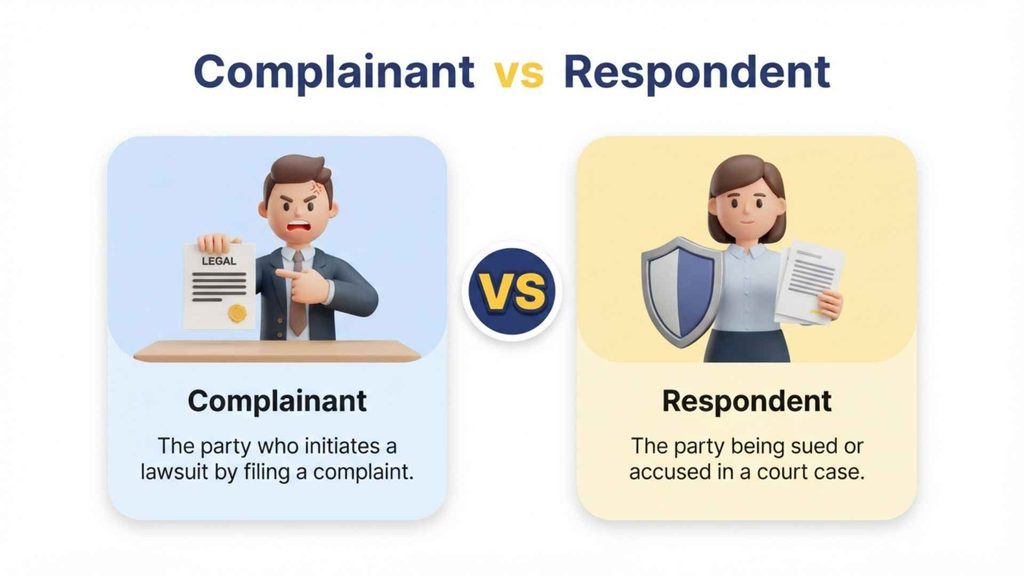
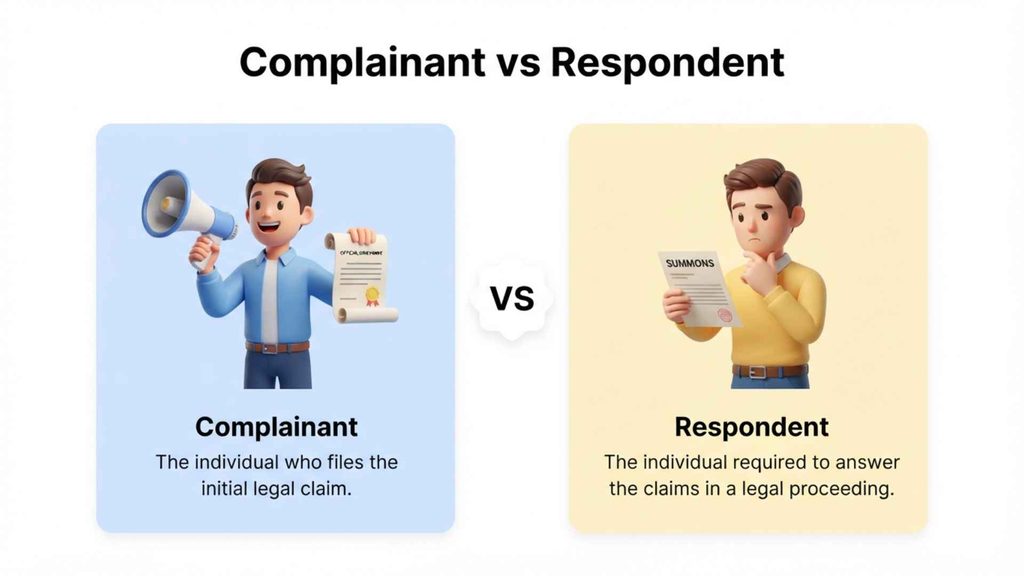
Ever read a legal notice and felt your stomach drop because you weren’t sure which side you were actually on? You’re not alone, these two words trip up even people who’ve been through a dispute before, and the confusion usually shows up at the worst possible moment.
This guide breaks down the true Complainant vs Respondent meaning in plain English, with real examples from court, family law, and workplace cases. You’ll walk away knowing exactly who’s who, why it matters, and how the respondent role differs from a defendant. Keep reading it gets clearer fast.
Key related terms in this article: litigant, plaintiff, defendant, appellee, civil lawsuit, legal dispute, court proceeding, appeal, correspondent, questionnaire participant, legal system, complaint.
What’s the difference between Complainant and Respondent?
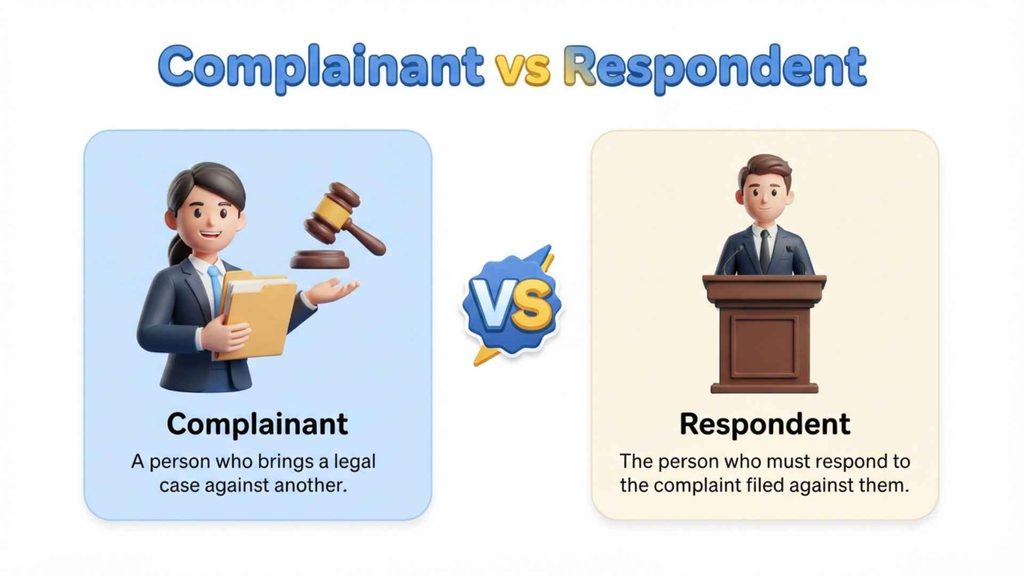
The Complainant vs Respondent split comes down to who starts the fight and who has to answer for it. A complainant files the complaint; a respondent responds to it. Simple on paper, messier in real life.
How Are These Roles Assigned in a Legal Case?
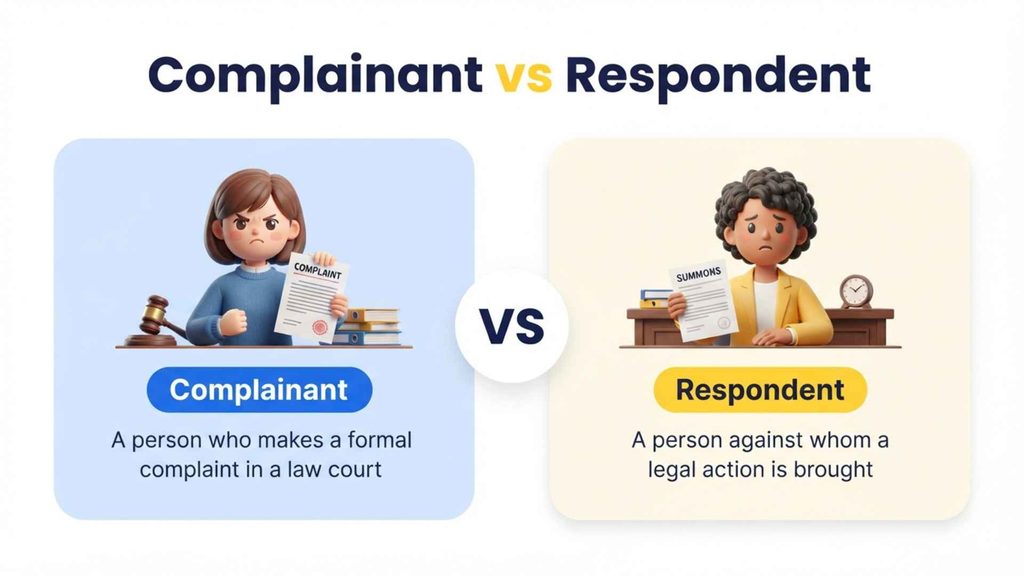
- The complainant is the person or party who initiates the legal action.
- The respondent is the party named to answer the claim.
- Roles can shift on appeal, where the original defendant may become the respondent.
- A civil lawsuit typically uses complainant/respondent instead of plaintiff/defendant in certain systems.
- Tribunals, HR panels, and family courts often prefer this pairing over “plaintiff vs defendant.”
- Both terms describe procedural position, not guilt or innocence.
- The respondent must file a formal reply, called an answer or response.
| Term | Role in the Case | Common Setting |
| Complainant | Brings the complaint | Civil courts, HR, tribunals |
| Respondent | Answers the complaint | Appeals, family law, arbitration |
| Plaintiff | Synonym for complainant | Civil lawsuits |
| Defendant | Related term to respondent | Criminal and civil cases |
As an adjective respondent is
Outside law, respondent also works as an adjective. Used this way, it describes something disposed of or expected to respond, answering, corresponding, or matching up with something else.
- Disposed to respond when prompted or questioned.
- Answering in a way that fits the situation.
- Corresponding closely with an expectation or condition.
- Rarely used in casual speech; mostly formal or archaic writing.
- Historical writers, including Francis Bacon, used it to describe wealth that matched or corresponded to contributions made.
Example in a legal sentence: “The court found the tenant’s actions respondent to the terms of the original lease.”
Related comparisons
The Complainant vs Respondent pairing sits inside a bigger web of legal vocabulary. Here’s how nearby terms connect:
- Complainant vs actor in some legal traditions, “actor” is an older term for the party bringing suit.
- Respondent vs defendant closely related; defendant is often used at trial, respondent at appeal.
- Complainant vs plaintiff plaintiff is treated as a direct synonym of complainant.
- Complainant vs bill a “bill” can refer to the formal document a complainant files.
- Respondent vs appellee appellee is the appeals-stage equivalent of respondent.
- Respondent vs versus “versus” simply separates the two named parties in a case title.
- Court vs respondent a court is the forum; a respondent is a party appearing before it.
- Correspondent vs respondent both share a root meaning “to answer or match,” but correspondent usually refers to communication, not legal answering.
Complainant vs Respondent Meaning in Simple Words
Strip away the legal jargon and it’s this: the complainant says “something happened to me,” and the respondent says “here’s my side of it.” One speaks first; the other answers.
- Think of it as question and answer at an institutional level.
- The complainant carries the burden of raising the issue.
- The respondent carries the burden of replying formally.
- Neither label decides who’s right that’s for the decision-maker.
- This meaning holds across courts, schools, workplaces, and online dispute platforms.
Complainant
A complainant is the party that brings a formal complaint or civil action against another. In everyday use, it also simply means someone who makes a complaint about anything.
Synonyms & related words for complainant
- Litigant a general term for anyone involved in a lawsuit.
- Plaintiff the closest direct synonym, common in civil courts.
- Complainaunt an older, now rare spelling of the same word.
Alternative forms
- Complainaunt an archaic form found in older legal and literary texts, still occasionally referenced in etymology discussions of complainant.
English
As an English noun, complainant entered legal vocabulary to describe the initiating party in a dispute, distinct from the person accused or answering.
Noun
- (legal) The party that brings a civil lawsuit against another; the plaintiff.
- One who makes a complaint, in or out of a legal setting.
- Used in both formal filings and general descriptions of grievance.
Example in a legal sentence: “The complainant alleged that the company failed to honor the contract.”
Who Is the Complainant in a Case?
The complainant is whoever formally raises the issue filing paperwork, naming a respondent, and asking a court or panel to step in.
- Usually the first party listed in a case title.
- Can be an individual, a company, or a government body.
- Responsible for providing evidence supporting the claim.
- Doesn’t have to win to remain the complainant on record.
- In HR settings, often the employee who reports misconduct.
Respondent
A respondent is the party required to answer a complaint, appeal, or formal inquiry. The word also describes someone who simply responds to a survey or question.
Synonyms & related words for respondent
- Defendant the closest related term, especially at the trial stage.
English
In English legal writing, respondent marks the party on the receiving end of a claim the one obligated to reply through the court.
Noun
| Sense | Meaning |
| Legal | Person who answers for the defendant before a court; on appeal, the state may be the respondent |
| General | One who responds; related to correspondent |
| Research | A participant who answers a questionnaire or survey |
Adjective
- Disposed or expected to respond.
- Answering in form or substance.
- According or matching with expectations.
- Corresponding in nature to something else.
Example in a legal sentence: “The insurer’s payout was respondent to the damages claimed.”
Who Is the Respondent in a Case?
The respondent is the party named to defend against the complainant’s claim whether in a lawsuit, an appeal, or an administrative hearing.
- Files a formal response or answer to the complaint.
- May request dismissal of the claim entirely.
- Can appear in civil, family, and administrative proceedings.
- In appeals, often the party that won at the lower court.
- Has the right to legal representation, same as the complainant.
Complainant vs Respondent in Court: Key Legal Differences
Courtrooms use this pairing most often in civil, tribunal, and appellate settings, where “plaintiff/defendant” doesn’t quite fit the procedure.
- Complainant files the initial claim or petition.
- Respondent receives service and must reply within a set deadline.
- Courts assign case numbers listing complainant first, respondent second.
- Either side may bring witnesses and documentary evidence.
- A judgment resolves the dispute regardless of who filed first.
- Costs can be awarded against either party depending on outcome.
- Appeals may reverse the original complainant/respondent roles.
| Stage | Complainant’s Role | Respondent’s Role |
| Filing | Submits complaint | Receives notice |
| Response | Waits for reply | Files formal answer |
| Hearing | Presents claim | Presents defense |
| Appeal | May become respondent | May become appellant |
Complainant vs Respondent in Family Law and Divorce Cases
Family courts frequently use complainant and respondent in petitions for divorce, custody, or protective orders, where emotions run high and clarity matters most.
- The spouse filing for divorce is usually the complainant/petitioner.
- The other spouse becomes the respondent to that petition.
- Custody disputes follow the same filing order.
- Protective order requests name the person seeking safety as complainant.
- The respondent must attend a hearing or risk a default ruling.
Complainant vs Respondent in HR and Workplace Complaints
Workplace investigations borrow legal language, so knowing the Complainant vs Respondent meaning helps employees understand internal processes.
- The employee raising a grievance is the complainant.
- The person or department accused is the respondent.
- HR must keep both parties informed throughout the investigation.
- Confidentiality protects both the complainant and the respondent.
- Findings can lead to disciplinary action, dismissal, or no action at all.
Can a Complainant Also Be a Respondent?
Yes roles aren’t permanent. A person can be a complainant in one matter and a respondent in another, even within the same broader dispute.
- Counterclaims can flip a respondent into a complainant on a new issue.
- Appeals often reverse the original filing order.
- Multi-party cases may assign both roles to the same entity.
- Family law disputes sometimes see cross-petitions between spouses.
- The label simply tracks procedural position at that moment.
Faqs
What does complainant mean in a legal case?
A complainant is the party who formally raises a complaint or lawsuit against another, similar to a plaintiff.
What does respondent mean legally?
A respondent is the party required to answer a complaint, appeal, or claim brought against them in court.
Is the respondent the same as the defendant?
They’re closely related; respondent is common in appeals and tribunals, while defendant is typical at trial in the Complainant vs Respondent framework.
Who files first, the complainant or respondent?
The complainant always files first, since the case begins with their formal complaint against the respondent.
Can the complainant and respondent settle out of court?
Yes, many Complainant vs Respondent disputes settle privately before a judge or panel issues a final ruling.
Does the respondent apply outside of court?
Yes, respondent also describes anyone answering a survey, questionnaire, or formal inquiry, not just legal matters.
Why do HR cases use complainant and respondent?
HR borrows legal language because it clearly separates the person raising concerns from the person answering them.
Conclusion
Understanding Complainant vs Respondent really comes down to one idea: someone speaks first, someone answers. The complainant files the claim, and the respondent replies to it whether in court, family law, or a workplace investigation. Neither label decides fault; it only marks who moved first. Roles can even reverse on appeal, so a respondent today might file as a complainant tomorrow. Next time you see these terms on a document, you won’t freeze you’ll already know which side you’re standing on, and what happens next.

Amelia Brooks is a US-based author known for inspiring stories on meaning, growth, and hope, blending insight with simple, engaging storytelling.