Introduction
You’ve stared at a wall of text before, right? Eyes glazing over, brain begging for a break, thumb hovering over the back button. That frustrating feeling is usually a sign that something important is missing structure.
This is exactly why understanding what is a subheading matters so much. In this guide, you’ll get a clear, human explanation of the subheading meaning, how it compares to a caption, and simple examples you can actually use. Keep reading it’s about to make a lot more sense.
What Is a Subheading? A Simple Meaning Anyone Can Get
Ever felt lost inside a long article with no signposts? That confusion is the whole reason subheadings exist they’re the map readers didn’t know they needed. Understanding what is a subheading starts here.
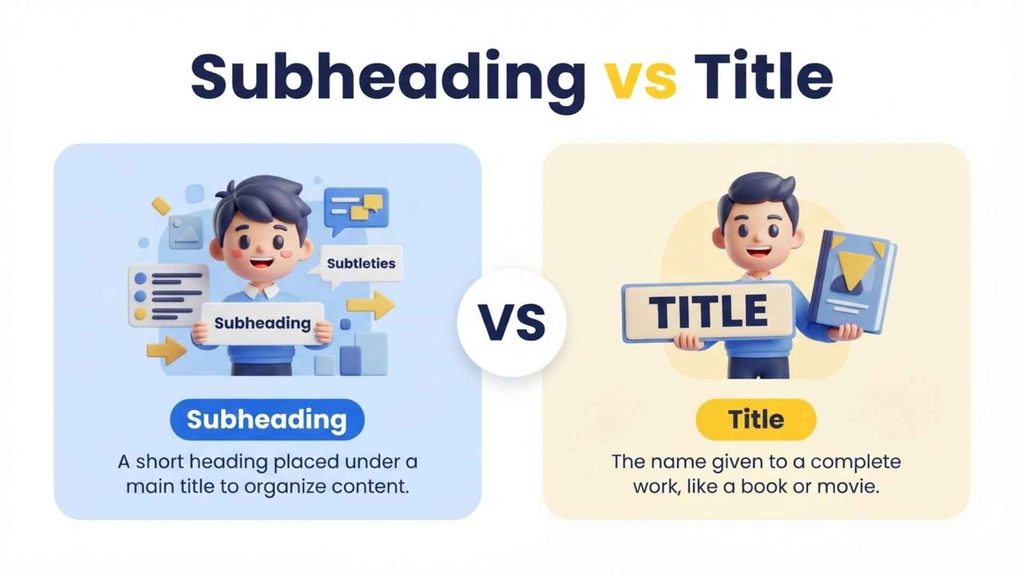
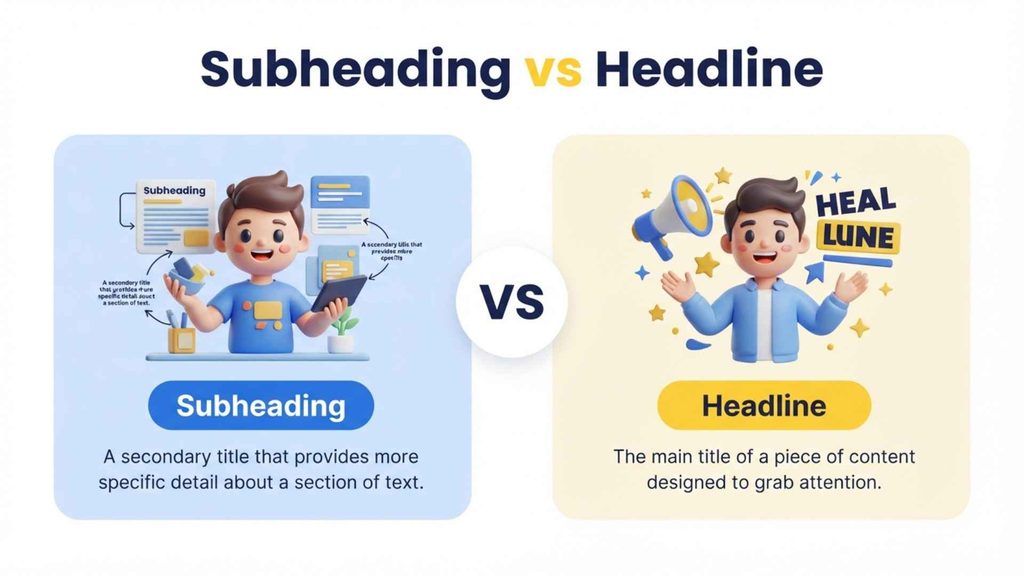
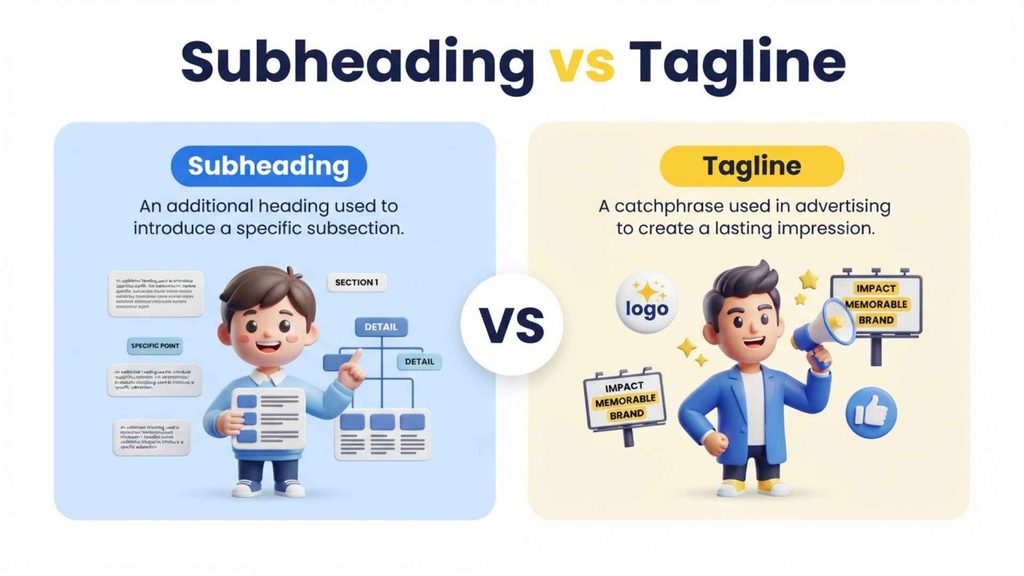
A subheading is a smaller heading placed under a main title or headline. It breaks a big topic into smaller, digestible sections so readers can scan, skim, and still understand the point.
- A subheading sits below the main headline or H1 title
- It introduces a smaller section within a larger piece of content
- Readers use it to scan content quickly without reading everything
- Search engines use it to understand page structure and topics
- It’s often written in bold or a slightly larger font than body text
- A subheading can be a phrase, a question, or a short sentence
- It works like a signpost guiding the reader through the page
Table: Quick Snapshot of a Subheading
| Feature | Description |
| Position | Below the main heading or title |
| Purpose | Breaks content into readable sections |
| Format | Usually bold, slightly larger than body text |
| Common tags | H2, H3, H4 in web content |
| Also called | Subhead, dek, sub-headline |
What Does a Subheading Actually Mean in Simple Words?
If you strip away the technical talk, a subheading simply means a “mini title” for one part of a bigger piece of writing. It tells the reader, in a few words, what the next chunk is about without forcing them to read the whole thing first.
Example in texting:
Friend 1: “I sent you that article, did you read the whole thing?”
Friend 2: “Nah just skimmed the subheadings, got the gist fast.”
Why Subheadings Matter for Readers and SEO
Nobody wants to feel lost in a giant block of text that’s the quiet panic subheadings quietly solve. This section shows why a subheading does far more than just look tidy on a page.
- Improves readability by breaking long content into chunks
- Helps search engines like Google understand topic structure
- Boosts the chance of ranking in featured snippets and AI overviews
- Keeps readers engaged instead of bouncing off the page
- Guides eye movement so key points aren’t missed
- Supports accessibility for screen readers and assistive tools
- Increases average time spent reading an article
Table: Reader vs SEO Benefits of a Subheading
| Benefit For | What It Does |
| Readers | Makes skimming and scanning easy |
| Search Engines | Signals topic relevance and structure |
| Accessibility | Helps screen readers navigate content |
| Featured Snippets | Increases chance of Google pulling your section |
What Does a Subheading Look Like in Real Writing?
Picture opening a recipe blog and seeing “Ingredients,” “Prep Time,” and “Steps” that’s the subheading doing quiet, powerful work behind the scenes for you.
- A subheading can be a short phrase like “Key Takeaways”
- It can also be a question, like “How Long Does It Take?”
- News articles often use a dek as a subheading under the title
- Blog posts use subheadings to separate steps or ideas
- Product pages use them to highlight features or benefits
- Academic papers use them to divide sections and subsections
How Is a Subheading Used in Everyday Writing?
From cookbooks to news sites to text messages summarizing an article, a subheading appears everywhere writing needs order. It’s the quiet organizer behind almost anything you read online today.
Example in chat:
Friend 1: “This blog’s so easy to read, how’d they do that?”
Friend 2: “Good subheadings, honestly. You can jump straight to the part you need.”
Caption vs Subheading – What’s the difference?
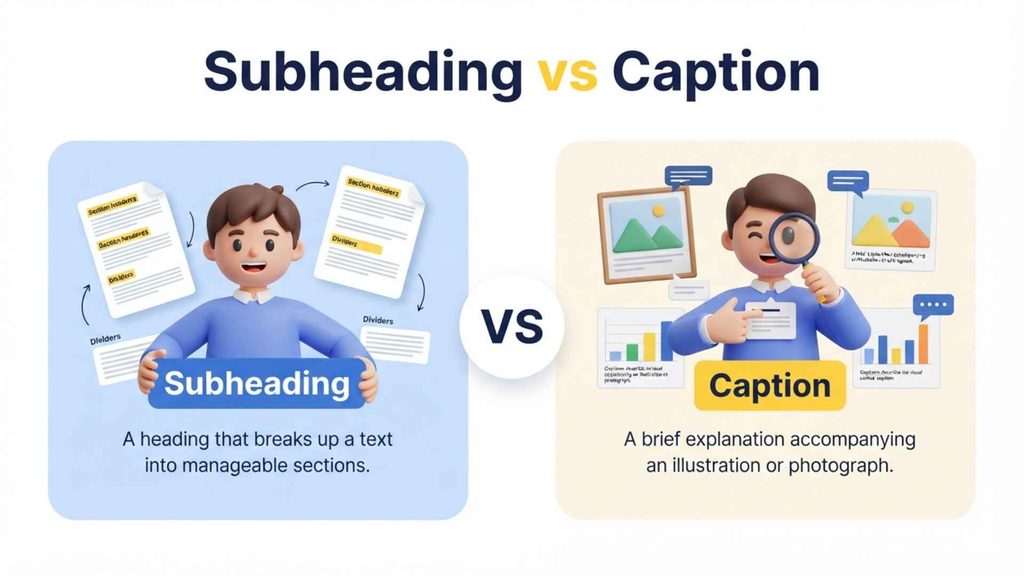
People mix these two up constantly, and honestly, it’s an easy mistake to make at first glance. But once you see them side by side, the difference between a caption and a subheading becomes obvious fast.
- A caption describes an image, photo, or illustration directly
- A subheading organizes written sections of a larger document
- Captions sit beneath or beside visual content, not paragraphs
- Subheadings sit above text sections, guiding written structure
- A caption can also appear as subtitles in film and video
- A subheading never applies to images only written content
Table: Caption vs Subheading Comparison
| Aspect | Caption | Subheading |
| Attached to | Images, illustrations, video | Written text sections |
| Purpose | Explains or labels visuals | Organizes and divides content |
| Location | Below or beside an image | Above a paragraph or section |
| Also known as | Subtitle (in film) | Subhead, dek |
Why Do People Confuse Captions With Subheadings?
The confusion usually comes down to both being smaller pieces of text sitting near a bigger one. But their jobs are completely different once you look closely at how each functions.
Example in texting:
Friend 1: “Wait, is the little text under the photo a subheading?”
Friend 2: “No that’s a caption, subheading is for the article text.”
As nouns the difference between caption and subheading
Getting technical for a second helps clear up any lingering doubt about these two very different words. As nouns, caption and subheading describe two entirely separate things in writing.
- Caption: the descriptive heading or title of a document or part of it
- Caption: a title or brief explanation attached to an illustration or image
- Subheading: any heading under which a main topic is subdivided
- Subheading: a heading subordinate to the main headline or title
- Both words act as nouns, but describe unrelated writing elements
- Caption can also function as a verb, unlike subheading
Example in chat:
Friend 1: “So caption and subheading aren’t even the same part of speech role?”
Friend 2: “Nope, caption can be a verb too subheading can’t.”
Caption
Let’s slow down on this one word alone for a second, because it carries more meaning than people expect. A caption isn’t just “text under a photo” it has layers.
- A caption is the descriptive title of a document or section
- It’s commonly attached to photos, illustrations, or graphics
- In film, a caption transcribes dialogue and important sounds
- Legally, a caption describes details on an official document
- As a verb, to caption means adding text to an image or clip
- Closed captions help viewers who are deaf or hard of hearing
What’s the Real Meaning Behind the Word Caption?
At its core, a caption exists to add context. Whether it’s under a meme, a news photo, or a courtroom document, its job is always the same explain what’s there.
Example in texting:
Friend 1: “What should I put as the caption on this pic?”
Friend 2: “Just something short, captions don’t need to be long.”
Subheading
Now let’s give this word its own full spotlight, since it’s the real star of this article. A subheading deserves a closer, deeper look at how it actually works.
- A subheading divides a main subject into smaller, focused parts
- It’s placed subordinate to a main headline or title
- Common synonyms include subhead and dek
- In HTML, subheadings are usually written as H2 or H3 tags
- A well-written subheading improves both readability and SEO ranking
- Subheadings can be styled in bold, italics, or a larger font
Table: Where You’ll Commonly Spot a Subheading
| Location | Example Use |
| Blog posts | Section breaks like “Step 1”, “Step 2” |
| News sites | The dek under a headline |
| Books | Chapter subsections |
| Websites | H2/H3 tags organizing page content |
Why Do Writers Rely So Heavily on Subheadings?
Writers lean on subheadings because attention spans are short and patience is shorter. A good subheading earns the reader’s trust that the content ahead is worth their time.
Example in chat:
Friend 1: “How do you make your blog posts so easy to follow?”
Friend 2: “Honestly, just strong subheadings every few hundred words.”
Types of Subheadings You’ll See Everywhere
Not every subheading looks the same, and that variety is actually the point. Different formats serve different reader needs, and recognizing them helps you write better ones yourself.
- Descriptive subheadings state exactly what the section covers
- Question-based subheadings mirror what readers are actually searching
- Numbered subheadings work well for steps or lists
- Benefit-driven subheadings highlight what the reader gains
- Curiosity-based subheadings tease information to keep readers scrolling
Example in texting:
Friend 1: “Why does this article keep asking questions as subheadings?”
Friend 2: “It’s a style thing, question subheadings pull readers in more.”
Why Do Websites Use Subheadings So Often?
Nobody enjoys a giant, unbroken paragraph staring back at them on a screen. Websites lean on the subheading structure constantly because it directly affects how long people stay and read.
- Reduces bounce rate by making pages easier to navigate
- Helps mobile readers scan content on small screens
- Increases the chance of appearing in Google’s featured snippets
- Signals clear topic organization to search engine crawlers
- Encourages longer time-on-page, which search engines reward
Example in chat:
Friend 1: “Why do all these blogs have so many little headings now?”
Friend 2: “It’s for SEO mostly, and it just reads easier too.”
How to Write a Strong Subheading
Writing a great subheading isn’t about sounding clever it’s about being instantly clear. A strong one tells the reader exactly what’s coming next in just a handful of words.
- Keep each subheading short, ideally under 10 words
- Use keywords naturally without forcing them awkwardly
- Make it specific rather than vague or generic
- Consider a question format for topics people search often
- Avoid clickbait phrasing that doesn’t match the section content
- Test how it reads out loud before finalizing it
Table: Weak Subheading vs Strong Subheading
| Weak Example | Strong Example |
| “More Info” | “How to Write a Strong Subheading” |
| “Details” | “What Does a Subheading Actually Mean?” |
| “Other Stuff” | “Types of Subheadings You’ll See Everywhere” |
When Should You Use a Subheading Instead of a Caption?
Use a subheading whenever you’re organizing written sections of text, not labeling an image. If there’s no photo involved and you’re guiding a reader through paragraphs, that’s a subheading‘s job.
Example in texting:
Friend 1: “Should this go under the photo or as a heading?”
Friend 2: “If it’s about the photo, caption. If it’s about the text, subheading.”
Faqs
What is a subheading in simple words?
A subheading is a smaller heading placed under a main title to organize one section of content clearly.
Is a subheading the same as a subtitle?
Not quite. A subtitle usually appears under a film title, while a subheading organizes written text sections instead.
What tag is used for a subheading on a website?
Most websites use H2 or H3 HTML tags to mark a subheading within page content.
Why is a subheading important for SEO?
A subheading helps search engines understand structure, which can improve rankings and snippet visibility significantly.
Can a subheading be a question?
Yes, question-based subheadings are common and often match exactly what people search on Google.
What is the difference between a heading and a subheading?
A heading is the main title, while a subheading is subordinate and organizes smaller sections beneath it.
Do subheadings need to include keywords?
Ideally yes, a subheading should include relevant keywords naturally without forcing or stuffing them in.
Conclusion
At the end of the day, understanding what is a subheading really just comes down to clarity. A subheading breaks big ideas into small, readable pieces, helps search engines understand your page, and keeps readers from bouncing away out of confusion. Unlike a caption, which explains images, a subheading organizes written text itself.
Whether you’re writing a blog, an essay, or a simple text summary, a strong subheading is what turns a wall of text into something people actually want to read. Next time you write anything longer than a few lines, ask yourself one thing: does this need a subheading to breathe?

Amelia Brooks is a US-based author known for inspiring stories on meaning, growth, and hope, blending insight with simple, engaging storytelling.