
You’ve typed it a hundred times without thinking twice, and then suddenly you stop mid-sentence and wonder if you’ve been getting it wrong the whole time. That tiny flicker of doubt — atleast or at least — is one of the most common spelling hesitations in everyday English, and it happens to writers at every level.
This guide clears up the confusion once and for all, with real examples, grammar rules, and simple tricks you can use immediately. You’ll walk away knowing exactly when to use least, why the mix-up happens so often, and how to never second-guess yourself again. Let’s get into it.
Atleast or At Least: Which Spelling Is Correct?
Here’s the short, honest answer people search for at 2 a.m. while proofreading an email: only one of these is a real word, and it’s not the one you might expect.
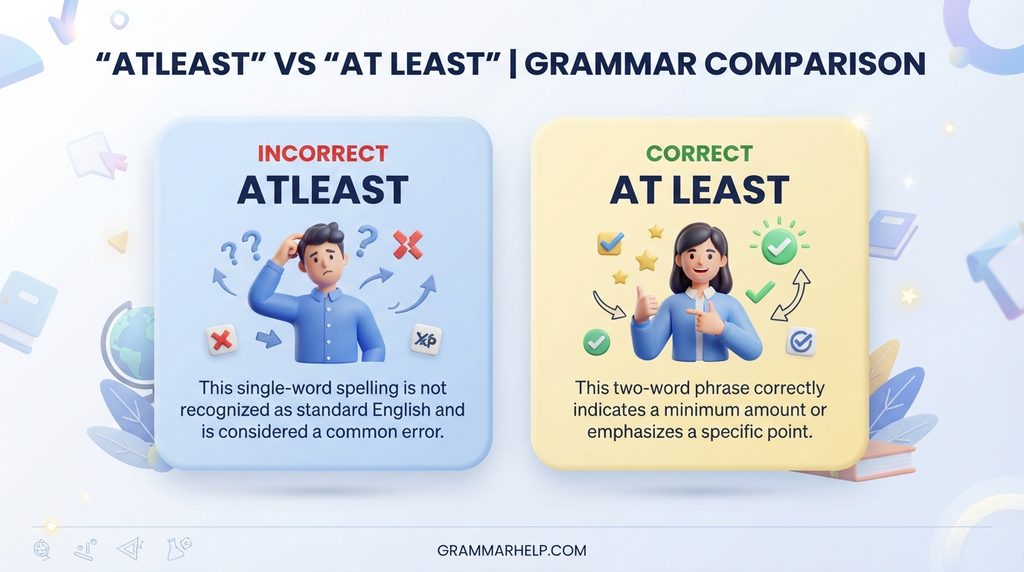
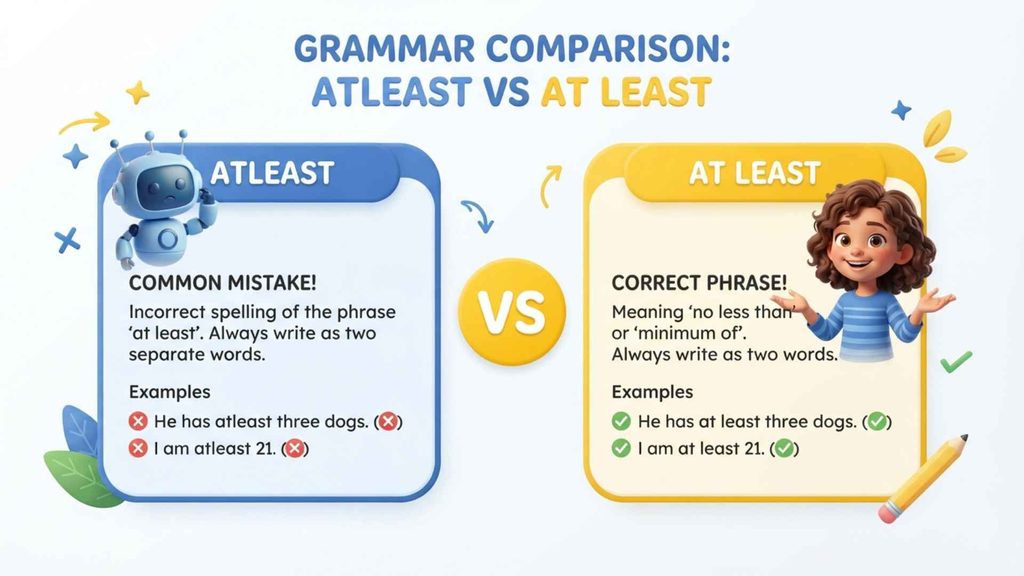
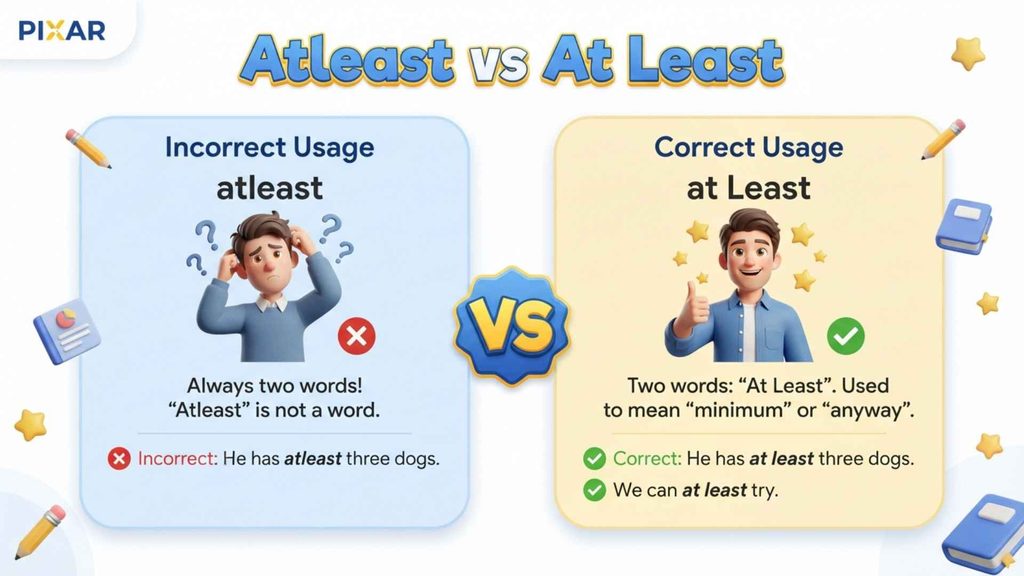
- At least is the correct spelling in standard English, always written as two separate words
- Atleast is not a recognized word in any major dictionary, including Merriam-Webster or Oxford
- Spell-checkers will usually flag “atleast” as an error, though some autocorrect tools quietly fix it
- Formal writing (essays, resumes, business emails) should never contain the one-word version
- Casual texting is the only place “atleast” tends to slip through unnoticed
Why Does English Have So Many Two-Word Phrases That Sound Like One?
English is full of phrases that blend together in speech — “a lot,” “in order,” “at least” — because rapid speech naturally smooths transitions between words.
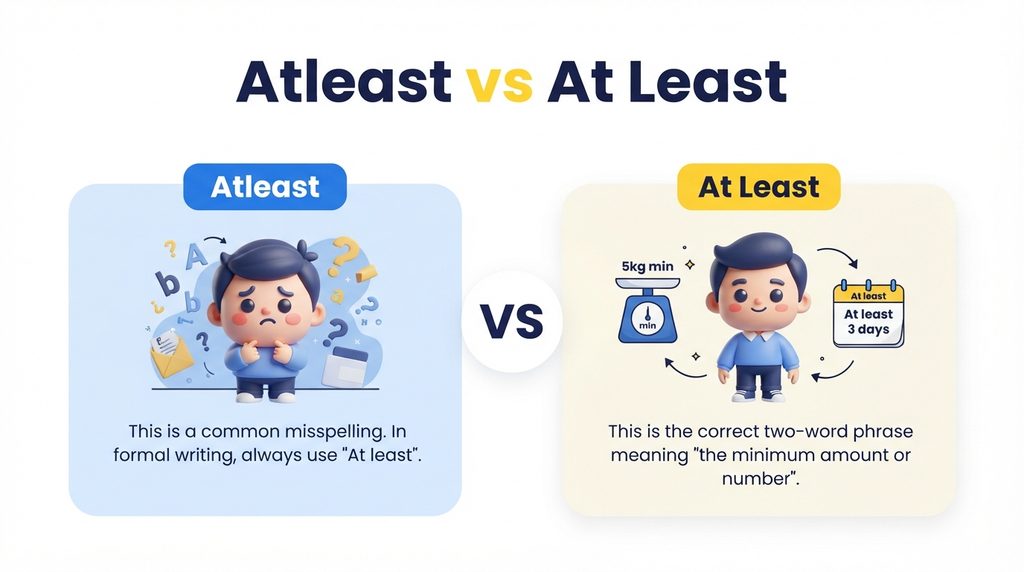
| Spelling | Correct? | Common Context |
| At least | Yes | Formal and informal writing |
| Atleast | No | Texting, casual chat (still incorrect) |
| At the least | Yes | Slightly more emphatic tone |
Example in texting:
Friend 1: I’ll be there atleast by 6, promise 🙏
Friend 2: It’s “at least” lol but okay, see you then!
At Least Meaning Explained
At its core, at least carries a simple idea: a minimum point below which something doesn’t fall. Whether you’re talking about time, money, effort, or comfort, the phrase sets a floor.
- Minimum quantity: “You need at least five ingredients for this recipe”
- Silver lining: “We lost the game, but at least we tried our best”
- Reassurance: “At least you’re safe” softens bad news with a positive angle
- Emphasis on effort: “Could you at least reply to the message?”
- Comparative baseline: “At least ten people showed up,” meaning ten or possibly more
The phrase almost always signals two things at once: a number or condition, and an implied comparison to something worse or smaller.
Example in chat:
Friend 1: Only 3 people liked my post 😭
Friend 2: At least someone did! That’s not nothing.
Why People Confuse “Atleast or At Least”
The confusion isn’t really about grammar — it’s about how the human ear processes fast speech. When we say “at least” out loud, the words blur together into a single sound, and writers instinctively type what they hear.
- Phonetic blending makes “at” and “least” sound like one syllable cluster
- Texting speed encourages shortcuts that skip the space bar
- Autocorrect inconsistency across phones and apps adds to the confusion
- Similar compound words like “already” and “although” set a false pattern
- Lack of visual reinforcement since most people rarely see the phrase written formally
What Does “At Least” Really Mean in Everyday Conversation?
In daily use, at least almost always means “no less than this, possibly more,” whether you’re setting expectations, comforting someone, or stating a rough number.
- Setting a floor: establishing the smallest acceptable amount
- Comforting tone: reframing a negative situation with a small positive
- Polite requests: softening a demand, as in “at least consider it”
- Estimating: giving an approximate lower bound rather than an exact figure
- Contrast marker: highlighting one good thing amid several bad ones
Is It Atleast or At Least in UK English?
British English follows the exact same rule as American English here — there’s no regional exception that legitimizes the one-word spelling.
| Region | Accepted Spelling | Notes |
| UK English | At least | Also accepts “at the least” |
| US English | At least | Identical usage and meaning |
| Australian English | At least | No regional variant exists |
- British dictionaries including Collins and Cambridge list only the two-word form
- UK style guides (Oxford, Guardian) never sanction “atleast” in print
- Regional dialects don’t create a legitimate spelling exception here
- British texting slang still treats “atleast” as informal shorthand, not correct grammar
- Academic writing in the UK follows the same two-word standard as anywhere else
Atleast or At Least Grammar Rules
Grammatically, at least is built from a preposition (“at”) plus a noun (“least,” the superlative form of “little”). Because it’s a phrase, not a compound word, it can’t be fused together.
- Preposition + noun structure means the words function independently
- No hyphenation is used unless part of a longer modifier before a noun
- Comma placement often surrounds the phrase when used as an aside: “This, at least, is true”
- Sentence position is flexible — it can open, close, or sit mid-sentence
- Compare “at most” which follows the identical two-word grammatical pattern
How Is “At Least” Used in Everyday Sentences?
Grammar rules matter less than seeing the phrase in motion, so here’s how at least naturally slots into real, spoken-style sentences people use daily.
- Before a number: “at least three times a week”
- At the start of a clause: “At least we tried”
- After a comma: “It’s fine, at least for now”
- In questions: “Can you at least try?”
- In negative contexts: “Not at least once did he apologize”
Atleast or At Least Examples in Everyday Writing
Seeing the phrase across different writing styles makes the rule stick faster than memorizing definitions alone.
- Emails: “Please respond at least 24 hours before the meeting”
- Reviews: “The food was mediocre, but at least the service was fast”
- Resumes: “Requires at least two years of relevant experience”
- Social captions: “At least the coffee was good today ☕”
- Academic essays: “The study included at least 200 participants”
Example in texting:
Friend 1: Did you finish the assignment?
Friend 2: Not fully, but I got at least half of it done
At Least Synonyms
If you want to vary your sentence structure, several synonyms carry a similar meaning to least in its minimum-amount sense, though the tone shifts slightly with each one.
| Synonym | Tone | Example |
| No less than | Formal | “No less than ten guests arrived” |
| At the very least | Emphatic | “At the very least, apologize” |
| A minimum of | Official | “A minimum of three signatures required” |
- No less than feels formal and precise, often used in contracts
- At a minimum works well in professional or technical writing
- Not under appears in pricing, ages, or measurements
- At any rate shifts toward the “anyway” sense of the phrase
- In any case replaces the reassurance meaning rather than the quantity meaning
Atleast or At Least Definition
To pin it down clearly: at least is an adverbial phrase meaning “not less than” a stated amount, or “in any event” when used to soften a statement.
- Dictionary classification: functions as an adverb or discourse marker
- Two core senses: minimum quantity, and general reassurance/contrast
- Etymology: from Old English “læst,” the superlative of “little”
- Usage frequency: one of the most common phrases in spoken and written English
- Register: appropriate in formal, academic, and casual contexts alike
Common Mistakes Related to “At Least”
Beyond the spacing issue, a few related errors show up again and again in everyday writing.
- Merging into one word: “atleast” instead of “at least”
- Confusing with “at most”: mixing up minimum and maximum meanings
- Overusing the phrase: repeating it several times in one paragraph
- Misplacing commas: forgetting to set off the phrase when used as an aside
- Autocorrect errors: letting predictive text silently introduce the wrong spelling
Why Do These Mistakes Keep Happening Online?
Fast-paced digital communication rewards speed over precision, so small spelling errors like this one spread quickly across texts, comments, and captions.
- Speed typing on phones skips careful proofreading
- Peer influence normalizes the error when friends use it too
- Low visibility of the mistake in casual, low-stakes messages
- Habit formation from repeated incorrect typing over time
- Minimal consequences since most readers still understand the intended meaning
Quick Trick to Remember the Correct Spelling
A simple mental trick beats memorizing rules, especially when you’re typing quickly and don’t have time to think it through.
- Substitute “at most” — since nobody writes “atmost,” the pattern should match
- Say it slowly, emphasizing the pause between “at” and “least”
- Picture the word “least” on its own, as a standalone adjective you already know
- Use spell-check actively rather than ignoring the red underline
- Practice writing the full phrase in a sentence a few times until it feels automatic
Example in chat:
Friend 1: How do you always remember to spell it right?
Friend 2: I just think “at most” has two words, so this does too!
Atleast or At Least in Tagalog
For Filipino speakers and English learners, the concept translates closely to a familiar everyday expression.
- Common translation: “kahit man lang” or “sa hindi bababa sa”
- Casual equivalent: “kahit paano” captures the reassurance sense
- Formal equivalent: “sa pinakamababa” reflects the minimum-quantity meaning
- Code-switching: many Filipino speakers use “at least” directly in Taglish conversation
- Spelling carryover: the English spacing rule still applies even in mixed-language texts
Is “Atleast” Ever Accepted Informally?
In truly casual, low-stakes settings, plenty of people use the one-word version without anyone batting an eye — but “used often” doesn’t mean “grammatically correct.”
- Group chats tolerate it without correction most of the time
- Social media comments rarely flag it as an error
- Gaming chat and fast-typed forums see it constantly
- Dictionaries still classify it as nonstandard, regardless of frequency
- Professional contexts should always avoid it, even under casual pressure
When Should You Use “At Least” in a Sentence?
Knowing when to reach for this phrase matters as much as spelling it correctly, since it fits naturally into comparisons, estimates, and softened statements.
- Giving a minimum number: “Bring at least two forms of ID”
- Softening bad news: “At least it’s not raining”
- Making a modest request: “At least text me when you land”
- Estimating roughly: “It’ll take at least an hour”
- Highlighting a silver lining: “At least we learned something”
At Least vs At the Least: What’s the Difference?
These two forms are close cousins, and most people use them interchangeably without losing any meaning.
- “At least” is the far more common, everyday version
- “At the least” sounds slightly more formal or emphatic
- Both mean “no less than” in the minimum-quantity sense
- “At the least” rarely appears in the reassurance sense
- Style guides treat both as fully correct, with no strict preference
How to Use “At Least” in a Sentence Correctly
Placement flexibility is one of the phrase’s best features, letting it fit naturally almost anywhere in a sentence.
- Start of sentence: “At least the weather held up”
- Before a quantity: “at least twenty minutes”
- Mid-sentence aside: “This, at least, we can agree on”
- End of sentence: “I tried, at least”
- In a question: “Could you at least call first?”
Example in texting:
Friend 1: Rent went up again this month
Friend 2: Ugh, at least your landlord fixed the heater though
Atleast or At Least in Academic and Professional Writing
Formal contexts leave zero room for the one-word version, and getting it wrong can quietly undercut your credibility.
| Context | Recommended Phrase | Why |
| Academic papers | At least | Preserves formal tone |
| Business emails | At least / A minimum of | Sounds professional |
| Legal documents | No less than | Precise and binding |
- Peer-reviewed writing always uses the two-word form without exception
- Cover letters signal attention to detail through correct spelling
- Reports and proposals benefit from precise minimum-quantity language
- Editors and proofreaders flag “atleast” as an automatic correction
- Professional reputation can take a small hit from repeated small errors
What Does “At Least” Really Mean in Formal English?
In formal registers, the phrase almost always narrows to its precise, minimum-quantity meaning rather than its casual, reassuring tone.
- Contracts use it to set binding minimum requirements
- Scientific writing pairs it with measurable quantities and data
- Policy documents rely on it for clear, enforceable thresholds
- Job postings use it to define minimum qualifications
- Statistics reporting frames it around sample sizes or confidence levels
At Least Meaning in Texting and Social Media
Online, the phrase does a lot of emotional heavy lifting, often softening bad news or adding a hopeful note to an otherwise flat message.
- Comfort function: cushions disappointing updates between friends
- Sarcasm marker: occasionally used ironically in memes or captions
- Brevity: pairs naturally with emojis to add warmth quickly
- Spelling drift: “atleast” appears often here despite being incorrect
- Tone softener: makes blunt statements feel gentler in fast chats
Why Correct Spelling Matters
Spelling might feel like a small detail, but it quietly shapes how readers judge your writing, your attention to care, and even your credibility.
- First impressions: small errors can distract from your actual message
- Professional trust: correct spelling signals competence and care
- Reader clarity: proper spacing avoids momentary confusion
- Search visibility: correctly spelled content performs better in search results
- Long-term habits: fixing small errors early prevents them from sticking
FAQs
Is atleast a real word?
No, atleast is not a real word in standard English. The correct spelling of this phrase is always at least, written as two separate words.
What does “at least” mean exactly?
At least means “no less than” a stated amount, or it’s used to highlight a small positive point despite a larger negative situation.
Can I ever write “atleast” casually?
While some people write atleast in texts, it’s still technically incorrect. Sticking with at least keeps your writing accurate everywhere.
Is “at the least” the same as “at least”?
Yes, “at the least” and at least share the same core meaning, though “at the least” often sounds slightly more formal or emphatic.
Why do so many people misspell “at least”?
People misspell at least because it sounds like one word when spoken quickly, so the ear-to-hand transition creates the merged spelling.
Does autocorrect fix “atleast” automatically?
Some apps correct at least automatically, but not all keyboards catch it, which is why the mistake still appears often in texts and posts.
Is “atleast” accepted in any English dictionary?
No major dictionary recognizes atleast as a standalone word. Every reputable source lists at least as the only correct spelling.
Conclusion
At the end of the day, the debate between atleast or at least has a clear, simple answer: at least is always correct, and atleast isn’t a real word in any dictionary. Whether you’re texting a friend, writing a résumé, or drafting an academic paper, sticking with the two-word form keeps your writing accurate and polished. The least you can do for your own credibility is train your fingers to add that small space every single time. Once it becomes a habit, you’ll never have to second-guess it again — and your writing will read just a little more confident because of it.
Meta description: “Atleast” isn’t a real word. Learn why “at least” is the only correct spelling, with grammar rules, examples, and easy memory tricks.
Want this saved as a downloadable Word doc or Markdown file for your site?

Amelia Brooks is a US-based author known for inspiring stories on meaning, growth, and hope, blending insight with simple, engaging storytelling.