
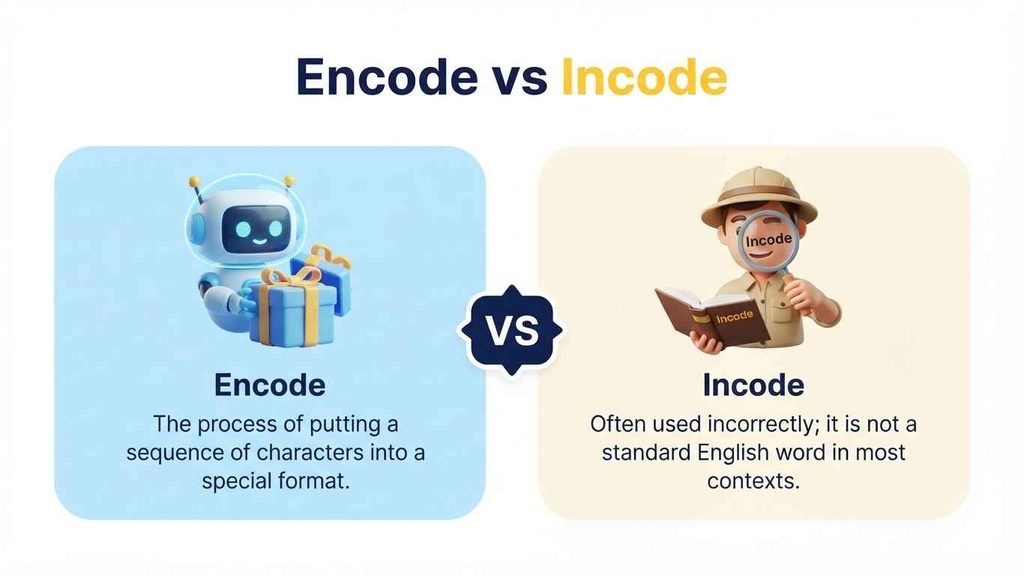
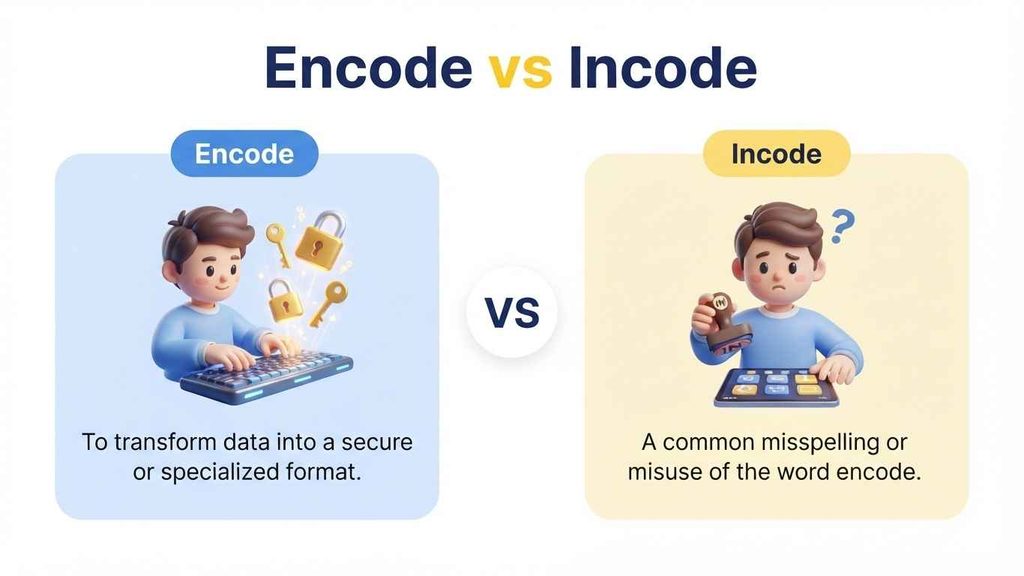
You typed a sentence, paused, and stared at the word for a second too long. Is it encode or is it incode? You’re not imagining things these two words look almost identical, and a lot of people freeze at exactly this moment, worried they’ll sound careless in an email, an assignment, or a line of code.
Here’s the good news: this guide clears up the confusion for good. You’ll get the real meaning behind encode or incode, simple examples, a few common mix-ups to avoid, and quick practice so the right word finally feels automatic. By the end, picking between encode and incode won’t feel like guesswork anymore keep reading.
Define Encode
Encode is the word doing almost all the heavy lifting in everyday English, and understanding it first makes everything else click into place. It’s the standard term you’ll meet in tech, writing, and daily conversation.
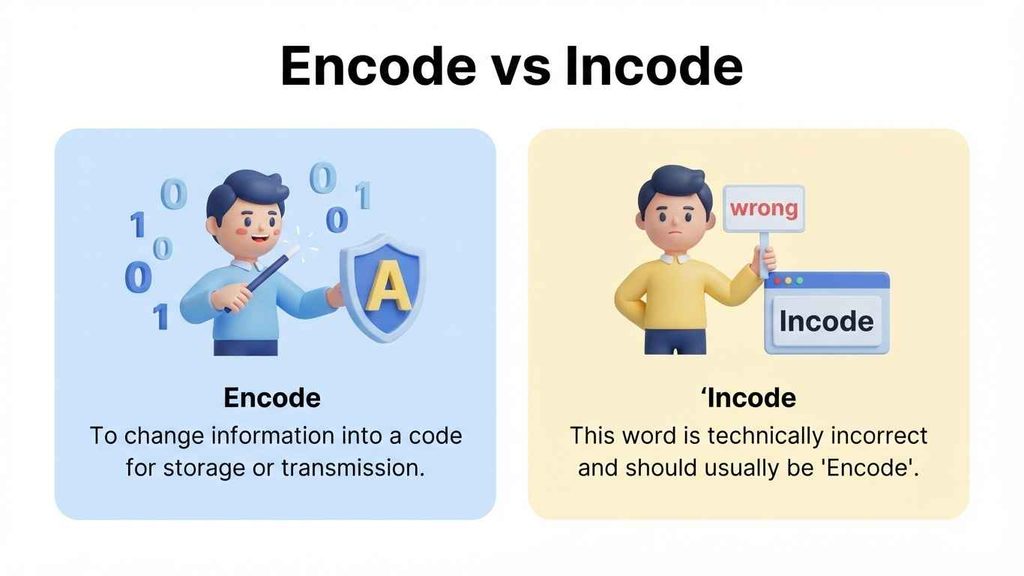
Encode means to convert information text, sound, video, or data into a specific format or code so a computer, device, or person can read, store, or send it correctly. It’s a real, dictionary-recognized word used constantly in computing, communication, and even biology (think DNA encoding genetic instructions).
What Does It Actually Mean To Encode Something?
- Convert raw information into a structured, readable format.
- Compress files so they take up less space and load faster.
- Protect sensitive data by turning it into a coded form.
- Translate analog signals (like sound) into digital data.
- Prepare files so they work across different devices or software.
- Standardize information so systems can understand each other.
| Term | Quick Meaning | Common Use |
| Encode | Convert data into a format | Programming, streaming, storage |
| Encoding | The process itself | Video, audio, text files |
| Encoded | Past tense / result | “The file was encoded successfully” |
| Encoder | Tool or person doing it | Software, hardware devices |
Example in texting: Friend 1: did you encode that voice memo yet? Friend 2: yep, just finished it’s in MP3 now 🎧
Define Incode
Incode isn’t an official dictionary word, and that surprises a lot of people the first time they hear it. Still, it shows up online, especially in casual writing, so it’s worth understanding exactly where it comes from.
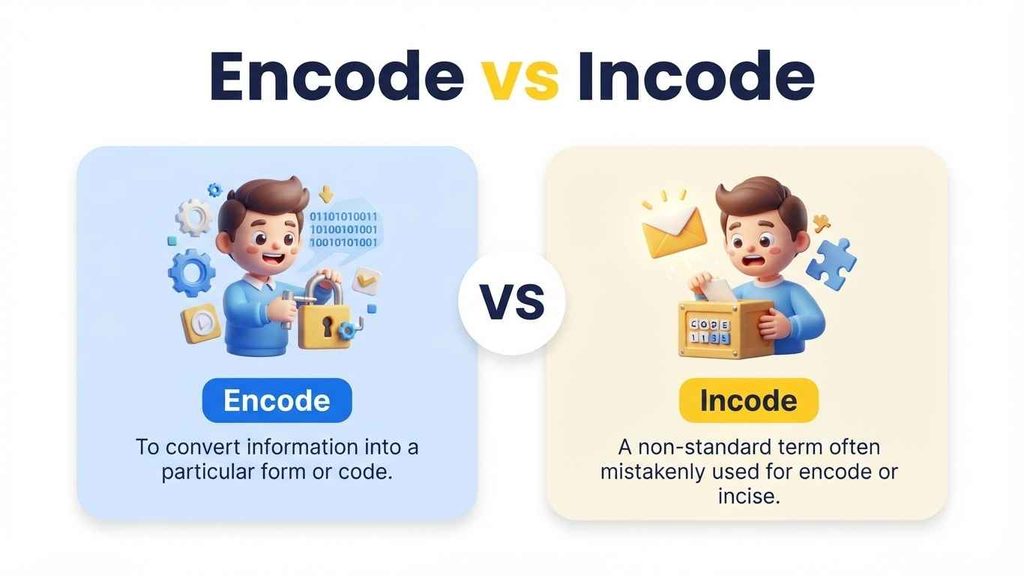
Incode meaning, in the loose way people actually use it, usually points to embedding or hiding information inside something else a file, an image, or a message rather than simply converting it into a readable format. It’s informal, sometimes a typo for “encode,” and occasionally used deliberately in niche or creative contexts.
Is Incode Ever Used Correctly Anywhere?
- Typo most often, “incode” is simply a slip for “encode.”
- Slang usage some online spaces use it loosely for hiding data.
- Not standard you won’t find it in major dictionaries.
- Confuses readers using it in formal writing looks like an error.
- Informal only best avoided in essays, resumes, or reports.
Example in chat: Friend 1: how do I incode a message inside this pic? Friend 2: I think you mean encode it with a steganography tool lol
How To Properly Use The Words In A Sentence
Getting encode or incode right in a real sentence comes down to one question: are you converting data, or are you hiding it inside something? That single check settles most confusion instantly.
Use encode whenever you’re talking about turning information into a usable, transferable, or storable format. Save incode for casual conversations about hiding or embedding something and even then, know that “embed” or “conceal” is the more accurate, professional word to reach for.
How Is Encode Used In Everyday Conversations?
- Encode your files before uploading them to a shared drive.
- Apps encode photos so they load faster on your phone.
- Developers encode passwords so they aren’t stored as plain text.
- Streaming platforms encode video into different quality levels.
- Voice assistants encode your speech into text almost instantly.
- Companies encode customer data to meet privacy regulations.
- Musicians encode audio tracks into shareable digital formats.
Example in texting: Friend 1: this video won’t upload, it says wrong format Friend 2: you need to encode it as MP4 first, try HandBrake
More Examples Of Encode & Incode Used In Sentences
Seeing encode or incode inside full sentences makes the pattern obvious fast. Once you spot it a few times, choosing the correct word becomes second nature instead of a guessing game.
Below are real-style examples for both words, side by side, so you can compare how naturally encode fits standard writing versus how incode only really appears in casual, offbeat contexts.
Sentences Using “Encode”
- The programmer had to encode the message before sending it over the network.
- She used special software to encode data for secure storage.
- The system automatically encodes information to prevent unauthorized access.
- The scientist encoded the DNA sequence using a simple numerical model.
- Before sharing the file, the engineer encoded it in the correct format.
- The video team had to encode the footage for online streaming.
- The messaging app encodes every conversation to prevent interception.
Sentences Using “Incode”
- The hacker tried to incode a virus inside a harmless-looking file.
- The spy supposedly incoded a secret note within a normal-looking email.
- The developer experimented with ways to incode metadata into an image.
- Some people mistakenly type “incode” when they clearly mean encode.
- The student asked how to incode a hidden clue for a scavenger hunt project.
| Sentence Type | Word Used | Correct? |
| “Please encode the file as JSON” | Encode | ✅ Standard |
| “Please incode the file as JSON” | Incode | ❌ Should be encode |
| “He incoded a hidden clue in the puzzle” | Incode | ⚠️ Informal only |
| “The app encodes your login securely” | Encode | ✅ Standard |
Common Mistakes To Avoid
Even confident writers slip up between encode or incode, especially when typing fast or when autocorrect gets involved. Spotting the usual traps ahead of time saves you from an awkward correction later.
Most mistakes fall into a small handful of patterns, and once you know what they are, they’re genuinely easy to catch even while proofreading quickly.
What Mistakes Do People Make Most Often?
- Swapping incode in for encode out of habit or typo.
- Assuming encode automatically means the same thing as encrypt.
- Skipping context, using either word without checking the sentence’s meaning.
- Trusting autocorrect blindly, which sometimes suggests the wrong spelling.
- Using incode in formal documents where it looks like an error.
- Forgetting that incode isn’t dictionary-standard English at all.
Using Incode Instead Of Encode
This is the single most common slip. Someone means “convert this data into a format” but types incode instead of encode, usually from typing speed or a shaky memory of spelling.
Assuming Encode Means Encrypt
Encode organizes data into a readable or transferable format. Encryption specifically locks data behind a security key so only authorized people can access it. They’re related, but they’re not interchangeable.
Example in chat: Friend 1: is encoding the same as encrypting my files? Friend 2: nope encoding is about format, encryption is about security 🔒
Context Matters
The right choice between encode or incode almost always comes down to context what you’re actually trying to say determines which word (if either) truly fits the sentence.
Context shapes meaning in writing, technology, and conversation alike. A quick mental check of the situation you’re describing will point you to the correct word nearly every time.
Why Does Context Change Which Word You Should Use?
- Technical writing almost always calls for encode, never incode.
- Casual chats sometimes use incode loosely, but encode still works better.
- Security topics need encode plus a clear mention of encryption if relevant.
- Academic papers should avoid incode entirely it isn’t standard English.
- Creative or playful writing is the only place incode slightly slides by.
| Context | Recommended Word | Why |
| Software development | Encode | Standard technical term |
| Formal essays or reports | Encode | Incode isn’t recognized |
| Casual texting about “hiding” something | Either (encode preferred) | Incode is informal slang |
| Cryptography discussions | Encode + Encrypt | Precision matters here |
| Everyday conversation | Encode | Clearer, widely understood |
Example in texting: Friend 1: for my essay should I say “incode” or “encode” the data? Friend 2: definitely encode, incode isn’t a real formal word
Exceptions To The Rules
Language rarely stays perfectly tidy, and encode or incode is no exception. A handful of situations bend the general guidance slightly, so it helps to know where those edges are.
Even so, these exceptions are narrow they don’t change the core rule that encode is the correct, standard choice almost everywhere.
1. Contextual Usage
In niche online communities coding forums, puzzle groups, or creative writing circles incode sometimes gets used deliberately as playful shorthand for “hide something inside.” It’s understood there, even if it’s not dictionary-official.
2. Regional Differences
Some non-native English speakers pick up incode from informal online sources and use it consistently, unaware it isn’t standard. This is more of a learning gap than a real regional rule, but it does explain the pattern.
3. Industry-Specific Terminology
- Marketing teams typically encode campaign data for tracking.
- Cryptographers rarely say incode they use encrypt, cipher, or encode.
- Game developers occasionally borrow incode informally for hidden Easter eggs.
- Security researchers stick strictly to encode, decode, and encrypt.
What Does Incode Mean In Texting Or Chat?
In texts and DMs, incode almost always means someone wants to hide or tuck information inside a file, image, or message even though encode is the technically correct term for that idea.
- Casual shorthand for embedding a secret message somewhere.
- Often a typo for the word people actually meant: encode.
- Not searchable in a real dictionary if you look it up.
- Understood loosely by friends, but confusing to strangers.
- Best swapped for “hide,” “embed,” or “encode” in serious chats.
Example in texting: Friend 1: I’m trying to incode a message in this meme lol Friend 2: haha you mean encode/embed it but I get what you’re saying
Why Do People Confuse Encode And Incode?
People mix up encode or incode mainly because the words look and sound almost identical, and because “incode” occasionally pops up online, making it feel more legitimate than it actually is.
- Similar spelling makes the eye skim right past the error.
- Autocorrect sometimes fails to catch the incorrect version.
- Casual internet use normalizes incode in certain spaces.
- Unfamiliarity with formal computing vocabulary adds to the mix-up.
- Speed typing on phones increases the chance of a slip.
Is Incode A Real Word In The Dictionary?
No incode does not appear as a standard entry in major English dictionaries, which is exactly why sticking with encode is the safer, clearer choice in almost every situation.
- Merriam-Webster, Oxford, and Cambridge don’t list incode.
- Spell-checkers frequently flag it as incorrect.
- Encode is the recognized, correct term across all contexts.
- Incode survives only as informal slang or a typo.
- Formal writing should never include the word incode.
Practice Exercises
Practicing encode or incode in real sentences is the fastest way to make the correct choice feel automatic instead of something you have to think through every time.
Exercise 1: Fill In The Blank
- The spy carefully _______ the secret message so only agents could read it.
- The company’s system accidentally _______ customer data, causing a small breach.
- The developer had to _______ the video before uploading it online.
- The hacker tried to _______ the company’s files to steal information.
Answer Key: 1. encode 2. encoded 3. encode 4. encode (incode would be non-standard in every sentence above encode is always correct here)
Exercise 2: Sentence Writing
Try writing two original sentences of your own one describing a real conversion task using encode, and one casual sentence where someone mistakenly reaches for incode.
Exercise 3: Multiple Choice
- The email system automatically _______ all messages for security. a) encode b) incode
- It’s important to lock and _______ your luggage tag before a trip. a) encode b) incode
Answer Key: 1. a) encode 2. a) encode
FAQs
What is the difference between encode and incode?
Encode converts information into a readable or secure format, while incode is informal slang, usually meaning “hide” or “embed.” Only encode is standard English.
Can I use incode instead of encode?
No. Swapping incode for encode in formal or professional writing reads as a mistake. Stick with encode for anything beyond casual chat.
What does incode meaning refer to online?
The loose incode meaning online usually points to hiding or embedding data inside a file or message, unlike the formal conversion process behind encode.
Does encode mean the same thing as encrypt?
Not exactly. Encode organizes data into a usable format, while encryption specifically protects it with security keys. The two often work together but aren’t identical.
How do I know when to use encode or incode?
Ask whether you’re converting data into a format (encode) or casually describing hidden data (incode, informally). When in doubt, encode is almost always correct.
Is incode acceptable in professional writing?
No. Professional, academic, and technical writing should always use encode. Save incode for casual texts, if you use it at all.
Why does encode matter so much in technology?
Every app, video, and password relies on some form of encode process to function, store safely, and transfer correctly across devices and platforms.
Conclusion
Choosing between encode or incode really comes down to one simple fact: encode is the real, standard English word, while incode is informal slang or a common typo. Whenever you’re converting, storing, or transferring information, encode is always the safe, correct pick.
Key takeaways:
- Encode converts information into a readable, transferable, or secure format.
- Incode is not standard English it’s mostly slang or a mistake.
- Context decides everything: formal writing always leans on encode.
- Encode and encrypt are related but not the same thing.
Next time your fingers hover over the keyboard wondering encode or incode, trust the standard word encode and your writing will read clean, correct, and confident every time.

Amelia Brooks is a US-based author known for inspiring stories on meaning, growth, and hope, blending insight with simple, engaging storytelling.